News
Why Tinubu Signed Executive Orders On Gas, Energy – Aide
- /home/naijuinz/public_html/wp-content/plugins/mvp-social-buttons/mvp-social-buttons.php on line 27
https://naijablitznews.com/wp-content/uploads/2024/02/Tinubu-appoints.jpg&description=Why Tinubu Signed Executive Orders On Gas, Energy – Aide', 'pinterestShare', 'width=750,height=350'); return false;" title="Pin This Post">
- Share
- Tweet /home/naijuinz/public_html/wp-content/plugins/mvp-social-buttons/mvp-social-buttons.php on line 72
https://naijablitznews.com/wp-content/uploads/2024/02/Tinubu-appoints.jpg&description=Why Tinubu Signed Executive Orders On Gas, Energy – Aide', 'pinterestShare', 'width=750,height=350'); return false;" title="Pin This Post">
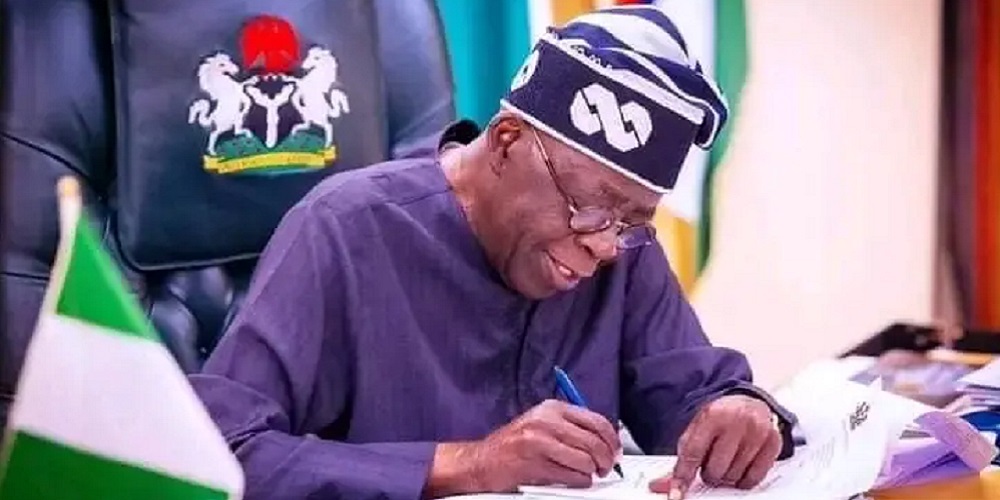
The Special Adviser to the President on Energy, Mrs. Olu Verheijen, has given reasons why President Bola Ahmed Tinubu signed Executive Orders to transform the gas and energy sectors of the economy, submitting that gas remains the best option for Nigeria’s attainment of energy stability.

The presidential aide, who addressed the media in Abuja on Friday, pointed out that the steps taken by the president was to make gas readily available to Nigerians at affordable rates for all purposes and reduce dependence on petrol and diesel.
Mrs. Verheijen said: “Our ambitions to accelerate our economic growth and diversify the economy for the benefit of all Nigerians require timely, credible, clear and consistent policy. We are faced with a revenue crisis which is impacting all Nigerians.

To urgently address this, President Bola Tinubu is actively seeking ways to grow revenue and forex to stabilize our economy and currency. The oil and gas sector is critical to our ability to do so. However, our current oil and gas production and investment levels falls significantly short of our potential.
“Since 2016, Nigeria has only accounted for only four percent four percent of Africa’s total oil and gas investments, despite possessing 38 percent of the continent’s hydrocarbon reserves. A society is not rich because of its resources but because of what it does with those resources.
President Bola Ahmed Tinubu is determined to reverse this trend and take decisive steps to ensure to a conducive business climate and reposition Nigeria as a preferred investment destination for oil and gas sector,” she explained.
The energy adviser said that it was in a bid to reverse the negative tendencies in the sector that the president issued a directive to streamline and clarify the scope of two regulators in the petroleum sectors and to provide certainty and create a conducive business environment for the players.
She pointed out that consequent upon the directive, the TNP pipeline, which had been repeatedly vandalized, is now enjoying improved uptime and doubled its availability, resulting in increased liquids of over 200,000 barrels/day being transported over the last six months and increasing the availability of NLNG Trains 1-6 from 57 percent in 2023 to 70 percent in Q1 2024.
The adviser said the president had also introduced fiscal incentives to deepen Compressed Natural Gas (CNG) and Liquified Petroleum Gas (LPG) penetration all aimed at easing the impact of fuel subsidies on transportation cost, enabling the displacement of PMS/Diesel and contributing to stabilising the price of cooking gas in the market and support the transition to clean cooking.
The presidential aide explained that the Fiscal Incentives for Non-Associated Gas (NAG), Midstream and Deepwater Oil and Gas Developments is aimed at facilitating the monetization of Nigeria’s extensive oil and gas resources.
She said: “For Gas, 76 percent of our gas reserves, remain undeveloped. This explains why, despite possessing one of the largest gas reserves globally, we lack sufficient gas to meet our domestic needs for industry, for power and for cooking. The fiscal incentives introduced will attract the much-needed investments to enhance energy security, catalyze economic activity, attract essential foreign exchange, and promote job creation.
“The President has issued directives to reduce contracting timelines and project delivery. Benchmarking and analysis revealed that the contracting cycle takes up to 36 months. This Directive should have the effect of compressing this cycle to less than 6 months in line with global averages. This will expedite the delivery of oil and gas products to the market and enhance overall value for the country.
“Local Content Practice Reform: This Directive seeks to ensure that local content requirements are implemented in a manner that does not impede investments or the cost competitiveness of oil and gas projects. This Directive aims to reduce the cost premium of operating in Nigeria, presently averaging at 40 percent. We anticipate significant benefits from this reform, including the development of local companies’ capacity, thereby generating additional business opportunities, job creation and boosting economic growth.
On how the new policies would be implemented for effective results, the presidential aide, explained that the assignments had been shared among different levels of government agencies to be followed up by her office.
Under the arrangement, she said, the Minister of Finance/Co-coordinating Minister of the Economy will develop and propose amendments to introduce fiscal incentives for deep-water developments into legislation while the Federal Inland Revenue Service (FIRS) and the Nigerian Upstream Petroleum Regulatory Commission (NUPRC) will issue guidelines on the implementation of the fiscal incentives.
News
Coup plot: DSS arraigns five associates of ex-Gov Silva
The Department of State Service (DSS) has arraigned five associates of former Minister of Petroleum Resources, Chief Timipre Silva, before the Federal High Court in Abuja over allegations that they concealed information about the whereabouts of their principal, who the agency said was implicated as a financier of an alleged aborted coup attempt against President Bola Tinubu.
Silva, a former Governor of Bayelsa State, has been declared wanted by the Federal Government, while some of his identified properties have been marked for forfeiture following allegations that he sponsored and masterminded the purported coup plot.
The five associates — Reuben Ayuba, Musa Mohammed, Friday Paul, Paganengigha Anagaha and Ayebaifife Suobite — were brought before Justice Peter Lifu on Wednesday and charged with allegedly concealing the whereabouts of Silva, who the DSS described as a fugitive of the law.
A two-count charge filed against them indicated that the accused persons, on April 28, 2026, became accessories after the fact of felony by concealing the whereabouts of Timiprey Silva, said to be a fugitive of the law.
The alleged offence is said to be contrary to Section 519 of the Criminal Code Act, Laws of the Federation of Nigeria, 2004.
The DSS also accused them of conspiracy to commit a felony, specifically concealing the whereabouts of Timiprey Silva, who is described as a fugitive of the law, contrary to Section 516 of the Criminal Code LFN, 2004.
However, all the accused persons pleaded not guilty to the charges when they were read to them.
DSS lawyer, Emmanuel Orubor, urged the court to fix a date for the agency to open its case by calling witnesses to testify against the accused persons.
Meanwhile, Sunusi Musa, a Senior Advocate of Nigeria (SAN), who represented Reuben Ayuba and Paganengigha Anagaha, the first and fourth accused persons, moved applications for bail on behalf of his clients.
Similar bail applications were also argued by Ibrahim Imadegbelo, who represented Musa Mohammed, the second accused person; I. G. Kelubia, who stood for Friday Paul, the third defendant; and E. C. Sogo, who represented Ayebaifife Suobite, the fifth accused person.
The lawyers informed Justice Lifu that their clients had been in custody since October 25, 2025, and urged the court to admit them to bail on liberal terms.
In a brief ruling, Justice Lifu granted the accused persons bail in the sum of N5 million each, with two sureties each in the like sum.
The sureties are required to swear to an affidavit of means, provide evidence of three years’ tax payment, show evidence of visible means of livelihood and deposit their recent passport photographs.
Justice Lifu further ordered that the identities of the sureties must be verified by the Registrar of the Court.
Pending the perfection of the bail conditions, the judge ordered that the accused persons be remanded in Kuje Prison.
The judge fixed July 22 for the commencement of trial.
The charges against them read:
COUNT ONE:
“That you, RUBEN AYUBA, MUSA MOHAMMED, FRIDAY PAUL, PAGANENGIGHA ANAGAHA and AYEBAIFIE SUOBITE, adults, males, on or about the 28th day of April, 2026, in Abuja, within the jurisdiction of this Honourable Court, did become accessories after the fact of felony by concealing the whereabouts of Timiprey Silva, who is a fugitive of the law and thereby committed an offence contrary to Section 519 of the Criminal Code Act LFN, 2004.”
COUNT TWO:
“That you, RUBEN AYUBA, MUSA MOHAMMED, FRIDAY PAUL, PAGANENGIGHA ANAGAHA and AYEBAIFIE SUOBITE, adults, males, on or about the 28th day of April, 2026, in Abuja, within the jurisdiction of this Honourable Court, did conspire to commit a felony to wit: concealing the whereabouts of Timiprey Silva, who is a fugitive of the law and thereby committed an offence contrary to Section 516 of the Criminal Code LFN, 2004.”
News
Why we declared Delta lawmaker’s seat vacant – Assembly
The Delta State House of Assembly says the decision to declare the seat of the member representing Udu Constituency vacant was taken in line with the provisions of the 1999 Constitution.
The Chairman of the House Committee on Information and House Leader, Hon. Emeka Nwaobi, gave the explanation in Asaba.
Nwaobi said the Assembly acted strictly within its constitutional powers and not for political reasons.
He said, “The House merely carried out its constitutional responsibility after considering the resignation and defection letter submitted by the lawmaker representing Udu Constituency.”
The assembly spokesman explained that the Constitution clearly states the conditions under which a lawmaker can defect from the political party on whose platform he or she was elected without losing the seat.
According to him, the only condition is where there is a division or crisis within the political party at the national level.
He said there was no evidence before the Assembly to show that the lawmaker’s defection met that constitutional requirement.
Nwaobi said, “The Delta State House of Assembly is guided solely by the Constitution of the Federal Republic of Nigeria. Every action taken by the House is rooted in the law, and nothing is done outside the provisions of the Constitution.”
He added that the Assembly’s resolution should not be seen as a political vendetta but as a faithful implementation of the Constitution.
The House leader reaffirmed the commitment of the Assembly to the rule of law, constitutional democracy and legislative integrity.
He urged members of the public to study the relevant provisions of the Constitution before drawing conclusions on the Assembly’s decision.
News
Judge’s illness stalls El-Rufai’s bail ruling
The Federal High Court in Kaduna on Wednesday failed to sit after the presiding judge reportedly fell ill, stalling the ruling on the bail applications filed by former Kaduna State Governor Nasir El-Rufai and his co-defendant, Jimi Lawal.
The case was that of an alleged corruption case instituted by the Independent Corrupt Practices and Other Related Offences Commission against the defendants.
Justice Hauwa’u Buhari had fixed Wednesday, July 1, 2026, for the ruling after hearing arguments from counsel for the prosecution and the defence.
However, proceedings could not go on as scheduled.
A court source who confirmed the development to The PUNCH said, “They said the judge is sick.”
A fresh date for the ruling is expected to be communicated to parties in the case.
The development came barely two days after the Kaduna State High Court declined a separate bail application filed by El-Rufai in another ICPC prosecution.
On Monday, Justice Diruis Khobo dismissed the former governor’s bail application, holding that it lacked merit.
The judge ruled that the defendant failed to place sufficient and convincing materials before the court to justify the exercise of its discretion in his favour.
Justice Khobo held that El-Rufai did not present reliable evidence or credible documents capable of warranting his release on bail.
Although the court refused the application, it directed the ICPC to grant the former governor unhindered access to his medical team or any medical facility of his choice within Nigeria for appropriate medical attention.
The court also ordered that El-Rufai remain in the custody of the anti-graft agency pending the determination of the case and adjourned the trial until July 7 and 8, 2026.
At the Federal High Court, El-Rufai is standing trial alongside his former Special Adviser, Jimi Lawal, and five corporate entities on an amended 11-count charge bordering on alleged abuse of office, financial impropriety and money laundering.
El-Rufai pleaded not guilty to count one, while Lawal pleaded not guilty to counts six, seven and eight.
One of the companies, Singularity Network Security Limited, pleaded not guilty to counts two, three, four, five, nine, ten and eleven.
The ICPC alleged that investigations uncovered irregularities in the handling of government funds and the award of contracts during El-Rufai’s administration, resulting in the alleged diversion and misapplication of public resources.
The former governor has consistently denied all allegations, insisting that every action taken during his eight-year administration was lawful and in the public interest.
The Federal High Court case had earlier been adjourned after the absence of two co-defendants at a previous sitting.
The PUNCH recalls that on April 14, 2026, Justice Rilwan Aikawa granted El-Rufai bail in the sum of N200m with two sureties, one of whom must be a serving or retired civil servant on Grade Level 15, while the other must be a recognised traditional ruler.
The court subsequently declined the former governor’s application seeking a variation of the bail conditions.
In the separate Kaduna State High Court case, El-Rufai is facing a nine-count charge bordering on alleged abuse of office said to have been committed during his tenure as governor between 2015 and 2023.
The ICPC accused him of violating public procurement and financial management procedures in the execution of some government contracts.
El-Rufai has pleaded not guilty to all the charges.
While his legal team described the prosecution as politically motivated and lacking merit, the anti-graft agency maintained that it had assembled sufficient documentary and witness evidence to prove its case.
The twin prosecutions have continued to attract widespread public attention due to El-Rufai’s prominence in national politics and his eight-year tenure as governor of Kaduna State.
-
News19 hours ago2027: NDC granted access to upload candidates on INEC portal – Dickson
-
News17 hours agoEkiti APC Primary Row Deepens As Akinlayo Releases Ibrahim’s Payslips Over Resignation Dispute
-
News14 hours agoCBN revokes licences of 46 Microfinance Banks over failure to satisfy regulatory requirements
-
News19 hours agoFCTA Begins Promotion Exercise For Over 13,000 Civil Servants
-
News19 hours agoFinally, Iran prepares for late supreme leader’s funeral
-
Entertainment17 hours agoPeller Shuts Down Pregnancy Speculations About Fiancée Jarvis, Insists He’s not set for baby
-
News17 hours agoMy Presidency will unite Nigeria for robust human capital development -Obi
-
News17 hours agoBREAKING: Borno Sch Releases Identities Of 36 NECO Candidates Still In Boko Haram Captivity After Invasion