





The Supreme Court on Tuesday allowed Texas to enforce for now a contentious new law that gives local police the power to arrest migrants.
The conservative-majority court, with three liberal justices dissenting, rejected an emergency request by the Biden administration, which said states have no authority to legislate on immigration, an issue the federal government has sole authority over.
That means the law can go into effect while litigation continues in lower courts. It could be blocked at a later date. Texas Gov. Greg Abbott, a Republican, hailed the court order, calling it “clearly a positive development,” though he acknowledged that the legal battle is not over. Joe Biden becomes first incumbent president to lose Democrat primary election in Samoa
White House press secretary Karine Jean-Pierre said in a statement that the law “will not only make communities in Texas less safe, it will also burden law enforcement and sow chaos and confusion at our southern border.”
“The court gives a green light to a law that will upend the longstanding federal-state balance of power and sow chaos,” liberal Justice Sonia Sotomayor wrote in a dissenting opinion. Justices Elena Kagan and Ketanji Brown Jackson also objected to the decision.
The majority did not explain its reasoning, but one of the conservative justices, Amy Coney Barrett, wrote separately to note that an appeals court has yet to weigh in on the issue. Advertisements “If a decision does not issue soon, the applicants may return to this court,” she wrote. Her opinion was joined by fellow conservative Justice Brett Kavanaugh.
The court has a 6-3 conservative majority. In response to the Supreme Court order, the New Orleans-based 5th U.S. Circuit Court of Appeals fast-tracked oral arguments on the Biden administration’s effort to block the law. Arguments are set to take place Wednesday morning, meaning a decision could come quickly.
The law in question, known as SB4, allows police to arrest migrants who illegally cross the border from Mexico and imposes criminal penalties. It would also empower state judges to order people to be deported to Mexico.
A top Mexico official said Tuesday in a statement on X that the country will not accept deportations from Texas.
According to a spokesperson for the Texas Department for Public Safety, there is no start date yet for enforcement of the law. Lt. Chris Olivarez said that state officials have been planning for its implementation for months, but they’re still discussing some practical details.
In Val Verde County on the U.S.-Mexico border, Sheriff Joe Frank Martinez said his small force, with three deputies on duty around the clock for a 3,145 square mile county of 47,586 people, will not start arresting migrants until he receives guidance from the state.
“I think that we all are in uncharted waters,” he said Tuesday.
He said not only is he not sure how and when to initiate enforcement of the state law, but that he will likely need more deputies and jail space if tasked with the new enforcement initiative. The county jail has a daily capacity of 94, Martinez said.“Right now we’re not equipped to handle that,” he said.
The dispute is the latest clash between the Biden administration and Texas over immigration enforcement on the U.S.-Mexico border. In a separate opinion, Kagan wrote that the Texas law appears to conflict with federal law, noting that “the subject of immigration generally, and the entry and removal of noncitizens particularly, are matters long thought the special province of the federal government.”
A federal judge blocked the law after the Biden administration sued, but the New Orleans-based 5th U.S. Circuit Court of Appeals said in a brief order that it could go into effect March 10 if the Supreme Court declined to intervene.
The appeals court has not yet decided whether to grant the federal government’s request to block the law. On March 4, Justice Samuel Alito issued a temporary freeze on the law to give the Supreme Court time to consider the federal government’s request. Solicitor General Elizabeth Prelogar said in court papers that the law is “flatly inconsistent” with Supreme Court precedent dating back 100 years.
“Those decisions recognize that the authority to admit and remove noncitizens is a core responsibility of the national government, and that where Congress has enacted a law addressing those issues, state law is preempted,” she wrote.
The appeals court, Prelogar added, did not explain its reasoning for allowing the law to go into effect. She dismissed Texas’ argument that its law can be defended on the basis that the state is effectively battling an invasion at the border under the State War Clause of the Constitution.
The provision says states cannot “engage in war, unless actually invaded” or in imminent danger. “A surge of unauthorized immigration plainly is not an invasion within the meaning of the State War Clause,” Prelogar wrote.
Defending the law, Texas Attorney General Ken Paxton said in court papers that the measure complements federal law and the state should be allowed to enforce it.
The Constitution “recognizes that Texas has the sovereign right to defend itself from violent transnational cartels that flood the state with fentanyl, weapons, and all manner of brutality,” he added.
Texas is “the nation’s first-line defense against transnational violence and has been forced to deal with the deadly consequences of the federal government’s inability or unwillingness to protect the border,” Paxton said.
The city of El Paso and two immigrant rights groups, Las Americas Immigrant Advocacy Center and American Gateways, have also challenged the law and filed their own emergency request at the Supreme Court.
In 2012, the Supreme Court invalidated provisions of a tough immigration law enacted in Arizona. Only two of the justices who were in the majority in that case are still on the court: Chief Justice John Roberts and Sotomayor.
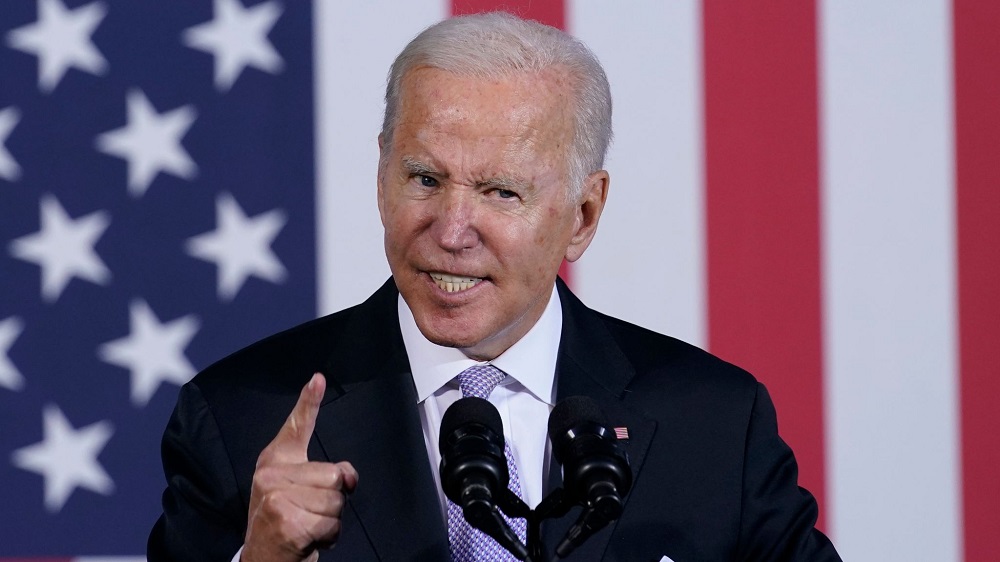
Biden administration outrage over Supreme Court verdict President Biden Outraged over Supreme Court’s Decision Granting Texas Authority to Arrest Undocumented Immigrants Pending Final Ruling, Making Border Crossings a State Crime.
In a statement, the Biden White House writes, “We fundamentally disagree with the Supreme Court’s order allowing Texas’ harmful and unconstitutional law to go into effect. “S.B. 4 will not only make communities in Texas less safe, it will also burden law enforcement, and sow chaos and confusion at our southern border.
“S.B. 4 is just another example of Republican officials politicizing the border while blocking real solutions. “We remained focused on delivering the significant policy changes and resources we need to secure the border – that is why we continue to call on Congressional Republicans to pass the bipartisan border security agreement, the toughest and fairest set of border reforms in decades.”