News
Why I Will Not Negotiate With Bandits – Gov Radda
- /home/naijuinz/public_html/wp-content/plugins/mvp-social-buttons/mvp-social-buttons.php on line 27
https://naijablitznews.com/wp-content/uploads/2024/03/Umaru-Radda.jpg&description=Why I Will Not Negotiate With Bandits – Gov Radda', 'pinterestShare', 'width=750,height=350'); return false;" title="Pin This Post">
- Share
- Tweet /home/naijuinz/public_html/wp-content/plugins/mvp-social-buttons/mvp-social-buttons.php on line 72
https://naijablitznews.com/wp-content/uploads/2024/03/Umaru-Radda.jpg&description=Why I Will Not Negotiate With Bandits – Gov Radda', 'pinterestShare', 'width=750,height=350'); return false;" title="Pin This Post">
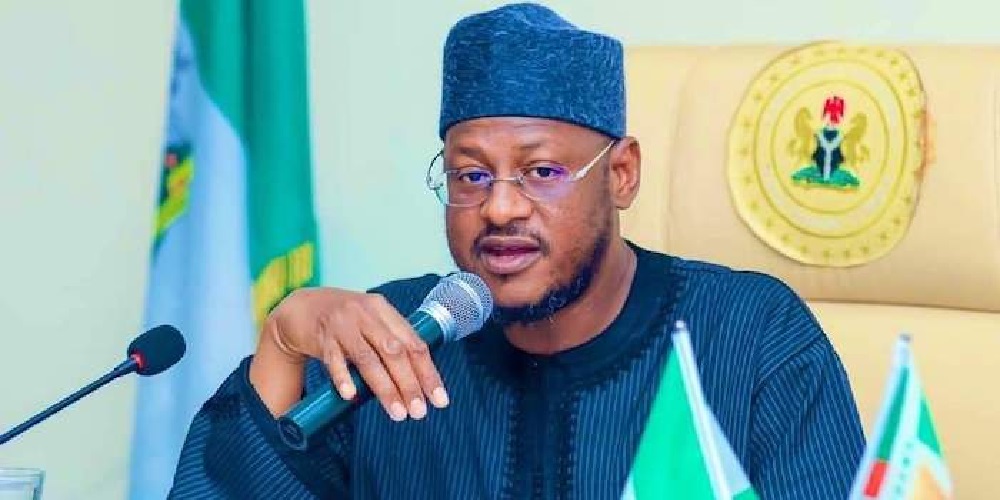
Katsina State governor, Mallam Dikko Umaru Radda, has said he decided not to negotiate with bandits because he did not want them to feel the government is helpless.

Radda who also advocated for state policing as part of measures to tackle insecurity that has plagued states, including Katsina, said governors need to be in charge of security in their states.
The governor disclosed this in his office on Wednesday when he received a high-powered delegation from the Media Trust Group, publishers of the Daily Trust Newspapers and owners of Trust TV and Trust Radio, led by the Chairman, Board of Directors, Malam Kabiru A. Yusuf, for discussions on a proposed regional summit on security.

Radda said with the current constitutional arrangement, governors seem helpless with regard to the security of their states as all conventional security agencies are answerable to their bosses, except where there are new arrangements, like the Katsina Community Watch Corps which is helping in tackling insecurity.
“Some people are saying that the only way to solve this problem is through non-kinetic means, through negotiations. I told the National Security Adviser (NSA) that in Katsina, I would not negotiate with bandits because we have done it under the previous administration and it didn’t yield positive results.
“We ended up giving them taxpayers money and they equipped themselves, acquired more weapons and relaunched their attacks on innocent citizens of the state,” he said.
He added “People have voted for us because we promised them that we will bring peace and security and without peace, you cannot achieve anything. It is very disheartening when you go to these affected communities and you see the state of their schools and hospitals, some of which have become bandits’ camps. Do we have to continue like that?
“We can’t fold our arms while some people are killing, maiming and raping our people, because we are not in control of the security architecture. So, we decided that we must have some approaches as leaders to protect our people.
“My first approach in dealing with this problem is that I decided not to negotiate with any bandit, because that will give them a sense of feeling that we are helpless and that we have to abide by their own terms and conditions.”
Radda said his decision to form the community watch corps was paying off as bandits have been pushed back to the fringes of the forest. The governor said it was frustrating, however, to hear some narratives that the approach of using trained locals to complement the efforts of the conventional security was wrong, maintaining that those holding such opinion were either completely ignorant of the happenings in the state or they were only being malicious.
“When we wanted to recruit the operatives of Katsina Community Watch, we didn’t give it the approach of either ‘Yan Sakai’ or the approach of vigilante. They were recruited and trained in a formal way by the conventional security agencies. They were trained on combat, weapons handling and every other aspect of security training and they are well-kitted.
“It is a well-thought idea, and it was backed by the law passed by our state assembly and the boys are working hand in hand with the conventional security agents,” he added. He, however, called for a regional approach to tackling the insecurity as many states in the northwest region are battling with banditry and kidnappings.
The governor said with the state security outfit, his administration was able to change the tide of banditry which was hitherto approaching the Katsina metropolis, but now they have been pushed back to the frontline local government areas, which become the battlefield once more.
He said the recent resurgence of banditry was nothing but a show of frustration by the bandits because they had been pushed back, saying that was why they attacked villages and set houses on fire.
The governor said that would not deter his administration as it will keep on pushing until they are severely dealt with banditry.
Governor Radda said another misleading narrative was that in the issue of banditry, it was the Fulani against the Hausa, stating that was untrue and diversionary.
“Go inside Katsina now and try to differentiate who is Hausa and who is Fulani. You can’t just do that. We are all the same people. I am of Fulani extraction from both parents. But the bandits are only criminals and we must treat them as such,” he said.
News
Traders Raise Alarm Over Circulation Of Counterfeit In Borno
Traders at the Kwaya Kusar Grains Market, Kwaya Kusar Local Government Area (LGA) of Borno have raised an alarm over the circulation of counterfeit N1,000 notes in circulation.
A cross-section of the traders raised their concern in separate interviews with the News Agency of Nigeria(NAN) in Kwaya Kusar community on Saturday.
According to them, the issue is not limited to Kwaya Kusar market but cuts across other markets in Biu and Bayo LGAs, where they normally buy their commodities depending on their market days.
They said that the issue was affecting their businesses and sabotaging the economic activities at the markets, while eroding trust between traders and their customers.
Malam Ibrahim Yusuf, a grain trader from Gombe main market who came to Kwaya Kusar market to buy maize, said he had been a victim of fake currency notes twice.
“About three weeks ago, I went to Biu grain market to buy some bags of maize, and I was given four pieces of fake N1,000 notes, and I didn’t realise until I was in transit.
“It was when I was about to pay the driver that I saw one new N1,000 note that was very light and felt unusual in my hand, and I suspected it was fake. ”
He said he immediately called the person who gave him the currency to complain after discovering three other pieces of such notes in the cash he withdrew.
“My profit is not much, as I make between N3,000 and N4,000 per bag after taking out transportation cost.
“Now I bought three bags, meaning I am expecting roughly N12, 000 but now I have N4,000 counterfeit notes, which means my profit margin has been reduced, ” he said.
He said government and relevant authorities should visit the various markets in Biu, Kwaya Kusar and even Shani rural markets to mop up these counterfeit notes and find the source.
“This is highly imperative, especially now that farmers have started harvesting their produce, which will surely increase the volume of trade in the markets.
“Urgent action from relevant agencies is necessary to protect traders from making huge losses,” Yusuf said.
Also speaking, Alhaji Hassan Mai-Dawa said he was once a victim of fake N1,000 notes, which he collected from one of the POS operators in Kwaya Kusar.
He said it was when he went to deposit the money in the bank that the notes were discovered to be fake.
Mai-Dawa said many of the traders don’t collect transfers, so he had to withdraw from POS to be able to buy his goods.
“I think this is something the government should come in because I also faced similar issues in Biu market.
“Many traders do not know the difference; so, we use the fake note alongside the original ones,” he said.
Mrs Hauwa Aminu, a rice trader, said she often noticed some unusual new N1,000 notes inside her cash, but she never really bothered because people collect them from her.
Aminu recounted an incident where she almost fought with a buyer who needed a refund after depositing cash the previous day.
“I gave him the cash I had, and he rejected some of the notes, but I insisted that I am not the one printing them.
“It was an intense argument, and since then, that buyer never came back to my shop to buy from me, ” she said.
Aminu, however, appealed to the government to send its officials to some of the rural markets to monitor and make necessary arrests to protect traders.
Others who spoke to NAN but did not want their names mentioned also lamented their ordeals because they could not identify the counterfeit notes from original ones.
They called for massive sensitisation to enable local traders to identify counterfeit notes to protect their businesses.
News
At 71, Nigerian Man Enrolls at UI Law School: Here Is Why He Did It
Not resting on his oars, 71-year-old Dr. Bolaji Ojo-Oba has proven right the age-old axiom that age is not a barrier to learning. Recently, Dr. Ojo-Oba went viral across various social media platforms, especially on TikTok. A video shared by his daughter, Rihanot Ojo-Oba, showed the septuagenarian sitting in class alongside his fellow colleagues.
Earlier this year, he was among the 4,430 newly admitted students for the 2025/2026 academic session at the University of Ibadan. He was formally matriculated during the university’s official ceremony in March 2026.
Studying at an advanced age in Nigeria is a powerful testament to lifelong learning, defying cultural stereotypes and proving that the quest for knowledge has no expiration date. According to him, he returned back to study law because of his lifelong ambition goal and the impact of a prolonged legal battle during his tenure at the Nigeria Football Federation (NFF).
Dr. Ojo-Oba’s illustrious career spans several decades, during which he has demonstrated exceptional leadership, versatility, and expertise. Ojo-Oba, who hails from Ibadanland, was born on 7 January, 1955. Last year, he marked his 70th birthday anniversary amid pomp and ceremony.
He obtained his first degree in French from the University of Lagos and earned a Master’s in the same discipline from the same university. He later earned his Master’s and Doctorate in Sports Administration from the University of Ibadan.
A cursory look at Ojo-Oba’s intimidating and enriching profile reveals a man who did not stumble on stardom by accident, but intricately sketched his way to the top. It was a hard climb, assisted by perseverance.
Ojo-Oba started his career in the civil service in 1989 as a Senior Bilingual Secretary of the NSC. He became the Head of NFA’s International Competitions Department from 1990 to 1992, before later becoming the Head of Department of Competitions from 1992 to 1995.
Ojo-Oba later became NFA’s Head of Marketing and Sponsorship Department in 1995, before becoming an officer in the Federal Ministry of Youth and Sports Planning till 1997. He later served as the Commissioner for Information, Youth, Sports and Culture in Oyo State from 1997 to 1999.
Ojo-Oba later rose to the post of an Assistant Director in the Federal Ministry of Sports And Social Development from 2004 to 2005. He subsequently served as Secretary-General of the Nigeria Football Federation (NFF) from January 15, 2007 to July 26, 2010.
He was for many years a security chieftain for both the Confederation of African Football (CAF) and FIFA, which he served meritoriously. Throughout his career, Dr. Ojo-Oba has exhibited a commitment to excellence, serving in various capacities, especially as a member of the Fédération Internationale de Football Association (FIFA) Committees.
News
British-Nigerian Businessman Dies After Penis Enlargement Procedure in Thailand
A 43-year-old British-Nigerian businessman and social media influencer, Igho Ubiribo, has died after undergoing a penis enlargement procedure while on holiday in Thailand with his wife.
An inquest at Inner West London Coroners’ Court heard last month that Ubiribo died in March after receiving 40-millilitre injections of hyaluronic acid and lidocaine at a clinic in Bangkok.
According to the *Daily Mail*, Ubiribo began experiencing chest pain and lost consciousness twice while receiving a massage with his wife, Danielle Simba Allen, following the procedure.
He was rushed by ambulance to Sukhumvit Hospital, where doctors identified a pulmonary embolism—a blood clot blocking a vessel in the lungs. He lost consciousness again before a recommended CT scan could be performed.
Medical staff attempted to resuscitate him for more than 100 minutes, but he was pronounced dead in the early hours of March 6.
A postmortem conducted in the UK revealed that cellular material found in Ubiribo’s lungs matched the hyaluronic acid used in the penile filler injection, confirming the diagnosis of a pulmonary embolism.
Coroner Jean Harkin concluded that Ubiribo died “as the result of a cosmetic procedure abroad,” recording the official cause of death as a pulmonary embolism resulting from the hyaluronic acid injection.
The *Daily Mail* reported that Ubiribo, who had approximately 185,000 Instagram followers, was laid to rest in London in May. His funeral was attended by Nigerian musician Davido and several other prominent figures.
Medical professionals have long warned against penile filler procedures. Professor Vaibhav Modgil, an NHS andrology specialist and consultant urological surgeon, noted that such procedures carry severe risks and can lead to devastating consequences for patients.
-
News17 hours ago‘Provide Evidence El-Rufai Paid Bandits To Kill Kaduna People’ – Ex-Gen Queries Defence Minister
-
News18 hours agoCourt of Appeal Upholds Order Against Mark-Led ADC Congresses, Declares Exercises Null and Void
-
News18 hours agoTwo Policemen fired over death of UNIPORT graduate in Port Harcourt
-
Sports15 hours agoSad! Military jet crashes during airshow
-
News18 hours agoPopular Journalist, Gloria Steinem Dies At 92
-
News17 hours agoStop empowering Nigerians with okada, Defense minister tells govs
-
Economy2 hours agoFG Can’t Account For ₦33.75 Billion Cash Transfers To Vulnerable Nigerians – Auditor-General
-
Sports18 hours agoWilliams sisters lose in thrilling return to US Open doubles