News
Parliamentary Diplomacy Critical To World Peace, Conflict Resolution – Akpabio
- /home/naijuinz/public_html/wp-content/plugins/mvp-social-buttons/mvp-social-buttons.php on line 27
https://naijablitznews.com/wp-content/uploads/2024/03/7F9A6304-FD1B-49E8-9D0D-170079A34241-1000x600.jpeg&description=Parliamentary Diplomacy Critical To World Peace, Conflict Resolution – Akpabio', 'pinterestShare', 'width=750,height=350'); return false;" title="Pin This Post">
- Share
- Tweet /home/naijuinz/public_html/wp-content/plugins/mvp-social-buttons/mvp-social-buttons.php on line 72
https://naijablitznews.com/wp-content/uploads/2024/03/7F9A6304-FD1B-49E8-9D0D-170079A34241-1000x600.jpeg&description=Parliamentary Diplomacy Critical To World Peace, Conflict Resolution – Akpabio', 'pinterestShare', 'width=750,height=350'); return false;" title="Pin This Post">
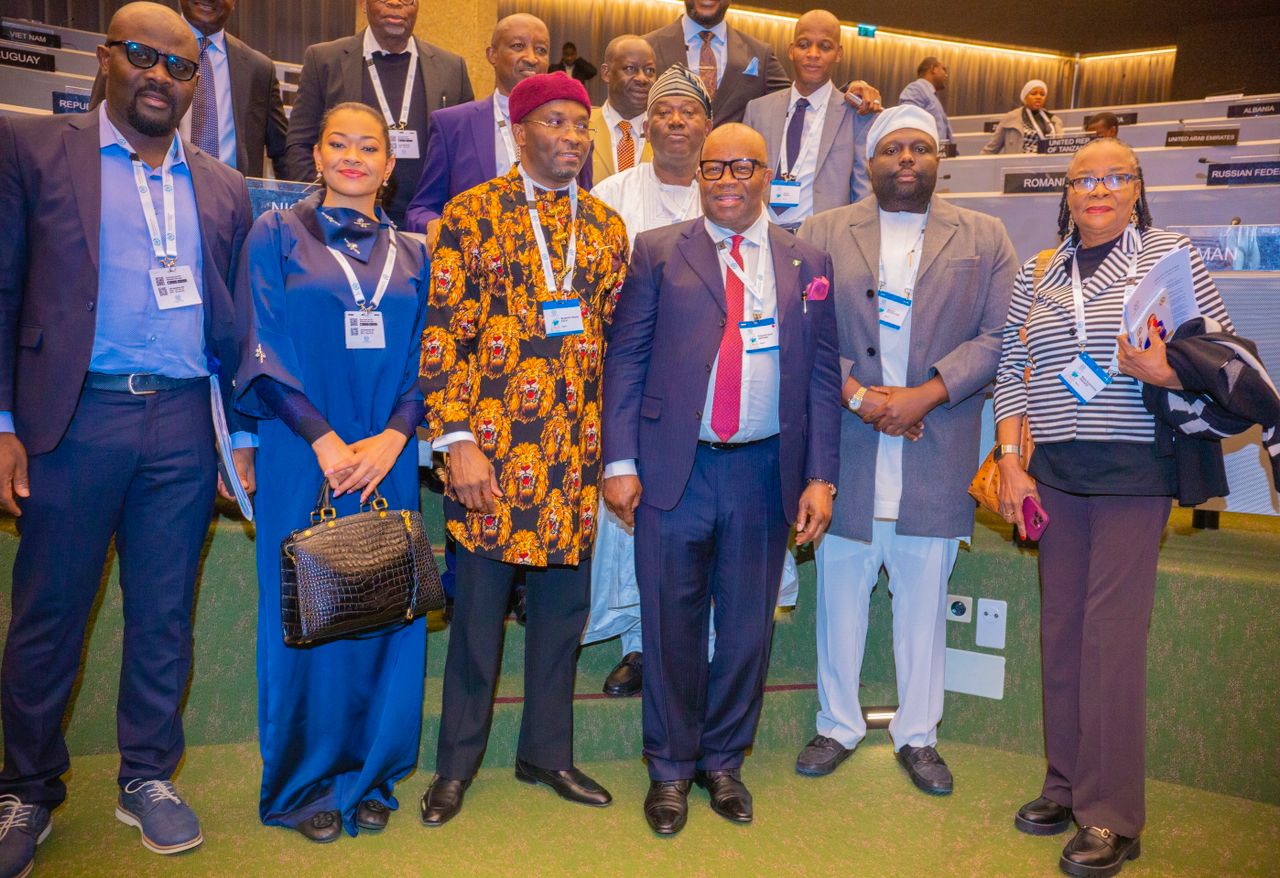
President of the Senate and chairman, National Assembly of Nigeria, Godswill Akpabio, has made a strong case for increased efforts in parliamentary diplomacy.

Akpabio, who spoke at the 148th Assembly of the Inter-Parliamentary Union and Related Meetings, held in Geneva, Switzerland, on Sunday, maintained that parliamentary diplomacy is quite critical to achieving peace in the world and resolving conflicts.
He called for more progress in parliamentary diplomacy, noting that though the Nigerian Parliament has explored the concept and achieved a myriad of successes, more can still be done.

According to him, the Parliament in Nigeria has played a crucial role in curbing polarisation and ensuring peace through legislation”.
Apart from the legislative function, Akpabio said the Parliament also “employs mediation to address conflicts between non-governmental organisations and the government, as well as disputes involving labour unions.”
Senator Akpabio, who shared the progress and initiatives of the 10th National Assembly under his leadership, said it has become imperative for the world to recognise the power of the collective voice in shaping a better future for all, as it is in a critical juncture in history.
He said: “We stand at a pivotal moment in history, an intersection where the choices we make and the words that we speak, have the potential to positively shape the future of a world in constant crisis.
“Therefore, we lend the voice of our country to the patriotic call for collective action to address the challenges facing our wonderful world.
“Nigeria has stunning kaleidoscopic diversity and a vibrant cultural heritage. The obverse side of this diversity is that Nigeria often faces the tragedy of commons where individuals and groups act in their self-interests, leading to the decline of shared resources.”
He noted that, “the government, with the support of the Parliament, has embarked on efforts to strengthen peace, collaboration, and unity. However, we are aware that the specter of polarization along political, ethnic, gender, religious, or racial lines is a global menace that requires the concerted efforts of all governments and non-governmental organizations to overcome.
“In Nigeria, our Parliament plays a crucial role in curbing polarization and ensuring peace and progress through legislation. One notable legislative milestone in Nigeria was the passage of the “Not Too Young to Run” Bill in 2018, which aimed to widen the horizon for youth and women to actively participate in governance.
“Nigeria has also actively contributed, with the support of Parliament, to international peace and security by deploying troops for peacekeeping missions across Africa and beyond.
“Nigeria’s bicameral parliament plays a significant role in conflict prevention and resolution through regional parliamentary forums, fact-finding missions to conflict areas, and addressing cross-border issues related to refugees, arms smuggling, and war-related criminal activities.”
According to him, Parliamentary friendship groups strengthen ties between parliaments of different countries and promote gender mainstreaming, democracy, and good governance.
“Preventive diplomacy is a powerful instrument for conflict prevention and peaceful mediation.
“Therefore, we engage in dialogue with foreign states to integrate peace-building into treaties and the constitution. The establishment of the National Center for the Control of Small Arms and Light Weapons demonstrates Nigeria’s commitment to combating insecurity by curbing the circulation of illicit arms in West Africa.”
The Senate President also highlighted other areas where the “Nigerian Parliament has made and continues to make great achievements, including evaluation of political appointees based on merit and in strict adherence to the constitution rather than bias, based on political party affiliation, gender, religion, race, or ethnicity and holding government agencies accountable through investigative and public hearings, among measures.”
Akpabio stated further that “the achievements of the Nigerian Parliament in upholding international commitments, promoting peace-building, and holding the government accountable, are laudable”.
He, however, called for “more progress in parliamentary diplomacy and increase in peace-building capacity, not only in Nigeria but across all sovereign states, saying: “let us advert our minds to Martin Luther King, Jr’s admonition that all mankind is tied together; all life is interrelated, and we are all caught in an inescapable network of mutuality, tied in a single garment of identity. Whatever affects one directly, affects all indirectly.
“We must walk together, hand-in-hand even if we do not see eye-to-eye, in our march to reshape our world. We must remember that we are the eyes, the ears, the hands and the minds of our people and we embody their hope for a brighter, more equitable future for this blessed world of ours.
“This, very distinguished ladies and gentlemen, is the legacy we owe the world.”

News
UNIABUJA law student emerges champion at West Africa 9th Inter-Universities Speech Contest, in Freetown
By Kayode Sanni-Arewa
University of Abuja law student, Amra Onize Salihu, has emerged champion at the 9th Inter-Universities Speech Contest organised by the Intergovernmental Action Group Against Money Laundering in West Africa (GIABA), held on Wednesday, 22 July 2026 in Freetown, Sierra Leone.
Amra, a 500-level student in the Faculty of Law, represented Nigeria after winning the national selection conducted by the Nigerian Financial Intelligence Unit (NFIU).
She defeated contestants from The Gambia, Liberia, Sierra Leone, and Ghana to claim the regional title, receiving the Winner’s Plaque, a Certificate of Honour, and a cash prize of US$1,000.
Fellow 500-level law student Abah Goodness Ojonoma attended as an observer.
The Director of the Law Clinic, Dr Nasiru Mukhtar coached the team, along with Mr J R Gogol of the NFIU, who provided
technical coaching.
The Vice-Chancellor, Professor Hakeem Babatunde Fawehinmi, said he was proud of the students performance.
“Our students from the Faculty of Law have once again made the University proud. I congratulate them on this great achievement. I also commend the Faculty of Law and the Law Clinic for their efforts in the training and mentorship of the students. We will continue to work even harder to enhance the University’s global visibility through academic excellence and outstanding achievements such as this.”
News
BREAKING: Fear as Enugu Air flight crash lands at Benin Airport
Fear as an aircraft belonging to Enugu Air has crashed at Benin City airport in Edo State.
The incident reportedly occurred on Thursday afternoon.
A video of the incident was shared on social media by an X user identified as @Oyindamola
“Enugu Air aircraft crash lands in Benin Airport this afternoon,” the X user wrote.
Recall that the Enugu Air is owned and operated by the Enugu State government.
There’s was no official statement on the matter by the aviation authorities at the time of filing in this report.
Details shortly…..
News
Reps Minority Caucus stage Walk Out as House Passes Tinubu’s State Police Bill
…allege constitutional breaches in voting process as 311 lawmakers back landmark amendment
…reaffirm their support for state policing in principle
By Gloria Ikibah
The Minority Caucus in the House of Representatives on Thursday staged a dramatic walkout during plenary in protest against the passage of President Bola Tinubu’s Executive Bill on the establishment of State Police, accusing the House leadership of violating constitutional provisions and the chamber’s Standing Orders.
Despite the protest, the House approved the Constitution Alteration Bill after 311 lawmakers voted in its favour, marking a major milestone in the ongoing effort to decentralise policing and strengthen Nigeria’s security architecture.
The Executive Bill, transmitted to the National Assembly by President Tinubu last week, seeks to amend the 1999 Constitution to create a constitutional framework for the establishment of State Police Services. The proposal followed months of debate over the need for a multi-layered policing system to tackle rising insecurity across the country. It also replaced an earlier version of the bill previously passed by the House after lawmakers rescinded their earlier resolution to accommodate the President’s proposal.
Speaking to journalists shortly after leading members of the caucus out of the chamber, Minority Leader, Rep. Fredrick Agbedi, said their action was not a rejection of state police but a protest against what they described as the disregard for due legislative process.
He argued that the Speaker, while presiding as Chairman of the Committee of the Whole, ignored the constitutional requirements governing amendments to the Constitution.
He said: “The Constitution is the grand norm. It is the rule book from which even our Standing Orders derive their powers. For the Speaker, acting as Chairman of the Committee of the Whole, to disregard the clear provisions of Section 9(2) of the 1999 Constitution, as amended, is a great affront to the workings of the House of Representatives.”
Agbedi maintained that attendance in the House is determined through members’ registers signed on each legislative day and not by names read during proceedings.
The Minority Caucus also insisted that every clause of a constitutional amendment bill must be considered individually and supported by a two-thirds majority, as required by both the Constitution and the House Standing Orders.
Quoting Order 13 Rule 15(a) of the House Rules, the lawmakers stated:
“In the clause-by-clause consideration in the Committee of the Whole, a clause shall be deemed passed only if supported by a positive vote of two-thirds majority of members of the House.”
The caucus faulted the decision to pass the bill through a voice vote after only the long title was read, without detailed consideration of each clause.
Reaffirming their support for state policing in principle, the lawmakers stressed that procedure should never be sacrificed.
“We are not against the creation of state police. Whatever will help address insecurity in Nigeria, we are prepared to support. But every action taken by Parliament must follow due process”, he added.
According to the minority leader, they had earlier held discussions with Speaker Abbas Tajudeen on aspects of the bill that required amendments, and believed there was an understanding that those concerns would be addressed.
The lawmaker warned that failure to comply with constitutional procedures could undermine the credibility of the National Assembly and Nigeria’s democratic institutions.
“Mr. Speaker even identified areas where we could intervene, but when he sat as Chairman of the Committee of the Whole, he simply read the long title and put the question through a voice vote. That is absurd.
“When the rules and regulations are not complied with, it affects the credibility of the institution as well as the credibility of Nigeria and our democracy”, Agbedi stated.
The caucus further alleged that the Speaker denied them the opportunity to raise constitutional points of order before the vote was taken.
“As Minority Leader, I raised a point of order, but before hearing me, the Chairman ruled me out of order. Which order was he ruling me out of? He ought to have heard my point of order first before deciding whether it complied with our rules or the Constitution”, he said.
The caucus also questioned how the constitutional requirement of a two-thirds majority could have been met after opposition lawmakers had left the chamber.
“If we walked out of the House, where are our votes? Can you count our votes? Can anybody decide a constitutional amendment with a voice vote? It is not possible”, he asked.
Describing the development as a dangerous precedent, the Minority Caucus accused the ruling All Progressives Congress (APC) of weakening democratic institutions.
“We stand on the side of Nigerians. We stand on the side of the rule of law. We stand on the side of what will make Nigeria a great nation and not what will diminish the integrity, progress and development of this country”, the minority leader noted.
The lawmakers urged Nigerians to remain vigilant, insisting that while they support the establishment of state police, any constitutional amendment must strictly comply with the provisions of the Constitution and the House Standing Orders.
Meanwhile, the House proceeded with the consideration and adoption of the report of its Committee on the Review of the 1999 Constitution, chaired by Deputy Speaker Benjamin Kalu.
At the conclusion of the exercise, Speaker Abbas Tajudeen announced that 311 members voted in support of the bill, comprising 276 lawmakers physically present in the chamber and 35 who participated virtually.
The bill, titled “A Bill for an Act to Alter the Constitution of the Federal Republic of Nigeria, 1999 to Provide for the Establishment of State Police Services and for Related Matters (HB. 2797),” now moves to the next stage of the constitutional amendment process.
In forwarding the legislation to the House, President Tinubu said the proposal builds on previous work by lawmakers while introducing additional safeguards to ensure the effective implementation of a dual policing system.
“This bill builds on the significant work already done in this regard by the House of Representatives and incorporates additional safeguards to ensure that the creation of a dual policing structure to address our nation’s evolving national security challenges can be achieved quickly and effectively to the benefit of all Nigerians.
“The proposed legislation is a critical component of our administration’s strategy to reorganize Nigeria’s security architecture to better protect our citizens, and I am confident that the House of Representatives will act quickly to consider and pass this Bill.
“While I look forward to expeditious consideration of this submission by the House of Representatives, please accept, Rt. Honourable Speaker, the assurances of my consideration and best regards”, he said.
Following receipt of the Executive Bill, the House rescinded its earlier resolution of 11 June 2026 on the establishment of State Police Services and dissolved the 12-member Conference Committee constituted on 9 July 2026, paving the way for consideration of the President’s revised proposal.
-
News14 hours agoSpain’s World Cup winner Gavi says he does not want Argentina players suspended after he was attacked
-
News14 hours agoPhotos: Top Dignitaries In Attendance As Wike’s Daughter Graduates At Southampton University
-
Sports14 hours agoTransfer: Arsenal Prioritise Deal For Yan Diomande, Target Four Other Stars
-
Sports14 hours ago2026 World Cup: FIFA Releases Team Of The Tournament [BEST XI]
-
News15 hours agoTrump Writes Tinubu, Commends Efforts To Tackle Terrorism, Violence Against Christians
-
News14 hours agoOndo Speaker gets Sunday deadline to resign or face impeachment
-
News14 hours agoSecurity: Accord, Police Clash Ahead Osun Governorship Election
-
Foreign14 hours agoUS Court Announces Date For Trial Of Ousted Venezuelan President Maduro