News
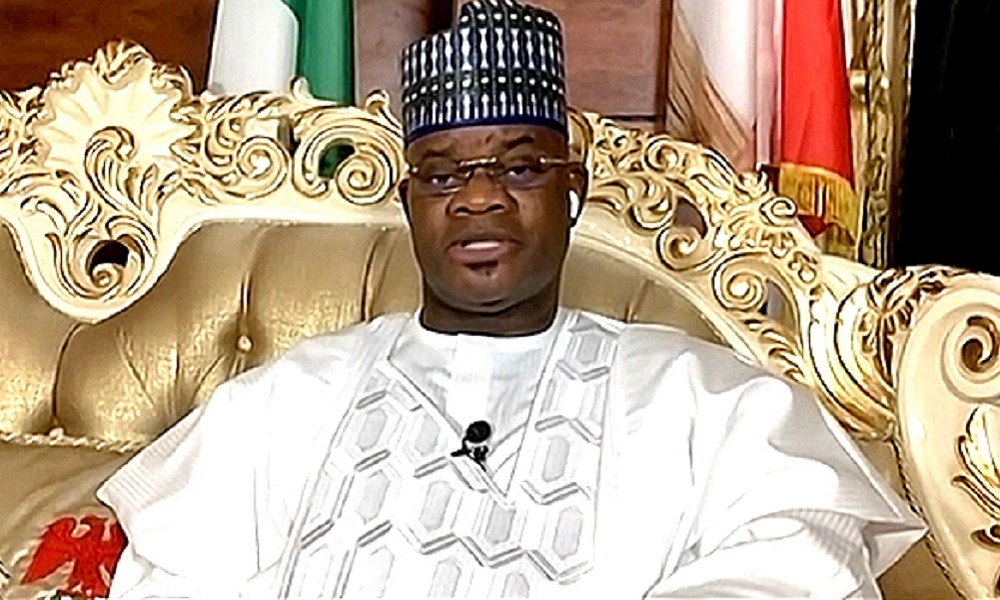
How Yahaya Bello withdrew $720,000 from Kogi account to pay child’s school fees -EFCC Chairman
- /home/naijuinz/public_html/wp-content/plugins/mvp-social-buttons/mvp-social-buttons.php on line 27
https://naijablitznews.com/wp-content/uploads/2024/03/yahaya-bello.jpg&description=How Yahaya Bello withdrew $720,000 from Kogi account to pay child’s school fees -EFCC Chairman', 'pinterestShare', 'width=750,height=350'); return false;" title="Pin This Post">
- Share
- Tweet /home/naijuinz/public_html/wp-content/plugins/mvp-social-buttons/mvp-social-buttons.php on line 72
https://naijablitznews.com/wp-content/uploads/2024/03/yahaya-bello.jpg&description=How Yahaya Bello withdrew $720,000 from Kogi account to pay child’s school fees -EFCC Chairman', 'pinterestShare', 'width=750,height=350'); return false;" title="Pin This Post">
By Francesca Hangeior

The Chairman of the Economic and Financial Crimes Commission, Ola Olukoyede, has revealed that a former governor of Kogi State, Yahaya Bello, transferred $720,000 from the government’s coffers to a bureau de change before leaving office to pay in advance for his child’s school fee.
Olukoyede revealed this during an interview with journalists on Tuesday in Abuja.

He said, “A sitting governor, because he knows he is going, moved money directly from government to bureau de change, used it to pay the child’s school fee in advance, $720,000 in advance, in anticipation that he was going to leave the Government House.
“In a poor state like Kogi, and you want me to close my eyes to that under the guise of ‘I’m being used.’ Being used by who at this stage of my life?”
Olukoyede further stated that he personally reached out to Bello, offering him a chance to clarify the situation in a respectful setting within the EFCC office but the ex-governor reportedly declined to cooperate, citing fears of harassment from an unnamed woman.
The EFCC boss added, “I didn’t initiate the case; I inherited the case file. I called for the file, and I said there are issues here.
“On my own, I called him, which I am not supposed to do, just to honour him as an immediate past governor. ‘Sir, there are issues. I’ve seen this case file. Can you just come let us clarify these issues?’
“He said, ‘Ha! Thank you, my brother. I know, but I can’t come. There’s one lady that has surrounded EFCC with over 100 people to come and embarrass me and intimitade me.’
Bello was said to have suggested that the EFCC come to his village rather than conduct an investigation at the agency’s quarters.
News
Nigerians granted visa-free entry to Grenada
The Consulate of Grenada in Nigeria has announced visa-free access for Nigerian passport holders as part of efforts to boost trade, tourism, and investment ties between the two countries.
Grenada’s Consul to Nigeria, Ambassador Abidemi Sonoiki, disclosed the development during an interactive session with journalists on Thursday.
He said the Caribbean nation has already approved free entry for Nigerians and is awaiting reciprocal action from the Nigerian government through diplomatic channels.
“I have a letter from Grenada’s foreign affairs authorities to Nigeria’s Ministry of Foreign Affairs. Grenada has approved free access for Nigerians, and we expect Nigeria to reciprocate the gesture,” Sonoiki stated.
The move aims to deepen economic relations.
Sonoiki highlighted investment opportunities for Nigerians in sectors including tourism, aviation, real estate, maritime services, education, agriculture, and financial technology.
Grenada, with a population of about 125,000, is described as a stable, investment-friendly destination with a low crime rate.
Its currency has remained stable since the country gained independence in 1974.
Tourism forms the backbone of its economy, attracting visitors for vacations, weddings, cultural events, and education.
The envoy disclosed that discussions were also ongoing to establish a direct air link between Nigeria and Grenada, with hopes that a permanent route could begin operations within the next six months.
Such connectivity would enhance tourism, trade, and people-to-people exchanges, positioning Grenada as a gateway to the wider Caribbean market of around 46 million people, while leveraging Nigeria’s role as a key entry point into Africa.
News
NUPRC Seeks Funding For Oil, Gas Operators
The Nigerian Upstream Petroleum Regulatory Commission (NUPRC) has appealed to financial institutions to increase funding for oil and gas operators as part of efforts to expand domestic production.
NUPRC chief executive, Oritsemeyiwa Eyesan, made the call during a visit by senior executives from Rand Merchant Bank (RMB) to the commission’s Abuja headquarters.
Eyesan emphasised the importance of collaboration between regulators, financiers and operators to unlock investment and accelerate growth in the country’s gas sector.
“One critical element will be financing, and we are hoping that you and the financial world will be there to support us. We will ensure that the industry operates in accordance with the Petroleum Industry Act and all other regulatory instruments,” Eyesan said.
She disclosed that the industry’s appetite for investment is very strong, as demonstrated by the interest in the ongoing 2025 licensing bid round, which witnessed almost 300 applications from IOCs and indigenous operators.
The NUPRC boss also highlighted ongoing initiatives around energy transition, including the issuance of Permits to Access Flare Gas (PAFG) to 28 firms and a target of 60 per cent reduction in fugitive methane emissions by 2031, among other initiatives aimed at promoting sustainable development in the upstream sector.
Responding, the head of Oil and Gas Coverage at Rand Merchant Bank, Jonathan Ross, said the bank is keen on supporting Nigeria’s efforts to grow oil and gas production, with a particular focus on gas development.
He described gas as a strategic priority for the bank, citing major infrastructure projects such as the OB3 Gas Pipeline as critical to unlocking the country’s vast gas potential.
The bank also acknowledged recent regulatory reforms and improvements in security in host communities, noting that Nigeria is in a stronger position to attract investment than in previous years.
News
Falana To FG: Recover $118.67bn, N66.4bn in Outstanding Oil Sector Funds
Human rights lawyer Femi Falana has urged the Attorney-General of the Federation and Minister of Justice, Lateef Fagbemi, to take immediate legal steps to recover over $120.5 billion and N66.4 billion owed to the federal government by the Nigerian National Petroleum Company Limited (NNPCL), international oil companies (IOCs), and other industry operators.
Falana, in a letter on behalf of the Alliance on Surviving Covid-19 and Beyond (ASCAB), stated that court rulings, government investigations, and federal agency reports confirm that these substantial amounts, comprising unpaid royalties, taxes, dividends, and other revenues, are still unpaid and must be remitted to the Federation Account.
The senior lawyer warned that if the Attorney-General does not initiate recovery actions within 14 days of receiving the letter, ASCAB would seek a court order compelling him to act in accordance with his constitutional and legal duties.
Falana identified five main categories of funds to be recovered.
The largest portion, he said, is $62 billion in unpaid royalties owed by international oil companies, due to the federal government’s failure to enforce the Deep Offshore and Inland Basin Production Sharing Contracts Act.
He explained that Section 16 of the law requires royalty increases when crude oil prices exceed $20 per barrel, but this was overlooked for 18 years, resulting in significant revenue loss.
Falana also stated in the letter that the governments of Akwa Ibom, Bayelsa, and Rivers approached the Supreme Court and that on October 20, 2018, the apex court issued a consent judgment instructing the federal government to recover these royalties and pay the states their 13% derivation entitlement.
The right advocate further stated that a committee set up by former Attorney-General Abubakar Malami concluded that $62 billion could be recovered from the international oil companies.
He also mentioned that the Federal High Court has issued judgments supporting Akwa Ibom, Rivers, and Bayelsa states’ claims to their share of the disputed royalties.
The lawyer further urged the government to recover $29 billion in proceeds from crude oil theft and undeclared exports.
He also pointed out that findings by lawyers hired by NIMASA reportedly showed that 60.2 million barrels of crude, worth about $12.7 billion, were discharged at the Port of Philadelphia, USA, between 2011 and 2014.
Falana also cited a House of Representatives ad hoc committee report that estimated that $17 billion in crude oil and LNG exports left Nigeria without proper records during the same period.
He called on the Attorney-General to direct the EFCC to recover the funds from the oil and shipping firms involved.
Regarding Nigeria LNG Limited (NLNG), Falana accused NNPCL of failing to remit $21.5 billion in dividends received on behalf of the federal government.
He pointed out that NLNG paid over $44 billion in dividends over 26 years, with NNPCL, holding a 49% stake, receiving about $21.5 billion, which has not been remitted to the Federation Account despite several recommendations and resolutions.
Falana also referenced NEITI’s 2022/2023 report, which identified $6.071 billion and N66.4 billion in outstanding revenues as of June 2024.
He criticised the National Assembly for approving a $2.1 billion external loan request in November 2024 amid these recoverable revenues.
The lawyer urged the Attorney-General to recover $2.9 billion spent on rehabilitating the Port Harcourt, Warri, and Kaduna refineries, noting contractual breaches by foreign contractors and operational issues, including refinery shutdowns.
He called for an EFCC investigation into the contracts and recovery of related funds.
He emphasised that recovering these sums would boost government revenue and lessen dependence on external borrowing.
“If the said sum is recovered, the Federal and state governments will avoid further external loans,” the letter stated.
Falana asserted that ASCAB has the legal standing to pursue legal action if necessary, citing its role in advocating amendments to the contracts law, which President Buhari signed into law in 2019.
As of now, neither the Office of the Attorney-General nor NNPCL has publicly responded to these claims and requests.
-
News22 hours agoVideo: FCT minister Wike embarks on final inspection of Kuje airport road
-
News24 hours agoNUPENG Deputy President Oladejo Felicitates Comrade Akinlaja at 76
-
News22 hours agoOyo Assembly Rejects Negotiation With Ogbomoso school children abductors
-
News21 hours agoBREAKING: House Erupts Over Minority Leader Race as Forgery, $50,000 Bribery Claims Trigger Uproar
-
News24 hours agoU3 Federal Constituency: Akpodiete Says Emarayo’s Multiple Party Membership Threatens PDP’s 2027 Chances
-
News16 hours agoSenate endorses Bill seeking to establish National Agency for Malaria elimination
-
News23 hours agoGov Aiyedatiwa reveals how youths plan to bomb govt house
-
Entertainment19 hours ago2026 Guber: I Will Be There To Defend Our Votes – Davido Assures Adeleke

Warning: Undefined variable $user_ID in /home/naijuinz/public_html/wp-content/themes/zox-news/comments.php on line 49
You must be logged in to post a comment Login