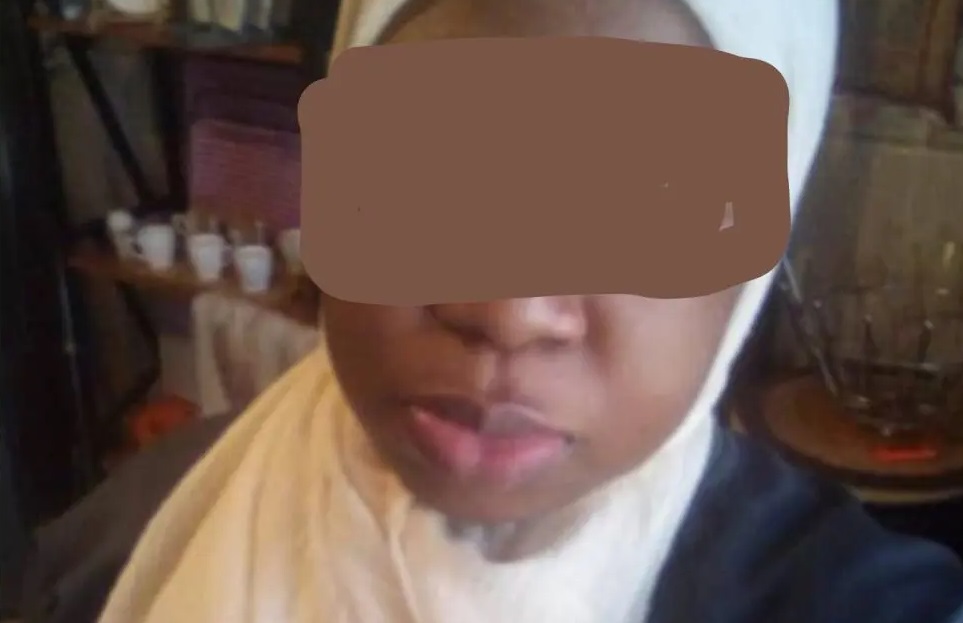
A 21-year-old lady from Anambra State, Chika Obiakaeze has narrated how she was trafficked to Libya for prostitution by a male friend whom she met on Facebook.


Enrolled in a fashion school in Nigeria, Chika’s aspirations took a sad turn when the said friend offered to help her with an employment as a domestic help in Libya.
She was assured of good pay and the prospect of working for foreign expatriates. 
Speaking in a telephone interview with DAILY POST, she said the friend introduced her to his sister who is based in Libya, who would assist her with accommodation and job when she gets there.
Narrating how she met the online friend, she said “We aren’t too close, in fact, I can’t remember his surname, when he introduced me to his sister, I thought that he just wanted to help me, I thought it was legit.”
She further stated, “I was learning tailoring before an online friend introduced me to his sister whom he claimed needed someone to stay with her and be taking care of the house while she left for work.
“He told me the job was a good one with good pay, and I would get a chance to work with foreign expatriates. So, he sent the number of his sister and I reached out to her.
“When I contacted the said sister, I asked her if it was a legit job and she assured me that it was just a normal cleaning job that is being done in Nigeria.
“We had the discussion at length and she gave me a direction on how to use the road to get to Libya, stating that that was how she got to Libya herself and I have to use the same route.
“So she sent me some money to buy some stuff before coming. She asked me to buy garri and water because, on the way, there was no water and there was no food.
“I asked her about the transportation and she told me that it was going to be a luxurious bus that would bring us to the country, assuring me that I didn’t have to worry about anything.
“She told me to go to a place in Kano from Enugu, I can’t remember what that place is called in Kano but she asked me to go there, that I will meet a particular man called ‘Connection man’.
“I don’t know his real name but that was what she addressed him as, so she said that when I meet with him, that he would direct me to where we would start the journey.”
The young lady revealed that the move to leave Nigeria was fueled by desperation and alleged rejection by her mother.
“My mum left me at five years old to marry early because she believed that as she gave birth to me, she wouldn’t see any man to marry her, so she married and abandoned me and I don’t know who my father is. My mum refused to tell me anything about him.
“According to my mum’s sister who is my aunty, my mum refused to breastfeed me when I was a baby, she said she didn’t want her breasts to fall, I have been living with my mum’s sister since I was a child, she sponsored my education to JSS3.
“My Aunty later got me a small apartment where I could stay and paid for me to learn tailoring because the husband didn’t like me and he threatened her that he didn’t want me to live with them any longer.
“That’s why she rented a house for me. She called my mum to contribute to my feeding but my mum claimed she had no money, I was living in the house and learning the work, feeding was very difficult for me and that was why I decided to go to Libya after my friend told me about it.
“I didn’t tell anyone I was traveling, I was so naive that I didn’t even ask people anything about the country. My friend’s sister told me that the work I would be doing in Libya would be paying me N100,000 daily, and I have never seen such money in my life before.
“I planned to work even if it’s two years to save money for me so that I can start something, since I have no helper,’’ she further disclosed.
Narrating their journey through the Sahara Desert, she said they were about 100 girls in number and had to lap themselves, adding that it took them two months on the road before they got to the Libya border.
“So when I left Enugu, it took me about a day to get to Kano State, because the bus I entered had a fault; when I got to Kano, I met with the man ‘Connection man’ and he told me to hold on for a week because I would be joining other people that were also going.
“I started getting worried, I called my friend’s sister and told her this wasn’t what she told me and she said that I should not panic, that I would see the rest of the people that I will be going with.
“So they took me to another person, the connection man is an Hausa person, so other girls started joining me where I was, they were young; as I met other girls, they were explaining to me where they told them that they would be going, so all of us looked at each other and we couldn’t say much because there were other people with us.
“So they brought some cars, I don’t know the names of the cars, but they brought about four cars and asked us to enter, stating that the journey had started.
“They had to rush us to enter the cars and make things snappy, we were so much that the cars couldn’t occupy all of us but they asked us to squeeze ourselves in, we had to lap each other so that everyone could find a space to seat.
“So we started the journey but we went through so many challenges, we couldn’t see the road, the Hausa guys were the ones driving us, and we got to a particular place where they said that if the cars should stop for everyone to come down, we should start running and according to what I heard, we were some miles close to the border where we can cross.
“So the Hausa guys told us that we have to be smart and be ready to run so that the police won’t arrest us and that once they catch us, they will put us in prison.
“So we had to use our legs to trek so that the police wouldn’t get us, so we started trekking, we trekked for hours and everyone became exhausted, and if you didn’t walk fast, they would start beating you and shouting, ‘Aya’; they were speaking their language and we didn’t understand all they were saying.
“We got to a particular place that looked like a ghetto, more of like an Hausa place, I do not know the name of the place, and they pushed us into the building and locked us there, there was no longer Nigerian network but it still looks like an Hausa environment, as they locked us in the ghetto where we can’t go out, they told us we are going to be there till the Arab white people will come and pick us.
“We were there for weeks, with no people to call because of no network, we had to feed on our garri and water with glucose, sometimes they would bring food and ask us to buy for N100.
“After two weeks, the Arab people arrived, so we still had to trek from bush to bush to avoid the police. We trekked for over seven hours.
“We got to a particular place where the Arab white men parked their Hilux trucks, the cars were about five; we entered the cars, and we were many.
“We started our journey and the way they were driving us was so rough. It was during the cold season and the cold was too much. I heard the place is called the Sahara Desert. We got to a point where our water even finished, they would go somewhere to fetch water for us in a keg they use in putting fuel into their trucks.
“The water tasted like fuel but they would ask us to drink it like that, we stayed in that desert for almost a month, and they drove us to another place where we entered some other vehicles, at that point, they collected all our phones and they told us that we are not allowed to use our phones, promising us that when we get to the end journey, they would release our phones for us.
“We continued the journey and at a point they instructed us to lie down in the Hilux, like sleep on ourselves and use our backpacks to cover ourselves, asking us not to make noise, there was no breathing space and two boys died during the journey and I don’t even know where they kept their bodies.
“They were just changing us from one person to another, so the man they gave me to, they asked the man to call my madam, so my madam came to pick me up and that was how I got to Libya.
“I started the Journey to Libya on September 18, 2022, and got to Libya on November 15, 2022.”
However, upon arrival in Libya, Chika’s dreams were shattered after she was almost forced into prostitution by her benefactor.
Her benefactor had said she would be remitting the sum of N1.5 million yearly after having sex with foreign expatriates.
Expressing her shock, the 21-lady-old had argued with her benefactor over a breach of agreement before she was shut down by the woman who allegedly threatened to use ‘’juju”, a fetish charm on her.
“She told me that the kind of job I would be doing is called “connection one”.
“I asked her to explain better that I didn’t understand and she said that it is called “Prostitution” that I will pay her 1.5 million naira; I was shocked and told her it wasn’t what we discussed, we talked about cleaning jobs.
“She threatened me that if I misbehaved she would make me run mad, she even forcefully took hair from my private parts. She told me that no one would help me, that it is either I accept to do what she asked me to do or she sells me.
“I was afraid but accepted. Then she took me to a prostitution house where I stayed for a month. I saved a little money and got a phone for myself without her knowing. I could no longer stay in that place, the people there were mostly Hausas, forcing little girls to sleep with them.
“I found a way to escape. I left December last year (2023).”
Obiakaeze would later escape from her benefactor through another friend she met on Facebook.
She continued: “So I chatted with someone on Facebook and narrated my ordeal; the guy told me that if I see any opportunity to escape from there, I should let him know.
“So one day he called me and told me that he would send someone to Libya to help me and that the person would act as if he wanted to pick me up for a job.
“So that was how I left the prostitution house and worked somewhere, but they refused to pay me my salary, I was told they were traveling and they would pay me when they were back, that was how the people I worked for left with my money and refused to pay me.”
When asked how she has been fending for herself where she currently stays, she said, “I am so tired, I just feel like ending my life because anything can happen to me over here, I don’t know my faith. I hardly eat, no help for me to come back home.”
She appealed to the Nigerian embassy in Libya to come to her aid as she wants to return to Nigeria.
‘’I just want to go back to Nigeria; I am tired of being stranded here, a lot of things are happening here, people are living in fear here, you might even go out and not return alive, and the police too might arrest us because we came here illegally.
“They will always ask for your passport and blood test and the Arab people here can just attack you and sell you into prostitution, they treat us like slaves here. I need help to go home; I want to return to Nigeria,” she pleaded.