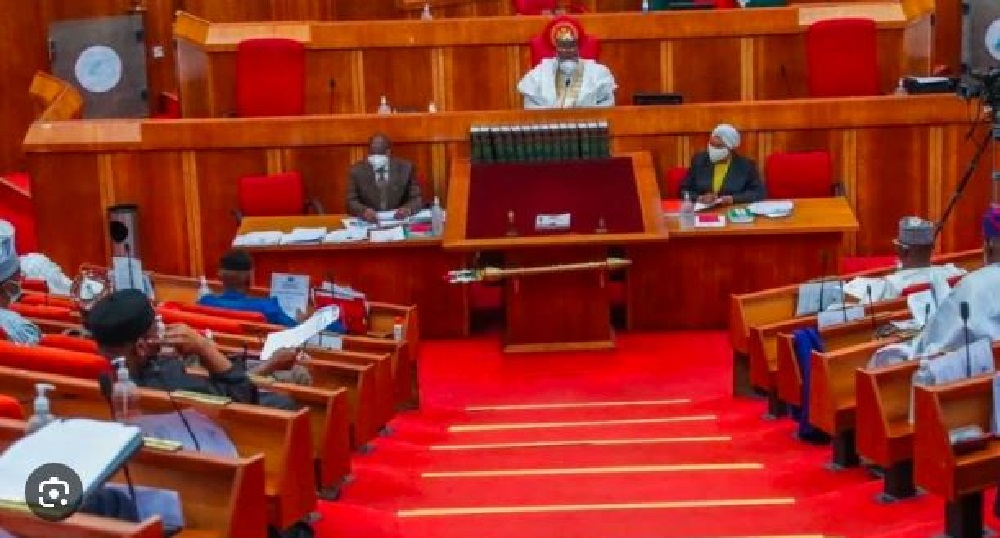
The Deputy Speaker of the House, Rt. Hon. Benjamin Kalu presiding:.
After leading the opening prayer and recitation of the national pledge, the Deputy Speaker approved the votes and proceedings of Tuesday, May 14th, 2024.
______________________________
ANNOUNCEMENTS:
1. The Senate has formed a conference committee to look into the Southeast Development Bill. The Minority Leader of the House of Representatives, Hon. Kingsley Chinda who chairs the committee in the House should liaise with the Senate and report progress.
2. Membership of the Conference Committee handling the matter on a Bill for an Act for the amendment of the Library Trust Fund Act was announced and it is to be chaired by Hon. Usman Zannah.
______________________________
PETITIONS:
1. Hon. Mohammed Jalo laid a petition on behalf of a complainant against the Nigeria Customs Service in an appeal for the payment of some dues allegedly being withheld.
2. Hon. Mark Obeta laid a petition on behalf of some complaints on alleged conspiracy against them
3. Hon. Jesse Onuakalusi laid a petition on behalf of a complainant against the Nigeria Police on alleged illegal detention and its disobedience of court order to release the detained individual
4. Hon. Ali Isa laid a petition on behalf of a community against the Central Bank Governor and his management for allegedly disengaging 3 of their members without due process
4. Hon. Afolabi Moruf laid a petition on behalf of a complainant against the Nigeria Police on his alleged premature retirement
5. Hon. Obinna Aguocha laid a petition on behalf of a complainant on the alleged unlawful termination of his appointment
All petitions were referred to the House committee on Public Petitions.
______________________________
MATTERS OF URGENT PUBLIC IMPORTANCE:
1. Hon. James Barka moved a motion on the need to address the devastation caused by a heavy rainfall in some communities of Adamawa State and it was seconded by Hon. Chris Nkwonta. Hon. James in leading the debate stressed the effect of the devastation of the storm on houses, farmlands, places of worship, businesses and market places in the communities worth millions of Naira. The effect he stated has caused untold financial and psychological hardship to the citizens.
Hon. James called on the Northeast Development Commission, the Ministry of Humanitarian Affairs, as well as the National Emergency Management Agency to provide relief to the affected communities. He further called on the relevant Committees of the House to ensure compliance. The motion was voted on, adopted and referred to the House Committee on NEMA, Northeast Development Commission, as well as that on Humanitarian Affairs.
2. Hon. Inyang Lemke moved a motion on a call to avert serious humanitarian crisis of displaced persons in Ere North/South in Cross River State and it was seconded by Hon. Muktar Shagaya. Hon. Lemke in leading the debate stated that the displacement is as a result of communal clashes that has claimed over 50 lives. He stated that the clashes have left scorched houses and destroyed farmlands in its wake. Hon. Lemke called for additional security for the safety of the inhabitants of the communities. He expressed worry at the absence of basic necessities in the shelters where the displaced persons are. He called for the provision of humanitarian assistance for the displaced and a conducive environment to be put in place for those who want to return home. Hon. Lemke called on the National Emergency Management Agency to provide relief materials for the affected, and that the communities should be rebuilt while provisions be made for children to continue schooling in the camps they are right now.
Hon. Billy Osawaru proposed an amendment to incorporate the House Committee on Poverty Alleviation to the prayer of the motion. The motion was voted on, adopted as amended and referred to the House Committees on NEMA, Basic Education, Primary Heath Agencies as well as that on Poverty Alleviation.
3. Hon. Rufus Adeniyi moved a motion on the urgent need to put an end to the shortchanging of the Nigerian economy by the exportation of raw materials and importation of finished goods back into the nation and it was seconded by Hon. Steve Fatoba. Hon. Adeniyi in leading the debate stated that this trend rubs Nigerians the economic advantage of exporting value added goods that can be taxed as well causes the loss of local job opportunities. He also stated that this is what has made Nigeria an import-dependent nation that has fostered poverty and idleness on citizens that should be duly and gainfully engaged. He called for the establishment of the proper environment to start processing raw materials for export and that the relevant committees of the House should pursue this and ensure compliance. The motion was voted on, adopted and referred to the House Committees on Commerce and that on Trade and Industry.
4. Hon. Kingsley Chinda moved a motion on the urgent need to correct the wrong perception of some sections of the public on the House of Representatives’ position on the implementation of the Cyber Security Act as amended and it was seconded by Hon. Sada Soli. Hon. Chinda in leading the debate stated that there is the wrong perception in some quarters that the House is against the Bill it passed which is detrimental to the livelihood of Nigerians. He clarified that the House explicitly stated that the levies should be borne by some establishments listed in the second schedule of the Act who make gains from cyberspace transactions and not on the Nigerian public. Hon. Chinda stressed the importance to clarify this opinion in public space. He called for better enlightenment and orientation of Nigerians by the relevant government agencies on the matter. He further called on the relevant committees of the House to ensure compliance.
Hon. Satomi Ahmed in contributing to the debate commended Hon. Chinda for bringing it up and stated that the need to clarify those who should be levied by the provisions of the Law as passed is long overdue.
Hon. Abubakar Yalleman also stated that the House should be careful in the implementation of the Act as the customers (Nigerians) of these institutions to be charged will be the ones to bear the resultant financial implications at the end.
Hon. Sada Soli blamed the Office of the Attorney General of the Federation for the ambiguous nature of the interpretation of the implementation of the provisions of the Act as it should have interpreted the provisions of the Act long time ago, he also stated that the Law Reform Commission is also culpable in the matter.
Hon. Ali Isa also stated that the House of Representatives remains the place of hope for Nigerians to channel their grievances and frustrations so the House should ensure that it continues to advocate with the federal government on behalf of Nigerians.
The Deputy Speaker of the House Rt. Hon. Benjamin Kalu stated that the role of the Legislature is to make Laws while the Executive Arm of government is saddled with the implementation of such Laws. He stated that the House in recognition of the gap in the Act amended it duly and called on the Executive to to ensure the regulatory bodies in charge of monitoring agencies adhere to the provisions in the right manner. He stressed the need for Nigerians to understand that the House remains committed to their well being in the implementation of the provisions of the Law.
Hon. Ademorin Adekuye in making his contribution blamed the directive of the Central Bank for the confusion in the public space. He stated that the Office of the Attorney General was supposed to have made the directive and not the CBN. He proposed an amendment to incorporate the House Committee on Justice to the prayer of the motion.
Hon. Aliyu Bappa also proposed an amendment to incorporate the House Committee on Digital and Electronic Banking into the prayers of the motion. The motion was voted on, adopted as amended and referred to the House Committees on National Security and Intelligence, Justice as well as that on Electronic Banking.
5. Hon. Satomi Ahmed moved a motion on the need to investigate the recurring fault in the Presidential Air fleets and it was seconded by Hon. Alex Mascot. Hon. Ahmed in leading the debate stated that the Presidential air fleet are designated to specific high ranking Public officials for their security when traveling. He expressed worry at the news that President Bola Tinubu had to travel to Saudi Arabia on a chartered flight due to fault of the Presidential airplane. He also stated that a similar news arose that Vice President Kashim Shettima had to cancel a trip to the United States due to his plane also being faulty. Hon. Ahmed expressed grave concern as this does the Nigerian image serious harm and compromises the security of these officials. He called on the Commandant of the Presidential Air fleet and the National Security Adviser to explain to the House why these planes are faulty and what is being done to ensure the security and safety of Nigeria’s high public officials is guaranteed.
Hon. Sada Soli in contributing to the debate expressed sadness at the embarrassing nature of the problem as the lives and security of such highly placed public officers are at risk as well as that of the Nigerian sovereignty. He called for a strong investigation into the matter with the view to resolving the embarrassing situation. He further called on the House to summon the Commandant of the Presidential Air fleet and the National Security Adviser to come before the House to explain why these planes are faulty and what is being done to ensure the security and safety of Nigeria’s high public officials.
Hon. Julius Ihonbvere in contributing to the debate also stressed the need to maintain the highest level of security and safety for these high level public officers, especially recognizing the high level of local and international security threats.
Hon. Kingsley Chinda and Hon. Ali Isa stated that there is nothing wrong with President Bola Tinubu traveling with public airlines as is done by other world leaders. They called for the re-establishment of a national carrier solely manage by Nigeria. They also called for the maintenance of the Presidential air fleet as the public discuss of such a matter is shameful. The Deputy Speaker of the House Rt. Hon. Benjamin Kalu stated that the relevant Committee of the House ought to have carried out due investigation into such an incident and invite the relevant heads of agencies, and not to wait till it is brought as a motion on the floor of the House The motion was stepped down by leave of the House for the House Committee on National Security and Intelligence chaired by Hon. Satomi Ahmed to carry out its due investigation.
______________________________
PRESENTATION OF REPORTS:
1. Committee on Aids, Loans and Debt Management:
Hon. Abubakar H. Nalaraba:
“That the House do receive the Report of the Committee on Aids, Loans and Debt Management Report (No.2) on the Proposed 2022-2024 External Borrowing (Rolling) Plan for the Bureau of Public Enterprise (BPE) ” (Referred:1/11/2023).
The report was laid following a motion by Hon. Abubakar Nalaraba
2. Committee on Communications:
Hon. Peter Ohiozojeh Akpatason:
“That the House do receive the Report of the Committee on Communications on a Bill for an Act to Authorize the issue from the Statutory Revenue Fund of the Nigerian Communications Commission the Total Sum of (₦549,674,311,000.00) five hundred and forty–nine billion, six hundred and seventy–four million, three hundred and eleven thousand, Naira only, out of which (N115, 059, 947. 00) one hundred and fifteen billion, fifty–nine million, nine hundred and forty–seven thousand Naira, only is for Recurrent Expenditure, (N18, 023, 435. 00) eighteen billion, twenty–three million, four hundred and thirty–five thousand Naira, only is for Capital Expenditure, (N66, 781, 032) sixty – six billion, seven hundred and eighty–one million, thirty–two thousand Naira, only is for Special Projects while the sum of (₦17,000,000,000) Seventeen Billion, Naira, only is for Transfer to Universal Service Provision Fund (USPF), (N332, 807, 853) three hundred and thirty – two billion, eight hundred and seven million, eight hundred and fifty – three thousand Naira, only is for Transfer to Federal Government and (N2, 044) two thousand and forty – four Naira, only is surplus/deficit transfers for the financial year ending 31 December 2024.
The report was laid following a motion by Hon. Peter Akpatason and seconded by Hon. Jafaru Yakubu
______________________________
ORDERS OF THE DAY:
BILLS:
1. A Bill for an Act to Establish Institute of Chartered Corporate and Business Affairs Management of Nigeria to Provide for the Control of its Membership, Promote and Foster the Practice of Corporate and Business Affairs Management in Nigeria and for Related matters (HB.480) – (Hon. Julius Ihonvbere) – Second Reading.
Debate:
Hon. Julius Ihonbvere moved for the second reading of the Bill and it was seconded by Hon. Jafaru Leko. Hon. Ihonbvere in leading the debate stated that the organization is already in existence and all it seeks is the legal framework to back up its functions. The Bill was voted on, approved for second reading and referred to the House Committee on Commerce.
2. A Bill for an Act to Provide for the Establishment of Oba Obafemi Vocational Skills and Entrepreneurship University, Owode and for Related Matters (HB. 726) (Hon. Olumide Osoba) – Second Reading.
Debate:
Hon. Olumide Osoba moved for the second reading of the Bill and it was seconded by Hon. Mukhtar Chawai. Hon. Osoba in leading the debate stated that the proposed university would be essential for the educational development of Nigerian youth and it is for promoting the development of entrepreneurial skills. He pleaded with Honorable members to allow it to pass for second reading. The Bill was voted on, approved for second reading and referred to the House Committee on University Education.
3. A Bill for an Act to Establish Elites Sheriffs Corps to Facilitate Tax Collection by Relevant Authorities in the Federation to Enhance Budget Implementation through Internal Revenue Generation and for Related Matters (HB.976) (Hon. Victor Abang) – Second Reading.
Second reading of the Bill was stepped down by leave of the House for further consultation.
4. A Bill for an Act to Amend the Court of Appeal Act, Cap. C36, Laws of the Federation of Nigeria, 2004 and for Related Matters (HB. 999) (Hon. Patrick Umoh) – Second Reading.
Debate:
Hon. Patrick Umoh moved for the second reading of the Bill and it was seconded by Hon. Bitrus Laore. Hon. Umoh in leading the debate stressed the need for the amendment which aims to increase the number of Justices in the penultimate Courts. He stated that the Bill seeks to amend Section 1 of the Act and urged Honorable members to support it for the speedy delivery of justice in Nigerian Courts. The Bill was voted on, approved for second reading and referred to the House Committee on Judiciary.
5. A Bill for an Act to Alter the Constitution of the Federal Republic of Nigeria, 1999 to make provision for the Presentation of the Audited Report of the Previous year’s expenditures by the President, alongside the laying of the Budget (estimates of the revenues and expenditure) of the Federation for the next financial year and for Related Matters (HB. 780) (Hon. Whinghan Sesi Olusegun) – second Reading.
Debate:
Hon. Sesi Olusegun moved for the second reading of the Bill and it was seconded by Hon. Abdulhakeem Ado. Before Hon. Olusegun could lead the debate, Hon. Kelechi Nwogu moved a constitutional point of order citing section 85(5) which will be breached by the Bill as the Attorney General can function in that capacity. The second reading of the Bill was then stepped down by leave of the House.
______________________________
MOTIONS:
6. Need to Commence the Construction of Rail Service from Itakpe in Kogi State to Abuja:
Hon. Francis E. Waive:
The House:
Notes that the Uje vwu – Itakpe rail line is expected to transport food stuff passengers from the South and passengers/goods – steel from Itakpe and to other parts of the country;
Also notes that the rail service from Ujevwu to Itakpe is very strategic as it spans through Delta, Edo and Kogi states;
Aware that until recently the 327km Ujevwu-Itakpe rail line as a means of transportation was abandoned long before the previous administration took giant steps to complete the long-abandoned project and commissioned same;
Also aware that an extension of the Ujevwu – Itakpe rail line Northwards by 200km taking it through Lokoja, Abaji, Gwagwalada, Kuje up to ldu (Abuja, city centre) linking it with the existing Abuja – Kaduna line and the planned Kaduna – Kano line has been planned and contract awarded;
Concerned that more than three years after the reported contract was awarded nothing has been done by the contractor to executed this all-important project;
Resolves to:
(i) urge the Ministry of Transport to ensure immediate execution of the Contract;
(ii) mandate the Committee on Land Transport to investigate the reasons for the non-execution of the contract and ensure immediate execution of the contract for the construction of Itakpe to Abuja and report back within the four (4) weeks; and
(iii) also mandate the Committee on Legislative compliance to ensure compliance.
Debate:
Hon. Francis Waive moved the motion on Need to Commence the Construction of Rail Service from Itakpe in Kogi State to Abuja and it was seconded by Hon. Umar Ajilo. The motion was voted on, adopted and referred to the House Committees on Land Transport as well as that on Legislative Compliance.
7. Implementation of Monthly Rent to Encourage Inclusive Rental System and Curb Arbitrary Increase in House Rent in the Federal Capital Territory:
Hon. Emmanuel Ukpong – Udo:
The House:
Notes that within the Federal Capital Territory, monthly rent payments are uncommon, with landlords usually demanding a minimum of at least one year’s rent, while others require two years upfront;
Also notes that Nigeria is ripe for an inclusive rental system that reduces housing burden on working class families which will offer affordable monthly rentals for low- and middle-income earners.;
Aware that majority of FCT residents are civil servants and artisans, live in affordable Abuja satellite towns due to their meager salaries;
Also aware that the Special Adviser to Lagos State Governor on Housing, Barakat Odunuga-Bakare, disclosed that the state’s monthly rental scheme will be enforced before the end of 2024 or early 2025;
Alarmed at the arbitrary increase of rent in Federal Capital Territory, one-bedroom self goes for 1 to 1.5 million, while two bedrooms is between 2 – 3 million, naira and three bedroom 3.5 which is quite burdensome due to the current economic hardship for civil servants, who are already grappling with fuel subsidy removal, rising foreign exchange rates, electricity tariffs increase, and tax or levies;
Worried at the exorbitant charges on house rents ranging from 5–10%, legal fees of 20%, and agency fees, while the service and maintenance fee is 150, 000 and the caution fee is 150, 000 to 400, 000, depending on the landlord;
Convinced that monthly rent provides tenants with flexibility, better cash flow management, reasonable move-out options, and ensures a stable income stream;
Cognizant of the need for government to come to the rescue of the resident and formulate policies that will to regulate house rents and the activities of landlords in Abuja;
Recognizes the need to build affordable house for civil servants in Abuja to reduce the burden of paying exorbitant rent in Abuja;
Resolves to:
(i) urge the Federal Ministries of Housing and Habitat, and Works to build affordable low-cost Houses and Estate to accommodate Civil Servant; and
(ii) mandate the Committees on Housing and Habitat and Works to invite relevant stakeholders to discuss viable solutions to the issue of arbitrarily increase of house rent in the Federal Capital Territory and recommend effective policies to regulate the activities of landlords and report back within four (4) weeks for further legislative action.
Debate:
Hon. Emmanuel Udo moved the motion on Implementation of Monthly Rent to Encourage Inclusive Rental System and Curb Arbitrary Increase in House Rent in the Federal Capital Territory and it was seconded by Hon. David Zakaria.
Hon. Ademorin Adekuye proposed an amendment to urge the House committee on FCT to look into the matter of arbitrary rent increase rather than the committee on Housing. The motion was voted on, adopted as amended and referred to the House Committee on FCT.
8. Rehabilitation of Yola–Girei–Song–Gombi–Hong–
Hon. James Shuaibu Barka:
The House:
Notes that Yola to Mubi Federal Road is a strategic highway connecting major towns in Adamawa state, such as Yola, Girei, Song, Gombi, Hong, Mubi Adamawa state and southern part of Borno State;
Aware that the rehabilitation of the Yola-Girei-Song-Gombi-Hong-
Also aware that AG Vision Nigeria Ltd, the contractor responsible for the rehabilitation of Yola Girei-Song-Gombi- Hong-Mubi Federal Road project, has failed to complete the project within the agreed time and budget, despite a review and an additional approval of 29 billion Naira in 2022;
Concerned that the Yola-Girei-Song-Gombi-Hong-
Cognizant of the need to investigate the delay and poor execution of the Yola-Girei-Song Gombi-Hong-Mubi Federal Road rehabilitation and holding AG Vision Nigeria Limited accountable for any breach of contract or negligence is urgent;
Resolves to:
mandate Committee on Works to investigate AG Vision Nigeria Ltd’s failure to rehabilitate Yola-Girei-Song-Gombi-Hong-
Motion stepped down by leave of the House as it has been overtaken by events.
9. Need for a Special Admission Quota for Graduates of Nigeria Military Schools into the Nigeria Defence Academy (NDA):
Hon. Emeka Idu Godwin O:
The House:
Recalls that Nigeria Military School Zaria, Kaduna State, popularly known as NMS, was first established as the Boys Company of Nigeria on May 20, 1954, modeled after the Boys Wing of the British Army;
Also recalls that the objective behind the NMS was the production of Middle Commissioned Officers, necessitating that overriding emphasis be placed on military and academic training;
Aware that subsequently, the Air Force Military School Jos, the Air Force Girls Military School Jos, and the Nigerian Navy Military School, Ikot Ntuen, were respectively established on August 18, 1980, October 1986, and April 15, 2018 respectively;
Also aware that these military schools admit boys and girls from the age of 12, mold them into disciplined and loyal elements of the Armed Forces of Nigeria through several techniques, including physical training, training on field crafts, weapon handling, tactics, map reading, signals, and other military subjects;
Cognizant that the ambition of most graduates of military schools is to join the Nigeria Defense Academy and make a career as commissioned officers in the Nigerian Armed Forces;
Concerned that many of these diligent and well-prepared graduates, called Ex Boys, Ex Jam, Ex Jaw, and Ex Seal, face substantial challenges in gaining admission into the Nigeria Defence Academy, a critical next step in their career paths, hence the need for a more inclusive and equitable admission process;
Worried that despite their exposure to regimental training at the Military Schools, statistics show that in the last decade, only about 4.1% of the total annual admissions into the Nigeria Defence Academy (NDA) have gone to the Military Schools’ applicants in their first or second attempts;
Disturbed that with the increased insecurity across Nigeria, such well-trained young men/women left frustrated could be a handy tool at the disposal of criminal gangs;
Resolves to:
(i) urge the Minister of Defense, Chief of Defence Staff, and Board of the Nigeria Defence Academy to urgently review the admission requirements by allocating at least fifty percent (50%) slots to each state to applicants from Nigerian Military Schools pending the presentation and passage of the Nigeria Defence Academy Amendment Bill aimed at making the allocation permanent and statutory; and
(ii) mandate the Committees on Defense and Legislative Compliance, to liaise with the Ministry of Defense, Chief of Defense Staff, and all other relevant military bodies towards the realization of the above and report back within two (2) weeks for further legislative action.
Debate:
Hon. Emeka moved the motion on Need for a Special Admission Quota for Graduates of Nigeria Military Schools into the Nigeria Defence Academy (NDA) and it was seconded by Hon. Terseer Ugboh who also proposed an amendment to state that every student who graduated from these schools should be entitled to automatic admission into the Nigeria Defense Academy if they so wish.
Hon. Austin Achado in speaking against the motion stated that it dwells too much on quota system instead of on the basis of merit as this disenfranchises duly qualified individuals.
Hon. Dickson Tachi stated that the position of Hon. Austin Achado is right as the NDA allows only 5 slots for admission yearly to each state and relies on merit.
Hon. Akintunde Rotimi also spoke against the motion as it contravenes relevant admission and recruitment Laws and it will make it look like the House is being meddlesome.
Hon. Joshua Gana in supporting the motion stated that the graduates of the military schools have all the basic trainings that should be harnessed into the stream of the NDA with less stress. He called for the increase of the slots from 5-10 per state if possible.
Hon. Ibrahim Mohammed also supported the notion that adopting graduates from military schools into the NDA will make for seamless progression as long as they meet the requirements.
Hon. Sada Soli opposed the motion on the ground that it looks preemptive of an existing Bill of the House.
Hon. Julius Ihonbvere commended the debate on the motion as it has opened a broad view of interests into the procedure of admission into the NDA. He called for a holistic overview of all sides of the debate in order to have a better resolution at the end of the day. The motion was voted on, adopted as amended and referred to the House Committee on Defense who are to come back to the House with a report on the way forward.
10. Need to Rehabilitate Rice Mill-Gboko-Ameladu Road in Benue State:
Hon. Sekav Dzua Iyortyom:
The House:
Notes that the Rice Mill-Gboko-Ameladu road in Benue State is a federal road;
Also notes that the Rice Mil|-Gboko-Ameladu road, which measures about 11.9 km, is one of the major roads linking Benue to the states of Cross River, Enugu and other parts of the east, as well as Western and Southern Nigeria;
Aware that along that stretch of road is a private University, two major hospitals, one of which is a regular hospital and the other an Orthopedic and Referral Hospital that service Benue indigenes as well as patients from all over Nigeria, a School of Nursing and Midwifery, Laboratory Technology, College of Health Technology and a Polytechnic;
Also aware that the road is used to convey people to different facilities located along the road, Agricultural products such as yams, oranges, groundnuts, cassava, etc, transported from the farms and markets to the eastern and other neighbouring states;
Cognizant that if the Rice Mill-Gboko-Ameladu road is not urgently rehabilitated, it will pose hazards to commuters, access to the University and Hospitals as well as other facilities on the road, will become impossible and the transportation of farm produce to other parts of the country will be affected, thereby undermining the social, economic and overall wellbeing of the people;
Resolves to:
(i) urge the Federal Ministry of Power to install and maintain solar power lights along the road to illuminate and prevent criminal activities;
(ii) also urge the Federal Roads Maintenance Agency (FERMA) to ensure the rehabilitation of the road from Rice Mill-Gboko-Ameladu to avoid loss of lives and properties;
(iii) further urge the Ecological Fund office to provide funds to rehabilitate the potions with ecological challenges along the road for the construction of concrete and durable side drains to avoid incursions of erosion;
(iv) again urge the Federal Ministry of Works to make provision for the general maintenance of the Rice Mill Gboko Ameladu road in the 2025 budget estimates; and
(v) mandate the Committee on the Federal Roads Maintenance Agency to ensure compliance
Debate:
Hon. Sekav moved the motion on the need to Rehabilitate Rice Mill-Gboko-Ameladu Road in Benue State. The motion was voted on, adopted and referred to the House Committee on Federal Road Maintenance Agency.
11. Need to Curb the Use of Casualized Labour by Employers of Labour in Nigeria:
Hon. Fuad Kayode Laguda:
The House:
Notes that the oppressive and exploitative act of casualization of employment in Nigeria is rapidly spreading in unprecedented proportions of intensity and scale;
Also notes that Section 7(1) of the Labour Act, provides that “not later than three months after the beginning of a worker’s period of employment with an employer, the employer shall give to the worker a written statement specifying the:
(a) name of the employer or group of employers and, where appropriate, the undertaking by which the worker is employed; and
(b) name and address of the worker and the place and date of his engagement;
Observes that despite the law limiting worker casualization to three months, the practice of casualization remains prevalent in Nigeria, where casual workers occupy a precarious position in the working place and society, and are effectively a new set of slaves’ and ‘underclass’ in the modern-day economy;
Also concerned that Casualization, a form of slavery, can gradually destroy a nation’s economy, leading to overworked individuals with inadequate income and retirement savings, this will result in an overworked population who relies on government for survival thus overbearing the social assistance capacity of the government;
Worried that the attributes attached to casualization, among others, include: abysmal low wages, absence of medical care allowances, no job security or promotion at work, no gratuity and other severance benefits, no leave or leave allowance, freedom of association is often jeopardized; no death benefits or accident insurance at work, no negotiation or collective bargaining agreement;
Aware that this unwholesome practice, though prevalent in the banking sector, has gradually become the norm among employers of labour in Nigeria, thereby breaching, the Labour Act and Workmen Compensation Act are not exempt from these provisions;
Alarmed that despite the inflationary trend in Nigeria, contract or casual staff are still paid between 40,000 and 150,000 naira, depending on the bank or financial institution and are often laid off at any time without notice or compensation since the banks are not under any legal contractual obligation or agreement with the employees;
Further notes that since the boom recorded in the banking sector in the early 2000s, banks and other financial institutions in Nigeria have heavily relied on the services of contract staff, often outsourced through recruiting firms and agents;
Also aware of recent findings shows that out of the 95,588 staff employed by Nigerian banks, 40,328 represent more than 42 percent of the total bank employees in Nigeria, as at third quota in 2023, 2 out of every five bank workers are contract workers;
Further aware that contract workers are for a specific period of time and carry out professional service like tellering, marketing, admin, ICT under an unfavourable condition without promotions or job security enjoyed by their colleagues in full-time employment considering their significantly contribute to the growth of the banking industry through their services, leading to profits declared by these banks;
Resolves to:
(i) mandate the Committees on Labour, Employment and Productivity and Human Rights to investigate the extent of these infractions against the rights of Nigerian workers and also relate with the relevant government agencies to curb the unwholesome practices;
(ii) also mandate the Committees on Labour, Employment, and Productivity, Banking Regulations, and Banking Institutions to liaise with the Central Bank of Nigeria (CBN) to halt the practice of contract staffing by banks and other financial institutions in Nigeria; and
(iii) further mandate the Committee on Legislative Compliance to ensure full implementation of these resolutions.
Debate
Hon. Fuad moved the motion on the need to Curb the Use of Casualized Labour by Employers of Labour in Nigeria and it was seconded by Hon. Chike Okafor.
Hon. Isa Mohammed proposed an amendment stating that some retired individuals are employed as casual staff or consultants within a timeframe and these situations need to be clarified and separated.
Hon. Chris Nkwonta also proposed an amendment to prayer 2 stating that casualising labor is widespread in diverse sectors of the economy, not just in the Banking sector and should be looked into.
Hon. Sada Soli also proposed an amendment to step down prayers 1 and 2 so that it doesn’t look preemptive. The motion was voted on, adopted as amended and referred to the House Committees on Banking Regulations, Banking Institutions, Labour, Employment and Productivity, as well as that on Legislative Compliance.
12. Challenges of Irregular Migration:
Hon. Tochukwu Okere:
The House:
Notes that the universal lawful procedures for migration to other countries for legitimate purposes are recognized by all countries in the world, therefore, not following these procedures amounts to illegal entry;
Also notes that many Nigerians do not follow the legitimate procedures as recognized by the migration laws of Nigeria and countries of destination but instead follow illegitimate routes, which expose them to unnecessary hardship, thus constituting an embarrassment to the image of Nigeria and its rating before the community of nations.
Aware that Nigerians traveling out of the country through illegal routes have denied the Nigerian Immigration Service the opportunity to have reliable data on Nigerians traveling out of the country as well as the Nigerian Missions information about the presence of such Nigerians in their host countries,
thereby unable to monitor their activities or provide consular services to such migrants when the need arises.
Also aware of the reports that between 2015 and 2023, a total of 277,833 Nigerians left the country through the desert and Mediterranean routes, out of this number, 2000 ended up in Libyan private prisons and 12,000 seeking asylum in Germany in 2017, in deplorable living conditions. Whereas a total of 5,145 people died in the desert and on the Mediterranean in 2016 and 186, 000 were missing in 2023.
Worried that irregular migration and its consequences have created an image problem for Nigeria and present her as a country without rules and regard for the welfare of its citizens.
Concerned that if urgent steps are not taken to stop this dangerous trend, the situation may worsen to a point that many countries would deal with Nigeria not on the basis of enlightened reciprocity but on the discretion of defective perceptions created by this ugly trend, this has the potential to affect our diplomatic relations with friendly countries whose security and social stability have been affected by it.
Cognizant that Nigerians in the diaspora, particularly those with legitimate migration status, have contributed significantly to the nation’s economic growth, development, and social stability and therefore deserve protection from being tainted by the activities of illegal migrants from Nigeria;
Conscious of the need to make appropriate resolutions that would help the President effectively deliver on the expectations of Nigerians, particularly in protecting the image and lives of the citizens.
Resolves to:
Mandate the Committees on Foreign Affairs and Interior to investigate the factors that have given vent to the challenges of irregular migration and matters associated therewith and report back within four (4) weeks for further legislative action.
Debate:
Hon. Okere moved the motion on Challenges of Irregular Migration and it was seconded by Hon. Umar Yusuf. The motion was voted on, adopted and referred to the House Committee on Diaspora, Foreign Affairs as well as that on Interior.
______________________________
CONSIDERATION OF REPORT (HOUSE IN THE COMMITTEE OF THE WHOLE) Rt. Hon. Benjamin Kalu Chaired:
13. Ad-hoc Committee on the Need to investigate the alleged Manipulation of UTME Result by Miss Ejikeme Joy Mmesoma:
Hon. Sada Soli:
“That the House do consider the Report of the Ad-hoc Committee on the Need to Investigate the alleged Manipulation of UTME Result by Miss Ejikeme Joy Mmesoma and approve recommendations therein” (Laid: 19/10/2023).
(i) that Miss Mmesoma Joy Ejikeme should cooperate with JAMB to ensure that all those who conspired with her are identified;
(ii) members of the public should always verify results through the issuing authorities when in doubt of what is presented to them by candidates seeking for patronage of any kind;
(iii) that JAMB should be commended for its watertight examination processes and procedures, transparency, innovations and record-keeping system, which makes it possible to retrieve unmutilated transactions with candidates at short notice;
(iv) the system adopted by JAMB, whereby candidates do not present their results directly to their chosen institutions but relies only on the results JAMB had earlier sent to the institutions, is commendable and should be emulated by employers of labour to reduce falsification of results;
(v) the Ad-hoc Committee further urged JAMB to continue to interact with Miss Ejikeme Mmesoma to unearth those behind the manipulation, especially those who connived with her to distort people’s perception of reality;
(vi) that JAMB should reconsider the three-year ban placed on Miss Ejikeme Joy Mmesoma considering the possible negative impact the ban may have on her career and life so as not to destroy her future prospects given the fact that she is a first offender and appeared remorseful;
(vii) that JAMB should engage in more public awareness, enlightenment, sensitization and educate members of the public on its procedures and activities, which the Committee finds very assuring and of high ethical standard, to clear any perceived negative perception about the institution;
(viii) that the House of Representatives should support and strengthen such Institutions like JAMB through appropriation in order to improve their capacity to continue to provide quality services to Nigerians.
Synopsis of the report:
Hon. Sada Soli stated that the investigation was referred to the Ad-Hoc committee by the House and it engaged with JAMB and Miss Mmesoma. Miss Mmesoma was said to have apologized for the deceit she caused. Based on the findings, the Ad-Hoc committee made its recommendations.
Recommendations voted on and adopted: 1-4, 6-8
Recommendation amended and adopted: 5
______________________________
HOUSE IN PLENARY:
The House reverted to plenary and adopted the report of the committee of the Whole following a motion by Hon. Julius Ihonbvere and seconded by Hon. Kingsley Chinda.
______________________________
CONSIDERATION OF REPORT (HOUSE IN THE COMMITTEE ON SUPPLY) Rt. Hon. Benjamin Kalu Chaired:
Committee on Aids, Loans and Debt Management:
Hon. Abubakar H. Nalaraba:
“That the House do consider the Report of the Committee on Aids, Loans and Debt Management Report (No.2) on the Proposed 2022-2024 External Borrowing (Rolling) Plan for Bureau of the Public Enterprise (BPE) and approve the recommendations therein” (Laid: 15/5/2024) – Committee of Supply
(i) approve the under listed ongoing negotiation of External Borrowing for BPE in the sum of Five Hundred million USD ($500,000,000)
Project Title
Development Partner
Credit Amount USD
Nigeria Distributing Sector Recovery Program (DISREP)
World Bank
500,000,000
(ii) Approved the sum of ($500,000,000) five hundred US Dollars;
(iii) that the terms and conditions of the loan from the funding Agencies be forward to the National Assembly prior to the execution of same for concurrence and proper documentation.
Synopsis of the report:
Hon. Nalaraba stated that the work done was a result of the referral from the House to the committee as a result of the communication to the House by President Bola Tinubu for the consideration of an external borrowing plan.
Summary of voting:
Clauses voted on and approved: 1 & 2
Committee on Communications:
Hon. Peter Ohiozojeh Akpatason:
“That the House do consider the Report of the Committee on Communications on a Bill for an Act to Authorize the issue from the Statutory Revenue Fund of the Nigerian Communications Commission the Total Sum of (₦549,674,311,000.00) five hundred and forty–nine billion, six hundred and seventy–four million, three hundred and eleven thousand, Naira only, out of which (N115, 059, 947. 00) one hundred and fifteen billion, fifty–nine million, nine hundred and forty–seven thousand Naira, only is for Recurrent Expenditure, (N18, 023, 435. 00) eighteen billion, twenty–three million, four hundred and thirty–five thousand Naira, only is for Capital Expenditure, (N66, 781, 032) sixty – six billion, seven hundred and eighty–one million, thirty–two thousand Naira, only is for Special Projects while the sum of (₦17,000,000,000) Seventeen Billion Naira, only is for Transfer to Universal Service Provision Fund (USPF), (N332, 807, 853) three hundred and thirty – two billion, eight hundred and seven million, eight hundred and fifty – three thousand Naira, only is for Transfer to Federal Government and (N2, 044) two thousand and forty – four Naira, only is surplus/deficit transfers for the financial year ending 31 December 2024 and approve the recommendations therein” (Laid: 15/5/2024) – Committee of Supply
issue from the Statutory Revenue Fund of the Nigerian Communications Commission the Total Sum of (₦549,674,311,000.00) five hundred and forty–nine billion, six hundred and seventy–four million, three hundred and eleven thousand, Naira only, out of which (N115, 059, 947. 00) one hundred and fifteen billion, fifty–nine million, nine hundred and forty–seven thousand Naira, only is for Recurrent Expenditure, (N18, 023, 435. 00) eighteen billion, twenty–three million, four hundred and thirty–five thousand Naira, only is for Capital Expenditure, (N66, 781, 032) sixty – six billion, seven hundred and eighty–one million, thirty–two thousand Naira, only is for Special Projects while the sum of (₦17,000,000,000) Seventeen Billion, Naira, only is for Transfer to Universal Service Provision Fund (USPF), (N332, 807, 853) three hundred and thirty – two billion, eight hundred and seven million, eight hundred and fifty – three thousand Naira, only is for Transfer to Federal Government and (N2, 044) two thousand and forty – four Naira, only is surplus/deficit transfers for the financial year ending 31 December 2024.
2024 Revenue, Capital and Recurrent Expenditure Budget
Summary of NCC Revenue, Capital and Recurrent Expenditure
Committee Recommendation.
A.
Revenue Profile
N’000
B.
Expenditure
Recurrent Expenditure
Establishment Costs
1,128,424
Salaries and Wages
35,074,681
Other Personnel Cost.
17,848,243
Travel Costs
5,175,127
Operational Costs
27,837,230
Administration Costs
9,636,314
Spectrum Expenses
18,359,927
Total Recurrent Expenditure
115,059,947
Capital Expenditure
Internal Projects
15,444,456
Consultancies
2,578,978
Total Capital Expenditure
18,023,435
Special Projects
Emergency Communications Centres (ECC):
5,117,984
Broadband Infrastrutu\re Development Project:
390,000
GSM Networks QoS Compliance Monitoring:
2,887,510
Strategic Intervention Projects:
14,944,299
Nigeria Data Protection Bureau:
2,870,141
Transfer to National Broadcasting Commission for Digital Switch Over:
35,300,000
Digital Skill Acquisition Programme:
3,442,578
Subscribers Database Management:
774,000
Digital Parks:
400,000
R&D in Emerging Trends in Telecoms:
654,520
Total Special Projects:
66,781,032
Total Capital Projects:
84,804,467
Total Cost:
199,864,414
Transfer to USPF:
17,000,000
Transfer to Federal Government:
332,807,853
Surplus/Deficit (Transfers):
2,044
Total Revenue:
549,674,311
approve the sum of Five Hundred and Forty-Nine Billion, Six Hundred and Seventy-Four Million, Three Hundred and Eleven Thousand Naira (₦549,674,311,000.) only be approved as the Nigerian Communications Commission’s Budget for the year 2024 Universal Service Provision Fund
Summary of USPF 2024 budget:
DESCRIPTION:
2024 Budget.
Revenue:
17,000,000,000
Total Funds (A)
17,000,000,000
Payments:
RECURRENT EXPENDITURE:
Employees Costs:
1,668,538,082
Operational Costs:
1,221,028,166
Administrative Costs:
93,781,487
Board Expenses:
575,714,384
Bank Charges:
4,000,000
Total Recurrent Expenditure:
3,563,062,118
Capital Expenditure:
193,300,000
Projects & Programmes Expenditure:
13,243,637,881
Total Budget Expenditure (B):
17,000,000,000
Surplus/(Deficit): (A) – (B):
0
Approve the sum of (₦17,000,000,000) Seventeen Billion Eight Naira only for Universal Service Provision Fund (USPF) for 2024 Budget
Synopsis of the report:
Hon. Akpatason stated that the report was as a result of work done by the committee on the subject matter and urged Honorable members to approve it for the Nigerian Communication Commission to perform optimally in adequately regulating revenue generation in the communication industry.
Before the commencement of the report could begin, Hon. Stanley Olajide made it known to Honorable members that the Minister has never appeared before the relevant House committees so he objects to the consideration of the report.
Hon. Peter Akpatason pleaded with Honorable members to consider and approve the report as Heads of the Agencies have honored the invitation of the House and it would be unfair to stall their issues due to the absence of the Minister who was absent at the time of the initial meeting.
The Chairman of the committee on Supply, Rt. Hon. Benjamin Kalu stated that it is wrong to consider a report where the Minister has had no input at all. To encourage this he stated would set a wrong precedent as it is a violation of the doctrine of separation of powers.
Consideration of the report was then deferred for further consultation and legislative action by leave of the House following a motion by Hon. Stanley Olajide.
______________________________
HOUSE IN PLENARY:
The House reverted to plenary and adopted the report of the committee on Supply following a motion by Hon. Julius Ihonbvere and seconded by Hon. Kingsley Chinda.
______________________________
Adjournment:
The House at 14:49 PM adjourned plenary to Thursday, May 16th, 2024 by 11:00 A.M following a motion for adjournment moved by the Leader of the House, Hon. Julius Ihonbvere and seconded by the Minority Leader, Hon. Kingsley Chinda.
Courtesy:
Media Unit, Office of the Speaker, House of Representatives.