ADVERTISEMENT

ADVERTISEMENT

… Reaffirms loyalty to President Bola Tinubu, vows to continue building sustainable leadership
Former Governor of Rivers State and Minister of the Federal Capital Territory (FCT), Chief Nyesom Wike, has challenged the people of Evo Kingdom to point to any tangible development or political empowerment attracted to their land by his predecessor, Chibuike Rotimi Amaechi, despite holding top political offices as Speaker, Governor, and Minister for 24 years.
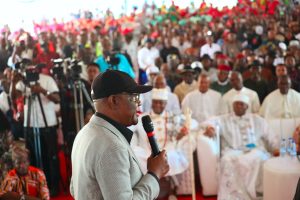
Speaking during an interactive session with leaders and stakeholders of Evo Kingdom in Obio-Akpor Local Government Area, Wike declared that unlike past leaders who used their elevation to pull down others and monopolize power, his political philosophy centers on human capacity development, divine gratitude, and uplifting his people.
Wike questioned the moral right of those who spent decades in high offices without leaving behind a legacy of leadership or infrastructure in the area, warning against selfish politics that crumbles once the leader passes on.
”Because how will I answer before God if these people could take that kind of risk, and opportunity came up for you to help, for you to uplift them? But because of your greed, because of your selfishness, you don’t want anybody to reach the level you are,” Wike said.

He said; “You don’t want anybody in Obio-Akpor to be governor again because you have become governor. God will not be happy with me”.
Taking direct aim at Amaechi’s 24-year tenure across various arms of government, Wike challenged the kingdom to present evidence of what was attracted to the land under his rival’s reign.
”Someone was Speaker of the House of Assembly for eight years, Governor for eight years, and Minister for eight years—that is 24 years in top leadership positions! What can anybody point to that he attracted to Evo Kingdom or Rivers State in all those 24 years? Nothing! Not one single thing!
”I was a Minister of State for Education, and as I sit here, I can count the projects I brought to Rivers State and my people. But somebody was Speaker, Governor, and headed a very lucrative ministry as a full Minister for eight years, yet brought nothing back home! How can someone who spent 24 years in power without empowering his people or raising new leaders now turn around to tell you he loves you?” Wike queried.

Highlighting his political trajectory and contentment with his achievements under the administration of President Bola Ahmed Tinubu, the FCT Minister stressed that he has no further personal political ambitions other than serving as a vessel for his people.
”After all, what do I want that God has not given to me? Nothing! Nothing! Nothing! The only thing I ask from God today is to continue to give me long life,” he said.
“I can’t be a governor again. I’ve been a minister two times. I cannot be chairman of council again. So I am happy. I don’t have anything to lose”.
He continued: “What leadership, as you are leaving, what’s the leadership you have kept behind to continue with where you have stopped? Because our problem here is that you just want only yourself. When you die, everything crumbles. That is not our own case.”
Addressing political uncertainties and betrayal, the Minister reiterated his firm trust in God rather than human promises.
”As a politician, I know that the only person who will not disappoint is God,” Wike declared.
“So, don’t ever believe that a human being will not disappoint you. No matter the love you have, do the best you can do. If the person disappoints you, don’t kill yourself. God will right the wrong”, he said.
Wike also recounted how his administration restructured the chieftaincy institution to give Evo Kingdom adequate representation in the Rivers State Council of Traditional Rulers, dismissing claims that traditional politics or native charms could intimidate him.
Political leaders and traditional rulers like Eze Temple Ejekwu
and Elder Peter Chinwo, President of Evo Assembly assured the FCT Minister of victory for the President and other candidates endorsed by the Rainbow Coalition.






















You must be logged in to post a comment Login