Connect with us

News

Man Missing For 26 Years Found Alive In Neighbour’s House

Published

on

ADVERTISEMENT
Zoom Ad
ADVERTISEMENT
Zoom Ad

By Kayode Sanni-Arewa

An Algerian man, Omar Bin Omran, who went missing at the age of 17, 26 years ago following an alleged kidnapping, has been found alive in his neighbour’s house.

According to Daily Mail on Wednesday, Omar was discovered in a hole in the ground within a sheep pen, concealed under stacks of hay.

Omar, one of nine children, disappeared in the city of Djelfa, Algeria, 26 years ago. His family believed he had been killed during the civil war that ravaged the nation in the 1990s and early 2000s.

Advertisement

According to reports, Omar was found less than 200 meters from his family’s home. A 61-year-old neighbour is now in police custody after Omar, now 45, was rescued on May 12.

Footage was shared on social media and broadcast on Algerian television networks of the moment that he was found in what appeared to be a hole in the ground, described by authorities as a sheep pen, within the home of his alleged captor.

The blurry video shows torchlights shining into a pit surrounded by hay as Omar furtively looks up, seemingly in shock at the search party surrounding him, with stray pieces of straw in his hair.

Other images have since been circulated of the bearded man emerging from the hole, thought to be a sheep pen, and of him as a teenager, sitting with a dog and with young children before he disappeared.

Advertisement

According to the Algerian newspaper El Khabar, his dog recognized his scent and stayed near where Omar was held. It was alleged that the captor poisoned the dog to ward the family off.

Omar went missing in 1998 while heading to a vocational school. He was found after the captor’s brother aired grievances on social media, reportedly over an inheritance dispute.

This led Omar’s family to search the neighbour’s house, where they found him. The captor attempted to flee but was restrained and arrested.

Tragically, Omar’s mother died in 2013 without knowing the fate of her son. Reports suggest Omar was informed of his mother’s death while in captivity.

Advertisement

A relative said on Facebook: ‘Thank god my cousin was found. Bin Imran Omar is in good health after 26 years of disappearance. Awaiting details of the case and investigations.’

Public prosecutors in Djelfa, a mountain city of around 500,000 people around 140 miles south of coastal capital Algiers, say Omar will receive psychological care after being rescued as they vowed to get him justice.

The Djelfa Attorney General’s Office informs the public that on May 12 at 8 pm local time, it found victim Omar B, aged 45, in the case of his neighbour, B.A., aged 61,’ they said in a statement.

A court official in Djelfa was quoted as saying: “Two days ago, on 12 May 2024, the Public Prosecutor’s Office received, through the regional department of the National Gendarmerie in El Jadid, a complaint against an anonymous person claiming that the complainant’s brother, Omar bin Omran, who has been missing for about 30 years, is in the house of one of his neighbours, inside a sheepfold.”

Advertisement

Following this report, the General Prosecutor of the Court of Idrisiya in the province of Djelfa ordered the National Gendarmerie to open an in-depth investigation and officers went to the house in question.

He added: “The Public Prosecutor’s Office ordered that the victim receive medical and psychological treatment, and the suspect will be presented to the Public Prosecutor’s Office immediately after the completion of the investigation.”

Officials have promised the ‘perpetrator of this heinous crime’ will be tried with ‘severity.’

The suspect, a civil servant, lived alone but was often seen buying enough food for two people. A neighbour recounted to Algerian TV station Bilad that Omar’s mother died without knowing her son was so close by.

Advertisement

Questions have arisen about why Omar did not call for help during his captivity. Some reports claim Omar said he was unable to call out because of a spell cast by his captor, while others suggest his psychological state may have prevented him from seeking help

The case may be among the world’s longest-running kidnapping cases. Eleven-year-old Jaycee Dugard was kidnapped in Meyers, California in 1991 and remained missing for over 18 years after she was captured by Phillip and Nancy Garrido.

Dugard was kept in depraved conditions and was subjected to extreme sexual abuse, having two children by Phillip Garrido, and later said she adapted to sympathising with her captors to survive.


Advertisement
Continue Reading
Advertisement
Click to comment

Warning: Undefined variable $user_ID in /home/naijuinz/public_html/wp-content/themes/zox-news/comments.php on line 49

You must be logged in to post a comment Login

Leave a Reply

News

Just in: Ex-HoR spokesperson Zakari Mohammed emerges Kwara ADC primary consensus guber candidate

Published

on

ADVERTISEMENT
Zoom Ad
ADVERTISEMENT
Zoom Ad

..promises party chieftains, supporters an unwavering loyalty

A former House of Representatives spokesperson, Hon Zakari Mohammed has emerged the gubernatorial candidate of African Democratic Congress ADC for Kwara state in the 2027 general elections.

Mohammed a frontline politician emerged as a consensus candidate of the party, in Kwara, he was a former Commissioner for Information and Energy is a strong grassroots politician who has at different times actively participated in both state and federal politics.

In a message gratitude to party chieftains and party loyalists, Mohammed thanked them all for the massive support he enjoyed during the primary.

Advertisement

He said:”The overwhelming confidence reposed in me by our national leadership, state leaders, stakeholders, and the teeming members of the African Democratic Congress across Kwara State, in adopting me as the consensus Governorship candidate of our great party, is deeply humbling and profoundly appreciated.

“I sincerely thank every leader and member of the party for this rare demonstration of trust, unity, and commitment to the collective aspiration of building a better Kwara State anchored on justice, competence, accountability, and people-oriented governance.
I particularly commend my colleagues within the Kwara leadership structure of the party for their patriotism, maturity, dedication, and genuine love for Kwara State in arriving at this historic consensus.

“Their sacrifices and determination to place the interest of the people above personal ambition have once again shown that ADC remains a party driven by democratic ideals, inclusiveness, and service to humanity.

“I accept this enormous responsibility with utmost humility and a deep sense of duty. I wish to assure all party members and the good people of Kwara State that I shall not betray the confidence bestowed upon me. By the grace of God, and with the collective support of our people, victory is certain.

Advertisement

“I call on all Kwarans and Nigerians who desire genuine change to massively support and vote for all ADC candidates from top to bottom in the forthcoming elections. The current economic hardship, suffering, and hopelessness imposed on Nigerians under the administration of the All Progressives Congress can only be reversed through purposeful leadership and people-centered governance.

“Our party stands firmly against godfatherism, political intimidation, and imposed leadership. In ADC, the people remain the center of our democratic process.

“Our members, supporters, and voters are our greatest strength and the premium focus of our attention, as clearly enshrined in democratic principles.

“Together, we shall rescue Kwara State and contribute meaningfully to the rebuilding of Nigeria.
Thank you all and may God bless Kwara State and the Federal Republic of Nigeria.

Advertisement
Continue Reading

News

Troops Repel Terrorists’ Attack on Military Post in North-east, Eliminate 12 ISWAP/Boko Haram Fighters

Published

on

By

ADVERTISEMENT
Zoom Ad
ADVERTISEMENT
Zoom Ad

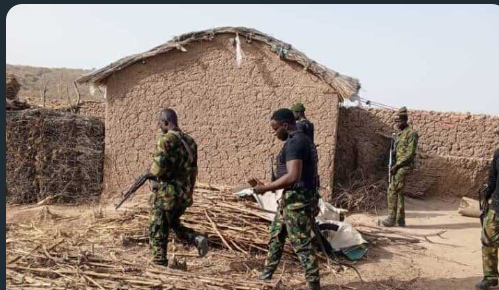
Troops of the Joint Task Force (North East), Operation Hadin Kai (OPHK), have eliminated 12 ISWAP and Boko Haram fighters during a failed attack on a military position in the Kirawa axis of Sector 1 OPHK Area of Responsibility in the early hours of May 22, 2026.

The operation was carried out under Operation Desert Sanity and Siege Operations after suspected terrorists attempted to infiltrate positions occupied by troops of the 153 Task Force Battalion and other allied forces along the Nigeria-Cameroon border axis.

According to the Media Information Officer of Joint Task Force (North East) Operation Hadin Kai, Lieutenant Colonel Sani Uba, the attack was promptly detected and effectively repelled by troops and members of the Civilian Joint Task Force (CJTF), who responded with superior firepower and maintained control of their positions throughout the encounter.

The terrorists were subsequently forced to abandon the mission and retreat towards the Cameroon axis after suffering heavy casualties during the gun battle.

Advertisement

“Intelligence, Surveillance, and Reconnaissance assets, as well as platforms of the Air Component of OPHK and partner forces, provided coordinated support during the operation.

“Following the engagement, troops confirmed the neutralisation of 12 terrorists, while several others reportedly escaped with gunshot wounds, as evidenced by blood trails along their withdrawal routes.

“Recovered items included AK-47 rifles, rocket-propelled grenade systems, ammunition, and a PKT machine gun, further weakening the operational capability of the insurgents in the area,” the statement said.

Troops of OPHK, working alongside the Civilian Joint Task Force, have continued exploitation operations to track fleeing terrorists and recover additional weapons and equipment, while maintaining heightened vigilance across the area.

Advertisement

The Joint Task Force reaffirmed its commitment to sustaining pressure on terrorist groups until they are completely neutralised across the theatre of operations.

The military high command also commended the troops for their gallantry, professionalism, and swift response, which it described as the third successful operation recorded within the week, urging them to sustain the operational momentum in the interest of national security.

Continue Reading

News

Africa needs $2.8 trillion by 2030 to meet climate goals — Report

Published

on

By

ADVERTISEMENT
Zoom Ad
ADVERTISEMENT
Zoom Ad

Africa will require an estimated $2.8 trillion between 2020 and 2030 to effectively tackle climate change and meet its commitments under the Paris Agreement.

A new report policy analysis by Harrison Rehoboth Consulting, states that the continent needs about $277 billion annually to fund climate adaptation and mitigation projects.

The investment is aimed at reducing the impact of floods, droughts, desertification, and other environmental challenges threatening livelihoods across the region.

Femi Sekoni, spokesperson for Harrison Rehoboth Consulting, said the funding is critical to strengthen infrastructure, protect vulnerable communities, improve food security, expand renewable energy, and support a transition to cleaner, more sustainable economies.

Advertisement

Despite the growing climate crisis, the report notes that Africa remains heavily dependent on foreign sources for climate financing. Domestic investors contribute only a small portion of available funds.

Local institutions including banks, pension funds, insurance firms, and private investors account for roughly 10% of climate finance flowing into the continent. International organisations and development partners provide the larger share.

Uneven distribution and structural barriers

Climate financing across Africa remains unevenly distributed. Countries with stronger financial systems and investment structures—South Africa, Egypt, Nigeria, Morocco, and Kenya—attract a significant percentage of available funding.

Advertisement

Many other African countries facing severe climate threats struggle to attract large-scale investment.

The report cites weak institutions, limited project preparation capacity, policy uncertainties, and concerns over investment risk as key barriers.

The analysis also raises concerns about the structure of climate financing available to African countries.

A large portion comes in the form of loans rather than grants or concessional financing, which could worsen debt burdens for nations already facing rising debt-servicing obligations and economic pressure.

Advertisement

Climate adaptation projects such as flood control systems, drought resilience programmes, and coastal protection infrastructure often provide social and environmental benefits but generate little direct revenue.

This makes loan repayment difficult for governments.

The report notes that rising debt levels have fueled global discussions around climate justice and the need for wealthier nations to provide more grant-based support to vulnerable countries facing the harsh effects of climate change.

The report acknowledges efforts by institutions such as the African Development Bank and some African countries, including Rwanda, Kenya, Senegal, Egypt, and South Africa, to expand climate investment initiatives and develop financing frameworks capable of attracting private investors.

Advertisement

However, Harrison Rehoboth Consulting stresses that Africa’s climate finance gap cannot be closed through international promises alone.

It calls for stronger domestic financial systems, improved governance, better project planning, and reforms in global financial institutions to make climate funding more accessible.

Key recommendations include: increasing concessional financing and grants for adaptation projects; improving collaboration between governments and private investors; strengthening policies that encourage long-term investment in climate and infrastructure projects; and building domestic financial capacity to reduce over-reliance on external funding.

The report concludes that closing Africa’s climate finance gap will require coordinated action at national, regional, and global levels to ensure funding reaches the countries and communities most exposed to climate risk.

Advertisement
Continue Reading

Trending

Copyright © 2024 Naija Blitz News