Connect with us

News

Just in: Nigerian students ordered to leave UK following cash crunch

Published

on

ADVERTISEMENT
Zoom Ad
ADVERTISEMENT
Zoom Ad

By Kayode Sanni-Arewa

Nigerian students have been thrown off university courses and ordered to leave the UK after a currency crisis left them struggling to pay tuition fees on time.

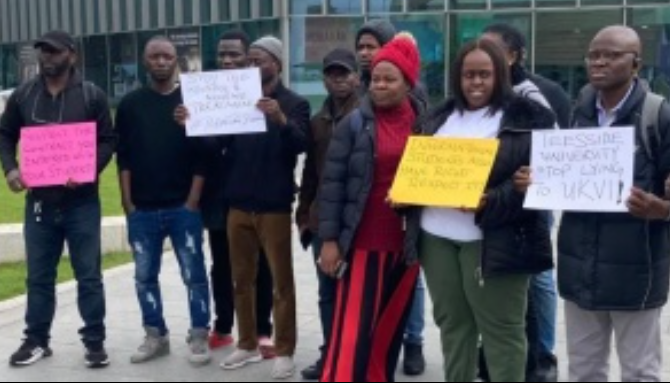
Teesside University students were blocked from their studies and reported to the Home Office after the value of Nigeria’s naira plummeted, wiping out their savings.

Some told the BBC they felt suicidal as they accused the university of taking a “heartless” approach to those who fell into arrears as a consequence.

Advertisement

A university spokesman said failure to pay was a breach of visa sponsorship requirements, and that it had “no choice” but to alert the Home Office. The Home Office said visa sponsorship decisions rested with the institution.

Nigeria is currently experiencing its worst economic crisis in a generation, which is having a significant impact on Nigerian students at some UK universities.

Average inflation is almost 34%, and the situation deteriorated when the country’s president attempted to replace old currency with new.

The currency subsequently depreciated by over 100% against the dollar in a year.

Advertisement

Before beginning their studies at Teesside, affected students were told they had to show proof of having enough funds to pay tuition fees and living expenses.

However, those funds were significantly depleted as a result of the crisis in their home country.

This exacerbated financial problems already being experienced by students as a result of the university changing tuition fee payment plans from seven instalments to three.

A group of students, 60 of whom shared their names with the BBC, began pressing the university for support after a number of people who defaulted on payments were frozen out of university accounts and involuntarily withdrawn from their courses.

Advertisement

Some were reportedly also contacted by debt collection agencies contracted by the university.

Adenike Ibrahim was close to handing in her dissertation at the end of two years of study when she missed one payment and was then kicked off her course and reported to the Home Office.

She subsequently paid the outstanding fees, but said she had not been re-enrolled and was told she must leave the country, along with her young son.

“I did default [on payments], but I’d already paid 90% of my tuition fees and I went to all of my classes,” she said.

Advertisement

“I called them and asked to reach an agreement, but they do not care what happens to their students.”

She said the experience was “horrendous” and she did not know what was happening with her qualification.

“It has been heartbreaking for my son especially, he has been in so much distress since I told him,” Ms Ibrahim added.

No right of appeal

Advertisement

The Home Office told students, including Ms Ibrahim, that their permission to enter the UK had been cancelled because they stopped studying at the university.

The letters, seen by the BBC, offer a date by which the student must leave the country and say they do not have a “right of appeal or administrative review against the decision”.

Since receiving his letter, one masters degree student – who did not want to be named – said he had seriously considered suicide and was not eating or drinking.

The university said it had made “every effort” to support affected students, who had now been offered individual meetings with specialist staff and bespoke payment plans where requested.

Advertisement

Esther Obigwe said she repeatedly tried to speak to the university about her financial struggles but received no response, until she too was blocked from her studies and received notice to leave the country.

“I attended all of my classes and seminars, I’m a hell of an active student,” she said.

“It is disheartening, I am now on antidepressants and being here alone, I have nobody to talk to.

“For over two months, I’ve barely eaten or slept and I don’t understand why this is being meted at us, we didn’t do anything wrong.”

Advertisement

She added that most of the students had “spent a lot of money to be here”.

Jude Salubi, who was studying to be a social worker, was midway through a placement when he was told his access to the university was suspended and he would have to leave the country.

Prior to that, he travelled from Teesside to Liverpool each weekend to work 18 hours in an attempt to pay off the outstanding fees.

“As of now I have paid £14,000 and have a balance of £14,000,” he said.

Advertisement

“I am willing to come to an agreement as to how I will make this payment, but I need guarantees that I will be re enrolled into school and my visa restored.”

Some affected students have managed to pay off outstanding fees, but the university is now unable to intervene in the Home Office process, the BBC understands.

A university spokesman said: “Teesside University is proud to be a global institution with a diverse student population but is also very aware of its obligations regarding visa issuance and compliance.

“These strict external regulations ensure that the university fully supports a robust immigration system and is outside of the university’s control.”

Advertisement

The spokesman added it was “aware of the challenging financial situation faced by some students” and had “actively offered bespoke payment plans where requested”. 

“This option has been taken up by many of our international students; however, some students have still defaulted on these revised payment plans,” he said.

The Home Office said a decision to offer or withdraw visa sponsorship rested with the sponsoring institution.

A spokesman said wherever a visa was shortened or cancelled, individuals should “take steps to regularise their stay or make arrangements to leave the UK”. (BBC)
Advertisement
Continue Reading
Advertisement
Click to comment

Warning: Undefined variable $user_ID in /home/naijuinz/public_html/wp-content/themes/zox-news/comments.php on line 49

You must be logged in to post a comment Login

Leave a Reply

News

Osun Poll: APC Heading for Crushing Defeat, Imole Campaign Council Fires Back at National Chairman

Published

on

ADVERTISEMENT
Zoom Ad
ADVERTISEMENT
Zoom Ad

By Gloria Ikibah

The Imole Campaign Council (TICC) has dismissed claims by the National Chairman of the All Progressives Congress (APC), Prof. Nentawe Yilwatda, that the party’s array of governors, National Assembly members and other political heavyweights would guarantee victory in the August 15, 2026 Osun State governorship election.

Reacting to remarks likening the APC’s political strength to a trailer against a “Keke Napep”, the council described the analogy as a display of political arrogance and evidence that the ruling party had misread the mood of Osun voters.

In a statement signed by the Chairman of its Media and Publicity Committee, Rep. Bamidele Salam, the council argued that elections are determined by the electorate rather than by the number of influential politicians a party can mobilise.

Advertisement

According to the statement, “The people of Osun State are not waiting for political heavyweights from outside the state to decide their future, the electorate are capable of making their own independent choice based on the performance of the government in power.

“The APC National Chairman may have assembled what he calls a political trailer, but he should understand that the people of Osun State are not political cargo to be moved around by outsiders. They are the owners of the mandate, and they alone will determine who governs them.”

The council maintained that the forthcoming governorship election would be decided by the performance of the incumbent administration rather than political rhetoric.

“The August 15 election will not be a contest between a trailer and a Keke Napep. It will be a contest between a performing Governor who has earned the confidence of his people and an APC candidate who is struggling to gain acceptance among the electorate.

Advertisement

“The reality on the ground is that Governor Ademola Adeleke enjoys tremendous goodwill among the people of Osun State because of the visible achievements of his administration. His record in road infrastructure, healthcare, education, workers’ welfare, water supply, agriculture, youth empowerment and other critical sectors speaks directly to the people”, he said.

The campaign council also questioned the popularity of the APC governorship candidate, Munirudeen Bola Oyebamiji, arguing that the party’s dependence on external political figures reflected an inability to build grassroots support within the state.

The council further challenged the APC to focus on presenting policies and programmes instead of relying on political symbolism.

“The APC governorship candidate, Munirudeen Bola Oyebamiji is obviously weak and unpopular, the decision of the APC to rely heavily on political figures from outside Osun is an indication of its candidate’s inability to independently mobilise the people.

Advertisement

“Rather than boasting about the number of governors and National Assembly members being deployed to Osun, the APC should tell the people what its candidate has to offer. The people are interested in issues, performance and credible leadership, not political metaphors”, he said.

The Imole Campaign Council urged the opposition party to respect the intelligence of Osun voters by running an issue-based campaign and offering what it described as credible alternatives ahead of the governorship election.

Continue Reading

News

ECOWAS Seeks Sanctions for Member States Ignoring MSME Policies

Published

on

ADVERTISEMENT
Zoom Ad
ADVERTISEMENT
Zoom Ad

By Gloria Ikibah

The ECOWAS Commission has called for tougher measures against member states that fail to implement agreed policies designed to support the growth of Micro, Small and Medium-sized Enterprises (MSMEs), warning that the region’s economic ambitions will remain out of reach without effective implementation.

The position was presented on Monday during the ongoing delocalised meeting of the ECOWAS Parliament’s Joint Committee on Industry and Private Sector, Macroeconomic Policy and Economic Research, Administration, Finance and Budget, and Public Accounts in Cotonou, Republic of Benin.

Speaking during a presentation on “Trade Facilitation, Regulatory Reforms and Formalisation,” Dr Tony Luka Elumelu of the ECOWAS Business Council Secretariat argued that the region already has sufficient policies, protocols and legal instruments to drive private sector growth, stressing that the real challenge lies in implementation rather than policy formulation.

Advertisement

He urged member states to shift their attention from producing new frameworks to creating a business-friendly environment that allows enterprises to flourish.

According to him, “We have very good policies, protocols, legal instruments in terms of the private sector development. We also have the MSME Charter. We have created an enabling environment in this particular document for development and growth of the MSMEs but, in summary, my recommendation is that we should implement what we adopt.

“We should make sure that we create an enabling environment for these businesses to thrive and not keep adopting policies. What we need to do is enforce those policies that we have adopted and remove every bottleneck that impedes MSMEs from thriving.”

Elumelu noted that West Africa must become more competitive, especially as the African Continental Free Trade Area (AfCFTA) opens new opportunities across the continent.

Advertisement

He said governments should prioritise investments in transport infrastructure and eliminate unnecessary barriers that continue to frustrate legitimate businesses operating across borders.

He also identified the proliferation of roadblocks and multiple checkpoints across the region as major obstacles to trade and economic integration.

“We need to make sure that we have the necessary infrastructure that our goods will use in terms of moving from one country to another. We also need to look at the vision that we have signed under the AfCFTA protocol.

“In fact, we already know that we are going to compete with other regions, which means that we need to make sure that we do not disturb our people who are trading legitimately, so that at the end, our region will benefit from the economic development and the benefits inherent in the AfCFTA trade.

Advertisement

“The multiple checkpoints, roadblocks, and also the practicality of what we are doing in the region… every legal instrument will always pass through the ECOWAS Parliament before adoption, which means that there should be strategy to put in timelines in terms of implementation. There should also be strategy to be conscious about implementation”, said.

Also speaking, the Principal Programme Officer in charge of Enterprise and Business Promotion at the ECOWAS Commission, Dr Olalekan Afolabi, stressed the importance of moving more businesses from the informal economy into the formal sector.

He said many enterprises across the region remain unregistered, limiting their ability to access finance, markets and government support, and urged parliamentarians to champion policies that encourage formalisation.

Afolabi also called for the effective implementation of the European Union-funded African Trade Competitiveness and Market Access Programme, valued at €50 million.

Advertisement

“How do we implement the African Trade Competitive and Market Access Program of the European Union, which is a 50 million euro project? Some of the responses we give to them include: one, going at the national level and seeing that these policies are properly domesticated. These policies are legislated at the national level and also coming to hold us accountable at the regional level, because we need to report periodically to the Parliamentarians.

“They need to monitor the implementation of some of those projects and this forum, of course, presents an opportunity for things like this”, he noted.

Discussions at the meeting centred on the need for stronger political commitment to implementing existing ECOWAS policies, with participants maintaining that sustained reforms, improved infrastructure and the removal of trade barriers are essential if MSMEs are to become key drivers of economic growth, regional integration and job creation across West Africa.

Advertisement
Continue Reading

News

Just in: Dangote gives ₦18.7 trn of his ₦56.2trn wealth to help the needy

Published

on

ADVERTISEMENT
Zoom Ad
ADVERTISEMENT
Zoom Ad


Africa’s richest man, Aliko Dangote, plans to donate one-third of his wealth to charity as part of his succession plan, his daughter, Halima Dangote, has revealed.

Halima, a trustee of the Aliko Dangote Foundation, revealed the arrangement in an interview with Bloomberg published on Tuesday, saying the billionaire had secured his family’s support to dedicate 33 per cent of his estate to philanthropy.


Advertisement

According to the Bloomberg Billionaires Index, Dangote’s net worth is estimated at $35.1 billion, meaning one-third of his current fortune would amount to about $11.7 billion if maintained at that level.


Explaining the decision, Halima said her father considers philanthropy central to his legacy and has embedded it into the family’s long-term succession plans.

“He sort of put all the structure in place whereby we focus a lot on health and education. He actually donated 25 per cent to the foundation. If you look at it, it is what we call in Sharia Code in Islam; it means he has donated 33 per cent of his whole inheritance to his foundation,” she said.

Advertisement

“That is how important it is to him because philanthropy needs to be in existence generation after generation.


“So giving back is part and parcel of what we do. We believe we’re here, that our business is successful because of the giving back and because of the philanthropic aspect. That is why the 33 per cent is important.

Advertisement
Continue Reading

Trending

Copyright © 2024 Naija Blitz News