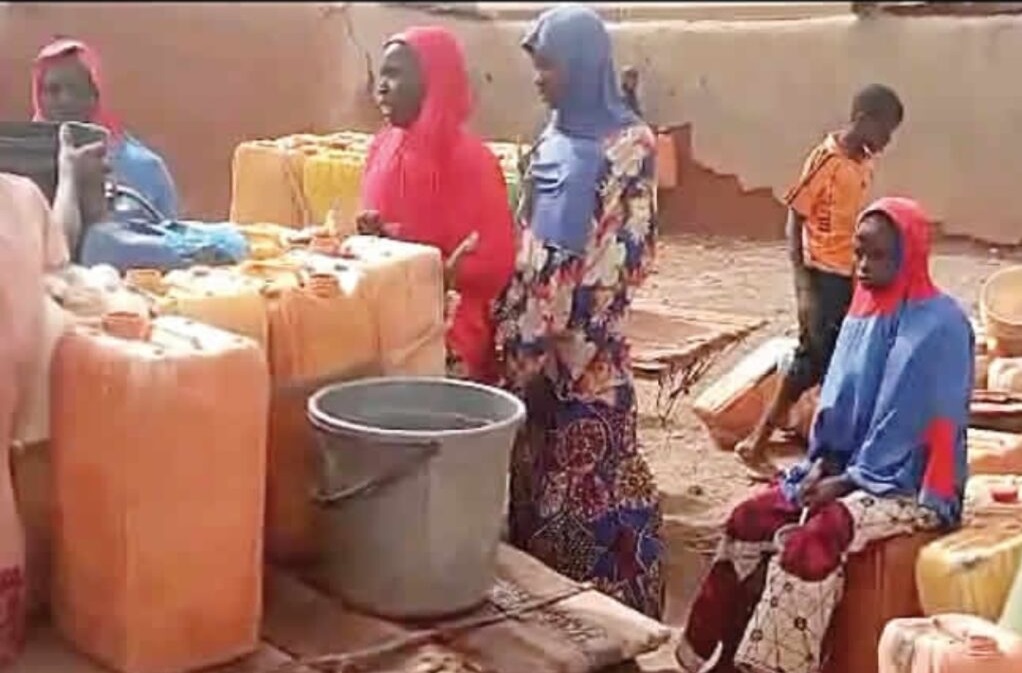
Abdullateef Fowewe writes on the harsh day-to-day life of residents living in Rafinduma and other communities in the Gada Local Government Area of Sokoto State where water scarcity forces them to travel for over seven hours on donkeys to scoop from wells in the Niger Republic:


For Abubakar Garba in Rafinduma village, Sokoto State, the day begins as early as 4:30 am.
At such wee hours, he feels the weight of the time, knowing that he is already behind schedule for his family’s daily routine. 
As devout Muslims, they must pray before setting out to fetch water from the Niger Republic, which is over six kilometres from Rafinduma, a routine dictated by the water scarcity plaguing the village.
Rafinduma is a village located in Kadadi, in the Gada Local Government Area of the state. A community of over 17,000 residents, it relies heavily on its neighbouring country, Niger Republic, for access to water.
This dependence not only highlights the acute water shortage but also underscores the absence of other essential social amenities. The villagers also lament the lack of electricity and other basic infrastructure, expressing their frustration at the dearth of development in their community.
Despite their reputation in agriculture, the villagers’ farming activities have been severely hampered by the unrelenting water scarcity.
Each year, they are forced to contend with this challenge, hindering their ability to fully engage in their livelihoods.
The plight of the Rafinduma community serves as a poignant reminder of the urgent need for sustainable solutions to address water scarcity and improve living conditions in the rural community.
Sharing the profound challenges the community faces due to water scarcity and the absence of electricity with our correspondent with a weakened voice, Garba said, “For over two decades, our village has been devoid of any accessible water source – no wells, no boreholes, not even a river to fetch water – we must trek to a neighbouring village in the Niger Republic, enduring a grueling journey just to meet up with our basic needs.
“The lack of water has had a profound impact on our daily lives. Basic hygiene practices like bathing and washing clothes become luxuries, and even drinking water is scarce for us.
Many people in the community, unable to cope with the distance between their homes and the water source, have been forced to relocate to the neighbouring country in search of more hospitable living conditions, leaving behind a dwindling population that clings to hope for a better future for our village, he said.
Despite the hardships, Garba and others like him remain resilient, holding onto the belief that one day, their community will receive the support it needs to thrive.
However, their story is a poignant reminder of the challenges faced by many rural communities around the world, where access to necessities is not a guarantee but a daily struggle – a culture.
Struggle for survival
Garba, the 56-year-old father of six told Saturday PUNCH that the current was hindering the community from harnessing its potential and leveraging its geographical size to contribute significantly to Nigeria’s economy through agricultural production.
“The daily struggle for water forces our children to undertake arduous journeys to the Niger Republic, over six kilometres away from Our community, just to quench our thirst. Despite the hardships, the residents remain steadfast in our commitment to the village’s development but the fear is that abandoning our community would leave it vulnerable to becoming a ghost town or a potential hideout for bandits and kidnappers.
“So, our determination to stay is rooted in the peaceful nature of our community. Unlike other areas plagued by insecurity, Rafinduma has remained safe, free from the incursion of herdsmen or other threats. However, our urgent need for water remains unaddressed,” he stressed.
Education, healthcare hindered
Saturday PUNCH gathered that the water scarcity has also taken a toll on children in the village, extending beyond physical discomfort to educational setbacks. With the daily struggle for water consuming their mornings, many children, including seven-year-old girls, are forced to forgo formal education in search of water.
Garba said, “This routine sees our children leaving the village as early as 5 am, returning only by 3 pm; the period has made them miss out on valuable learning opportunities.”
Also, a teacher in the area, Suleiman Mindaudu, expressed sadness that the education in the community had declined significantly.
Mindaudu said, “The struggle for water has directly affected the pupil’s academic performance, with many unable to attend school regularly. Pupils often return late from fetching water, missing valuable learning time.
“This situation has made it challenging to enforce discipline, as punishing pupils for lateness seems unjust when everyone is grappling with the same water scarcity issue. Many of them, despite managing to attend school, struggle with basic reading and writing skills due to the constant worry about water.”
With dry wells, some reaching depths of over 100 metres, in the community, he said many villagers resort to the use of paper as a substitute for water for cleansing after using the toilet. This is worsened by the absence of clinics or pharmaceutical stores.
“This compromise on hygiene is particularly challenging for us as Muslims because cleanliness is a crucial aspect of our religious practices. Also, the absence of medical facilities worsens our plight.
“Without a single pharmacy or clinic in our village, childbirth occurs at home, often resulting in tragic outcomes. The nearest medical help is over 14 kilometres away, a journey made even more challenging by poor roads. As a result, many illnesses are treated with herbal medicine,” Garba added.
Govt neglect, unanswered pleas
Our correspondent learnt that the unfulfilled promises of politicians are an added burden to the community.
A resident who did not want to be named said, “During election campaigns, politicians often visit Rafinduma, pledging support and assistance. However, once in power, the promises are forgotten, leaving the community to fend for themselves.
“Despite numerous letters written to the local government, seeking help and support, we have not received any feedback or assistance.”
However, despite the efforts of the community chairman, it has faced disappointment in attempts to secure assistance from the local government.
Now, children born within the 20 years that the water scarcity has persisted have lived a life of struggle for one of nature’s gifts for survival.
Long wait for electricity
For the residents of Rafinduma, the promise of electricity has remained elusive. Since its inception, the villagers have been left to navigate their lives in darkness, with no relief in sight, another resident, Alhaji Saidu Zakari, told Saturday PUNCH.
“The hope sparked by the installation of transformer pillars during former President Olusegun Obasanjo’s administration was short-lived as the project was never completed. Despite the initial efforts to bring electricity to the community, the transformers lie dormant like relics serving no other purpose than a reminder of unfulfilled promises,” he added.
Like Zakari, Abubakar Abdullah, speaking with our correspondent, expressed a profound sense of resignation as he detailed the daily struggles he and his family endure to secure access to water.
“Lack of water in our rural area presents a multitude of challenges that permeate every aspect of our daily lives,” Abdullah lamented.
“Imagine waking up each day knowing that accessing clean water for basic needs like drinking, cooking, and bathing is a luxury rather than a given,” he added.
According to him, the burden shouldered by the women and children due to the challenges was unimaginable.
The father of six said he had earlier made the difficult decision of moving his children to Zamfara State to get formal education but had to bring them back to the village due to security concerns in the state (Zamfara).
“My children are left with limited options, spending their days fetching water and helping me with farm work,” he added.
Like Garba, the Chairman of the Rafinduma Development Association, Muhammad Badamasi, said one of the most pressing challenges resulting from this water crisis was the impact on education.
Badamasi said, “They (children) spend hours each day fetching water, leaving them exhausted and unable to focus on studying. As a result, the education level in the community has significantly declined, perpetuating the cycle of poverty and illiteracy.
“Despite living in a peaceful community free from insecurity issues, the residents face a daunting challenge, severe water scarcity. This scarcity has created a myriad of problems, making simple daily tasks like brushing one’s teeth and performing ablution a challenge. In desperate times, the community is forced to purchase water at high prices,” he added.
Speaking further, he said, “Women, in particular, are affected, often appearing unkempt due to the scarcity of water for personal grooming. Also, our children bear the brunt, often seen covered in mud due to the inability to bathe properly.
According to a farmer, Buda Nayusa, it usually takes seven hours to reach Kadadi, a nearby town, and 10 hours to reach the Niger Republic with the help of donkeys and cows.
Nayusa also explained that villagers fetch water from wells on the outskirts of the community, rather than entering people’s premises in the Niger Republic.
He said, “My village is situated near the border of Nigeria and the Niger Republic. Despite the border restrictions, we can travel comfortably to villages in the Niger Republic. However, the water supply in Kadadi is insufficient, leading to long queues. As a result, many of our people often make the journey to the Niger Republic despite the distance.”
In an interview with our correspondent, another farmer, Rabiu Yusuf, said the water crisis was exacerbating food shortages within the community.
“Without sufficient water for irrigation, our crops wither and die, leading to food shortages and economic losses. Sometimes, during the rainy season, if the rain stops for a week, it usually has effects on our crops,” Yusuf added.
“Moreover, the lack of clean water exposes us to a myriad of health risks,” Yusuf added.
Tragic tale of Amina
In a heart-wrenching account shared with our correspondent, one of the villagers, Adamu Adamu, recounted how a 10-year-old girl, Amina, whose family depended solely on her to fetch water, died of diarrhoea, a preventable disease exacerbated by the scarcity of clean water.
He explained that Amina’s daily routine involved embarking on a long, treacherous journey to the nearest water source, a contaminated pond in the Niger Republic that served as the community’s only lifeline.
Adamu said her family, already burdened by poverty, could only watch helplessly as their beloved daughter’s life slipped away.
“Despite her tender age, Amina bore this burden with unwavering resolve, understanding that water was not just a necessity but a symbol of survival. With no access to proper medical care in the community, her condition rapidly deteriorated.
“Amina’s story is not unique in our village, where countless lives including livestock are marred by the cruel consequences of water scarcity; It serves as a grim reminder of the harsh realities we face, where the simple act of accessing clean water can mean the difference between life and death,” he added.
Unmet SDG goal
Water scarcity affects more than 40 per cent of people, and with rising temperatures, the figure is projected to rise, according to the United Nations Development Programme. It disclosed that though 2.1 billion people had improved water sanitation since 1990, dwindling drinking water supplies were affecting every continent.
“More and more countries are experiencing water stress, and increasing drought and desertification are already worsening these trends. By 2050, it is projected that at least one in four people will suffer recurring water shortages,” the UNDP said under Sustainable Development Goal Six which centres on clean water and sanitation.
Meanwhile, in its Water, Sanitation, and Hygiene – National Outcome Routine Mapping (WASH-NORM) Survey 2018, the National Bureau of Statistics stated that 73.4 per cent of households in Nigeria utilised improved sources of drinking water.
It, however, said that of the six geopolitical zones, the North-West had the lowest percentage of households with improved sources of drinking water, with 62.8 per cent, compared to 87.0 per cent in the South-West Zone, 82.9 per cent in the South-East, and South-South’s 77.0 per cent.
However, it’s crucial to understand that just because an improved water source is available does not guarantee that the water is managed safely. Recent data shows that a significant number of Nigerians do not have access to safe drinking water, with estimates ranging from 110 million to 179 million people.
In Nigeria, according to NBS, there are a total of 2.04 million water facilities, with 70 per cent being self-supplied. One in five facilities are equipped for individuals with disabilities, and two-thirds are boreholes. Also, water production by public utilities is currently operational in only 28 states and the federal capital territory, leaving 8 states without this service.
However, the UNDP emphasised that safe and affordable drinking water for all by 2030 required investment in adequate infrastructure, provide sanitation facilities, and encourage hygiene.
However, Governor Ahmed Aliyu of Sokoto State presented a 2024 budget of over N270bn to the House of Assembly, allocating N9,243,892,234.54 to water resources.
Water scarcity mental health risk — Physician
In an interview with Saturday PUNCH, medical practitioner, Dr Idowu Osebi, noted that the effects of water scarcity extended beyond physical health.
“While nobody enjoys perfect physical health and social well-being, access to water is essential for survival. Without it, individuals risk contracting diseases like cholera, diarrhoea, dysentery, hepatitis A, typhoid, and polio, which can be life-threatening. Tragically, over 1,000 children under five years old die daily from diseases caused by contaminated water, poor sanitation, and unsafe hygiene practices, as their immune systems are unable to combat the pathogens in unsanitised water.
“Lack of access to clean water also heightens the risk of disease, emphasising the critical role of water in personal hygiene. Moreover, water scarcity can lead to mental health issues. When water sources are distant, collecting water consumes valuable time, often at the expense of education, particularly for girls, whose school enrollment, attendance, and performance suffer,” Olorun-Osebi, who is also the Managing Director of Olorun-Osebi Hospital Ilorin, Kwara State, said.
Furthermore, he emphasised that the absence of access to water could result in dehydration, a condition that could cause children to exhibit signs of premature aging beyond their chronological years, adding that for adults, dehydration might potentially contribute to mental instability.
“Pregnant women are also at risk, as dehydration can reduce amniotic fluid levels, impacting the baby’s development, increasing the likelihood of preterm labour, and affecting breast milk production. Additionally, dehydration can impair mental function in adults, highlighting the importance of staying hydrated, as the body and brain are predominantly composed of water.
“Ensuring adequate hydration is crucial, as cognitive function improves when brain cells receive sufficient hydration,” the physician added.
‘Govt will address water issue’
While responding to enquiries from our correspondent, the Sokoto State Commissioner for Information, Bello Danchadi, said Rafinduma would benefit from the state government’s effort to address water scarcity.
“I am confident that the state government will address this issue in due course. Given that this government is relatively new, it may take some time to address all the challenges and every challenge can’t be solved at once.
“However, I believe that every community will eventually benefit from the government’s actions. I intend to personally engage with the relevant commissioners to expedite action, particularly in resolving the water scarcity issue in Rafinduma, as I understand the hardships associated with living without access to water. Nevertheless, we urge the community to be patient with us, as this government is for everyone and its development will eventually come to their area too,” he said.
Credit: PUNCH