Connect with us

News

Minimum wage: We’re not fixated on a figure — NLC

Published

on

ADVERTISEMENT
Zoom Ad
ADVERTISEMENT
Zoom Ad

By Francesca Hangeior.

 

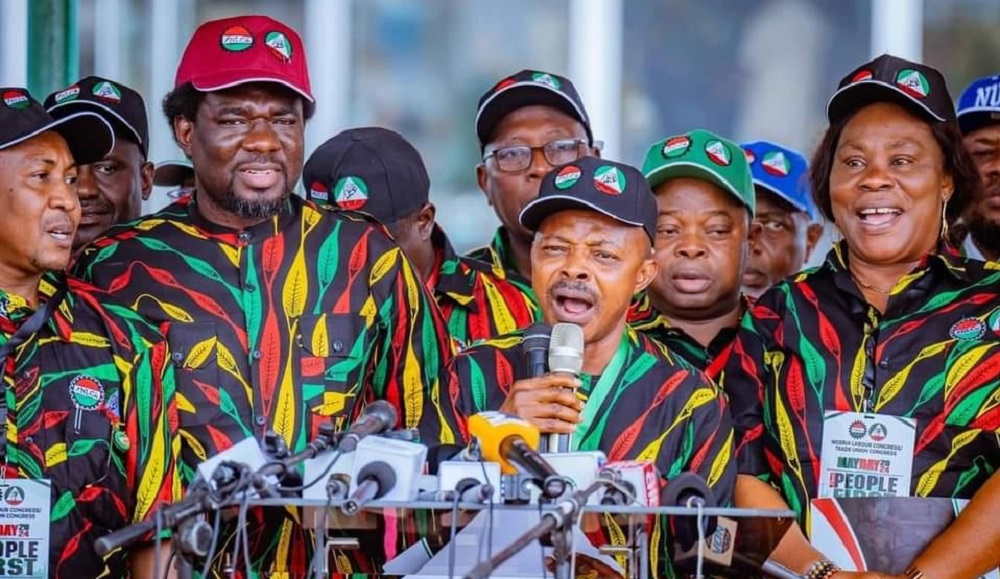
The Nigeria Labour Congress (NLC) said that it is not fixated on a figure as negotiations continue with the Federal Government over a new national minimum wage.

Recall that Organised Labour on Monday declared a strike ove a new minimum wage and the recent hike in electricity tariff for Band A customers.

Advertisement

Following the strike action, the federal government and organised labour reached an agreement on a new minimum wage that will be “above N60,000.”

The figure was disclosed by the government late Monday after a meeting with the Nigeria Labour Congress (NLC) and its counterpart, the Trade Union Congress (TUC), at the Office of the Secretary to the Government of the Federation (OSGF).

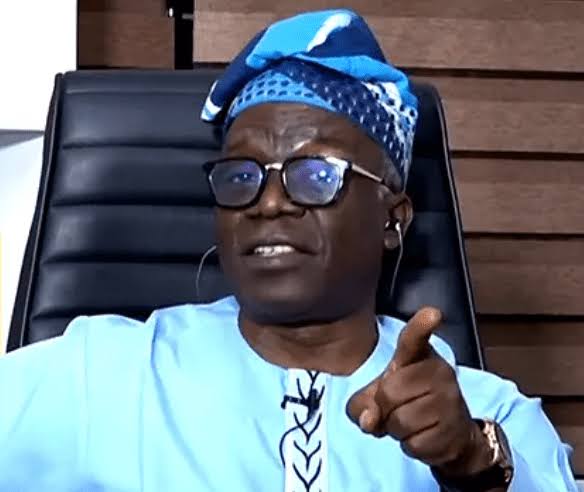
Speaking during an appearance on Arise TV on Tuesday, Benson Upah, Head of Department of Information NLC, disclosed that Organised Labour is not fixated on a figure but would consider a fair and reasonable figure that can take a family of six home.

His words: “We are not fixated on any figure; our first offer was N615,000, but we climbed down, and we’re now on  N494,000. Let me be emphatic; our fixation is with value. If today the government takes the needed decisions to create value around the naira, we’ll be ready to take a figure that is realistic.

Advertisement

“In 1981, the national minimum wage was N125, equivalent to $188. If the government takes the requisite decision to create value around the naira, we’ll be ready to take a figure that is fair and square.”

Speaking further, he stated that President Bola Tinubu, since assuming office, has made decisions that have affected the country’s economy.

“The first is the ill-advised removal of fuel subsidy rather than dealing with the criminal content of the subsidy. The president admitted to the presence and existence of a cabal, and rather than deal with that, he instead chose to deal with Nigerians,” he said.

“The second one is the mindless devaluation of the naira, which took it from N350 to N1900 and it’s now hovering around N1600; the third is the tariff hike; and the fourth is the 26.5 per cent interest rate. When you look at this, it becomes highly toxic for business.”

Advertisement

The NLC spokesperson responded to comments made by Bayo Onanuga, Special Adviser to President Bola Tinubu on Information and Strategy, stating that the union has no political sentiment.

He said, “As we speak now, we’re the only reliable voice that can speak to power at the risk of our lives. We’ve been consistent from pre-independence to the military and democratic eras. This is not the first time we’ve taken on a government. Right from 1999, the presidency of Obasanjo; then Yar’adua; and Jonathan, but Onanuga didn’t see political sentiment.

“I want to assure you that we’ve no political sentiment. Our sentiments in this matter are pure, patriotic, and in the interest of this country,” he added.

Advertisement

News

Plateau in panic mode as nine members of same family 2 month old baby killed in renewed attack

Published

on

ADVERTISEMENT
Zoom Ad
ADVERTISEMENT
Zoom Ad


No fewer than nine members of the same family, including a two-month-old baby, were killed in a fresh attack by suspected gunmen on Kum and Wereng-Camp communities in Riyom Local Government Area of Plateau State late Saturday night.

The attack, according to residents, began at about 11:30 p.m. on Saturday and lasted for more than one hour, leaving the village head of the community critically injured after he was allegedly attacked by the assailants.

Advertisement

A resident, Precious Tok, told Vanguard that the victims were slaughtered in their home during the coordinated assault, describing the incident as one of the deadliest attacks witnessed in the area in recent times.

He said the gunmen invaded the communities in large numbers, shooting indiscriminately and forcing terrified residents to flee into nearby bushes for safety.

The National Publicity Secretary of the Berom Youth Moulders Association, Rwang Tengwong, who confirmed the attack, said the assailants struck under the cover of darkness and unleashed violence on helpless residents.

According to him, the attack wiped out nine members of one family, including a two-month-old infant, while the village head sustained life-threatening injuries and was rushed to hospital for treatment.

Advertisement

He added that security agencies had been alerted and expressed hope that the perpetrators would be apprehended and brought to justice.

The latest attack has thrown the affected communities into mourning, with residents urging the Federal and Plateau State governments to strengthen security across Riyom and other vulnerable communities to halt the recurring attacks.

As of the time of filing this report, security personnel had reportedly been deployed to the affected communities, while many residents remained displaced and fearful of further attacks.

Efforts to obtain official confirmation from the Plateau State Police Command were unsuccessful. (Sunday Vanguard)

Advertisement
Continue Reading

News

Atiku Condemns Proposed N50,000 WAEC, NECO Examination Fees

Published

on

By

ADVERTISEMENT
Zoom Ad
ADVERTISEMENT
Zoom Ad

Former Vice President Atiku Abubakar has criticised the Federal Government’s decision to approve a uniform N50,000 registration fee for the Senior Secondary School Certificate Examinations (SSCE) conducted by the West African Examinations Council (WAEC) and the National Examinations Council (NECO), warning that the policy could further limit access to education for millions of Nigerian students.

The Federal Government, through the Federal Ministry of Education, approved the adoption of a uniform N50,000 registration fee for WAEC and NECO SSCE internal examinations, effective from 2027.

Under the new arrangement, NECO’s registration fee will increase from N30,000 to N50,000 per candidate, while WAEC’s fee will rise from N27,000 to the same amount.

The approval was contained in a memo dated June 18, 2026, signed by the Director of Senior Secondary Education at the Federal Ministry of Education, Adeniji Ibrahim, on behalf of the Minister of Education. The memo, addressed to the Registrar of NECO, stated that the decision followed a meeting between the ministry and examination bodies held on March 31, 2026, where stakeholders agreed to adopt a harmonised fee structure.

Advertisement

Reacting in a statement issued by his Senior Special Assistant on Public Communication, Phrank Shaibu, Atiku described the planned increase as “cruel, economically insensitive and fundamentally incompatible” with the government’s obligation to make education accessible to every Nigerian child.

He argued that the policy comes at a time when many households are grappling with rising inflation, escalating food and transportation costs, higher electricity tariffs, unemployment and declining purchasing power.

“It is unconscionable that at a time when Nigerian families are battling record inflation, soaring food prices, rising transportation costs, crippling electricity tariffs, stagnant incomes and widespread unemployment, the Tinubu administration has chosen to make education even more expensive,” Atiku said.

The former vice president maintained that education remains one of the most important pathways to social mobility, warning that higher examination fees could force more children out of school and deny qualified students the opportunity to pursue higher education.

Advertisement

“Every additional financial burden imposed on parents translates into another child being denied the opportunity to learn, dream and contribute meaningfully to society,” he said.

He noted that Nigeria already has one of the world’s largest populations of out-of-school children and argued that government efforts should be focused on reducing educational barriers rather than introducing policies that could worsen the situation.

“Nigeria already bears the painful distinction of having one of the largest populations of out-of-school children in the world. Any government confronted with such a national emergency should be investing aggressively to bring these children back into school,” he added.

Atiku further warned that the increase in WAEC and NECO fees, alongside the recent hike in fees for Federal Unity Colleges, would disproportionately affect low- and middle-income families already struggling to meet basic needs.

Advertisement

According to him, many academically qualified students may be unable to sit for the qualifying examinations required for admission into tertiary institutions due to financial constraints.

“The recent increase in WAEC and NECO examination fees represents far more than another financial burden on parents. It is a systemic filter that will inevitably restrict access to tertiary education for thousands of indigent but academically qualified Nigerian students,” he stated.

He also criticised the Federal Government’s reliance on the Nigerian Education Loan Fund (NELFUND), arguing that student loans cannot solve the challenges facing children who are unable to complete secondary education or afford examination fees.

“A university loan offers little comfort to a child who has already been priced out of secondary education or cannot afford the qualifying examination required to secure admission,” he said.

Advertisement

Atiku called on the Federal Government to prioritise investment in educational infrastructure, recruit more qualified teachers, expand the capacity of public tertiary institutions and implement policies that ensure poverty does not determine a child’s access to education.

He urged President Bola Tinubu’s administration to immediately reverse the increase in Unity School fees and the proposed N50,000 WAEC and NECO examination fees, while convening stakeholders to develop sustainable funding mechanisms for public education.

Continue Reading

News

SERAP sues INEC over alleged N800bn APC govs campaign fund

Published

on

By

ADVERTISEMENT
Zoom Ad
ADVERTISEMENT
Zoom Ad

The Socio-Economic Rights and Accountability Project has sued the Independent National Electoral Commission over alleged failure to investigate claims that governors elected on the platform of the All Progressives Congress diverted N800bn for political and campaign activities.

SERAP, in the suit filed before the Federal High Court in Abuja, is asking the court to compel INEC to probe allegations that APC governors have been making monthly contributions from their Federation Account Allocation Committee allocations into a dedicated fund for President Bola Tinubu’s 2027 re-election campaign.

The suit, marked FHC/ABJ/CS/1426/2026, was filed by SERAP’s lawyers, Kolawole Oluwadare and Kehinde Oyewumi.

The organisation is seeking an order of mandamus directing INEC to demand full disclosure from the governors and the APC on the alleged campaign fund, including the identities of contributors and the sources of the funds.

Advertisement

SERAP is also asking the court to compel the electoral body to investigate whether political parties and candidates are complying with the provisions of Section 91 of the Electoral Act on campaign finance limits and transparency.

According to SERAP, the allegations raised concerns about political finance accountability, electoral fairness and the ability of Nigerians to freely participate in the democratic process.

“Opaque political financing remains a major entry point for corruption and a threat to democratic legitimacy.

“Nigerians deserve to know who funds the candidates or political parties of their choice and the sources of any such funding,” SERAP said.

Advertisement

The organisation argued that the alleged use of public resources for political advantage could undermine confidence in Nigeria’s electoral system.

“The abuse of state resources for electoral advantage undermines democratic integrity and public trust. Fairness, transparency, and accountability in political or campaign finance are essential safeguards against corruption, state capture, and undue influence in democratic processes,” it stated.

SERAP maintained that INEC has a constitutional responsibility to monitor political financing and ensure that parties and candidates comply with campaign finance regulations.

“The commission has constitutional and statutory obligations to ensure that no individual or political party exceeds legally prescribed contribution limits, whether directly or indirectly, and to ensure full transparency regarding the origin and quantum of political funding,” the suit read.

Advertisement

The group said allegations involving large financial resources and possible misuse of public funds required urgent intervention by INEC to protect the credibility of the 2027 general elections.

“The allegations of diversion or opaque use of public funds pose a grave risk to the integrity of the 2027 general elections,” SERAP stated.

It argued that any deployment of public funds for political purposes could distort competition among candidates and political parties.

“Where public resources are allegedly diverted or deployed for political and campaign purposes, the result is not merely financial impropriety; it is a direct distortion of electoral competition,” the suit added.

Advertisement

SERAP also relied on provisions of the 1999 Constitution, the Electoral Act, the African Charter on Human and Peoples’ Rights, the International Covenant on Civil and Political Rights and the United Nations Convention Against Corruption.

SERAP argued that Section 14(2)(c) of the Constitution, which guarantees citizens’ participation in government, places an obligation on institutions to protect the integrity of the democratic process.

“The provision also imposes a binding obligation on all institutions, including INEC, to safeguard the integrity of the democratic process.

“Section 15(5) of the Nigerian Constitution requires public institutions to abolish all corrupt practices and abuse of power. Section 13 imposes a clear responsibility on INEC to conform to, observe and apply the provisions of Chapter 2 of the Constitution.

Advertisement

“Article 13 of the African Charter on Human and Peoples’ Rights guarantees every citizen the right to participate freely in government. Similarly, Article 25 of the International Covenant on Civil and Political Rights requires that elections reflect the free expression of the will of the electorate. Nigeria has ratified both treaties.

“Nigeria has made legally binding commitments under the UN Convention against Corruption to ensure accountability in the management of public resources. Articles 5 and 9 of the UN Convention against Corruption also impose legal obligations on the Commission to ensure proper management of public affairs and public funds.

“These commitments ought to be fully upheld and respected. Article 7(3) of the Convention requires institutions, including INEC, to ensure political finance transparency. The provisions aim to prevent corruption in and through elections,” the suit read.

It further stated that the alleged deployment of public resources for political purposes would not only amount to financial impropriety but could distort electoral competition.

Advertisement

“Where public resources are allegedly diverted or deployed for political and campaign purposes, the result is not merely financial impropriety; it is a direct distortion of electoral competition,” it added.

The group said any use of public funds for political advantage would constitute “a grave violation of national and international standards and a threat to electoral credibility.”

The organisation said these legal frameworks impose obligations on public institutions to promote transparency, accountability and fairness in electoral processes.

No date has been fixed for the hearing of the suit.

Advertisement
Continue Reading

Trending

Copyright © 2024 Naija Blitz News