Connect with us

News

Minimum Wage: Finance Minister, Edun Beats Deadline Submits Template To Tinubu Today

Published

on

ADVERTISEMENT
Zoom Ad
ADVERTISEMENT
Zoom Ad

By Kayode Sanni-Arewa

The Federal Government and Organised Labour on Wednesday adjourned the minimum wage talks till Thursday (today) when the negotiation is expected to continue.

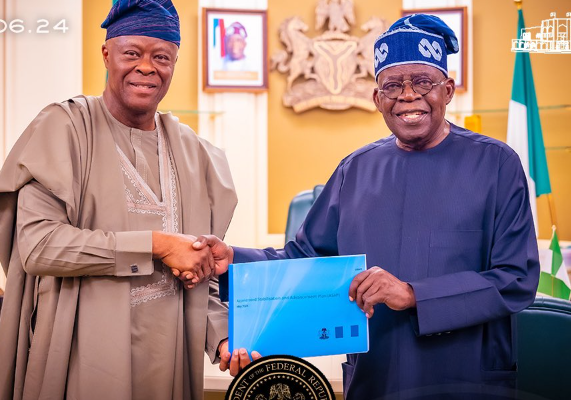
The Tripartite Committee on National Minimum Wage postponed the session in anticipation of the Minister of Finance, Wale Edun, submitting the salary template to President Bola Tinubu today.

Tinubu had on Tuesday directed the finance minister to present the cost implications for a new minimum wage within two days.

Advertisement

The President gave the order at a meeting with the government negotiation team led by the Secretary to the Government of the Federation, George Akume, at the presidential villa in Abuja.

Sources in the labour unions privy to the committee meeting said the parties decided to await the outcome of the presidential template before proceeding with further negotiations.

A source who attended the meeting said, “The meeting has been adjourned until Thursday. We showed understanding because we all know that the president gave the minister of finance 48 hours to come up with a minimum wage. So, we decided to give them the time. We will be meeting by 2 p.m.”

A top labour official who is a labour representative on the tripartite committee explained that the template was crucial to the minimum wage negotiation.

Advertisement

The source, who cannot be quoted because he was not authorised to disclose information to the media on the negotiation, expressed confidence that the talks would record good progress once the presidential template is presented to the parties.

The Minister of Information and National Orientation, Mohammed Idris, had hinted that the President wished to know the financial implications of the new minimum wage in 48 hours.

Briefing journalists on the presidential directive, the information minister said, “We were all there to look at all issues, and the President has directed the minister of finance to do the numbers and get back to him between today and tomorrow so that we can have figures ready for negotiation with labour.”

Idris assured of the president’s readiness to accept the committee’s resolutions, adding that “The president is determined to go with what the committee has said and he’s also looking at the welfare of Nigerians.

Advertisement

“Government is not against or opponent of labour discussions; the government is not an opponent of wage increase, but what is there is that government is always there to ensure a balance between what government pronouncement is and what the realities are on the ground.

“And therefore, we will work assiduously to ensure that whatever promises the government makes are promises that will be kept. That is the idea of this meeting.”

Furthermore, he said Tinubu directed the government representatives to work collectively with the organised private sector and the sub-nationals to achieve a new affordable wage award for Nigerians.

Idris explained, “The President has given a marching order that all those who have negotiated on behalf of the Federal Government and all those who are representatives of organised private sectors, the sub-nationals to come together to have a new wage that is affordable, sustainable and realistic for Nigerians.

Advertisement

“The wage is not just that of the Federal Government; as I mentioned earlier, the sub-nationals are involved, the organised private sector is involved; the Labour stepped out during that procedure. Now we have come back to the negotiation table.”

The minister assured that all hands would be on deck to present a new minimum wage for Nigerians in one week.

“All of us will work together assiduously within the next week to ensure that we have a new wage for Nigeria that is acceptable, sustainable and realistic,” Idris said.

Despite the intervention of the leadership of the National Assembly, labour embarked on a nationwide strike on Monday and Tuesday, crippling economic activities nationwide.

Advertisement

Banks, airports, public schools and courts were shut, forcing the Federal Government to convene an emergency meeting to find a way out of the impasse.

Following a meeting with the SGF, National Assembly leaders, and the National Security Adviser, Nuhu Ribadu, on Monday, the unions announced on Tuesday the suspension of industrial action for five days after President Tinubu agreed to pay a national minimum wage higher than N60,000. The tripartite committee pledged its readiness to convene daily until a new minimum wage is announced.

In an interview on Channels television, the President of the Trade Union Congress, Festus Osifo, said the unions would not insist on its N494,000 demand, indicating that the labour leaders were willing to accept a reasonable compromise.

Though the union leader refused to mention a specific amount, he said the new minimum wage must equal purchasing power to the value of N30,000 in 2019 and N18,000 in 2014.

Advertisement

Meanwhile, airlines lament the revenue loss incurred during the two-day strike declared by the labour unions.

The action forced airports to shut down, resulting in scores of cancelled flights and huge financial losses.

The Chief Operating Officer of United Nigeria Airlines, Osita Okonkwo, highlighted the severe impact of the strike on UNA’s operations.

He said, “For two days, we didn’t fly. Ours (revenue loss) runs into millions. We do about 24 flights every day, and for two days, we didn’t do 48 flights. I can tell you it runs into millions.

Advertisement

“Our passengers were continuously informed of the situation. Our call centre was busy 24/7. The fallout now is what do we do with passengers who want to continue with their businesses because they have lost two days and all want to travel tomorrow (today)?

“And then, we have passengers booked to travel tomorrow (today). We are trying to accommodate as many as we can. Where possible, we put in additional flights. But you know capacity, you can’t stress it too much. Most flights are full now because of what happened in the last two days. It is not like we are against the strike, but everybody is feeling the situation of the country.’’

Okonkwo canvassed that essential services should be exempted from strikes, lamenting the plight of stranded passengers.

“It is understandable what labour is doing. But essential services should be exempted from this type of strike. Hospitals, and air travel, because some people had connecting flights. Some were stranded in Asaba, and they were supposed to go to Europe,” he noted.

Advertisement

The Chief Operating Officer of Ibom Air, George Uriesi, also expressed concern over the financial losses recorded by the local airlines during the labour action.

“There was a massive loss of revenue. If you were going to take N100 of revenue a day, and you don’t fly at all, you will probably make N2 or N3. And then there’s more to it because we must accommodate all the people that didn’t fly. So, you may be unable to sell seats for a long time because you’re dealing with a backlog,” he explained.

The Assistant General Secretary of the Aviation Round Table, Olumide Ohunayo, emphasised the strike’s broader impact on the aviation industry.

“It’s not only the airlines. The aviation industry lost lots of money due to the strike. The airlines, airport terminals, concessionaires, taxi drivers, and others. In fact, the entire ecosystem lost millions of naira, even the charter flights.

Advertisement

“Some flights were cancelled. People are now forced to reschedule flights and see if they can get seats on a future date. And in getting those seats, ticket prices have jumped due to the rush to get seats.” he stated.

Pointing out the long-term economic effects on the aviation sector, the Chief Executive Officer of Centurion Security Limited, John Ojikutu, said, “The domestic airlines will lose some money, and that will affect the economy. The kind of money I’m talking about is not coming from local airlines because they contribute virtually nothing. If you compare the money they make from ticket sales to the money we make from foreign airlines, that is where the problem is.

“In the next two, three days, they would have cleared all those passengers, and we would now go back to our normal aviation problems, which are fuel and ticket fares,” he said.

Speaking on the long-drawn minimum wage negotiation, Debo Adeniran, the Executive Director of the Centre for Anti-Corruption and Open Leadership, urged the Federal Government and labour unions to finalise their talks quickly.

Advertisement

“The FG and the labour unions should not waste any more time beyond the 48 hours given to the finance minister. Everything is already concluded; they need to harmonise their positions based on their capacities to raise resources,” Adeniran stated.

Stressing the need for swift negotiations, he noted, “Labour unions and the FG should be realistic, which should not take an eternity to conclude. They should aim to finalise everything by the end of tomorrow (today).”

Adeniran also cautioned the labour unions against rushing to embark on strikes.

On his part, the Executive Director of the Civil Society Legislative Advocacy Centre, Auwal Rafsanjani, admonished the government to be honest and realistic during the negotiation.

Advertisement

“The Federal Government needs to be honest and realistic. They should be able to restore dignity in labour. Once the FG is realistic in presenting a minimum wage to Nigerians, there would not be any delay in the meeting with labour unions,” he concluded.

Continue Reading
Advertisement
Click to comment

Warning: Undefined variable $user_ID in /home/naijuinz/public_html/wp-content/themes/zox-news/comments.php on line 49

You must be logged in to post a comment Login

Leave a Reply

News

Osun DECIDES:INEC starts distribution of reprinted ballot papers to party agents in 30 LGAs

Published

on

ADVERTISEMENT
Zoom Ad
ADVERTISEMENT
Zoom Ad


The Independent National Electoral Commission (INEC) on Thursday began the distribution of reprinted ballot papers and result sheets to agents of all participating political parties across the 30 Local Government Areas (LGAs) of Osun State ahead of Saturday’s governorship election.

The exercise commenced at the Commission’s state office in Osogbo on Thursday night, following INEC’s compliance with a Federal High Court judgment ordering the inclusion of the Social Democratic Party (SDP) governorship candidate, Dr. Francis Olugbenga Ajala, and his running mate, Faseke Babajimi Oladipo, in the election.

The Federal High Court, Abuja, had on July 22, 2026, delivered judgment in Suit No. FHC/ABJ/CS/344/2026, directing INEC to recognise, accept, upload, process and publish Ajala’s candidature for the August 15 governorship election.

Advertisement

INEC complied with the judgment on Wednesday, August 12, 2026, leading to the reproduction of the ballot papers and relevant result sheets to reflect the inclusion of the SDP candidates.

The reprinted materials were subsequently moved to the Osun State INEC office in Osogbo, where agents of the participating political parties gathered on Thursday night to witness the distribution process.

Addressing journalists at the venue, the Osun State Resident Electoral Commissioner, Mrs. Oluwatoyin O. Babalola, explained that the exercise would commence with the signing of the result sheets by the party agents before the distribution of the materials to the respective Local Government Areas.

Babalola said the materials had already been customised according to the polling units for which they were intended, with the names of the polling units clearly indicated on the documents.

Advertisement

“Everything is going to be customised. Believe it. All the results, they already have the name of the polling units on them,” the REC told journalists.

She explained that the customisation was intended to ensure that the materials could be properly identified and matched with their designated polling units during the electoral process.

According to her, the signing by party agents was an important part of the documentation process preceding the distribution of the materials.

“If you are signing, you see what happened,” she said, while explaining the procedure to the agents and journalists at the venue.

Advertisement

The REC also indicated that the materials had been prepared in a manner that would allow the Commission and the political parties to keep track of the documents allocated to the various areas.

The exercise was not, however, a distribution of the materials directly to polling units.

Rather, the reprinted ballot papers and result sheets were being distributed to agents of the participating political parties for the respective 30 Local Government Areas of Osun State.

The party agents were present at the INEC office to witness the process, beginning with the signing of the result sheets before the materials were handed over for the respective Local Government Areas.

Advertisement
Continue Reading

News

Osun election: INEC records 1.9million PVC collections

Published

on

ADVERTISEMENT
Zoom Ad
ADVERTISEMENT
Zoom Ad


The Independent National Electoral Commission (INEC) has disclosed that 1,906,390 Permanent Voter Cards (PVCs) have been collected ahead of Saturday’s governorship election in Osun State.

The figure represents 81.50 per cent of the 2,339,233 registered voters in the state, according to a statement issued on Thursday by INEC National Commissioner and Chairman of the Information and Voter Education Committee, Mohammed Haruna.

Haruna said the remaining 426,842 PVCs, representing 18.50 per cent of the registered voter population, had been securely deposited with the Central Bank of Nigeria (CBN), in line with the Commission’s established procedure.

Advertisement

INEC also disclosed that 6,101 voters whose PVCs were damaged, defaced or lost applied for replacement and subsequently printed downloadable copies of their voter cards.
The Commission said it had published a polling-unit-by-polling-unit breakdown of the collected PVCs on its official website.

INEC further assured political parties, civil society organisations, the media and residents of Osun State of its preparedness to conduct a free, fair, credible, transparent and inclusive election on Saturday, August 15, 2026.
Police deploy thousands for election security
Meanwhile, security agencies have intensified preparations for the governorship election, with the Nigeria Police Force deploying thousands of personnel across the state’s 30 local government areas.
Police sources and official statements indicate that at least four police officers will be deployed to each of the 3,673 polling units across the state.
The deployment, however, excludes personnel from other sister security agencies expected to participate in the election security operation.
With the election just hours away, political parties and candidates are making final preparations while voters await the outcome of what is expected to be a closely watched governorship contest.

Continue Reading

News

Uncovered: N24bn Ghost Workers’ Pension Remains Unclaimed Two Years After ICPC Seizure

Published

on

ADVERTISEMENT
Zoom Ad
ADVERTISEMENT
Zoom Ad


Two years after the Independent Corrupt Practices and Other Related Offences Commission (ICPC) uncovered and seized N24 billion allegedly meant for the payment of ghost workers’ pensions, no individual or organisation has come forward to claim ownership of the funds or challenge the seizure in court.

ICPC Chairman, Dr Musa Aliyu, disclosed this on Thursday in Abuja while delivering a lecture titled, “Anti-Corruption Reforms, Economic Stability and Effective Communication,” organised by Economic Confidenti.

Aliyu said investigations by the commission had uncovered cases in which unpatriotic civil servants allegedly enrolled their children and other family members as ghost workers on government payrolls.

Advertisement

According to him, one individual was found to have enrolled 14 members of his family on the payroll and was allegedly collecting 13 salaries.

“Up till now, no single person has come out to claim the N24 billion or gone to court to claim ownership of the money,” Aliyu said.

He said the commission would continue to investigate payroll fraud and other financial irregularities in government institutions to protect public funds.
The ICPC chairman described corruption as one of the greatest challenges confronting Nigeria, stressing that the menace must be tackled with seriousness if the country is to achieve sustainable economic progress.

He called for stronger enforcement of anti-corruption laws, noting that the country continues to lose significant amounts of money through bribery and other corrupt practices.

Advertisement

Aliyu also expressed concern over the involvement of some public officials in economic crimes, despite their responsibility to serve as role models for younger Nigerians.
He said some officials allegedly use consultants as intermediaries to facilitate corrupt activities and conceal the movement of illicit funds.
Recalling a major case uncovered by the ICPC in 2012, Aliyu cited an alleged diversion of $65 million released for the construction of houses for public officers to address accommodation challenges.

He said instead of using the funds for the intended purpose, those involved allegedly diverted the money and abandoned the housing project.
The ICPC chairman warned that pervasive corruption could discourage both local and foreign investment, stressing that investors would be reluctant to commit their resources to an environment where corruption thrives.
He said the commission would henceforth place greater emphasis on strengthening weak government systems that create opportunities for fraud and undermine economic growth.
Aliyu also referred to the recent discovery of a fake government agency, saying such an organisation should have been detected earlier if the country’s institutional systems were sufficiently robust.

He further identified the insertion of unexecuted projects into government programmes as another consequence of weak systems, saying the practice deprives Nigerians of value for money.

According to him, contractors found to have been awarded such projects would be compelled to execute them once identified.
To build a stronger culture of integrity, Aliyu urged Nigerians to begin anti-corruption campaigns from the primary school level, saying children should be taught early about the dangers and consequences of corruption.
He said such efforts would help raise a generation that would reject corrupt practices and demand accountability from public officials.
“Nigeria can capture corruption and a solid foundation will come up for the country on integrity. The damaging effect of corruption is too much and must not be allowed to thrive,” he said.
Aliyu added that the ICPC would focus on addressing systemic weaknesses that facilitate corruption in areas including constituency projects and payroll management, while working to sanitise the public sector.

Advertisement
Continue Reading

Trending

Copyright © 2024 Naija Blitz News