News
Sanwo-Olu’s Aide To Nigerians: Things Are Tough But Be patient with Tinubu
- /home/naijuinz/public_html/wp-content/plugins/mvp-social-buttons/mvp-social-buttons.php on line 27
https://naijablitznews.com/wp-content/uploads/2024/06/Screenshot_20240614-005910-720x600.png&description=Sanwo-Olu’s Aide To Nigerians: Things Are Tough But Be patient with Tinubu', 'pinterestShare', 'width=750,height=350'); return false;" title="Pin This Post">
- Share
- Tweet /home/naijuinz/public_html/wp-content/plugins/mvp-social-buttons/mvp-social-buttons.php on line 72
https://naijablitznews.com/wp-content/uploads/2024/06/Screenshot_20240614-005910-720x600.png&description=Sanwo-Olu’s Aide To Nigerians: Things Are Tough But Be patient with Tinubu', 'pinterestShare', 'width=750,height=350'); return false;" title="Pin This Post">
By Kayode Sanni-Arewa

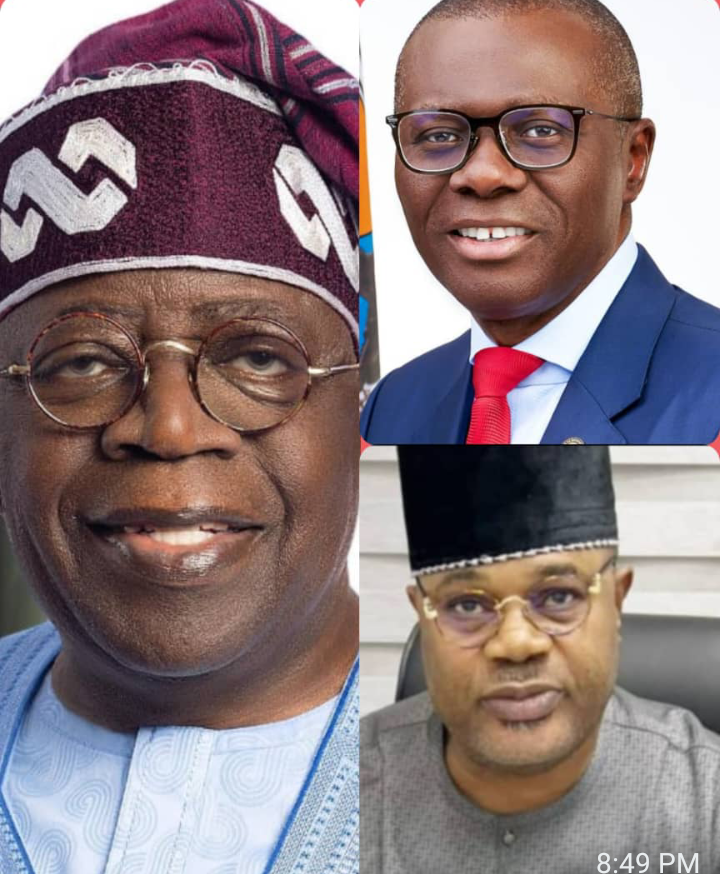
Abdul-Akeem Ayodeji Amodu, Senior Special Assistant to the Governor Babajide Sanwo-Olu of Lagos State on Housing, has urged Nigerians to be patient with President Bola Tinubu.
Amodu spoke in Abuja while briefing newsmen during the 25 years celebration of uninterrupted democracy.

He said: “Let us be patient with Asiwaju Bola Ahmed Tinubu. He is celebrating his first June 12 anniversary. Things will get better.
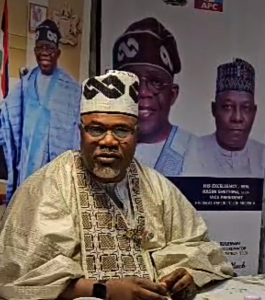
“We know things are tough. The economy is really not doing well. But we are looking forward to it, we are hoping that very soon, possibly before the end of this year Nigeria will be better. Dollar will come down, fuel price will reduce because our indigenous refinery will be working.
“May God continue to give the president the strength and wisdom to rule. We want him to do more. We know he is trying his best and we’ll continue to support him.”
On the missed steps by Tinubu at Eagles Square, which had been trending, he said: “Yes it’s not the first time a President has fallen. Joe Biden of the United States of America fell about three weeks ago, the World did not come to an end.
“Let us respect and pray for our Leaders. let us see that whatever happens to our Leader he’s carrying the burden of about 230 million Nigerians and it’s not easy for a man of his age carrying such burden.”
He continued: I want to say to us members of APC let’s continue to keep our flag flying 2027 is around the corner. That is why I visited Abuja to meet with Alhaji Hon. Aminu Suleiman, who is the founder of Tinubu Support Organization (TSO). He was the man that started the struggle and yet he’s a Northerner. Loyalty is in his blood, he has stayed with Asiwaju Ahmed Tinubu for the past 30 years.
“A lot of people have gotten appointments but he’s still keeping calm and he’s still waxing strong to ensure we continue to promote Asiwaju Bola Ahmed Tinubu.”

News
The Sundiata Post Model (7): A Philosophical Triad and the Language of 21st-Century Journalism
By Max Amuchie | The Sunday Stew
Language does more than describe reality. It shapes how we perceive it.
Every enduring discipline eventually develops its own vocabulary. Law has its language. Medicine has its language. Economics, engineering, diplomacy and computer science all possess conceptual vocabularies that enable practitioners to describe phenomena with greater precision than ordinary language permits.
Journalism is no exception.
Yet the vocabulary of journalism has largely remained rooted in the 20th century. We continue to speak of newsrooms, reporters, editors, publishers, news cycles and audiences—concepts that remain important but no longer fully capture the realities of a profession transformed by digital technology, artificial intelligence, data science and knowledge production.
If journalism itself is changing, then its language must also evolve.
Throughout this series, I have argued that the 21st century newsroom should no longer be understood merely as a producer of news but as a knowledge-producing institution. That institutional transformation inevitably requires a corresponding conceptual transformation. New realities require new language.
A Note on the Definition of the Sundiata Post Model
In Part 1 of this series, I defined the Sundiata Post Model as an institutional framework for media-based knowledge production. The development of the Model across the subsequent parts has, however, clarified its institutional character and conceptual architecture. I therefore refine that original definition here and assert the following as the canonical definition:
The Sundiata Post Model is an institutional model for media-based knowledge production in which an independent newsroom systematically integrates journalism, original research, conceptual innovation, and scholarly dissemination to produce original analytical constructs that contribute to public understanding, academic inquiry, and policy discourse within the global knowledge ecosystem. Its conceptual framework sets out the principles, structures, processes and mechanisms through which such a newsroom can become a knowledge-producing institution and sustain that capacity over time.
The Sundiata Post Model (SPM) therefore proposes not simply an institutional model but also a vocabulary through which its conceptual framework can be understood and communicated.
This vocabulary should not be viewed as rigid terminology imposed upon the profession. Language evolves through use rather than decree. Some concepts will prove useful. Others may be revised or replaced. Ultimately, the value of any terminology lies not in its novelty but in its capacity to illuminate reality more clearly.
What follows is therefore an emerging lexicon for 21st century journalism. It gives language to the ideas developed throughout this series.
Knowledge-Producing Institution
Perhaps the central concept within the SPM is the Knowledge-Producing Institution.
Traditional media organisations produce journalism. A knowledge-producing institution produces journalism while simultaneously generating research, analytical frameworks, datasets, policy knowledge and institutional memory. It informs today’s public while contributing to tomorrow’s understanding.
This distinction represents the philosophical foundation upon which the entire model rests.
Dual Engine Architecture
The Dual Engine Architecture describes the internal structure through which journalism and knowledge production become mutually reinforcing.
The Media Operations Engine generates journalism, public engagement and commercial activity.
The Knowledge Operations Engine converts that journalistic activity into research, intellectual frameworks, datasets, publications and institutional knowledge.
Together they create a continuous cycle in which journalism enriches research and research strengthens journalism.
Media Operations Engine
The Media Operations Engine is the institution’s public-facing operational system.
It encompasses reporting, editing, verification, multimedia production, audience engagement, commercial publishing, conferences, public events and other activities through which the institution serves society while generating the resources necessary to sustain its mission.
Knowledge Operations Engine
The Knowledge Operations Engine is the institution’s intellectual infrastructure.
It conducts research, develops theories, constructs analytical frameworks, curates datasets, preserves institutional memory and maintains standards for methodology, research quality and knowledge governance. It transforms information into enduring knowledge.
Institutional Intelligence Cycle
The Institutional Intelligence Cycle describes the continuous movement of knowledge between journalism and research.
Reporting generates observations.
Observations generate questions.
Research transforms those questions into structured knowledge.
That knowledge subsequently enriches journalism, producing deeper reporting and more informed public discourse.
The cycle then begins again.
Knowledge therefore accumulates rather than disappears.
Institutional Memory
Institutions do not become enduring simply because they survive. They become enduring because they remember.
Institutional Memory refers to the organised preservation of knowledge generated through journalism, research, governance and public engagement. It ensures that experience accumulates across generations rather than disappearing with personnel changes, the passing of news cycles or successive algorithmic transformations.
Knowledge Stewardship
Creating knowledge is only the beginning.
Knowledge Stewardship concerns the responsibility to preserve, organise, govern and transmit that knowledge responsibly across generations.
It treats intellectual assets not as temporary outputs but as permanent institutional resources.
Knowledge Governance
If knowledge is to become an institutional asset, it must also be governed.
Knowledge Governance refers to the principles, systems and standards through which institutions ensure methodological integrity, research quality, documentation, accessibility, preservation and responsible use of knowledge.
It provides order to institutional intelligence.
Realm of the Long Term
Every institution eventually reaches the point where immediate performance gives way to long-term stewardship.
The Realm of the Long Term describes that stage in institutional development.
Here, management shifts its attention from short-term success to enduring relevance.
Leadership becomes stewardship.
Growth becomes continuity.
Performance becomes permanence of purpose.
The Seven Pillars
The Seven Pillars constitute the institutional foundations upon which the Realm of the Long Term rests:
- Financial Sustainability
- Human Capital and Leadership
- Knowledge Stewardship
- Governance
- Innovation and Adaptation
- Trust and Reputation
- Mission Continuity
Together they provide a practical philosophy for institutional endurance.
The Logic of the Long Term
The Logic of the Long Term is the principle that enduring institutions are sustained not by isolated organisational strengths but by the interaction of mutually reinforcing capabilities. Within the SPM, it explains why the Seven Pillars operate as an integrated institutional system rather than as independent functions.
Institutional Success
Within the SPM, institutional success extends beyond commercial performance. It encompasses four progressively deeper levels.
Operational Success measures present performance.
Institutional Success measures organisational endurance.
Civilisational Success measures the institution’s enduring contribution to society’s accumulated stock of knowledge.
Legacy measures Generational Influence—the extent to which an institution’s ideas, values, methods and contributions continue shaping future generations.
Success is therefore measured not only by what institutions produce, but ultimately by what continues because the institution existed.
The Triple Institutional Architecture
The SPM is not only an institutional model. Its development has also generated an emerging institutional architecture through which its principles can be expressed in practice.
That architecture consists of three complementary institutions: Sundiata Post Media Ltd., the Sundiata Post Intelligence Unit (SPIU), and the Sundiata Post Foundation.
Sundiata Post Media Ltd. constitutes the media and public-information institution. Its primary function is journalism: reporting, investigation, verification, public engagement and the dissemination of knowledge to society. The Sundiata Post Intelligence Unit (SPIU) constitutes the research and knowledge institution. Its function extends beyond journalism into original research, conceptual innovation, analytical constructs, datasets, policy research and scholarly dissemination. The development of The Insecurity Triad, the Trinity of Sovereignty Decay (TSD) and the Decoupling Sovereignty Index (DSI) demonstrates the potential for this research function to generate original intellectual contributions rather than merely reproduce existing knowledge.
The Sundiata Post Foundation constitutes the social-impact and civic-engagement institution within the wider ecosystem.
Together, these institutions form a Triple Institutional Architecture:
Media—Knowledge—Social Impact
The three institutions are distinct in function but complementary in purpose. Their differentiated institutional roles create distinct but mutually reinforcing pathways for sustaining public value.
This architecture also extends the Dual Engine Architecture of the SPM beyond the internal structure of a newsroom. The Media Operations Engine and Knowledge Operations Engine remain the core internal mechanisms of the knowledge-producing institution, while the Triple Institutional Architecture shows how those functions can connect to a wider institutional ecosystem in which journalism, research and social impact reinforce one another.
The four original constructs developed through the Sundiata Post intellectual project provide an initial proof of concept for the knowledge-producing capacity underlying this architecture.
The Triad demonstrates the capacity to develop an original analytical lens. The TSD demonstrates theoretical innovation. The DSI represents an attempt to translate theory into an empirical measurement system. The SPM itself provides the institutional model through which such knowledge can be generated, preserved and disseminated.
The significance, therefore, lies not in the existence of four ideas or three institutions independently, but in their interaction.
The constructs demonstrate intellectual production.
The institutions provide organisational embodiment.
The architecture connects knowledge production to public value.
Beyond Journalism: Strategic Management and Organisational Theory
The SPM sits at the intersection of journalism and media studies, organisational theory, and strategic management.
From journalism and media studies, it draws on the tradition of public service—a profession dedicated to informing society, strengthening democracy, and contributing to public understanding.
From organisational theory, it draws on the study of how institutions are designed, governed, sustained and renewed over time, emphasising organisational structure, institutional memory, culture, stewardship and long-term continuity.
From strategic management, it draws on the principles of institutional endurance—financial sustainability, governance, human capital development, innovation, knowledge stewardship and mission continuity.
These are not separate concerns. The SPM argues that journalism cannot fulfil its public purpose without institutional strength, and that institutional strength cannot be built without understanding journalism’s unique mission.
This interdisciplinary foundation is reflected throughout the Model—in its Dual Engine Architecture, its Seven Pillars, its measures of institutional success, and its proposed vocabulary. Each element integrates the concerns of both fields, offering a framework that is both mission-driven and institutionally grounded.
A Living Vocabulary
No vocabulary is ever complete.
The language proposed in this series should therefore be understood as a living intellectual framework rather than a finished dictionary. As journalism evolves, new concepts will emerge. Existing concepts will be refined. Some terms may disappear altogether while others become widely adopted. That is how intellectual traditions develop.
History reminds us that new ways of understanding the world often begin when someone gives language to a previously unnamed reality. Once that language gained acceptance, the underlying ideas became easier to understand, debate and improve.
The SPM aspires to make a similar contribution. Its value will not be determined by whether every term survives unchanged, but by whether this vocabulary helps journalists, scholars, media executives and researchers think more clearly about what the newsroom of the 21st century can become.
If that conversation continues beyond these pages—if these concepts are questioned, tested, adapted and applied—then the language will have served its purpose.
Because institutions are built with systems.
Ideas are built with language.
The future of journalism will require both.
Across these seven parts, I have defined the problem, formulated a new institutional model, proposed its architecture, articulated its guiding principles, developed measures of success, and finally given it its own vocabulary. Together, these elements give the SPM its internal coherence and completeness.
A Philosophical Triad of Enduring Influences
With humility, drawing on decades of experience at the forefront of the African media industry, a fellowship at the highest level of the Chartered Institute of Human Resource Management (CIHRM), foundational membership in the Institute of Strategic Management Nigeria, and from my desk at Sundiata Post in Abuja, I release these ideas—the Sundiata Post Model—into the world. Their future is no longer mine to determine. If they endure, it will not be because I insisted upon their importance, but because others found them worth questioning, testing, adapting and building upon.
For many years, my life journey and the arc of my interdisciplinary thinking have been shaped by a philosophical triad of enduring influences. The first is Sigmund Freud’s insight that “immortality means being known by many anonymous people”—which, to me, revealed the possibility that ideas can outlive their creators and that the truest measure of intellectual work lies not in personal recognition but in the enduring life of ideas.
The second is Edward Said’s vision of the intellectual as one who engages society’s most pressing questions with independence, integrity, and moral courage.
The third is Antonio Gramsci’s conception of the organic intellectual, which helped me see journalism as far more than the reporting of events. It reframed journalism for me as an intellectual vocation—one that interprets reality, organises knowledge, frames public understanding, and contributes to society’s accumulated stock of learning.
Together, these three influences have shaped my conception of journalism not merely as a profession, but as an intellectual vocation and a means of creating knowledge that can outlive its creator.
If, through the development of four original constructs—The Insecurity Triad, the Trinity of Sovereignty Decay, the Decoupling Sovereignty Index, and now the Sundiata Post Model—I have made a meaningful contribution in that tradition, I am content to leave the judgment to history and to those who engage with these ideas in the years ahead.
This series is concluded.
Trust is sacred. Stay seasoned.
•Dr Max Nwabueze Amuchie is an African scholar-practitioner and framework builder whose original intellectual work spans insecurity, sovereignty, institutional development, and journalism as knowledge production. His frameworks include the Insecurity Triad, the Trinity of Sovereignty Decay, the Decoupling Sovereignty Index, and the Sundiata Post Model. He is the CEO & Theorist-In-Chief of Sundiata Post, Lead Researcher at the Sundiata Post Intelligence Unit (SPIU), and an Expert Member and Peer Reviewer in Behavioural and Social Sciences at ScienceOpen.
News
NDLEA nabs India-bound bizman with cocaine, recovers N3.6b Colos, codeine in Lagos(Photos)
. 70-year-old grandpa nabbed, large consignments of opioids, others seized in Kano, Kwara, Edo, Plateau, Oyo, Delta sweeps
A 48-year-old businessman Nwankwo Innocent Onyebuchi who liquidated all his assets to chase a dream of quick riches in the illicit drug trade has been arrested by operatives of the National Drug Law Enforcement Agency (NDLEA) at the Murtala Muhammed International Airport (MMIA) Ikeja Lagos, while heading to New Delhi, India, with 1.550 kilograms of cocaine cleverly concealed within the side walls and railings of his bag.

Nwankwo who deals in marbles in Lagos was arrested at the departure hall of terminal II of the Lagos airport while attempting to board a Qatar Airways flight to New Delhi, India.
A search of his check-in bag uncovered 1.550 kilograms of cocaine factory-fitted in the walls and railings of his bag.
In a candid confession that lays bare the desperation that fuels the drug trade, Nwankwo said he had sold off his marble business and every asset he owned to raise the ₦23 million he paid for the consignment, with the expectation of selling it in India for as much as N100 million.
With his assets gone, and Nwankwo’s dream of transiting from a marble trader to a drug kingpin effectively shattered following his arrest, the suspect remains in custody awaiting prosecution and likely time in jail.
In another operation, NDLEA operatives acting on credible intelligence raided a warehouse within a residential compound at 20 Hakeem Dosumu street Ago Palace area of Okota, Lagos, where a massive stockpile of codeine-based syrup was discovered.
A total of 3,776 cartons, comprising 377,600 bottles of the controlled substance, valued at over N2.6 billion, were recovered between Friday 7th and Saturday 8th August 2026.
In yet another intelligence-led operation, NDLEA operatives on Wednesday 14th August raided the residence of a 55-year-old kingpin Shoremi Kayode, at 37 Ogundare street, Ipaja estate, Ipaja area of Lagos, recovering 324 kilograms of Colorado, a synthetic strain of cannabis, with a street value of Nine Hundred and Seventy-Two Million Naira (N972,000,000).
Also recovered from the suspect were a Mercedes-Benz car and a Toyota Corolla car.
In Kwara, two suspects: Abubakar Adamu, 50, and Bilyaminu Nuhu, 30, were on Thursday 13th August arrested at Kam Wire area of Ilorin with 55.96kg skunk in a truck marked DKA 350 XL recovered, while two other suspects: 70-year-old grandpa Abdulfatai Oyelaran and Abdulrauf Ajadi, 50, were nabbed by NDLEA officers on patrol along the Lagos-Ibadan expressway, Ibadan, Oyo state on Wednesday 12th August. Recovered from their Toyota Sienna vehicle marked FFA-115KA, include: 52,000 ampoules of pentazocine injection and 6,000 ampoules of tramadol injection.


A total of 124,100 pills of tramadol; 786 bottles of codeine syrup; 2,598 tablets of rohypnol;
4,800 tablets of diazepam; 470 ampoules of pentazocine injection and 200 ampoules of tramadol injection were recovered from two suspects: Osaro Ikpoba, 43, and Samuel Godbless, 18, along Onitsha/Asaba expressway on Thursday 13th August, while another suspect, Emeka Tony, 50, was nabbed with 1,244 pieces of cartridges and monetary exhibit of eight million naira (N8,000,000) only along Kwale/Ozoro expressway on Wednesday 12th August.
A Toyota Corolla car with registration number MKD 341 EA was intercepted by NDLEA operatives along Riyom/Jos road, Jos Plateau state where 239,490 caps of tramaforce, a brand of tramadol were recovered and a suspect Kasum Sherif arrested.
In Kano, six suspects were arrested on Monday 10th August by NDLEA operatives on patrol along Zaria-Kano road.
They include: Okodili Ibeabuchi, 60; Onyeka Vincent, 47; Nwanko Wisdom, 36; Success Chigozie, 30; Emmanuel Jude, 27; and Chinedu Peter, 39. Large consignments of opioids were recovered from them include 728,958 pills of tramadol, rohypnol, and others as well as 360 grams of cocaine, 99.8 grams of methamphetamine, 50 bottles of codeine syrup and and 2.7 kilograms of Loud, a synthetic strain of cannabis.

Also in Kano, NDLEA operatives on Friday 14th August raided the Zawaciki Gida Dubu, Kumbotso LGA, where they recovered 171 blocks of skunk weighing 106.8kg and arrested two suspects: Mustapha Iliya, 30, and Abdulwahab Abdulrashid, 24 in connection with the seizure.
A total of 4,628.9775kg skunk was destroyed on two cannabis farms that measured 1.851591 hectares at Ugboku/Igbanke forest, Orhionmwon LGA, Edo state where a suspect Agholor Elebojie, 40, was arrested in one of the farms during a raid by NDLEA operatives on Wednesday 12th August. Another suspect, Kingsley Anigala, 28, was nabbed with 25.857kg Loud and 93 grams of meth during a raid of drug joints at Oluku area of Benin city on Friday 14th August.

The War Against Drug Abuse (WADA) social advocacy activities by NDLEA Commands equally continued across the country in the past week. Some of them include: WADA sensitization lecture delivered to students and staff of Madarasatu Sheikh Muhammad Rabi’u Arabic School, Kano and Olomu Junior Secondary School, Ajah, Lagos state, among others.
While commending the officers, men and women of MMIA, Lagos, Kano, Kwara, Edo, Plateau, Oyo and Delta Commands of the Agency for the arrests and seizures of the past week, Chairman/Chief Executive Officer of NDLEA, Brig. Gen. Mohamed Buba Marwa (Rtd) also praised their counterparts in all the commands across the country for pursuing a fair balance between their drug supply reduction and drug demand reduction efforts.
News
Major reason why dancing Gov Adeleke won Osun again: The Forces Behind the Governor’s 2026 victory
Dancing Governor Ademola Adeleke’s victory in the 2026 Osun State governorship election was more than a routine incumbency advantage.
It was the product of several political forces coming together at a critical moment: a strong grassroots structure, the visibility of his administration, strategic vote mobilisation and an opposition that failed to convert its numerical strength into a winning coalition.
When the Independent National Electoral Commission (INEC) finally declared the result, Adeleke of the Accord Party had secured 511,067 votes, defeating the All Progressives Congress (APC) candidate, Bola Oyebamiji, who polled 444,815 votes.
The governor won by 66,215 votes and carried 19 of the state’s 30 local government areas.
The figures tell only part of the story. Behind them lies a political campaign that demonstrated the importance of grassroots organisation, personal popularity and the ability to turn incumbency into electoral advantage.
The incumbency advantage
Perhaps the most obvious factor was Adeleke’s position as the sitting governor.
Unlike his principal challenger, Adeleke entered the contest with an established political structure and a record voters could assess. His campaign was therefore not based entirely on promises about what he would do; it could point to projects and programmes undertaken since his assumption of office.
Before the election, his campaign organisation repeatedly highlighted his administration’s achievements and its five-point agenda, while presenting the governor as a leader with a record to defend. That strategy gave his campaign a simple message: voters should compare the administration they had experienced with the alternative being offered.
In an election where more than two million voters were registered, that distinction mattered.
A powerful grassroots machine
Osun politics has always been heavily influenced by grassroots mobilisation, and Adeleke’s political strength has increasingly been built around that reality.
The governor did not rely solely on major rallies in Osogbo or other urban centres. His campaign maintained visibility across local governments and communities, with political structures working to translate his popularity into actual votes.
The final result showed how effective that machinery was.
Adeleke did not simply win narrowly in a handful of constituencies. He accumulated sizeable margins in several areas, producing a statewide advantage that the APC could not overturn. Reports from the collation exercise showed Accord taking important victories in places including Iwo, Ede South and Ife North.
That pattern is significant: in a first-past-the-post election, winning comfortably in multiple local governments can be more decisive than producing isolated landslides.
The Adeleke factor
Another major reason for the victory was the governor’s personal political brand.
Adeleke has developed an unusual connection with sections of the Osun electorate, particularly among younger voters. His dancing, informal public appearances.
-
News21 hours agoBREAKING: Gov Adeleke in Early Lead, Wins First INEC Announced Results
-
News8 hours agoJonathan, Oborevwori, Diri, Ibori Mourn 104-Year-Old Prince Penawou
-
News8 hours agoFerran Torres Joins PSG From Barcelona
-
News8 hours ago“U No Try President Bola Tinubu’ – Davido Accuses Tinubu Of Planning To Withdraw Police, Military From Osun
-
News21 hours agoDavido Alleges He Was Barred From Entering Osun to Cast His Vote
-
News19 hours agoOsun election: Oyinlola Loses Polling Unit to Accord Party
-
News9 hours agoAdeleke Maintains Lead As Collation Of Osun Governorship Results Continues
-
News9 hours agoINEC Plans To Declare Osun Election Inconclusive— Adeleke Camp

Warning: Undefined variable $user_ID in /home/naijuinz/public_html/wp-content/themes/zox-news/comments.php on line 49
You must be logged in to post a comment Login