


News
Experts Reveal Why Manhood Cancer Is On The Rise
- /home/naijuinz/public_html/wp-content/plugins/mvp-social-buttons/mvp-social-buttons.php on line 27
https://naijablitznews.com/wp-content/uploads/2024/06/Screenshot_20240622-122548-1.png&description=Experts Reveal Why Manhood Cancer Is On The Rise', 'pinterestShare', 'width=750,height=350'); return false;" title="Pin This Post">
- Share
- Tweet /home/naijuinz/public_html/wp-content/plugins/mvp-social-buttons/mvp-social-buttons.php on line 72
https://naijablitznews.com/wp-content/uploads/2024/06/Screenshot_20240622-122548-1.png&description=Experts Reveal Why Manhood Cancer Is On The Rise', 'pinterestShare', 'width=750,height=350'); return false;" title="Pin This Post">
In 2018, Brazilian pensioner João sought medical help after he found a wart on his penis.
“I started visiting medical clinics to find out what it was, but all the doctors told me it was due to excess skin and prescribed medication,” the 63-year-old recalls.
Despite the medication, the wart continued to grow. It started to take a toll on his marriage and João and his wife’s sex life declined. “We were like siblings,” he admits. He was determined to find out what was going on.
For five years João, not his real name, went back and forth to specialists who prescribed more medication and ordered new biopsies. “Nothing solved it,” he says.
Then, in 2023, he was given a diagnosis – João had penile cancer.
“For my family, it was a very unpleasant surprise, even more so because I had to have part of the penis amputated. I feel like I was decapitated,” he says.
“It’s a type of cancer that you can’t talk about with people because it could turn into a joke.”
Penile cancer is rare, but incidences and mortality rates are on the rise around the world.
According to the latest studies, Brazil, where João is from, has one of the highest incidence rates of 2.1 per 100,000 men.
*Terrified of surgery’*
Between 2012 and 2022, there were 21,000 reported cases, according to Brazil’s Ministry of Health. This resulted in more than 4,000 deaths and, over the past decade, there have been more than 6,500 amputations – averaging one every two days.
Maranhão, the poorest state in Brazil, was found to have the highest incidence rate globally at 6.1 per 100,000 men.
Symptoms of penile cancer often start with a sore on the penis that does not heal and a strong-smelling discharge. Some people get bleeding and colour changes of the penis, too.
When detected early, there is a high chance of recovery through treatments such as the surgical removal of the lesion, radiotherapy and chemotherapy.
But if left untreated, partial or total amputation of the penis, and possibly other nearby genital organs such as the testicles, may become necessary.
João underwent a partial amputation in January and says it was a difficult time.
“It’s something you never imagine will happen to you, and when it does, you can’t just go around telling people,” he says.
“I was terrified of surgery, but there was no other alternative. The feeling in the first weeks after the surgery was one of sadness, I can’t deny it. Not having part of your penis is horrible.”
Some patients undergo a total amputation which is life-changing.
Thiago Camelo Mourão from the Department of Urology at AC Camargo Cancer Center in São Paulo says: “In the case of partial amputation, urine continues to exit through the penis.
“However, in total amputation, the urethral orifice can be relocated to the perineum, between the scrotum and the anus, requiring the patient to urinate while sitting on the toilet.”
Mauricio Dener Cordeiro of the Brazilian Society of Urology says personal hygiene is important
Mauricio Dener Cordeiro of the Brazilian Society of Urology says the persistent infection of human papillomavirus (HPV), a name given to a common group of viruses, is “one of the main risk factors”. HPV can be transmitted during sex and in some cases, it can lead to cancers including in the mouth and penis.
He says: “Mass vaccination against HPV is essential due to its high effectiveness in preventing related lesions,” but he adds that vaccination rates in Brazil are below the level needed to be truly effective.
“In Brazil, despite the availability of the vaccine, the HPV vaccination rate remains low for girls – reaching only 57% – and for boys, it doesn’t exceed 40%,” he says. “The ideal coverage to prevent the disease is 90%.”
He believes misinformation about the vaccine, unfounded doubts about its effectiveness and a lack of vaccination campaigns have contributed to the low take-up.
According to the UK’s National Health Service (NHS) website, smoking can increase the risk of getting penile cancer, too. It also says you might be more likely to get penile cancer if you “have problems pulling back your foreskin (the skin covering your penis) to keep your penis clean (a condition called phimosis)”.
“When a man does not expose the glans and fails to clean the foreskin properly, it produces a secretion that accumulates,” Dr Cordeiro says. “This creates a highly favourable environment for bacterial infections.
“If this occurs repeatedly, it becomes a risk factor for the appearance of the tumour.”
Getty Images
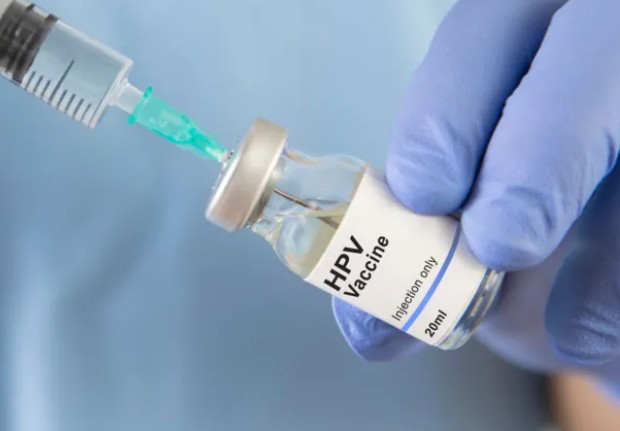
Mass vaccination against HPV is essential to prevent penile cancer, experts say
But Brazil is not the only place where penile cancer is on the rise. According to the latest research, the number of cases is increasing around the world.
In 2022, the journal JMIR Public Health and Surveillance published the results of a large-scale analysis involving the latest data from 43 countries.
It found the highest incidence of penile cancer between 2008 and 2012 was in Uganda (2.2 per 100,000), followed by Brazil (2.1 per 100,000) and Thailand (1.4 per 100,000). The lowest was in Kuwait (0.1 per 100,000).
“Although developing countries still bear the higher incidence and mortality of penile cancer, the incidence is on the rise in most European countries,” the team of researchers led by Leiwen Fu and Tian Tian from Sun Yat-Sen University in China found.
They reported that England had seen an increase in penile cancer, rising from 1.1 to 1.3 per 100,000 between 1979 and 2009 and in Germany cases increased by 50% from 1.2 to 1.8 per 100,000 between 1961 and 2012.
These figures are only set to get higher, according to the Global Cancer Registries prediction tool. It estimates that by 2050, the global incidence of penile cancer will rise by more than 77%.
This change can largely be attributed to the ageing population, according to the experts, who say the highest incidence occurred in men in their 60s.
Dr Cordeiro says: “Penile cancer is a rare disease but also highly preventable”.
He advised that using condoms during sex and undergoing surgery to remove the foreskin in cases of phimosis could help
reduce the risk of penile cancer.
Neil Barber, Clinical Lead for Urology at Frimley Health NHS Foundation Trust, adds: “Penile cancer is almost unheard of in the circumcised population. Poor hygiene and infections beneath the foreskin, as well as conditions like phimosis that make it difficult to retract the foreskin and maintain good hygiene, are risk factors. This is linked to higher overall infection risks”.
“Established risk factors also include unprotected sex, specifically not using condoms, with poor hygiene further increasing risks through this route.”
João is currently waiting for his latest test results, which he will receive later this year. “I’m confident that these exams will show that I’ll be cured,” he says.
“Now, following the amputation, the pain has gone away, and I’ve been feeling much better. But I’ll have to live with a partially amputated penis for the rest of my days.”
According to Cancer Research UK, more than 90% of men diagnosed with penile cancer which has not spread to nearby lymph nodes survive for five years or more

News
No plans to increase electricity tariffs – Power Minister assures Nigerians
The Minister of Power, Joseph Tegbe, has declared that President Bola Tinubu’s administration has no intention to jerk up electricity tariffs beyond the current level.
He disclosed this during a media briefing in Abuja on Friday.
According to him, the Tinubu administration’s priorities are improving electricity service delivery, expanding access to electricity, and ensuring that Nigerians pay only for the electricity they consume.
The minister said that, over the last two weeks, the country has consistently generated 5,000 megawatts of electricity.
“We are already witnessing encouraging improvements in electricity generation. Over the course of the last two weeks, we have consistently generated 5,000MW.
“Permit me to address two issues that have generated considerable public discussion. First, there is no policy by this administration to increase electricity tariffs beyond the current level. Our priority is not a tariff increase in the immediate term. Our priority is service improvement, universal metering, and ensuring Nigerians pay only for the electricity they actually consume,” he stated.
He added that the objective of the Federal Government is to provide reliable electricity to homes across the country.
“Our ambition is clear: reliable electricity that powers our homes.”
Tegbe’s comments come amid debate over a fresh electricity tariff hike, fuelled by remarks made by Tinubu’s Special Adviser on Power Infrastructure, Sadiq Wanka.
Nigerian electricity consumers have kicked against the proposed electricity tariff hike.
News
Fresh facts emerge as in-law of slain Col Ude alleges he was assassinated
A fresh twist has greeted the recent passing of senior military intelligence officer, Colonel Abdulrasaq Abdussalam Ude, who was killed while returning to his residence at Kurudu area in Abuja Municipal Area Council of the Federal Capital Territory.
The officer was attacked shortly after returning to his home on Monday evening, July 27, 2026. His driver and security guard also sustained gunshot wounds during the assault.
It was learnt the attackers attempted to abduct the officer but met stiff resistance.
“He resisted them. From what investigators have gathered, they wanted to take him away, but he fought back. Unfortunately, he paid the ultimate price,” a source familiar with the preliminary investigation was quoted to have said.
After failing to take him away, the assailants allegedly shot the officer multiple times before fleeing the scene.
His wife, driver and security guard, who were caught in the attack, were rushed to the hospital and are receiving treatment for varying degrees of gunshot injuries.
But in a Facebook post on Wednesday, one Ali Chukwudi, who identified himself as the deceased’s brother-in-law, described the attack as a calculated murder rather than a failed abduction.
“Yesterday, Nigeria failed one of its finest. My brother-in-law, Colonel Abdulrazaq Abdulkareem Ude, a senior intelligence officer who dedicated years of his life to defending this nation, was not killed while resisting a kidnapping, as some reports may have claimed. He was deliberately targeted and brutally assassinated,” Chukwudi wrote.
“The attackers shot him in the head, killing him. They also shot his wife, my sister, in the leg. The driver and the gate man were both shot in the legs as well. As I write this, my sister is in the hospital, fighting to survive,” he added.
Chukwudi said the late colonel had served Nigeria loyally for years and was only months away from a promotion he described as well-deserved.
He further described the killing as a direct attack on a patriotic officer.
Chukwudi urged authorities to conduct a thorough and transparent investigation.
Neighbours speak on last moments of late officer
Speaking to our reporters yesterday, one of the residents, identified as Amina, who previously lived in the colonel’s residence before relocating to a nearby plaza after he (Ude) moved in with his family, said the late officer allowed her family to remain close by and paid for the place they now occupy.
She described the colonel as a kind and humble man who maintained a close relationship with her family.
Amina said the colonel, who usually travelled on Mondays and returned on Fridays, unexpectedly returned home between 9pm and 10pm on the fateful Monday while it was raining.
She said her son, Sani, who usually opened the gate whenever the officer returned home, rushed to open it after hearing the vehicle’s horn.
According to her, her husband, Usman, also walked towards the house to welcome the colonel, but came under gunfire moments after the gate was opened.
“My husband later told me that immediately the gate was opened, the attackers opened fire on him. He dived into a culvert and lay on the ground before escaping by jumping over a fence. He came back shouting that they were going to kill his boss,” she said.
Amina said her husband believed lying inside the culvert gave him a better chance of surviving the attack before he eventually escaped.
She said the sound of gunfire continued for several minutes, adding that residents could not count the number of shots fired.
She also said residents believed about five armed men carried out the attack, but no one saw how they arrived or how they escaped, as they were not seen with any vehicle or motorcycle.
Amina said her son, Sani, who opened the gate for the colonel that night, sustained a gunshot wound to the thigh and is receiving treatment alongside the colonel’s wife.
When Daily Trust visited the area yesterday, the colonel’s daughter was seen returning to the house with women from the community who had gone to sympathise with the family.
However, the woman declined requests for an interview, saying she was still traumatised by the incident.
The colonel’s younger brother, Yusuf Ude, told Daily Trust that he was not at the residence when the attack occurred.
He said the officer’s wife was recovering from her injuries and that the family was currently focused on her treatment.
Asked whether the military had deployed additional security to the residence, Yusuf said he could not confirm the situation for now, noting that the family would have a clearer picture after she recovered.
During the visit, Daily Trust observed a heavy military presence around the residence, with armed soldiers stationed in the area, including personnel in a military Hilux vehicle and a black military van.
Some soldiers were also positioned inside an uncompleted building overlooking the neighbourhood.
A Daily Trust reporter approached officers in the black military van for comments, but one of the officers, who identified himself simply as Umar, declined, saying those authorised to speak on the matter were not around.
Residents who spoke with Daily Trust said the incident has left many living in fear, with several calling for improved security in the community to prevent a recurrence.
Our reporters observed that the late officer’s apartment, which is located in the Phase 5 area of the Post Army Housing Estate in Kurudu, is within an isolated area.
It was learnt that it was not too long that the officer moved into the area.
The killing has sent shockwaves through military circles, as Colonel Ude was preparing for promotion to the rank of Brigadier General.
An indigene of Enugu State, the late officer served in several strategic intelligence and counter terrorism roles within the Armed Forces.
He participated in operations against insurgents in the North East and was also deployed on specialised international assignments in Chad and France, where he contributed to intelligence and security cooperation.
The remains of Colonel Ude was buried on Tuesday after a funeral prayer at the Mambilla Mosque in Abuja in accordance with Islamic rites.
Colleagues described him as a courageous and highly respected intelligence officer whose dedication to duty earned him widespread admiration within the military.
The incident occurred about two years after retired Brigadier General Uwem Harold Udok was killed by armed men who invaded his residence in the Lokogoma area of Abuja while he was defending his family. (Adapted from a Daily Trust report)
News
Catholic Priest lifeless body found in Kogi
A Catholic Priest, Rev. Fr. Samuel Opeyemi a Catholic priest, has been found dead in Ajaokuta, Kogi State.
Until his death, he served as a priest at St. Mary’s Catholic Church, Egbe.
Rev. Fr. Opeyemi was reportedly stabbed multiple times, and his lifeless body was discovered by the roadside in Ajaokuta.
Confirming the incident, the State Police Public Relations Officer, ASP Afusat Salihu, said, “We received information that the lifeless body of an unidentified male was found by the roadside along Church Road, Ajaokuta.
”Operatives promptly mobilised to the scene, where it was observed that the deceased had sustained severe machete cuts to the head. The body was evacuated to the ASCL Hospital, where he was confirmed dead by a medical doctor, and was thereafter deposited at the mortuary for autopsy.
”The deceased was later identified as Rev. Fr. Samuel Opeyemi of St. Paul Parish, Ayetoro Gbede, Ijumu LGA, Kogi State.
”The case is currently under investigation, and efforts are ongoing to apprehend those responsible. Upon the conclusion of the preliminary investigation, the case will be transferred to the State Criminal Investigation Department (SCID) for discreet investigation.”
-
News24 hours agoTinubu dismantles Presidential C’ttee on federal properties with immediate effect
-
News23 hours agoResident doctors issue fresh notice to FG to begin nationwide indefinite strike
-
News12 hours agoSenate Begins Oil Sector Probe, Summons NNPCL, CBN, Major IOCs
-
News22 hours agoReps Probe Lingering Bille Gas Leak, Demand Swift Action as Regulators Confirm Emissions Continue
-
News5 hours agoDoctors Perform First Successful Manhood Transplant on 43-Year-Old Man
-
News12 hours agoEFCC forfeited assets Auction: Nigerian auctioneers alleges impersonation
-
News12 hours agoLeaked DSS Memo Warns of Fresh Terrorist Attacks
-
News3 hours agoWatch moment FCT minister Wike led security operatives to criminals hideout in Kukwaba

Warning: Undefined variable $user_ID in /home/naijuinz/public_html/wp-content/themes/zox-news/comments.php on line 49
You must be logged in to post a comment Login