Connect with us

News

Polls open in Iran for presidential election

Published

on

ADVERTISEMENT
Zoom Ad
ADVERTISEMENT
Zoom Ad

By Kayode Sanni-Arewa

Polls in Iran opened on Friday for a presidential election following the death of ultraconservative president Ebrahim Raisi in a helicopter crash last month.

The Guardian Council, which vets candidates, allowed him to run against a field of conservatives now dominated by parliamentary speaker Mohammad Bagher Ghalibaf and former nuclear negotiator Saeed Jalili.

Also left in contention is cleric Mostafa Pourmohammadi after two ultraconservatives dropped out — Tehran major Alireza Zakani and Raisi’s former vice president Amir-Hossein Ghazizadeh Hashemi.

Advertisement

“We start the elections” for the country’s 14th presidential ballot, Interior Minister Ahmad Vahidi said in a televised address.

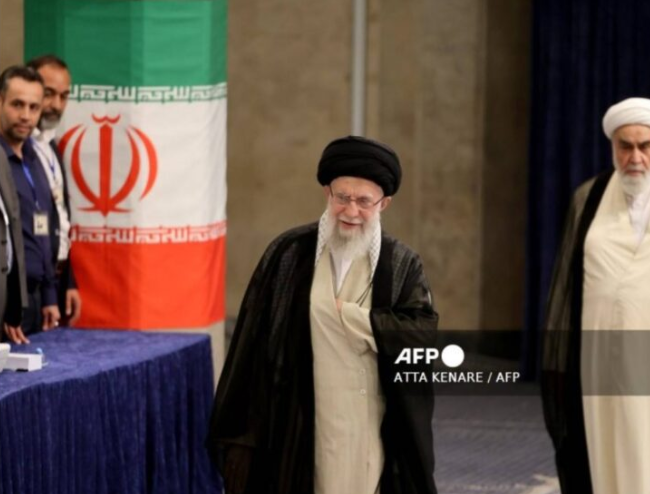
Iran’s supreme leader Ayatollah Ali Khamenei cast his ballot shortly after the polls opened and urged Iranians to vote.

“Election day is a day of joy and happiness for us Iranians,” he said in a televised speech where he also called for a high turnout.

“We encourage our dear people to take the issue of voting seriously and participate,” he said.

Advertisement

The election in sanctions-hit Iran comes at a time of high regional tensions between the Islamic Republic and its arch-foes Israel and the United States as the Gaza war rages on.

Polls opened at 8:00 am (0430 GMT) in 58,640 stations across the country, mostly in schools and mosques.

Polling stations will be open for 10 hours, though authorities could extend voting time as in previous elections.

Early projections of the results are expected by Saturday morning and official results by Sunday.

Advertisement

If no candidate wins 50 per cent of the vote, a second round will be held on July 5, for only the second time in Iranian electoral history after the 2005 vote went to a runoff.

The candidacy of Pezeshkian, until recently a relative unknown, has revived cautious hopes for Iran’s reformist wing after years of dominance by the conservative and ultraconservative camps.

Iran’s last reformist president, Mohammad Khatami, praised him as “honest, fair and caring”.

Khatami, who served from 1997 to 2005, had also endorsed the moderate Hassan Rouhani, who won the presidency and sealed Iran’s nuclear deal in 2015 with Western powers before it was derailed three years later.

Advertisement

The Iranian opposition, particularly in the diaspora, has called for a boycott of the vote.

Ultimate political power in Iran is held by Khamenei, the supreme leader.

Khamenei insisted this week that “the most qualified candidate” must be “the one who truly believes in the principles of the Islamic Revolution” of 1979 that overthrew the US-backed monarchy.

The next president, he said, must allow Iran “to move forward without being dependent on foreign countries”.

Advertisement

However, Khamenei also said that Iran should not “cut its relations with the world”.

During campaign debates, Jalili criticised the moderates for having signed the 2015 nuclear accord which promised Iran sanctions relief in return for curbs on the programme.

Jalili said the deal, which the United States withdrew from in 2018 under then-president Donald Trump, “did not benefit Iran at all”.

Pezeshkian has urged efforts to salvage the agreement and lift crippling sanctions on the Iranian economy.

Advertisement

“Are we supposed to be eternally hostile to America, or do we aspire to resolve our problems with this country?” he asked.

The contentious issue of compulsory head covering for women also emerged during the campaign, almost two years since a vast protest movement swept the country after the death in custody of Mahsa Amini, 22.

An Iranian Kurd, Amini had been arrested for an alleged violation of the country’s strict dress code for women.

In the televised debates, all candidates distanced themselves from the sometimes heavy-handed police arrests of women refusing to wear the hijab head covering in public.

Advertisement

Pourmohammadi, the only clerical candidate, said that “under no circumstances should we treat Iranian women with such cruelty.”
Continue Reading
Advertisement
Click to comment

Warning: Undefined variable $user_ID in /home/naijuinz/public_html/wp-content/themes/zox-news/comments.php on line 49

You must be logged in to post a comment Login

Leave a Reply

News

Photos/Video: Senator pays working visit to FERMA boss Agbasi over failed Gashaka Saldana federal road

Published

on

ADVERTISEMENT
Zoom Ad
ADVERTISEMENT
Zoom Ad

…demands urgent intervention

…as Engr promises to carry out on the spot assessment to effect restoration

Senator Haruna Manu representing Taraba Central alongside his colleague Senator Babangida Hussaini, paid a working visit to the Managing Director of the Federal Roads Maintenance Agency (FERMA), Engr. Chukwuemeka Agbasi, over urgent intervention on failed Gashaka Sardauna federal in Taraba.

Senator Manu explained the critical need for repairs on the stretch linking in Gashaka LGA to Sardauna LGA, Serti – Gembu road, from Mayo -Selbe in Gashaka LGA to Nguroje in Sardauna LGA and from Lekitaba in Sardauna LGA to Gembu where the road is about to totally cave-in due to gully erosion.

Responding, Engr. Agbasi committed to conducting a formal evaluation of the road to make the necessary restoration arrangements.

Rounding up, Senator Manu urged the agency to prioritize the restoration plan to ensure the road is fixed without delay as it serves as a major link to two big local government areas in the state.


WATCH:

Advertisement
Continue Reading

News

Reps Probe Lingering Bille Gas Leak, Demand Swift Action as Regulators Confirm Emissions Continue

Published

on

ADVERTISEMENT
Zoom Ad
ADVERTISEMENT
Zoom Ad

By Gloria Ikibah

The House of Representatives Committee on the South-South Development Commission has launched an investigation into the prolonged gas leak 0in Bille Community, Degema Local Government Area of Rivers State, expressing concern over the environmental and humanitarian consequences nearly a year after the incident first came to public attention.

At an interactive session held on Thursday at the National Assembly, lawmakers questioned officials of the National Oil Spill Detection and Response Agency (NOSDRA) and Nigerian Upstream Petroleum Regulatory Commission (NUPRC) over the delayed response, conflicting official reports and the continued hardship faced by residents.

In his opening remarks, Committee Chairman, Rep. Julius Pondi, said the investigation was intended to establish the facts surrounding the incident, evaluate the response of relevant agencies and identify measures to prevent a recurrence.

Advertisement

He said: “The Committee approaches this engagement with an open mind. Our objective is neither to prejudge any individual or institution nor to apportion blame without due process. Rather, we seek to establish the facts, identify operational or regulatory shortcomings, ensure every stakeholder is held accountable and make practical recommendations that will strengthen environmental governance and improve regulatory oversight.”

Presenting NOSDRA’s findings, the agency’s Director of Oil Field Assessment, Cyrus Nkangwang, told lawmakers that it first became aware of the unusual gas emissions in October 2025 after receiving reports from residents of Bille Community.

He explained that the investigations detected elevated concentrations of methane, hydrogen sulphide and carbon dioxide, as well as groundwater contamination, deteriorating air quality and potential health risks for residents.

When the committee sought clarification on whether the emissions had stopped, NOSDRA admitted that the leak was still active.

Advertisement

Pondi asked:
“After this moment we speak, has this stopped leaking or is the leak still going on?”

The agency’s representative replied:
“It’s still leaking.”

Lawmakers also queried the apparent delay in responding to the incident despite repeated complaints from the affected community.

Explaining the circumstances, the NOSDRA official said:
“This incident is not the regular incident that attracts reportage. It is not from any facility. It is gas bubbling that enveloped the community… It started gradually and the community brought it to public attention before we became aware of it.”

Advertisement

Representing the NUPRC, Mr Joseph Olushola said the commission only became directly involved after a stakeholders’ meeting convened by the Ministry of Petroleum Resources on February 4, 2026.

“Our clear involvement started when that meeting was called. Before then, we had reports of investigations being carried out by NOSDRA. We also believed we should have been brought up to speed since the community had reported the incident”, he said.

He disclosed that joint investigations involving Renaissance Africa Energy, Newcross Exploration and Production, NNPC Eighteen Operating Limited and host community representatives confirmed methane emissions across approximately 1.5 kilometres of the community.

According to him, extensive field studies, laboratory analyses and geological investigations found no evidence linking the emissions to existing oil and gas infrastructure.

Advertisement

He explained that the evidence suggested the gas was migrating naturally from deep underground reservoirs.

“There is no relationship between the pipeline, the facility, to the signature and the structure of the gas seepage.

“This began to give an indication that this gas may be coming from deep reservoirs up to the surface. We therefore commenced detailed geological and geophysical investigations to determine the source, the trigger and the migration pathways”, he said.

Describing the incident as unusual, the NUPRC official added:
“This is novel. We have studied similar seepages around the world, but the expanse, the duration, the pressure of the bubbling and the fact that it is linked to almost every borehole and water well in Bille Community makes this a special occurrence.”

Advertisement

Lawmakers, however, questioned why residents had continued to suffer while investigations dragged on.

Pondi asked:
“From December to February when you got involved till now, what happened to the Bille people? Whose water has been affected? Who does not have clean water to drink? Whose farmland has been devastated? What remedial measures have you taken?”

In response, the commission said it had pursued both technical investigations and humanitarian interventions.

The commission disclosed that relief materials had already been distributed and that a medical outreach programme would begin within two weeks.

Advertisement

“No operator has been found culpable, but the industry decided to rally round as part of its corporate social responsibility.

“An integrated relief programme involving medical outreach, provision of potable water and safety management is ongoing while technical investigations continue”, he noted.

The regulator also acknowledged that the community’s environment had been adversely affected.

“The water is contaminated. Air is polluted. We visited and we felt it. You smell the odour”, he said.

Advertisement

Officials explained that temporary measures had been introduced to vent gas above rooftop level to reduce fire risks, but maintained that a lasting solution would depend on identifying and sealing the source of the seepage.

The hearing also revealed inconsistencies between reports submitted by the two regulatory agencies.

Committee members questioned a section of NOSDRA’s report indicating that the NUPRC had “no pipeline record in the area”, an assertion the commission firmly rejected.

“Emphatically, no. We have always had records of the pipelines, their operating status, pressures, temperatures and other operating parameters,” the NUPRC official said.

Advertisement

Asked to explain the discrepancy, NOSDRA maintained that the statement reflected discussions at an earlier stakeholders’ meeting but admitted it may have conveyed a misleading impression.

Several lawmakers criticised what they described as the slow pace of intervention.

One member remarked:
“Are we saying after eight months we cannot stop the leakage? If we cannot, then the only thing left is to relocate the village.”

Another urged the Federal Government to immediately involve the National Emergency Management Agency (NEMA), describing the situation as a humanitarian emergency.

Advertisement

The committee also questioned why the Environmental Remediation Fund established under the Petroleum Industry Act had not yet been deployed.

Responding, the NUPRC official said remediation could only commence after investigators identified the precise source of the gas seepage.

“Any attempt to conduct remediation now will be like plastering over cracks. We cannot begin remediation until we identify and stop the source”, he stated.

On the possibility of relocating residents, the commission revealed that it had advised the Rivers State Government to consider a managed evacuation pending the outcome of ongoing health and risk assessments.

Advertisement

“The laboratory analysis shows there are gases that should not normally be breathed. Government should consider a managed evacuation of the people pending further investigations”, he said.

Pondi assured residents that the House committee would sustain its oversight until a permanent solution was found, insisting that protecting lives, public health and the environment remained its foremost priority.

Continue Reading

News

Video of Deltans scooping fuel from Tanker in Asaba surfaces online

Published

on

ADVERTISEMENT
Zoom Ad
ADVERTISEMENT
Zoom Ad

A video depicting residents scooping fuel from a leaking tanker in Asaba, the Delta State capital, has surfaced on social media, raising fresh concerns over public safety.

The incident reportedly occurred around the City Gate area of Asaba after a tanker developed a leak, causing its contents to spill onto the road.

Rather than fleeing the scene over fears of a possible explosion, dozens of people were seen rushing toward the tanker with buckets, jerrycans, kegs and other containers to collect the leaking fuel.

Footage circulating online captured men and women crowding around the tanker as they struggled to fill their containers, apparently ignoring the dangers associated with highly flammable petroleum products.

Advertisement

Eyewitnesses said the leaking tanker quickly attracted a large crowd, with many residents taking advantage of the situation to gather free fuel despite the significant risk posed by the spill.

The incident has sparked widespread reactions on social media, with many Nigerians expressing concern over the hazardous behavior and warning that such actions could easily trigger a devastating fire or explosion.Africans & Diaspora

Safety experts have repeatedly cautioned the public against approaching or attempting to collect fuel from damaged tankers, noting that even a small spark from a vehicle, mobile phone, cigarette or any ignition source can ignite spilled fuel and lead to catastrophic consequences.

Fuel tanker accidents have claimed hundreds of lives across Nigeria over the years, particularly in situations where residents gathered to scoop spilled petrol before an explosion occurred.

Advertisement

The latest incident has renewed calls for greater public awareness on the dangers of fuel spills, with many urging motorists and residents to immediately vacate areas where petroleum tankers are leaking and allow emergency responders to secure the scene.

As of the time of filing this report, there was no official statement from the relevant authorities regarding the incident, and it remained unclear whether emergency personnel were deployed to contain the fuel leak or prevent further danger.

Continue Reading

Trending

Copyright © 2024 Naija Blitz News