Connect with us

News

South Africa’s ex-leader Zuma expelled from ruling ANC

Published

on

ADVERTISEMENT
Zoom Ad
ADVERTISEMENT
Zoom Ad

By Francesca Hangeior.

 

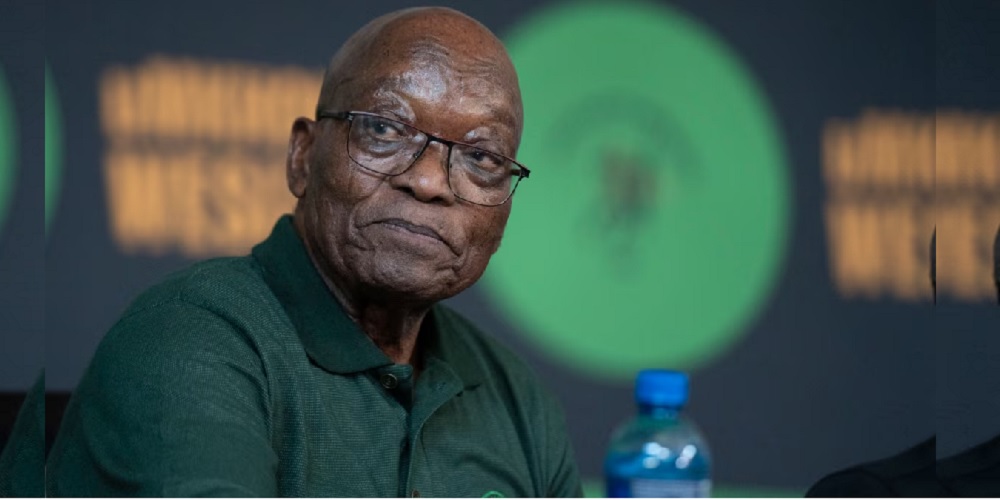
South Africa’s ruling ANC on Monday expelled its former leader ex-president Jacob Zuma for leading a rival party into elections following disciplinary proceedings.

The African National Congress, which lost its absolute parliamentary majority for the first time in May largely due to Zuma’s defection, said the veteran politician’s conduct was “irreconcilable” with its constitution.

Advertisement

“Former President Jacob Zuma has actively impugned the integrity of the ANC and campaigned to dislodge the ANC from power while claiming that he had not yet severed his membership,” ANC Secretary General Fikile Mbalula told a press conference.

He was thus “expelled” from the party, Mbalula said.

The ANC first suspended the scandal-tainted ex-leader in January, after he endorsed the newly formed uMkhonto weSizwe (MK).

MK cut into the ANC’s share of votes in the May 29 elections, taking third place with 14.5 percent.

Advertisement

The ANC managed 40 percent in the May vote — its weakest score since it came to power three decades ago to replace the apartheid government.

The result forced it to form a coalition government with nine other parties. MK was left out and is leading the opposition, with 58 lawmakers in the 400-seat National Assembly.

MK, a populist, radical leftist party, initially disputed the election result.

“His platform is dangerous, appeals to extremist instincts in our body politic and riles up a political base that may foment social unrest,” Mbalula said of Zuma’s MK.

Advertisement

Zuma has been barred from serving as an MP because of a 2021 conviction for contempt of court.

After news of his upcoming expulsion was leaked, the party lashed out at the “grave injustices against its leader”.

“An examination of the leaked document reveals that the disciplinary process was not only not only profoundly flawed but also conducted in a manner akin to a kangaroo court,” said MK spokesman Nhlamulo Ndhlela.

Elected South African president in 2009, he was forced from office in 2018 under the cloud of corruption allegations and was replaced by long-term rival, President Cyril Ramaphosa.

Advertisement

The charismatic and outspoken 82-year-old still carries considerable political clout in South Africa, even enjoying support within some factions of the ANC.

Many believed his political career would end when he was sentenced to 15 months in jail in June 2021 after refusing to testify to a panel probing financial corruption and cronyism under his presidency.

His imprisonment triggered riots that sparked South Africa’s worst episode of violence since the fall of apartheid, leaving more than 350 dead.

He spent only two months behind bars and was released for health reasons, after which Ramaphosa commuted his sentence.
Advertisement
Continue Reading
Advertisement
Click to comment

Warning: Undefined variable $user_ID in /home/naijuinz/public_html/wp-content/themes/zox-news/comments.php on line 49

You must be logged in to post a comment Login

Leave a Reply

News

NAMA Pushes for 56% Share of Aviation Revenue

Published

on

ADVERTISEMENT
Zoom Ad
ADVERTISEMENT
Zoom Ad

…agency say ageing infrastructure threatens airspace safety

…AAAU call for statutory funding to build aviation workforce

By Gloria Ikibah

The Nigerian Airspace Management Agency (NAMA) has urged the National Assembly to increase its share of the statutory five per cent aviation revenue pool from 22 per cent to 56 per cent, warning that the current funding structure is no longer sufficient to sustain the country’s air navigation infrastructure.

Advertisement

At the same public hearing organised by the House of Representatives Committee on Aviation on Thursday, the African Aviation and Aerospace University (AAAU), Abuja, also wants inclusion as a statutory beneficiary of the five per cent Ticket Sales Charge (TSC), proposing that at least 10 per cent of the fund be reserved for aviation education, research and manpower development.

Speaking before lawmakers, NAMA Managing Director, Engr. Farouk Ahmed Umar, said the responsibilities of the agency  had expanded significantly over the years while its funding had remained inadequate, despite the critical role it plays in ensuring the safety of Nigeria’s airspace.

He stressed that aviation safety depends on well-funded institutions across the sector, including the regulator, accident investigators, meteorological services and training institutions, but argued that NAMA’s operational burden deserved greater financial support.

According to him, the agency currently receives just 22 per cent of the statutory revenue pool, despite being responsible for managing Nigeria’s air navigation services.

Advertisement

Umar clarified that NAMA was not asking for an increase in the existing five per cent charge on air tickets but a review of how the available revenue is shared among aviation agencies.

“Long before a passenger boards an aircraft, NAMA’s personnel and systems are already at work. A flight plan must be processed, aeronautical information must be current. Radios must be clear. Navigation aids must be serviceable. Surveillance must be available. Controllers must be at their positions. Engineers must be ready to respond. Power and backup power must hold.

“When the aircraft takes off, all these elements must come together, not later that day, not after a supplementary release, but at that very moment.

“That is the nature of air navigation services. They are continuous, technology-intensive and unforgiving of delay. A broken office printer can wait until morning. A degraded safety-critical communication link cannot. A postponed meeting may be inconvenient. Deferred radar support, navigation-aid calibration or controller training can reduce the resilience of the national system”, he said.

Advertisement

The NAMA chief revealed that the agency spent more than N43 billion on its operations in 2023, including about N21 billion on personnel costs, over N12 billion on capital projects and more than N10 billion on overheads.

He lamented that the agency’s navigation charge had remained at N11,000 per flight since 2008 despite rising inflation, exchange rate pressures, higher energy costs and increasing expenses associated with maintaining modern aviation technology.

“These are not abstract numbers. Behind them are controllers, engineers, communication systems, navigation aids, surveillance platforms, power systems, spares, software, calibration, training and facilities spread across our country.

“At the same time, a navigation charge as low as ₦11,000 per flight had remained unchanged since June 2008.

Advertisement

“Consider what has happened to the cost of fuel, electricity, foreign exchange, imported components, software licences and specialist training since 2008. The service has had to absorb today’s costs with yesterday’s tariff base.

“The dedication of our workforce has helped bridge that gap, but dedication is not a substitute for a sustainable funding system”, he added.

Umar also drew attention to the ageing Total Radar Coverage of Nigeria (TRACON) system, warning that maintaining obsolete surveillance equipment was becoming increasingly difficult due to limited availability of spare parts and changing manufacturer support.

He added that Nigeria must also invest in emerging technologies such as performance-based navigation, satellite surveillance, digital aeronautical information systems and cybersecurity to remain globally competitive.

Advertisement

The NAMA boss further appealed to lawmakers to recognise obstacle assessment and WGS-84 aeronautical surveys as chargeable technical services undertaken by the agency.

He explained that NAMA was uniquely positioned to carry out the specialised technical work linking aeronautical surveys, obstacle analysis, flight procedure design and airspace management.

While insisting that the regulatory aspect of Aviation Height Clearance should remain with the appropriate authority, he argued that NAMA should be paid directly for the technical components of the service.

Umar also called for the harmonisation of existing aviation laws, noting that while the Civil Aviation Act allocates 22 per cent of the revenue pool to NAMA, the agency’s enabling Act provides for 23 per cent.

Advertisement

“The law should speak with one voice. The beneficiaries should be named correctly; the percentages should total 100 per cent; collection and remittance responsibilities should be unambiguous; and the effective date should be clear”, he said.

Although he acknowledged that redistributing the statutory revenue could affect other aviation agencies, he argued that future allocations should be based on operational realities rather than historical arrangements.

“A regulator and an Air Navigation Service Provider are both indispensable, but their cost structures are not identical. The law should recognise those differences while ensuring that every safety institution remains viable”, he said.

Making a final appeal, Umar urged lawmakers to consider the critical infrastructure and skilled workforce behind every safe flight within Nigerian airspace.

Advertisement

“When a pilot calls an air traffic controller over Nigerian airspace, that voice is more than a radio transmission. It is the sound of a national safety system working.

“Behind it are years of training, towers and centres, antennas and links, radar and navigation aids, engineers and procedures, generators and batteries, software and vigilance. The country expects that voice to be clear, confident and continuously available.

“I respectfully pray the National Assembly to approve a 56 per cent allocation to NAMA from the existing five per cent pool; harmonise the affected enactments; recognise obstacle assessment and WGS-84 aeronautical survey as chargeable NAMA technical services; establish transparent, automated remittance; and pair the enhanced allocation with firm accountability and oversight.

“Give us the means and hold us to the result. Give Nigerian airspace the resilience it requires and require us to demonstrate that resilience. In doing so, this National Assembly will not simply amend a percentage. It will strengthen the safety, efficiency, sovereignty and future competitiveness of our nation’s airspace”, he stated.

Advertisement

Also addressing the hearing, Acting Vice-Chancellor of the African Aviation and Aerospace University, Prof. Mustapha Abdullahi, argued that sustainable growth in the aviation industry will not be possible without consistent investment in training and research.

He said the university, established as Nigeria’s specialised aviation institution, should be recognised as a statutory beneficiary of the Ticket Sales Charge to support the development of skilled aviation professionals.

According to him, aviation safety ultimately depends on a steady supply of competent air traffic managers, aeronautical engineers, aviation managers, meteorologists, aerospace scientists, airport managers and other specialists.

Earlier, Speaker of the House of Representatives, Rt. Hon. Tajudeen Abbas, reaffirmed the commitment of the 10th House to strengthening the financial framework of Nigeria’s aviation industry.

Advertisement

Represented at the hearing, the Speaker said the proposed legislative reforms were aimed at improving the capacity of aviation agencies to safeguard the country’s airspace while boosting investor confidence in the sector.

Chairman of the House Committee on Aviation, Rep. Abdullahi Garba, said the bills under consideration were designed to strengthen the financial and institutional foundations of Nigeria’s aviation industry, improve transparency and enhance service delivery across the sector.

Continue Reading

News

Namdas Applauds President Tinubu Over  Military Welfare Package

Published

on

ADVERTISEMENT
Zoom Ad
ADVERTISEMENT
Zoom Ad

…say army expansion will strengthen border security

By Gloria Ikibah

Director-General of the Border Communities Development Agency (BCDA), Dr Abdulrazak Namdas, has praised President Bola Ahmed Tinubu for approving an upward review of salaries and allowances for personnel of the Nigerian Armed Forces, describing the move as a major boost to troop morale and national security.

Namdas also welcomed the President’s approval for the expansion of the Nigerian Army from eight to 12 divisions, alongside the recruitment of 28,000 additional personnel, saying the decision would significantly enhance security across Nigeria’s border communities.

Advertisement

The former Chairman of the House of Representatives Committee on Army said the expansion would improve military presence in many underserved areas, particularly the country’s border settlements.

He noted that the initiative would benefit more than 3,000 border communities spread across 105 local government areas in 21 states, many of which currently have little or no military presence.

Describing the President’s decisions as timely and far-reaching, Namdas said they reflected a strong commitment to the welfare of military personnel and the country’s security.

“This salary hike sends a strong message to our troops on the frontlines and in barracks across the country that their service is seen, valued, and appreciated. Increasing the take-home pay of our officers and men will not only enhance welfare but also strengthen operational efficiency, retention, and patriotism within the Armed Forces.

Advertisement

“I equally commend Mr President for approving the expansion of the Nigerian Army from eight to 12 divisions; and in addition the directive for the recruitment of 28,000 personnel. This is a bold and courageous investment that can reset the nation’s Armed Forces,” he said.

Namdas stressed that a motivated and adequately equipped military remains crucial to tackling insecurity and delivering on the Federal Government’s Renewed Hope Agenda.

He also expressed confidence in the ability of the Ministry of Defence, the military high command and other relevant agencies to ensure the smooth implementation of the new welfare package.

The BCDA Director-General urged Nigerians to continue supporting the Armed Forces through prayers and public goodwill, while encouraging military personnel to remain disciplined, professional and committed to their constitutional responsibilities.

Advertisement

“I salute our gallant men and women in uniform. I believe Mr President’s gesture will go a long way in boosting morale and enhancing the war against insecurity in the country. May God continue to protect and strengthen our Armed Forces,” Namdas added.

Continue Reading

News

Nigerian military authorities place N60m bounty on two most wanted bandits, expose ISWAP commanders

Published

on

ADVERTISEMENT
Zoom Ad
ADVERTISEMENT
Zoom Ad


The Nigerian military has unmasked several senior commanders of the Islamic State West Africa Province (ISWAP) following what it described as a major intelligence breakthrough during ongoing counter-terrorism operations in the Lake Chad region of Borno State, placing a combined ₦60 million bounty on two of the group’s most wanted leaders.

The development came after troops of the Headquarters Joint Task Force (North East), Operation HADIN KAI, recorded a series of successful offensives against ISWAP terrorists operating in northern Borno, leading to the recovery of critical intelligence materials that exposed the identities, operational locations and command structure of several high-ranking insurgent leaders.

Acting Military Information Officer of Operation HADIN KAI, Captain Mohammed Goni, said troops recovered several technical devices and other high-value intelligence materials, including a camcorder allegedly used by the terrorists to produce propaganda videos and document their operations.

Advertisement

According to him, forensic exploitation of the recovered devices generated actionable intelligence that enabled security forces to identify terrorist hideouts and several senior ISWAP commanders operating within the Mangari–Metele–Dogon Chukun axis along the fringes of the Lake Chad Basin in Abadam and Kukawa Local Government Areas of Borno State.

The military subsequently released photographs of dozens of identified ISWAP leaders and field commanders in a public appeal for information capable of leading to their arrest.

A large intelligence poster bears the inscription: “Most Wanted ISWAP Leaders – We Know Them. You Can Stop Them. These are known ISWAP terrorists and commanders operating in our communities. Your information can save lives and help restore peace.”

The poster contains photographs and aliases of at least 38 suspected ISWAP commanders and fighters believed to be active across northern Borno and the Lake Chad region.

Advertisement
Continue Reading

Trending

Copyright © 2024 Naija Blitz News