Connect with us

News

JUST IN: Court Confines Protesters In Abuja To MKO Abiola Stadium

Published

on

ADVERTISEMENT
Zoom Ad
ADVERTISEMENT
Zoom Ad

By Kayode Sanni-Arewa

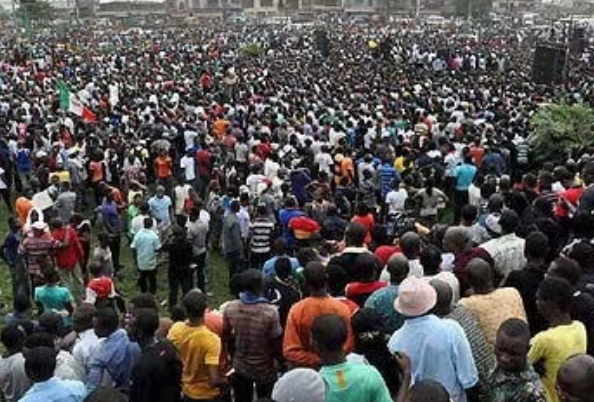
Justice Sylvanus Oriji of the Federal Capital Territory High Court in Abuja has restricted protesters in the August 1 demonstration to the MKO Abiola Stadium in the nation’s capital.

Justice Oriji issued the order on Wednesday while delivering a ruling in an ex-parte application brought before him by the Minister of the Federal Capital Territory (FCT) Nyesom Wike.

In the exparte application argued by his counsel, Ogwu Onoja, the FCT Minister had applied for an order of interim injunction restraining the five leaders of the protesting groups from gathering or parading themselves along any roadway, streets, offices, and public premises within the FCT between August 1 to August 10, or any other day thereafter, pending the hearing and determination of the motion on notice.

Advertisement

He also applied for another order of interim injunction mandating the security agencies to prevent the protesting leaders from gathering or parading themselves along any roadway, offices, or public premises within the FCT between August 1 and 10, pending the hearing of his motion on notice.

The minister who said that the Federal Government was not averse to the protest, claimed that intelligence and security reports reaching him indicated that some elements within the leadership of the protesters intend to capitalize on the planned protest to cause havoc and irreparable damages to public facilities and blocking of roadways to prevent movement of persons and vehicles and disturb public peace.

He claimed that when he contacted the security agencies to ensure that the planned protest did not degenerate into criminality and disturbance of public peace and order, he was told that they were not well equipped to manage any crisis that may arise from the planned protest at short notice.

In his ruling, Justice Oriji, who recognized the rights of the protesters to embark on the protest, however, restricted them to the stadium given the genuine fears expressed by the minister.

Advertisement

“In the light of the above, the court considers it appropriate and expedient to grant an order under the omnibus or general prayer to ensure that the rights of the protesters are guaranteed and that the protest does not negatively or adversely affect the rights of other citizens to move about and to ensure that properties and other public facilities are not destroyed,” the judge held.

He therefore ordered the 1st to 5th respondents to “use the Moshood Abiola Stadium” only for the protest.

Meanwhile, the court ordered the service of processes in the suit as well as the confinement order on the respondents by placing the same on the newspapers.

Defendants in the suit are Omoyele Sowore, Damilare Adenola, Adama Ukpabi, Tosin Harsogba, persons unknown, Inspector General of Police, Commissioner of Police, Director General of the State Security Service, Director General, Nigeria Civil Defense Corps, Chief of Army Staff, Chief of Air Staff, Chief of Naval Staff as 1st to 12th respondents.
Advertisement
Continue Reading
Advertisement
Click to comment

Warning: Undefined variable $user_ID in /home/naijuinz/public_html/wp-content/themes/zox-news/comments.php on line 49

You must be logged in to post a comment Login

Leave a Reply

News

Boko Haram Faction Pocketed 90% Of Nigeria’s Nearly $5.8Million Ransom Payments In One Year –Report

Published

on

ADVERTISEMENT
Zoom Ad
ADVERTISEMENT
Zoom Ad

A single faction of Boko Haram collected 90% of all ransom money paid to kidnappers across Nigeria between July 2025 and June 2026, according to a new report by SBM Intelligence, in a finding that suggests the country’s kidnap-for-ransom crisis has been effectively captured by a designated terrorist organisation.

The report, titled The Capture of Nigeria’s Kidnap Economy, found that of ₦7.779 billion ($5.78 million) paid in ransom nationwide during the period, the Jama’atu Ahlis Sunna Lidda’awati Wal-Jihad (JAS) faction of Boko Haram and its allied cells took ₦7.0015 billion from just eight recorded incidents.

“Attributing each ransom to the actor named in its reporting, the JAS faction and its allied cells account for N7.0 billion of the N7.779 billion paid around the country, a staggering 90% of all ransom collected in Nigeria this year, from just a handful of incidents,” the report stated.

By contrast, the entire diffuse population of bandits and unaffiliated kidnappers, responsible for 146 separate cases, collected only ₦719.4 million between them, or 9.2% of the national total.

Advertisement

Two abductions, ₦7 billion

SBM Intelligence traced almost the entire national ransom bill to two mass abductions carried out months apart.

In April 2026, a faction reportedly commanded by one Ali Ngulde abducted 416 people from Ngoshe in Gwoza, Borno State, issuing a 72-hour ultimatum for ₦5 billion. The report said the full amount was paid, the largest single ransom SBM has ever recorded.

Months earlier, in November 2025, gunmen abducted 315 pupils and staff from St Mary’s School in Papiri, Niger State, in what the report called “one of the worst mass abductions in the country’s history.” Multiple intelligence sources cited in the report put the ransom paid at ₦2 billion.

Advertisement

“Together, these two incidents account for N7 billion and explain almost the entire national ransom bill,” the report said.

A “bumper harvest” for terrorism

The report described the shift as a structural change in how Nigeria’s kidnap industry now functions, warning that a “designated terrorist organisation is no longer merely participating in the kidnap economy; in ransom terms, it is the kidnap economy.”

It drew a sharp contrast between the economics of ideologically-driven mass abduction and everyday criminal kidnapping. Bandits and unaffiliated kidnappers, the report found, demanded ₦13.492 billion across 146 cases but collected only 5.3% of it. JAS, meanwhile, demanded ₦9.205 billion and collected 76.1% of what it asked for.

Advertisement

“Measured by what was demanded, the kidnap economy is a crime of the many. Measured by what was actually paid, it is dominated by a single terrorist organisation,” the report said.

It added that this concentration carries strategic consequences beyond the immediate cash figures: “For a designated terrorist organisation to collect N7 billion in a single year is hardly the criminal-justice failure that it may appear to be, because, on the contrary, it is a material transfer of resources to an insurgency, one that buys weapons, pays fighters and sustains the very campaign that produces the next round of abductions.”

A record-setting demand

The report noted that 2026 marked the first year in the life of the annual series that the highest amount demanded in a single incident and the highest amount actually paid were identical, the ₦5 billion Ngoshe ransom.

Advertisement

“In every prior year, a wide gulf separated the boldest demand from the largest settlement; and the fact that the two now coincide is the clearest possible signal of a counterparty with the leverage to be paid exactly what it asks,” the report said, attributing that leverage to a group “holding hundreds of hostages, and willing to kill.”

Inversion of the naira-dollar trend

The report also flagged a break from the pattern of recent years, in which ransom sums in naira climbed while their dollar value stagnated due to currency devaluation.

In 2026, the naira strengthened even as the ransom total rose, meaning the dollar value of ransom paid, approximately $5.7 million, more than tripled from the previous cycle’s $1.66 million.

Advertisement

Call for action on financial flows

SBM Intelligence argued that the concentration of ransom proceeds in the hands of a single armed group changes the calculus for how the crisis should be addressed, calling for action to disrupt the financing rather than treat kidnapping purely as a policing problem.

“Breaking this cycle demands two actions: disrupting the financial flows that now underwrite insurgency, and addressing the economic desperation that supplies its foot soldiers,” the report concluded. “Without a coordinated strategy that targets both the profitability of the crime and its roots, Nigeria risks entrencing kidnapping not merely as a criminal industry but as a funding mechanism for the very groups that most threaten its stability.”

Advertisement
Continue Reading

News

Impeachment move: Suspected thugs invade Ondo Assembly

Published

on

ADVERTISEMENT
Zoom Ad
ADVERTISEMENT
Zoom Ad

Suspected thugs on Thursday invaded the Ondo State House of Assembly amid the lingering crisis over the alleged impeachment of the Speaker, Olamide Oladiji.

The men, said to be from Ondo town, the constituency of the embattled Speaker, reportedly moved around the Assembly complex, visiting different offices without disclosing their purpose.

A staff member, who spoke on condition of anonymity, said the development caused tension among workers as the suspected thugs moved from one office to another.

According to the source, the situation was eventually brought under control following the intervention of a lawmaker, Olajide Oguntodu, some other members of the Assembly and security personnel.

Advertisement

The source said the intervention prevented the situation from escalating, adding that the suspected thugs were subsequently forced to leave the premises.

The development came amid the unfolding leadership crisis in the Assembly, with lawmakers reportedly divided over the fate of Oladiji.

The alleged impeachment move has heightened tension around the legislative complex, with security personnel maintaining a presence to forestall a breakdown of order.

As of the time of filing this report, there was no official statement from the Assembly authorities on the alleged invasion or the circumstances surrounding the impeachment proceedings.

Advertisement
Continue Reading

News

SAD! NLC General Secretary Emmanuel Ugboaja is dead

Published

on

ADVERTISEMENT
Zoom Ad
ADVERTISEMENT
Zoom Ad

Emmanuel Ugboaja, the fifth General Secretary of the Nigeria Labour Congress and the first Nigerian lawyer to work full-time for a trade union, has died after a protracted illness.

NLC President Joe Ajaero announced Ugboaja’s passing by reading a letter from his family to members of the Congress National Executive Council meeting in Enugu. Details surrounding his death remained sketchy at the time of filing.

Born May 15, 1966, Ugboaja obtained a law degree from the University of Calabar in 1987 before entering the trade union movement in 1993. He served as General Secretary of NUCFRLANMPE from 2000 to 2005, participated in constitutional reform conferences under Presidents Obasanjo and Jonathan, and was appointed NLC General Secretary in August 2019 following a competitive selection process ratified at the NEC meeting in Kano.

His death leaves a significant void in Nigeria’s organised labour movement.

Advertisement

Vanguard

Continue Reading

Trending

Copyright © 2024 Naija Blitz News