News
EXPOSED; How Tinubu’s Aides, Ministers shared N54bn forfeited by Emefiele’s accomplices
- /home/naijuinz/public_html/wp-content/plugins/mvp-social-buttons/mvp-social-buttons.php on line 27
https://naijablitznews.com/wp-content/uploads/2024/08/kjjh.jpg&description=EXPOSED; How Tinubu’s Aides, Ministers shared N54bn forfeited by Emefiele’s accomplices', 'pinterestShare', 'width=750,height=350'); return false;" title="Pin This Post">
- Share
- Tweet /home/naijuinz/public_html/wp-content/plugins/mvp-social-buttons/mvp-social-buttons.php on line 72
https://naijablitznews.com/wp-content/uploads/2024/08/kjjh.jpg&description=EXPOSED; How Tinubu’s Aides, Ministers shared N54bn forfeited by Emefiele’s accomplices', 'pinterestShare', 'width=750,height=350'); return false;" title="Pin This Post">
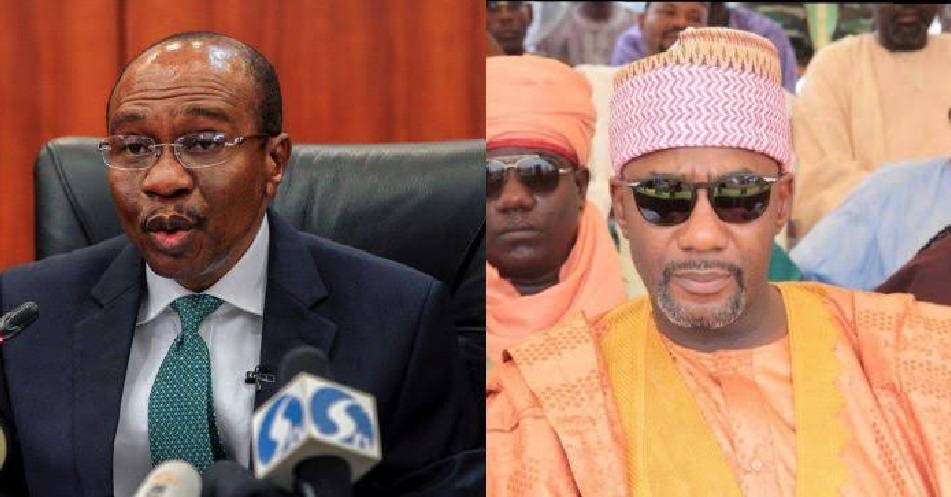
Some of President Bola Tinubu’s ministers and aides are accused of sharing over N54 billion from the N120 billion forfeited to the Federal Government by Aminu Yaro and his wife, Saadatu Yaro.

The Yaros, who were associates of former CBN Governor Godwin Emefiele, reportedly agreed to forfeit the funds as part of a plea bargain with the EFCC to drop pending criminal charges.
According to sources, a portion of the forfeited monies, totalling N54 billion, were disbursed among key ministers and advisers of Tinubu in cooperation with EFCC officers.

“Emefiele’s accomplices Aminu Yaro and his wife, Saadatu Yaro, forfeited N120 billion as plea bargaining,” one of the sources said. “Now Tinubu’s aides and ministers shared over N54 billion of the money amongst themselves, and the EFCC is explicitly aware.”
When contacted by reporters, Mr. Dele Oyewale, the EFCC’s Head of Media and Publicity, declined to comment on the accusation, neither confirming nor denying it.
“Let me find out; I will get back to you,” he said.
Oyewale had not responded to reporters as of Tuesday, when this report was filed.
According to reports, the EFCC’s investigations discovered a N70 billion scam reportedly committed by Godwin Emefiele, former CBN governor, in cooperation with others.
According to sources who spoke to our reporter, Emefiele, Alhaji Aminu Yaro, Sarkin Hausawa of Lagos, and his wife, Saadatu Ramallan Yaro, generated the monies through a foreign exchange differential fraud operation that Emefiele assisted.
Sources added that Emefiele blatantly misused his official privileges by committing FX differential fraud with the cooperation of the Sarkin Hausawa Lagos, Yaro, and his wife.
“This is a case of forex differential fraud involving the CBN governor, Godwin Emefiele.
“The governor sells forex to various individuals at the official rate on paper. He has an understanding with the individuals that they will sell at the black market rate when the CBN credits the banks of the individuals that buy the forex.
“When they sell, the difference will be paid into the account of Aminu Yaro on behalf of Emefiele,” one of the sources said.
“So far, about N70 billion has been traced to the account in the course of the investigation.”
According to these sources, Saadatu Ramallan Yaro was a signatory on the firm account where the cash was put.
SaharaReporters revealed on May 22, 2023, that the EFCC charged Saadatu Ramallan Yaro and her company with money laundering charges worth more than N140 billion before Justice Obiora Egwuatu of the Federal High Court in Abuja. Yaro is also a director at April 1616 Investment Limited and Amsamay Limited.
In a 25-count allegation, she was accused of neglecting to report Tsami Babi Resources Limited’s activities, allowing transfers of over N100 billion into the company’s account with a new generation bank, in breach of her duties as a director of a designated non-financial corporation.
In a second 12-count allegation, Saadatu Ramallan-Yaro and M.A.Y. Fine Fragrance Limited, a designated non-financial institution, are accused of money laundering to the tune of N40 billion.

News
2027: Tinubu’s details incompletes as primary, secondary qualifications missing from INEC EC9 documents
President Bola Tinubu failed to include primary and secondary school qualifications in the educational qualifications section of the personal particulars submitted to the Independent National Electoral Commission, INEC, for the 2027 presidential election.
The documents, published by INEC on Saturday in line with its revised timetable for the 2027 general election, contain the nomination papers and supporting credentials of presidential and vice-presidential candidates.
A review of Tinubu’s EC9 nomination form shows that the President listed only a Bachelor of Science (B.Sc.) degree in Business Administration obtained from Chicago State University in 1979 under the educational qualifications section.
The sections provided for his primary and secondary school qualifications were left blank.
However, Tinubu attached copies of his university degree certificate and National Youth Service Corps, NYSC, certificate to his nomination papers.
In the form, the President stated that he was born on March 29, 1952, in Lagos and described his occupation as “Politician.”
He also declared that he worked at Mobil Nigeria Limited between 1983 and 1992 before serving as Governor of Lagos State from 1999 to 2007.
He listed his current employer as the Federal Government of Nigeria from 2023 to date and stated that he had never been dismissed from public service.
News
“Greatest Threat Is Misinformation, Not Technical Glitch” – INEC Chairman Tasks Media On Osun Poll Coverage
The Chairman of the Independent National Electoral Commission, INEC, Prof. Joash Amupitan, SAN, has described misinformation and disinformation as the greatest threat to the August 15 Osun State Governorship Election, urging the media to prioritize verified and ethical reportage.
He made the call on Saturday in Osogbo during an interactive session with media executives, describing journalists as the “Fourth Estate of the Realm” and critical stakeholders in the democratic process.
“However, your role as the Fourth Estate is critical to the survival of the process. In this final day window, the greatest threat we face is not technical failure, but the pathology of misinformation and disinformation,” the INEC Chairman said.
“Fake news, manufactured election-day panics, and the unauthorized declaration of parallel results are direct assaults on our public peace and democratic stability.”
He said the Commission has accredited field reporters through its dedicated portal “because we want you to see everything,” and in return demanded “a commitment to verified, ethical, and dispassionate reporting.”
“Verify your facts before you broadcast. When a glitch occurs in a single polling unit, do not report it as a systemic failure across the entire state,” Prof. Amupitan charged.
“Use your channels to educate voters: remind them that No PVC means No Voting, and that vote-buying remains a criminal offense that our partners at the EFCC and ICPC have been mandated to curb.”
Giving an update on readiness, the Chairman said the just-concluded mock accreditation proved the resilience of the BVAS.
“The Bimodal Voter Accreditation System (BVAS) demonstrated optimal field resilience. On average, it took between 30 seconds to 2 minutes to successfully verify a voter using either their fingerprints or facial recognition,” he stated.
“As a result, we have increased the total number of BVAS for the election from 4,427 to 5,130 so as to service split polling units in large PUs in Ife East, Irewole, Egbedore, Ede North, Osogbo. In the process, we increased the number of back-ups from 664 to 1,328 for quick intervention in case of any malfunction.”
Prof. Amupitan also addressed insecurity, saying INEC has moved “from reactive monitoring to proactive prevention” through ICCES. He listed hotspot LGAs to include Atakumosa East and West, Boripe, Ede North and South, Ife Central, Ifedayo, Ila, Osogbo, Ifelodun, and Oriade.
On inclusivity, he reaffirmed the Commission’s commitment to vulnerable voters.
“Democracy is incomplete if it excludes vulnerable populations. The Commission has integrated practical assistive devices across polling locations based on our disability mapping in Osun State. We have provisions for braille ballot guides for visually impaired voters; magnifying glasses for voters with albinism and low vision; EC40H poster manifests for hearing-impaired citizens and Priority Voting Queues for Persons with Disabilities (PWDs), pregnant women, nursing mothers, and the elderly,” he said.
The Chairman said 32,000 NYSC members have been engaged as ad-hoc staff via the INECPRES portal and that training for Supervisory Presiding Officers has been concluded.
“We do not care who wins the election; we only care how they win. Our sole job is to ensure that the process is clean, that every valid vote counts, and that the declaration reflects nothing but the true sovereign will of the Osun electorate,” Prof. Amupitan concluded.
The session had in attendance National Commissioners, the Osun REC Barrister Oluwatoyin Babalola, NUJ and BON leadership, Bureau Chiefs, Editors and other senior media executives.
News
Coalition want explanation over alleged BVAS failure in Osun mock accreditation exercise
A group, aegis of Coalition of Concerned Nigeria Citizens (CCNC), has called on the Independent National Electoral Commission (INEC) to immediately explain the alleged widespread failure of the Bimodal Voter Accreditation System (BVAS) during Saturday’s mock accreditation exercise conducted ahead of the August 15 Osun State governorship election.
The group alleged that the mock accreditation, designed to test the commission’s readiness for the election, experienced significant technical challenges after commencing in selected polling units across the state, raising concerns about INEC’s preparedness for the governorship poll.
In a statement signed by its spokesperson, Comrade Raufu Sodiq, popularly known as “Oluomo Success,” the coalition claimed that although the exercise was scheduled to begin at 8:30 a.m., it started behind schedule in some polling units. It further alleged that less than 40 minutes after the exercise commenced, many BVAS machines stopped recognising fingerprints, facial features and Permanent Voter Cards (PVCs), preventing the successful accreditation of voters in the affected locations.
Describing the development as disturbing, the group said a mock accreditation exercise should ordinarily boost public confidence in the electoral process, adding that the reported malfunction of the accreditation devices during the test exercise had instead raised questions about the commission’s level of preparedness.
The coalition argued that accreditation remains the foundation of every credible election because it determines voter eligibility and protects the integrity of the electoral process. According to the group, any failure at that stage could undermine public confidence in the outcome of the election if not urgently addressed.
CCNC also queried why such challenges allegedly occurred despite what it described as years of preparation and substantial public investment in electoral technology. It called on the Osun Resident Electoral Commissioner and the national leadership of INEC to provide a comprehensive explanation on the cause of the reported BVAS malfunction and disclose measures being taken to prevent a recurrence during the August 15 governorship election.
Among its demands, the coalition asked INEC to clarify whether the reported glitches resulted from software, hardware or configuration problems, explain its contingency plans for the 3,763 polling units across Osun State, replace any faulty BVAS machines and consider conducting another mock accreditation exercise before the election to restore public confidence.
“We believe in strong democratic institutions and do not want to see INEC fail. However, public confidence must be built on competence, transparency and accountability. The people of Osun deserve an election where every eligible voter can cast their vote without avoidable technological failures,” the statement read.
The group further urged the Chairman of INEC to personally address Nigerians before the governorship election by explaining the outcome of the mock accreditation exercise, outlining corrective measures and assuring voters that all identified technical challenges would be resolved before Election Day.
INEC had organised the mock accreditation exercise to assess the functionality of the BVAS and other electoral processes ahead of the governorship election scheduled for August 15 across the state’s 3,763 polling units.
-
News9 hours ago‘Stop complaining about Buhari, others for your failures,’ Atiku slams Tinubu
-
News9 hours agoJust in: After Hugh Backlash, FIFA finally Scrap Infantino’s £15B World Cup Private Investment Proposal
-
News9 hours agoColonel Behind Alleged Tinubu Coup Plot Admits Failed Promotion Pushed Him, Reveals How He Was Lured By Army Chiefs
-
News9 hours agoHow Prison Inmate on D*ath Row Livestreamed On TikTok, Earned Money From Ogun Prison
-
News9 hours agoINEC Rejects PDP’s Submission Of Jonathan As 2027 Presidential Candidate
-
News8 hours agoSAD: FRSC Enugu Sector Commander Is Dead
-
News8 hours agoUK PM Burnham slams Infantino, says he’s the ‘wrong man’ to lead FIFA
-
News5 hours agoPresidency reacts to Onaiyekan’s comment, says he’s not speaking for Christians, insists Catholics supporting Obi

Warning: Undefined variable $user_ID in /home/naijuinz/public_html/wp-content/themes/zox-news/comments.php on line 49
You must be logged in to post a comment Login