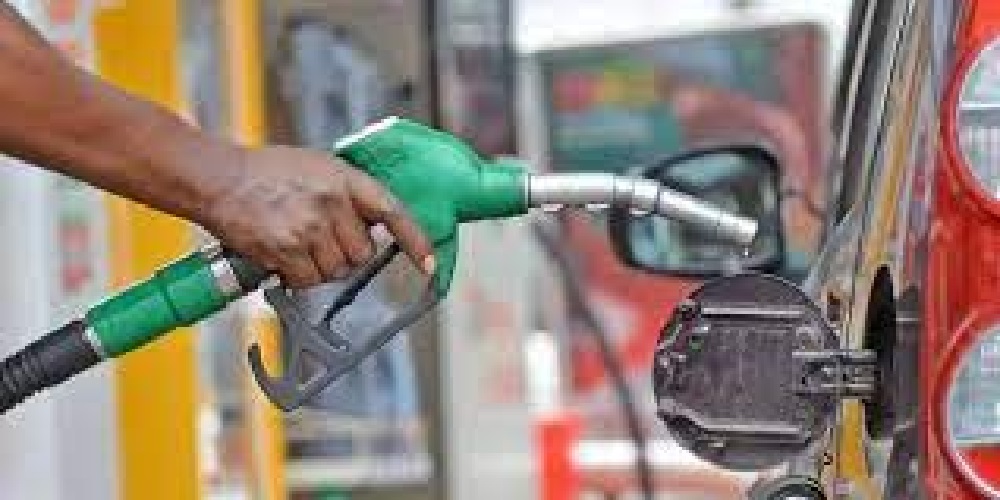
The pump prices of Premium Motor Spirit, popularly known as petrol, may rise above N1,000/litre in filling stations as the cost of the commodity in some private depots has been increased to between N920 and N950/litre.


This comes as protesters hit the streets of Abuja on Monday demanding the immediate dismissal of the Group Managing Director of the Nigerian National Petroleum Corporation Limited, Mele Kyari, over the lingering fuel scarcity in the country.
It was gathered that the NNPC had informed oil marketers about the financial strain regarding the importation of petrol. 
This raised concerns among dealers, who expressed worry over the possibility of a halt in the importation of petrol by NNPC.
NNPC’s spokesperson, Olufemi Soneye, had earlier declared that the national oil company was facing financial strain. NNPC is the sole importer of PMS into Nigeria, shouldering subsidies on the commodity running into several trillions of naira.
“NNPC Ltd faces financial strain due to PMS supply costs, impacting supply sustainability. NNPC Ltd has acknowledged recent reports in national newspapers regarding the company’s significant debt to petrol suppliers. This financial strain has placed considerable pressure on the company and poses a threat to the sustainability of fuel supply.
“In line with the Petroleum Industry Act, NNPC Ltd remains dedicated to its role as the supplier of last resort, ensuring national energy security. We are actively collaborating with relevant government agencies and other stakeholders to maintain a consistent supply of petroleum products nationwide,” Soneye stated on Sunday.
Marketers said officials from the oil company had informed petrol dealers of the development, stressing that this may further lead to a hike in the pump prices of petrol in the coming weeks.
“Now, only NNPC Trading imports petrol, and they have come out frankly to inform marketers that they can no longer sustain it, which means they are subsidising the product all this while,” the National Publicity Secretary, Independent Petroleum Marketers Association of Nigeria, Ukadike Chinedu, stated.
“Of course, the cost of petrol at the pumps may rise further in the coming weeks because up till now we are not getting enough products. So, something urgent and drastic needs to be done to tackle this challenge now.”
This came as private depots sold a litre of petrol at prices ranging from N920 to N950/litre, contrary to the position of the Nigerian Upstream and Downstream Petroleum Regulatory Authority that depots were meant to sell PMS at a stipulated price.
The spokesperson of the NMDPRA, George Ene-Ita, argued last week that the petrol price reports the regulator gets from its officials at the depots were different.
“Our depot people see a different price because we ask them to publish the prices at the depots every day and it is not N850/litre. Our field agents at the depots give us a different figure,” he said.
When told that some filling stations operated by independent marketers in Lagos and many other states dispensed their products for as high as N900 and N1,000/litre, the NMDPRA official said such outlets would be brought to book if apprehended.
“If we get these outlets, all we do is to try and shut them down, because NNPC is the company that brings in the product and they tell us how much they sell as their ex-depot prices to off-takers. And we sit down together and work out the margins and there is no way it should be that high,” Ene-Ita added.
The NMDPRA spokesman further noted that there was no way the agency could reconcile the high cost of petrol sold by independent marketers.
“Once we get these outlets, we are going to shut them down. NNPC tells us how much they sell and there is no way the pump prices should be that high. We don’t expect it to be higher than N650/litre,” he warned.
However, checks by our correspondents on Monday showed that many filling stations owned by independent marketers sold petrol close to N1,000/litre. In Kaduna, it sold for as much as N1,300/litre in some filling stations.
The National Vice Chairman of IPMAN, Hammed Fashola, disagreed with the NMDPRA, saying the regulator was not being sincere.
“I read in the news that the NMDPRA said no depot is selling at higher rates. I am not sure that should come from the NMDPRA. They are not being sincere. The NMDPRA knows what is happening because they have their officials in all the depots.
“The private depots sell to us at higher rates. If you add the cost of transportation and other expenses, the price will be higher. That’s what you see today in filling stations,” he stated.
Fashola said the cause of the price disparity between the major and independent marketers is the fact that IPMAN members do not get the product directly from NNPC, the sole importer of fuel.
According to him, the shortage in supply still lingers and the law of demand and supply has been taking place, saying higher demands have been forcing up the price of the product.
He stated that many private depots now sold petrol at N920/litre, while others sold for N950/litre.
This, he said, explained why the independent marketers, who own about 80 per cent of the filling stations in Nigeria, sell at higher rates than the major marketers.
“As of today, some depots sell at N920 and some sell at N950/litre. That’s the situation we find ourselves and that is why the price is higher in filling stations,” Fashola stated.
Fashola had charged the government to either return the fuel subsidy or remove it instead of engaging in partial deregulation.
“The Federal Government and the NNPC should just do this thing once and for all. If they want to deregulate, let them deregulate fully, because we know where we are going; that’s why you’re seeing this disparity whereby the NNPC retail is selling at N580 in Lagos and independent marketers will be selling at N900 or N800.
“You can see the gap. It’s killing our business; we are not making progress; it’s killing us,” Fashola stated.
The IPMAN official added that some of the depot owners also faced lots of challenges to get fuel from NNPC.
“The problem is that it’s only NNPC that can bring this product because of forex. They are the only ones selling. Two or three independent marketers once tried to import, but they could not.
“The depot owners we are talking about, if you are close to some of them, they will tell you what they go through too, because when the NNPC brings this product, it will not drop it at their depots. They will pay hired daughter vessels and pay some charges in dollars. So, you cannot even blame them so much. That’s the reality. The depot owners also incur some expenses,” he noted.
Meanwhile, scores of demonstrators carried banners calling for NNPC boss Kyari’s immediate dismissal.
The protest comes after NNPC admitted that its substantial debt to suppliers was endangering the sustainable fuel supply.
Chanting solidarity songs and displaying several banners that read ‘We are tired of fuel scarcity and stories on why refineries are not working, ‘No direction under Kyari’ and ‘We want accountability in the affairs of NNPCL’, the demonstrators lamented that Kyari’s tenure was marked by a dismal scorecard that raised more questions than answers.
Addressing newsmen at Unity Fountain after the rally in Abuja, Convener of the Coalition of Concerned Civil Society Organisations, Aminu Abbas, wondered why a nation blessed with oil like Nigeria would continue to suffer acute petrol scarcity.
He said, “To President Ahmed Bola Tinubu and all those in positions of power, we say the time to act is now. Show us that you stand with the people, not those who profit from our misery. Mr Kyari must be shown the way out and the NNPCL must be reformed to serve the interests of all Nigerians. We will not be silenced.
“The fuel scarcity we endure today is not just a mere inconvenience; it is a calculated perpetuation of suffering. Under Mr Kyari’s leadership, the situation has gone from bad to worse, with no end in sight. What has he done to alleviate this crisis? It is clear he seems intent on maintaining a status quo that benefits only a select few while the masses suffer.
“Why do we, the people, have to endure endless queues, inflated prices, and the daily uncertainty of whether we can fuel our vehicles or power our homes? The answer lies in the gross incompetence and mismanagement that have become the hallmarks of Mr. Kyari’s leadership.”
Human rights lawyer, Femi Falana, also raised concerns over the rising cost of living, stating that arbitrary hike in the pump price of petrol and its attendant scarcity had contributed to the number of fewer vehicles plying Nigerian roads.
Falana, who disclosed this on Sunday’s Channels Television’s Politics Today, also charged that it is high time the ‘monumental fraud’ bedeviling fuel importation in Nigeria was exposed.
He said, “How many people have bought a car in the last one and a half years, even second-hand cars (in Nigeria)? The point I am making is that the number of vehicles on the road has been reduced. Yet, we were told that during the days of boom, the NNPCL was subsidising 68 million litres of fuel per day.
“Now that there are problems, scarcity and poverty everywhere, no new vehicles on the road, we are still paying for 68 million litres of fuel. Whereas before this regime came on board, the Comptroller General of Customs challenged the NNPCL during a Senate public hearing to pay for the amount of fuel that is said to be smuggled out of the country.”
Falana said emerging reports suggested that NNPC was not telling Nigerians everything it claimed to know about the smuggling of crude from the country.
According to him, smugglers need 2,000 petrol tankers to scoop the volume of fuel the corporation claimed was being stolen frequently.
“This is because we man the borders and you will need about 2,000 tankers to take out the amount of fuel the NNPCL claimed was being smuggled out. So, what has changed? This is the time to expose the monumental fraud that has characterised the importation of fuel,” he stated.
TUC kicks
However, the Trade Union Congress and major opposition parties on Monday warned that new increment in pump price of petrol might inevitably lead to uncontrolled protests nationwide.
They made the appeal in separate interviews with The PUNCH on Monday.
The National Deputy President, TUC, Tommy Etim, said, “Any increment in may lead to uncontrolled protests by citizens. Recall that one of the agreements that we had with the government was that the refineries would start working. Till now, the date for the Port Harcourt refinery is still hanging.
“Last week, the FCCPC gave instruction that prices of goods and services must come down. What they failed to understand is that things don’t happen like that, you must attend to the real reasons behind the high cost of these goods and services.”
APC anti-people – PDP
The Peoples Democratic Party said the All Progressives Congress was against the interests of the people.
While reacting to the issue on Monday, PDP National Publicity Secretary Debo Ologunagba, said they were not surprised by the ongoing scarcity and rising fuel prices under the APC administration.
“It is unfortunate that fuel may now be sold at N1,300 and above. But we are not surprised because that is what the APC is all about — anti-people,” Ologunagba told The PUNCH.
“That is the mark of the APC. The APC represents misfortune from (Muhammadu) Buhari to the current administration, which seems to take pleasure in the suffering of the citizens.
“The strength of a government is not about claiming ‘we can do it, we will do it, and nothing will happen.’ It is about the capacity to listen to the cries of the people.
“The primary purpose of government is the welfare and security of the people. If you introduce a policy that you believe will improve people’s lives but it does not, this is chaos. We are suffocating, and it is unfortunate that this government is not concerned about the welfare of the people.
“Nigerians are hungry and dying by installments. The anger of a hungry people is better imagined, but the APC does not care.”
Also, the Labour Party expressed disappointment in the manner the Federal Government and the NNPC handled the issue of the lingering fuel scarcity.
Speaking with The PUNCH, National Publicity Secretary, LP, Obiora Ifoh, lamented that it was unfortunate Nigerians did not heed their warnings on the impending suffering the President Bola Tinubu administration would visit on the people before the 2023 election.
He said, “We warned Nigerians about this before the election. It will not just end with the fuel pump price. As you would have observed, things are getting higher in the market.
“All we can say is that Nigeria should brace for more for the remaining three years this regime has left. There is virtually nothing anybody can do about it. Most of the youths who went out for the #EndBadGovernance protest are still in detention till date.”
The National Publicity Secretary, New Nigeria People’s Party, Ladipo Johnson, also bemoaned the situation.
“What can we say again? We have been lamenting that things are not done properly. Yet, they told us once subsidy is gone, things will work smoothly. So, who will clean up the rubbish?
“The Tinubu-led government is responsible for the rubbish we are in today. They are mismanaging the economy. After all, is the NNPC not under them? So, they should stop the excuses,” Johnson stated.
Long queues persist
Meanwhile, the ongoing fuel scarcity across the country has worsened in most states in the South-East and South-South geopolitical zones.
On Monday, long queues were evident in several filling stations in Yenagoa, the Bayelsa State capital, with a litre of fuel selling between N950 and N1000.
In Delta, several fuel stations in twin metropolitan cities Warri and Effurun were without fuel, which led to long queues in the few filling stations with fuel to sell.
Consequently, black marketers had a field day, selling to desperate buyers in jerry cans at between N1,000 to N1,100/litre.
In Akwa Ibom State, NNPC mega stations dispensed for between N595 and N600/litre, while independent marketers sold for between N970 and N1000/litre.
There were no queues as independent marketers sold the product for N1,000 in Cross River, with other fuel stations dispensing for between N870 and N900/litre.
However, Abia State witnessed minimal queues as the product sold above N1000 on Monday, thus forcing a lot of private vehicle owners to resort to commercial transportation.
In Imo, it was sold for N970/litre in most stations while NNPC mega stations sold for N595.
In Ebonyi, the price of fuel hit N1,050 in Abakaliki, the state capital.
Although the price of the product keeps rising in the state amid queues, buyers for either domestic or commercial were unperturbed.
An Abakaliki resident, Peter Ogbu, said, “There are things you cannot do without, fuel is one of them. The situation in the country is such that you should prepare for the worst, because it may not get better any time soon.”
The situation in Edo State is not better as motorists sleep at NNPC mega fuel stations in an attempt to buy the product at a cheaper price.
The mega station, the only one that sells fuel for N591/litre, has witnessed an influx of motorists, who cannot afford to buy a litre for N950 at filling stations owned by independent marketers in the metropolis.
The problem was compounded by the fact that fuel stations owned by major marketers like Mobil, Total and Ardova Petroleum, who sell for between N695 and N699 per litre, hardly have fuel to sell to their customers.
In Rivers, there was no scarcity, but queues were present at NNPC mega stations and Mobil filling stations, which sold for N700 and N750 respectively, while independent marketers sold between N950 and N1,000/litre. The product sold for between N980 and N1100/litre on the outskirts of Port Harcourt.
In Anambra, fuel sold above N990 per litre in most petrol stations.
Most petrol stations visited in major cities Onitsha, Ekwulobia, Nnewi and Awka, sold the product at between N990 and N1,100/litre while only NNPC mega stations sold below N990 amid long queues.
This development has led to commercial drivers increasing transportation fares by above 50 per cent, thereby forcing commuters to pay more.
The scarcity, has also taken its toll on socio-economic activities in the North in the past two months.
On Monday in Kaduna State, there were long queues at the few fuel stations where petrol was available, while many independent marketers claimed to be out of stock as NNPC and other stations sold for N620/litre and N950-N1,300/litre respectively
It was same scenario in Kano as only a few stations opened for business. Independent marketers sold for between N980 and N1000/litre while black marketers sold for N1400 and N1600/litre.
Transport fares have jumped by at least 20 per cent, depending on the routes, in Plateau State following the hike in pump price and scarcity of the product.
A random survey of petrol stations within Jos, the capital city, showed that the prices ranged between N900 and N950/litre on Monday while the retail outlets of the NNPC sold for N670/litre.
Similarly, the long queues at fuel stations in Kwara have worsened as petrol sold for as much as N1,000/litre pump price in Ilorin, the state capital on Monday, as many independent marketers shut their stations over non-availability of the product.
While NNPC stations in various parts of the city sold for N580/litre, some independent marketers dispensed at between N800 and N1,000/litre.
It was same story in in Yola, the Adamawa State capital, where most filling stations were empty as pump price jumped to ₦1000/litre.
There were no fuel queues in most of the filling stations in Gusau, the Zamfara State capital, and other parts of the state as fuel for between N900 to 950/litre.
The product sold for between N930 to N950/litre in Lafis, Nasarawa State, amid scarcity, while in Benue State pump price ranged from N950 to N980/litre with free vehicular movement in and out of filing stations visited in Makurdi, the state capital.
In Sokoto, the scarcity persisted with a litre of the product selling for between N980 and N990/litre in most stations while NNPC sold for N620/litre.
There were long queues at NNPC outlets in Damaturu, Yobe State as the state oil firm sold for N637/litre while independent marketers sold for between N980 and N1000/litre.
A drive by one of our correspondents around the city of Lokoja, the Kogi State capital on Monday showed a reduction in queues in filing stations as the only station selling at N680 was Mobil at Paparanda roundabout.
Pump prices in most filling stations visited were adjusted to N900 and N950/litre.
There were long queues in parts of the southwest with the prices of the product determining the extent of the queues. In Ondo State, some filling stations sold between N660 and N700/litre and others selling for N850, N960 and N1000 selling without queues.
CSOs react
The Executive Director, Civil Society Legislative Advocacy Centre, Auwal Rafsanjani, questioned debts earlier disclosed by the NNPC, while criticising ongoing “unproductive expenses”, including the payment of refinery workers who have been inactive for years.
He challenged President Bola Tinubu to be accountable and to explain how the situation had escalated, despite previous claims of financial gains.
“Why is it that NNPC is still keeping unproductive expenses and spending as well as staff? In their last audit report, they showed that they are spending so much, billions, paying refinery workers that didn’t actually do anything for years.
“I think the Nigerian officials have not done very well in managing our national resources. President Tinubu, who is the Minister of Petroleum, needs to also account to the nation how this happens because it is under his leadership that the so-called subsidy was gone, and it is under his leadership that he says more money has been realised, and it is under his leadership that we are now hearing about the debt”, he said.
The Chairman of the Centre for Accountability and Open Leadership, Debo Adeniran, said the price hike would increase the hardship in the country to an “intolerable level”, while also describing it as a betrayal of trust by the government, following the negotiations for a N70, 000 minimum wage.
“It will increase the hardship in the country because already the hardship we are facing is getting to an intolerable level. If there will be further increase in macro-economic products, Nigerians will get near to breaking point. And that will make everybody become angry at the government. It is unwarranted for now.
“They should find a way to ensure that the fuel price does not increase. After all when the minimum wage was not negotiated, one of those things was discussed and because the labour unions didn’t want the increment in the petroleum as threatened by the government, they agreed to N70,000 as minimum wage. So, it will be a betrayal of trust if the government now allows increment on the prices of petroleum products.”
Credit: PUNCH