Connect with us

News

Anenih’s state burial not cause of Obaseki, Oshiomhole rift – Ex-commissioner

Published

on

ADVERTISEMENT
Zoom Ad
ADVERTISEMENT
Zoom Ad

By Francesca Hangeior.

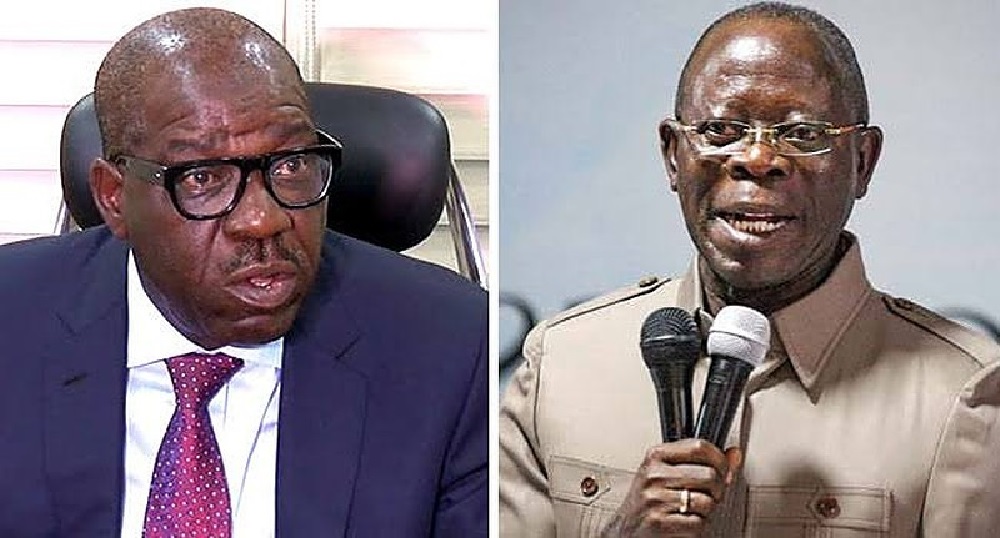
The Media Director of the Edo All Progressives Congress Campaign Council, Kassim Afegbua, has faulted the claim by Governor Godwin Obaseki that he fell out with a former governor of the state, Adams Oshiomhole, over the state burial given to the late Tony Anenih.

Obaseki said on Friday during the Peoples Democratic Party campaign for the September 21 governorship election in the state that one of the problems his administration had with Oshiomhole was that it organised a state burial for the deceased PDP leader.

Speaking to party supporters at Okpujie Demonstration Primary School in Uromi, Obaseki said Oshiomhole questioned the rationale behind his organising a state burial for Anenih.

Advertisement

He said, “When Chief Tony Anenih died, I gave him a state burial while I was still in the All Progressives Congres, and this is one of the things that caused problems between Oshiomhole and me.

“He said the late Anenih was not an elected official, so why would I give him a state burial? I said the man has done more than many governors, so he deserved it.”

However, Afegbua, who was a commissioner under Oshiomhole, said in a statement on Sunday that Obaseki was playing cheap politics with the claim.

He said, “I just read what was attributed to Governor Obaseki as the reason he gave for falling out from Comrade Adams Oshiomhole, and I wondered why an executive governor could make such a bogus claim just to score a cheap political point.

Advertisement

“It is terrible character indices for Governor Obaseki to raise such devious reason as the rationale for his breaking apart from Comrade Adams Oshiomhole.

“Governor Obaseki is not even smart at all. Chief Tony Anenih, of blessed memory, died on the 28th of October 2018, at the age of 85, but Governor Obaseki’s political squabbles with Comrade Oshiomhole started in late 2017, by February 2018, it had become so visible and almost irreconcilable.

“I remember vividly that I met with Governor Obaseki at his residence on Commercial Avenue on the 18th of May 2018 in an attempt to bring the two of them together after a series of failed reconciliations by Alhaji Aliko Dangote and a couple of other governors.

“At the 18th May 2018 meeting, I confronted Governor Obaseki about the reason why he fell out with Comrade Adams Oshiomhole, his benefactor. He pointedly told me that he just wanted to be his own man. He showed an aspect of his ethnic chauvinism when he rendered the following words; “that short man from that little village of Iyamho cannot run the show”.

Advertisement

“I remember asking him at what time he suddenly realised that his benefactor was a ‘short man’ and from ‘that little village’ because I recalled he was always carrying Oshiomhole’s bag each time they were travelling. At that point, his countenance changed.”

Afegbua said he insisted that he put together a team of 10 mutual friends to meet and resolve the issue, and the governor obliged him that evening before he left for Abuja the following day.

He added, “When I got to Abuja, I met with Comrade Oshiomhole and related to him my encounter with Governor Obaseki. He was willing to attend such a meeting but doubted if the governor was genuine in his affirmation. But on the evening of May 19, Governor Obaseki called me to inform me that he would no longer subscribe to the meeting and that I should call it off.

“When I called Comrade Oshiomhole to inform him of the governor’s disposition against the meeting, he told me he would have been surprised if the governor would have been available for the meeting. That was how I put off the meeting.

Advertisement

“Chief Tony Anenih died on October 28, 2018, almost a year after the political differences started. So, it is the height of ungodliness and devilish intentions for Governor Obaseki to make reference to the state burial for Chief Anenih as the cause of his differences with Comrade Oshiomhole.

“He wants to profit from the death of Chief Anenih for political reasons. I am ashamed to hear this and to read this. Imagine the height of desperation to implant a godson when he once quarrelled with the idea of a godfather. What manner of a leader is Governor Obaseki? Profiteering from the dead?”
Continue Reading
Advertisement
Click to comment

Warning: Undefined variable $user_ID in /home/naijuinz/public_html/wp-content/themes/zox-news/comments.php on line 49

You must be logged in to post a comment Login

Leave a Reply

News

NUT suspends strike, directs Oyo teachers to resume Thursday

Published

on

ADVERTISEMENT
Zoom Ad
ADVERTISEMENT
Zoom Ad

The Nigeria Union of Teachers (NUT) has suspended its industrial action across public primary and secondary schools in Oyo State, directing members to resume work on Thursday, July 2, 2026.

The decision followed fresh engagements with the Oyo State government and assurances on measures to improve security after the abduction of teachers and learners in Oriire Local Government Area.

In a statement jointly signed by the Oyo State Chairman of the union, Comrade Hassan Ajibola Fatai, and the State Secretary, Comrade Olukayode Salami, the union said the suspension was approved by its national leadership after reviewing the prevailing security situation and considering appeals by the state government and other stakeholders.

According to the statement, the strike, which was declared in protest against the kidnapping of teachers and students in the Oriire Local Government Area, was suspended in the interest of teachers, learners, and the general public.

Advertisement

“The Nigeria Union of Teachers hereby directs all public primary and secondary school teachers in Oyo State to resume official duties on Thursday, July 2, 2026,” the statement read.

The union said the state government had assured it of sustained efforts to secure the safe release of the abducted victims while strengthening security around schools and vulnerable communities across the state.

It noted that the government had committed to intensified rescue operations for the abducted teachers and learners, the establishment of a well-equipped Joint Security Task Force to patrol vulnerable schools and access roads, continuous engagement with affected families, psychosocial support and rehabilitation for rescued victims, and payment of gratuities and other entitlements to the families of deceased teachers.

Other commitments, according to the union, include strengthening the Safe School Initiative through public sensitisation and improved early warning systems, enhancing emergency response mechanisms, dismantling criminal hideouts, upgrading school infrastructure, tackling illegal mining and open grazing in forest reserves, improving community intelligence gathering, ensuring the speedy prosecution of criminal suspects, improving the welfare of security personnel, and deploying technology to improve school security.

Advertisement

The union commended its members for their discipline and solidarity throughout the industrial action while also appreciating the support of the All Nigeria Confederation of Principals of Secondary Schools (ANCOPSS) and the Association of Primary School Head Teachers of Nigeria (AOPSHON).

“We sincerely appreciate all our members, ANCOPSS, AOPSHON, and other stakeholders for their discipline, solidarity, and unwavering support during this period. Your cooperation has once again demonstrated our collective commitment to the welfare and safety of teachers and learners,” the statement added.

While directing teachers to return to the classroom, the union urged members to remain vigilant and report any security threats to the appropriate authorities.

“We urge all teachers to remain vigilant, law-abiding and promptly report any suspicious activities or security threats within their schools and communities to the relevant authorities. Together, we can build safer schools for our children and educators,” it stated.

Advertisement

The union reaffirmed its commitment to protecting the welfare and security of teachers, saying it would continue to engage the government until all outstanding concerns regarding the safety of teachers and learners are fully addressed.

“Our resolve to safeguard the lives, welfare and dignity of teachers remains unwavering. We shall continue constructive engagement with the government until every concern relating to the security of our members and learners is adequately addressed,” the statement said.

Continue Reading

News

Citizen Patience and Collaborative Efforts: A Pathway to Greatness for Tinubu’s Government, By Hajia Hansatu Zannah*

Published

on

ADVERTISEMENT
Zoom Ad
ADVERTISEMENT
Zoom Ad

Nation-building is never the sole responsibility of government; it is a shared endeavor that requires the active participation, patience, and collaboration of citizens. In Nigeria today, President Bola Ahmed Tinubu’s administration faces the daunting task of steering the country toward economic stability, social cohesion, and sustainable development. While policies and reforms are critical, their success ultimately depends on the willingness of citizens to remain patient and supportive during the often difficult process of implementation.

Transformational leadership demands bold decisions—structural reforms, economic adjustments, and institutional restructuring—that may not yield immediate results. In such circumstances, patience becomes a vital national asset. By resisting the urge for instant gratification and allowing time for reforms to mature, Nigerians can help create an environment where government initiatives are given the opportunity to succeed.

Every nation, regardless of its stage of development, grapples with challenges—economic struggles, political transitions, social tensions, and infrastructural gaps. These realities test the resilience of both leaders and citizens. In moments of strain, the attitude of the people toward their country becomes a powerful determinant of progress. Constructive criticism is healthy and necessary for accountability, but outright condemnation and vitriolic attacks against one’s nation can be deeply counterproductive.

Words shape perception, and perception influences reality. When citizens consistently speak negatively about their country, they reinforce hopelessness and despair. This weakens national morale and discourages foreign investors, partners, and allies who rely on the confidence of citizens as a measure of stability. By contrast, balanced and solution-oriented dialogue strengthens Nigeria’s image and inspires collective action.

Advertisement

Collaboration, however, goes beyond compliance—it requires active engagement. Citizens can contribute meaningfully to nation-building by supporting reforms through constructive dialogue rather than resistance, participating in civic duties such as voting, community service, and public consultations. These actions serve as catalysts for greater national progress. At the same time, holding leaders accountable in a respectful and lawful manner is essential. While harsh and divisive criticism may be insidious, patriotism calls for promoting unity across ethnic, religious, and political divides to strengthen national cohesion.

If citizens embrace patience and collaboration, Tinubu’s government stands a better chance of achieving greatness. Economic reforms can stabilize markets, infrastructural projects can transform communities, and social policies can uplift vulnerable populations. Greatness, in this context, is not merely about political success but about building a Nigeria where prosperity, justice, and peace are attainable for all.

Citizens are not passive observers; they are active participants in governance. By engaging in respectful dialogue, supporting reforms, and holding leaders accountable through lawful means, they contribute to the nation’s growth. Patriotism does not mean blind loyalty—it means believing in the possibility of progress and working toward it.

A nation is like a family; disagreements are inevitable, but condemnation destroys trust. Citizens must rise above destructive criticism and embrace constructive engagement. By doing so, they preserve the dignity of their country and create an atmosphere where greatness can flourish. The path to national transformation lies not in tearing down but in building up—through patience, collaboration, and unwavering belief in Nigeria’s future.

Advertisement

The greatness of any government is measured not only by the vision of its leaders but also by the resilience and cooperation of its people. For Tinubu’s administration, citizen patience and collaborative effort are indispensable. Together, government and citizens can write a new chapter in Nigeria’s history—one defined by progress, unity, and enduring impact.

*Hajia Hansatu Zannah is a distinguished member of the Governing Council of the African Union Agenda 2063 and Ambassador Plenipotentiary. She is also the widow of the late Zannah Umar Mustapha, former Deputy Governor of Borno State.*

Continue Reading

News

BREAKING: CBN revokes licences of 46 Microfinance Banks over failure to satisfy regulatory requirements

Published

on

ADVERTISEMENT
Zoom Ad
ADVERTISEMENT
Zoom Ad

The Central Bank of Nigeria (CBN) has revoked the operating licences of 46 microfinance banks across the country, citing their failure to meet key regulatory requirements for continued operation.

The decision takes effect from Wednesday, July 1, 2026, according to a statement issued by the Acting Director of the CBN’s Corporate Communications Department, Hakama Sidi-Ali. The apex bank said the action was taken in line with its powers under Sections 12 and 13 of the Banks and Other Financial Institutions Act (BOFIA), 2020, and was approved by the CBN Governor, Olayemi Cardoso.

According to the CBN, the affected institutions lost their licences after failing to satisfy the conditions required to remain licensed financial institutions.

The bank explained that the revocation was based on one or more regulatory infractions, including insufficient assets to meet liabilities, shutting down operations without obtaining CBN approval, prolonged inactivity and cessation of financial intermediation, failure to commence business within 12 months after receiving a licence, and failure to maintain the minimum capital requirements without impairment from accumulated losses.

Advertisement

The CBN described the move as part of its ongoing efforts to strengthen the nation’s financial system and ensure that all licensed financial institutions operate in compliance with existing laws and prudential regulations.

“The revocation of the licences is part of the Bank’s ongoing efforts to safeguard the stability of the financial sector, protect depositors, and ensure that licensed institutions comply with current laws and regulatory requirements,” the statement said.

The apex bank reiterated its commitment to maintaining a safe, sound and resilient financial system, stressing that it would continue to take appropriate supervisory and regulatory measures where necessary to sustain public confidence in Nigeria’s banking sector.

Advertisement
Continue Reading

Trending

Copyright © 2024 Naija Blitz News