Connect with us

News

Abiodun Presents N1.054trn Appropriation Bill To Ogun State House Of Assembly

Published

on

ADVERTISEMENT
Zoom Ad
ADVERTISEMENT
Zoom Ad

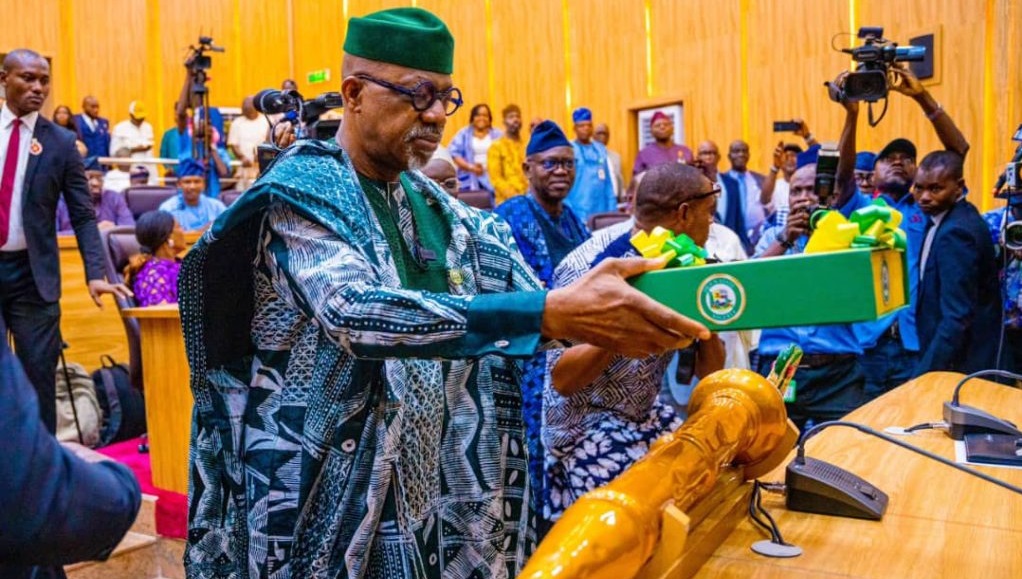
Ogun State Governor, Prince Dapo Abiodun, has presented a total of N1,054,542,020,147.47 to the State House of Assembly as the State’s proposed budget for 2025.


Speaking at the Assembly’s Complex, Oke-Mosan, Abeokuta, Governor Abiodun said the budget, tagged “Budget of Hope and Prosperity,” is made up of N453.56 billion as recurrent expenditure and N600.98 billion as capital expenditures.

Giving highlights of the appropriation, the governor said N120.1 billion would go for personnel costs, N37.49 billion for consolidated revenue cost, public debt charges would gulp N76.07 billion, while N219.86 billion would be spent on overhead costs.

On some of the key physical capital projects that would be executed in the 2025 budget, Abiodun listed the renovation of general and state hospitals and the purchase of laboratory and medical equipment across the state, revitalization of 80 primary health centers, and procurement of laboratory and medical equipment across all primary health facilities in the state, as well as the construction of roads across the state.

Advertisement

Other projects include the procurement and energizing of transformers, construction of fire stations across the state, upgrading of rural roads across the state, extension of the Redline Metro Rail from Agbado to Kajola, Blueline Metro Rail from Okokomaiko-Agbara/Lusada, and the Purpleline Metro Rail line.

He said the government would also embark on the construction of the Ogun Lodge Government House in Abuja, rehabilitate 150 km of feeder roads across the state, construct the OGIRS Revenue House, and a modern Court of Appeal in the state.

On the funding of the 2025 budget, Governor Abiodun said an estimated N120.97 billion would come from the State Internal Revenue Service, N193.85 billion from Ministries, Departments, and Agencies (MDAs), totaling N314.82 billion.

Statutory allocations from the Federal Government, including Value Added Tax, are projected at N228.06 billion, while capital receipts comprising internal and external loans as well as grants and aids are estimated at N472.66 billion.

Advertisement

Giving a sectoral rundown of the budget, the governor said education would gulp N117.83 billion (17%), health N134.538 billion (13%), housing and community development N66.382 billion (6%), agriculture and industry N65.387 billion (6%), infrastructure N284.456 billion (27%), recreation, culture, and religion N25.27 billion (2%), social protection N39.836 billion (4%), general public service – executive organ N46.863 billion (4%), general public service – (financial & fiscal affairs) N42.284 billion.

He said: “We will continue to accord priority attention to the completion of ongoing projects across the ISEYA development pillars; projects with revenue potentials; projects that enhance employment generation; projects consistent with priorities articulated in the State Economic Development Plan & Strategy 2021 – 2025.

“Projects that align with the seven thematic areas contained in the Medium-Term National Development Plan 2021-2025, namely: Economic Growth and Development; Infrastructure; Public Administration (Governance, Security, and International Relations); Human Capital Development; Social Development; Regional Development; Plan Implementation, Communication, Financing, Monitoring, and Evaluation,” the governor noted.

Giving a review of the 2024 budget, Governor Abiodun said the state had achieved 79% of its pro-rated revenue target and 56% of its pro-rated expenditure target as of September 30, emphasizing that the performance over the past few years underscores the state’s fiscal reliability.

Advertisement

“Our internally generated revenue capacity remains commendable among sub-national entities. We will continue to leverage existing statutes to enhance revenue transparency, broaden the base, and strengthen the state’s finances without imposing additional burdens on residents,” the governor assured.

In his opening remarks, the Speaker of the House of Assembly, Rt. Hon. Oludaisi Elemide, spoke on the need to grant autonomy to the legislature, increase the running cost, provision of official vehicles for the Clerk and other officers, as well as funds for the execution of constituency projects.

He said the Assembly in the last year considered 14 bills, of which nine were passed, while 32 motions were passed into resolutions, adding that the Assembly also ensured that funds meant for projects were judiciously used by Ministries, Departments, and Agencies of government through oversight functions


Advertisement

News

Jehovah’s Witnesses announce fresh adjustment to blood transfusion policy

Published

on

ADVERTISEMENT
Zoom Ad
ADVERTISEMENT
Zoom Ad

The Governing Body of Jehovah’s Witnesses has announced that members can now decide whether to accept or donate the four main components of blood based on their personal conscience.

The organisation made this known in a statement issued by its World Headquarters in Warwick, New York and made available on its website on Friday.

According to the statement, “the decision to accept red cells, white cells, plasma or platelets from another person’s blood is a matter of personal conscience.”

Jehovah’s Witnesses announce adjustment to blood transfusion policy
It added that “each Witness must decide whether or not to donate blood for the clearly expressed purpose of providing components or fractions for use by another person.”

Advertisement

However, the organisation said its position on whole-blood transfusion had not changed.

“The long-standing refusal of whole-blood transfusions on religious grounds, a core teaching based on the command to ‘abstain from blood’ (Acts 15:20), is unchanged,” the statement said.

International spokesman for Jehovah’s Witnesses at the organisation’s World Headquarters, Paul Gillies, said, “Blood remains sacred to Jehovah’s Witnesses, who continue to regard life and blood as precious gifts from God.

“We recognise that medical decisions involving blood components are a matter of conscience between each Witness and their God, Jehovah.”

Advertisement

The organisation said the adjustment “follows earlier updates regarding blood fractions and the use of one’s own blood during medical procedures.”

It added, “Since the Bible does not comment on such decisions, they are a matter of individual conscience. That same reasoning has now been extended to the four main components of blood.”

On medical care, the statement said, “Jehovah’s Witnesses love life and want the best available medical care. They do not practise faith healing, and they seek out doctors who can provide effective treatment in accord with their wishes, values and beliefs.”

Gillies said local congregations would not interfere in members’ personal decisions.

Advertisement

“Congregations do not involve themselves in personal decisions that rest with the individual conscience. We will continue to respect and support the personal decisions of our fellow believers.

“We are grateful, too, for the many skilled and compassionate physicians who provide quality medical care that respects our personal wishes regarding blood,” he said.

The organisation said Jehovah’s Witnesses number “over nine million worldwide, in congregations across more than 200 lands.”

Recall that the religious group had clarified its position on the use of a member’s own blood during surgery and other medical procedures.

Advertisement

The clarification allowed individual Witnesses to decide whether their blood could be removed, stored and returned to them during medical treatment, while the organisation maintained its position against receiving blood from another person.

Punch

Continue Reading

News

Army speaks on Boko Haram, ISWAP attack alert as fake

Published

on

ADVERTISEMENT
Zoom Ad
ADVERTISEMENT
Zoom Ad

The Nigerian Army has dismissed as fake and unverified a purported intelligence alert warning of planned Boko Haram and ISWAP attacks on schools, churches, mosques, NYSC orientation camps and other public institutions across the country.

Anele said the Army was aware of the circulation and had heightened vigilance across its formations and commands to prevent attacks on vulnerable facilities.

She described the purported intelligence as speculation and urged the public not to treat the document as an official Army security alert.

The response followed the circulation of a document purportedly signed by one A.M. Sodiq, which claimed that Boko Haram and ISWAP were planning coordinated attacks across several parts of the country.

Advertisement

The document listed churches, schools, NYSC orientation camps and other vulnerable locations as possible targets and alleged that suspected ISWAP operatives had begun surveillance of selected locations.

It further claimed that the alleged attacks could coincide with the resumption of the 2026/2027 academic session.

However, the Army disowned the document, maintaining that it did not originate from the institution.

The Army assured Nigerians that security formations remained on heightened alert and were taking necessary measures to protect schools, places of worship and other vulnerable public facilities.

Advertisement
Continue Reading

News

Police Allegedly Shoot Engine Oil Seller During Minna Protest

Published

on

ADVERTISEMENT
Zoom Ad
ADVERTISEMENT
Zoom Ad

MINNA, Niger State — An engine oil seller in Minna, the Niger State capital, has reportedly sustained serious injuries after allegedly being shot during a police operation to disperse protesters.

The victim, identified as Ibrahim Mohammed Dada, was reportedly standing outside his shop at Tunga Market when he was struck by a bullet.

Ibrahim’s brother, Yakubu Dada Mohammed, said the victim was not part of the protest and was attending to customers at his engine oil stall when the incident occurred.

According to him, Ibrahim was simply trying to earn a living and support his family when a police officer allegedly fired a shot that hit him in the head and severely injured his face.

Advertisement

«“He was not among those protesting. He was standing in front of his shop selling engine oil when one of the police officers fired a bullet that struck his head and badly injured his face,” Yakubu said.»

Ibrahim is currently receiving treatment at Minna General Hospital, where his condition was reportedly described as critical.

The incident occurred amid protests in Minna over the reported deaths of 37 miners who were allegedly in the custody of the Nigeria Security and Civil Defence Corps (NSCDC).

Reports indicate that 65 miners were arrested on September 15 and 16, with 37 subsequently reported dead while in security custody.

Advertisement

The protests, which began on Thursday, continued into Friday as security personnel moved to disperse demonstrators. Security forces were reportedly accused of using tear gas and live ammunition during the operation.

However, the circumstances surrounding Ibrahim’s shooting have not been independently established.

The Niger State Police Command spokesperson, SP Wasiu Abiodun, appealed for calm and said the incident would be investigated.

The case has since heightened concerns over the conduct of security personnel during the ongoing protests.

Advertisement
Continue Reading

Trending

Copyright © 2024 Naija Blitz News