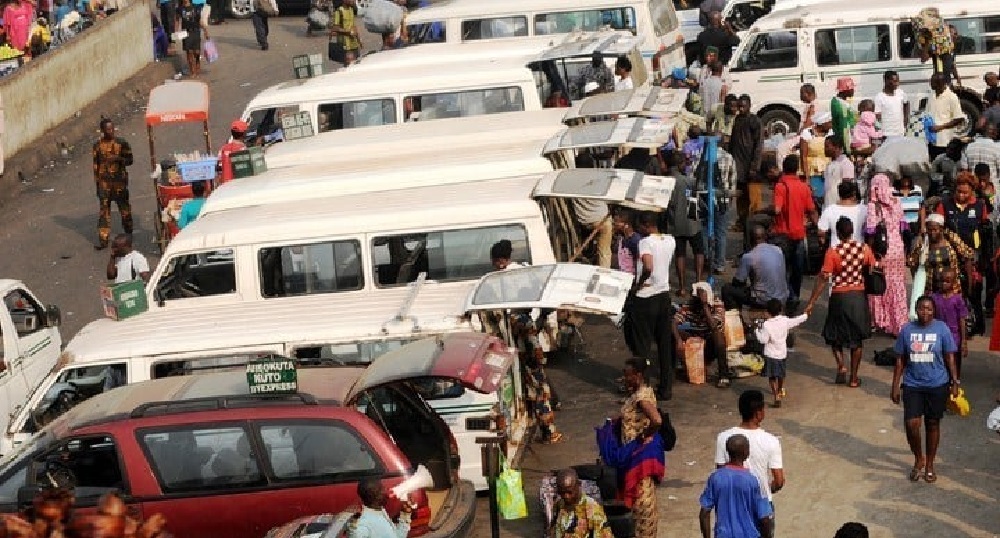
Despite the recent reduction in petrol prices by the Nigerian National Petroleum Company (NNPC) Limited and some petrol stations, bus drivers in Lagos, Ogun and Abuja say they will not lower their transport fares.


While Nigerians expected relief from the high cost of transportation following the reduction in petrol prices, the bus drivers told TheCable that soaring expenses for vehicle maintenance and spare parts have made it impossible to reduce fares.
On December 19, Dangote Petroleum Refinery reduced the ex-depot price of its petrol to N899.50 per litre. 
Similarly, the refinery partnered with MRS Oil Nigeria Plc filling stations to sell petrol at N935 per litre at its retail outlets.
Also, the Petroleum Products Retail Outlets Owners Association of Nigeria (PETROAN), on December 21, said the NNPC reduced its ex-depot price to N899 per litre in Lagos.
Checks by TheCable on December 23 showed that NNPC reduced the retail price of petrol at its outlets to N925 per litre in Lagos and N965 per litre in Abuja.
NNPC dropped the price of the product from N1,025 per litre in Lagos and N1,040 in Abuja.
Despite the reductions, transport fares remain unchanged.
Speaking to TheCable on December 31 at the Jabi motor park, John Chukwuma, a driver for one of the interstate transport services, which travels between Lagos and Abuja, said fares have not dropped due to the high cost of spare parts and vehicle maintenance.
“Yes, petrol prices have come down, but we’re still struggling with the high cost of spare parts and vehicle maintenance. These things haven’t reduced, and they make up a big part of our expenses,” he said.
“We still carry Abuja to Lagos N27,000 to N30,000.”
Also, a ticketing officer at the same bus terminal, who identified himself as Adebola, confirmed that fares had remained steady between December 23 and December 30.
“Even though the cost of petrol has dropped, other operational costs like staff salaries, taxes, and levies we pay to park unions are still the same, if not higher. It’s not just about petrol prices,” he said.
When asked what factors could lead to a reduction in fares, several drivers pointed to systemic issues.
Emeka Nwosu, a driver heading to Aba said if the government provides subsidies for spare parts or reduces toll gate charges, “we might be able to lower fares”.
‘COMMISSION, UNION FEES ALSO MADE IT IMPOSSIBLE TO REDUCE FARES’
Another driver, who spoke on condition of anonymity, in Lugbe Park, noted that while petrol prices have dropped, the union fees and commission to the owner of the vehicles have not.
He detailed the current expenses drivers face, including daily returns to vehicle owners, which have increased from N2,500 to N3,500 for older vehicles and up to N5,000 for newer models.
“Before, when they used to sell fuel for N500, we were carrying passengers from Lugbe to Lifecamp N500, and from Lugbe to secretariat N500 but it was later increased to over N1000. From Lugbe to anywhere inside town became N700. Now, even though petrol prices have dropped slightly, spare parts remain costly, so fares cannot come down,” he said.
“If you bring the price down to N500 or N600, driver cannot get balance, cannot eat food, and cannot pay the owner of the motor. Even the owners of the motor were collecting N2,500 for the old motor per day as a return but now, it is N3,000. Some collect N3,500 while delivery for new motor is N5,000.
“Before we were buying tyre N11,000 (new) but now, it is N45,000. Belgium (used tyres) was N3,000 now it’s N27,000-28,000. We are driving somebody’s car where the owner increased delivery fee from N2,000 to N3000. How will the driver pay the fee? We have family to feed, we will also pay union.
“Union fee was N50, but now, in some places it’s N300. If union load motor for you for 5-6 passengers, they will collect N300. For the first loading, they will give you ticket which is N300. That is N600 in total. Aside from that when you come back and load again, you must pay the N300.”
Giving a breakdown of daily earnings and expenses, the driver said for a route charging N700 per passenger, a six-seater bus makes N4,200 per trip but after subtracting union fees, petrol costs, and other expenses, drivers are left with a marginal profit.
“We might make N11,200 after three or four trips. But out of that, we spend about N4,000 on feeding a day apart from water that we would buy and engine oil,” the driver added.
‘PETROL PRICE REDUCTION PREVENTED SOME FROM INCREASING FARES’
In Lagos, Monsuru Anisere, a driver at Ojota Park, stressed that the primary issue lies with petrol prices and declining passenger traffic.
However, he said the reduction in petrol price prevented drivers from increasing fares.
“Before, we were loading at N8,500, and it is still the same. If petrol prices had not dropped, we might have increased fares to N10,000. To Ilorin is over N10,000 and that is the normal price because no passenger outside. People are not travelling too much because of lack of money,” Anisere said.
“If the petrol price drops, the transport fare would also reduce. We would reduce our fare. It’s because of fuel that our price is going too high but when they reduce the price of fuel, we will reduce the price of fares.”
Also, Tijani, the treasurer of Ogba Park, noted that tyre prices, which once cost N7,000, now sell for N13,000, while engine oil has surged from N3,500 to N14,500.
“This is festive period and there is no bus stop you go to that they haven’t increased their price. Like me now, I went from Ifo to Agege this morning, I used to enter it N1,000 before but now it is N1,200 because of the festive period. Maybe after the festive period it will reduce,” he said.
“It’s not only petrol that motor uses. Engine oil we used to buy N3,500 before is now N14,500. The price of both tyre and engine oil have increased. You know when things go up in Nigeria, it’s really hard for it to return to normal. If things reduce, prices of motor fare would also reduce.
“Now, from Ogba to Oshodi is N700. Mile 2 didn’t increase their fare. They carry for N1,200. We carried for N1,000 like six months ago before the price increased but the big buses still carry for N1,000. Small buses carry for N1,200. Big buses carry to Oshodi for N600 now but small buses carry for N700.
“Our government should help us reduce petrol prices, it will reduce the prices of fares as well as foodstuffs.”
Adewale, a driver in Iju Ishaga, noted how the removal of petrol subsidy made business difficult.
“When the government removed the fuel subsidy, everything became harder for us drivers. Fuel price went up, and we had to increase fares to survive. Not just fuel; spare parts and maintenance costs also jumped. We didn’t want to charge passengers more, but we had no choice,” he said.
He added that even with stable petrol prices, the cost of maintenance leaves drivers unable to lower fares.
“Now that fuel price has dropped small, people want us to reduce fares. But the truth is, other things haven’t reduced. Spare parts are still expensive, and the number of passengers has reduced too because many can’t pay the fares. If we reduce the fares now, we might not even make enough to maintain the bus,” Adewale said.
“We drivers are not enjoying this situation either. We’re just trying to survive like everyone else. If fuel prices stay stable and other costs reduce, we’ll gladly reduce fares. But for now, things are tough for us too.”
‘REDUCTION IN PETROL PRICES NOT SIGNIFICANT ENOUGH TO REDUCE FARES’
At Mowe bus stop in Ogun state, Gafar, a bus driver, said the reduction in petrol prices was too insignificant to impact transport fares.
“The reason is that the price that they are reducing is too small,” Gafar said.
“From over N1,100, they reduced it by only about N150. Here in Ogun state, NNPC stations sell petrol for N980 per litre, while others sell for N985.”
Gafar explained that other costs, particularly vehicle maintenance, have continued to rise sharply.
“And all the parts that we are buying are not coming down. We used to buy engine oil for N5,000 for four litres; now it costs N15,000 to N16,000. Tyres that were N4,500 are now N18,000 to N19,000. Even vulcanisers have increased their rates. To gauge a tyre now is N400 or N500 per tyre. Patching a tyre now costs N1,500. Something we used to do for N500 before,” he said.
“With all these expenses, how can fares reduce? I have been carrying Berger N700 before NNPC reduced the petrol prices and it’s still N700. If petrol prices drop to N500 or N600, then we can talk about reducing fares to N400 or N500.”
Another driver, who spoke anonymously, at Mowe bus stop also lamented the impact of high petrol prices on their livelihood, stating that many buses now remain parked due to the high cost of operations and low passenger turnout.
“Because of the fuel matter, you see buses parked like this. Before, when it was N200, you can’t see any bus parked like this. We were carrying N300-N400. By this time, you’re done with work, and gone to your house. Not now that If you haven’t worked from morning to night, you won’t see anything,” he said.
“Last year, I used to do four trips a day and deliver N7,000 to the vehicle owner and now, I’m delivering N10,000. I struggle before I see the N10,000 now. The price of petrol should come down, so the price of motor would reduce and people will come out. Motors will see passengers instead of being parked.”
The drivers collectively appealed to the government to reduce the pump price of petrol to N500 per litre, which they believe will ease the financial burden on both drivers and passengers.
A commuter, Comfort Onuoha, travelling to Asaba, said she had to adjust her budget to cope with the high fares.
“It’s disappointing. We were hoping for a Christmas miracle, but it seems the transporters have their own struggles,” Onuoha lamented.
Another passenger, Chioma, said with limited incomes, the sudden increase after the petrol subsidy removal made everyday activities like going to work or the market a struggle.
“Even though fuel prices have dropped slightly, fares remain the same. It’s hard not to feel like passengers are being unfairly treated, especially since fares went up quickly when fuel prices increased,” she said.
“We know drivers face challenges too, but something must give. The government needs to regulate fares and create a system where both passengers and drivers can manage the costs fairly.”
On May 29, 2023, President Bola Tinubu announced the end of petrol subsidy.
After the declaration, petrol prices exponentially increased, with inflation rate rising above 30 percent.