Politics
Fear grips APC spokesperson, Morka says ” family received over 400 death threats” after he allegedly threatened Obi
…wants police to arrest those threatening him

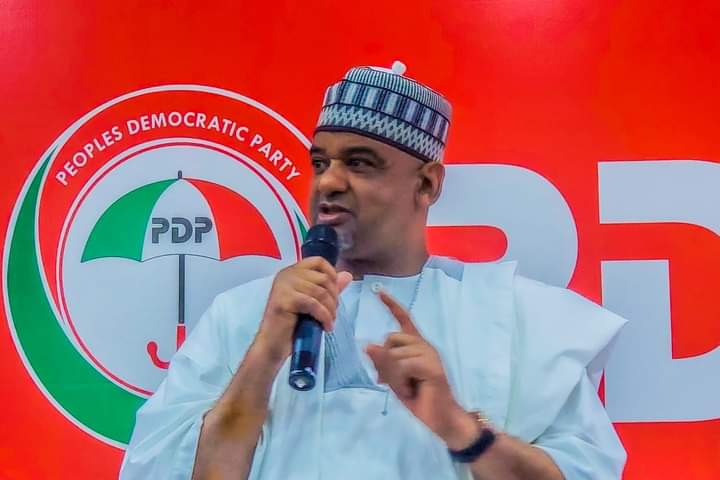
Felix Morka, the All Progressive Congress (APC) National Publicity Secretary, has revealed that he and his family have received over 400 death threats following his comments about Labour Party’s former presidential candidate, Peter Obi.
The threats were allegedly sparked by Obi’s accusation that Morka’s remarks during a Sunday interview on Arise Television posed a danger to his life.

Morka shared this in an interview on Arise News on Wednesday, stating, “Peter Obi’s allegations that my words in that interview threatened his life have triggered serious consequences.
“As of now, I have documented 400 threats, about 200 of which are explicit death threats. These are written threats that I will be submitting to law enforcement agencies.”
He continued, explaining the graphic nature of the threats: “In these messages, individuals have detailed how they plan to harm me—threatening to shoot me, behead me, and carry out other gruesome acts. This is not mere rhetoric.
“It has even extended to direct threats against some members of my family. These are explicit and graphic threats, not vague insinuations.”
Morka firmly denied any intent to threaten Obi, calling the accusations unfounded.
“This entire situation is baseless and cannot be attributed to me. I did not threaten Peter Obi in any way. Those issuing these threats are acting on their own, but I trust that law enforcement will respond swiftly to bring them to justice,” he stated.
Opinion
Beyond the Politics of Name-Calling: Time to Put Development Front and Center
By Dr. Osamhanze Akugbe Idahosa.
Nigerian politics has a familiar rhythm that repeats itself with the certainty of the rainy season. As an election approaches, the airwaves fill not with policy proposals or development blueprints, but with recycled scandals, resurrected controversies, and character assassinations dressed up as accountability. Old files are reopened. Rumours are given new life. Personalities are dissected forensically, while the economy — the very thing that determines whether ordinary Nigerians eat, work, and hope — is left to fend for itself in the background noise.
This is not new. It is, in fact, a pattern the late Professor Claude Ake diagnosed with uncomfortable precision decades ago. In his enduring body of work on how politics has underdeveloped Africa, Ake argued that the continent’s governing elites have rarely treated development as politics’ central business. Instead, politics became the prize — an unrelenting contest for power and its spoils, disconnected from any serious commitment to transforming people’s material conditions. Development was talked about, promised, and occasionally budgeted for, but it was never the organizing logic of governance. Power for its own sake was.
Nigeria, in many painful ways, has continued to prove Ake right. A country blessed with abundant human capital, fertile land, solar potential across its northern belt, gas reserves that could power industries for generations, and a youthful population bursting with energy and ambition, still finds itself struggling with basic questions of electricity, food security, and job creation. The paradox is not a mystery. It is the direct consequence of a political culture that majors on the minor and minors on the major—one where cutthroat politicking consistently displaces the harder, slower, less theatrical work of nation-building.
The Noise That Drowns Out the Signal
Every election cycle in Nigeria seems to produce its own theatre of distraction. Certificates are questioned. Personal histories are excavated. Allegations, some genuine and many manufactured for effect, are deployed not to inform the electorate but to overwhelm them. The result is a public conversation so saturated with noise that the signal — what each aspirant actually intends to do about unemployment, inflation, infrastructure decay, and industrial collapse — gets lost entirely.
This is not to say that character and integrity do not matter in leadership. They do, profoundly. But there is a difference between legitimate scrutiny of a candidate’s fitness for office and the wholesale substitution of personality warfare for policy debate. When name-calling becomes the primary currency of political engagement, it does more than distract; it actively erodes the electorate’s capacity to hold anyone accountable for economic outcomes, because the entire conversation has shifted away from outcomes altogether.
What 2027 Should Really Be About
As Nigeria edges toward the 2027 electioneering season, there is a genuine opportunity to break this cycle — but only if electorates themselves insist on it. The question voters ask of every aspirant should not primarily be “what has this person done to embarrass their opponent,” but rather “what, brick by brick, will this person do to build an economy that works?”
Brick by brick is the operative phrase, because national economic transformation is not a single grand gesture. It is the cumulative result of deliberate choices: stable macroeconomic policy that tames inflation without strangling growth; a manufacturing and agro-industrial base that converts raw endowments into finished value rather than exporting them raw; an education and skills pipeline that matches the needs of a modern economy; an investment climate credible enough to attract long-term capital rather than speculative inflows; and an energy infrastructure reliable enough to let businesses plan beyond the next generator refueling.
None of this makes for exciting soundbites. It does not trend the way a scandal trends. But it is the substance that determines whether Nigeria remains a country of enormous unrealized potential or becomes genuinely competitive within the comity of nations — able to stand alongside the economies it is so often, and so wistfully, compared to.
Change for the Sake of Change Is Not Change
The revered Benin monarch, Oba Ewuare II, recently offered a formulation that deserves wider circulation in the run-up to 2027: change should not be pursued for its own sake, but only where it promises something demonstrably better than what already exists. This is a subtle but important corrective to a political culture that often treats “change” as a self-justifying slogan, detached from any rigorous comparison of what is being offered versus what is being replaced.
Applied to Nigeria’s coming election, the royal father’s counsel suggests a discipline that both aspirants and voters would do well to adopt. Aspirants should be pressed to show, in concrete, measurable terms, how their vision improves on the present—not merely that they are different from the incumbent or from a rival. And voters should resist the seduction of change as spectacle, insisting instead on change as substance: a credible, costed, and coherent pathway to shared prosperity.
A Call to Refocus
Nigeria’s governing class, and the political ecosystem that surrounds it — commentators, party strategists, media platforms, and yes, the electorate itself — bear collective responsibility for the terms on which political contests are fought. If the 2027 cycle is allowed to descend, once again, into a contest of who can most effectively humiliate whom, the country will have squandered another opportunity to have the conversation it desperately needs: the conversation about how to convert its abundant natural and human endowments into the kind of broad-based prosperity that reduces poverty, creates jobs, and restores national dignity.
Professor Ake’s warning was never simply academic. It was a call to reorder national priorities before politics as usual consumes what remains of the country’s developmental promise. As 2027 approaches, that call deserves to be heard again — not as a lament, but as an instruction: look beyond the name-calling, beyond the personality contests, and ask instead what each aspirant will actually build.
Dr. Osamhanze Akugbe Idahosa is of the Africa Development Studies Center and writes from Abuja.
Politics
“Lecturers pledging loyalty to TInubu cannot supervise elections”-Atiku tells INEC
The Atiku Media Office has expressed concern over the reported endorsement of President Bola Ahmed Tinubu by hundreds of lecturers from universities across Northern Nigeria, warning that academics who openly declare partisan allegiance should not subsequently be entrusted with sensitive electoral responsibilities by the Independent National Electoral Commission (INEC).
Lecturers have every constitutional right to support, campaign for, and vote for any candidate of their choice. That right is not in dispute. What is unacceptable, however, is for persons who have publicly taken partisan positions to later present themselves as neutral electoral officials.
Any academic who openly endorses a presidential candidate should not come anywhere near sensitive INEC assignments as returning officers, collation officers or officials entrusted with the collation, declaration and announcement of election results. Electoral credibility requires not only actual neutrality, but also public confidence in the neutrality of those administering the process.
More disturbing is the reported presence of elected governors and a serving Minister of Defence at the endorsement. That senior officials of the ruling party would lend the weight of their offices to such an overtly partisan gathering of academics is deeply troubling and speaks to the desperation surrounding the Tinubu administration’s quest for re-election.
It is a shame that the Tinubu administration appears determined to strip our scholars of the dignity of their academic gowns and dress them instead in the garb of partisan political rascality. Universities should remain centres of independent thought, scholarship and intellectual freedom, not recruitment grounds for the political machinery of a desperate ruling party.
What we are witnessing tells the story of a government increasingly prepared to push against every moral boundary in its determination to secure another term in office, regardless of the damage done to institutions that ought to command public trust.
This principle must apply equally to academics who openly support Atiku Abubakar or any other presidential candidate. No one should be allowed to play today and referee tomorrow.
“You cannot wear a party jersey today and expect Nigerians to accept you as an impartial referee on election day.
INEC must take note and ensure that academics who have publicly declared partisan allegiance are excluded from sensitive electoral responsibilities in the 2027 elections.
Politics
Comparative analysis as Obi lists ten achievements in public office, Tinubu’s ten failures as president
The Peter Obi Media Office on Sunday rolled out what it described as 10 major achievements of the former Anambra State governor in public office and placed them against 10 alleged failures of President Bola Tinubu, declaring that Obi’s case for the presidency rests on performance rather than political patronage.
The intervention came as Obi’s camp pushed back against claims by supporters of the President that the Nigeria Democratic Congress, NDC, presidential flagbearer is “overhyped” and that his popularity and political rating are exaggerated.
In a statement signed by Idris Zekeri Jnr, the media office said Obi had already demonstrated his capacity to manage public resources during his eight years as governor of Anambra State and therefore did not need the presidency as a training ground.
“Peter Obi is not asking Nigerians to make him President so that he can learn how government works,” the statement said.
“He is asking Nigerians to entrust him with Nigeria after demonstrating, as Governor of Anambra, how he manages money, builds institutions, invests in human capital and plans for the future.”
Obi Rolls Out His Record
Heading the list of Obi’s claimed achievements was his experience managing Anambra State between 2006 and 2014 despite political and legal battles that interrupted his tenure.
The media office said his administration demonstrated fiscal discipline, kept Anambra among the country’s least-indebted states and accumulated substantial savings and investments.
Citing Obi’s 2023 presidential manifesto, it put investments and savings associated with his administration at approximately $500 million, including $156 million in dollar-denominated investments.
His ability to leave financial reserves behind rather than exhaust available government resources was listed as a separate achievement and presented as evidence of his philosophy of prudent management.
Education was another area highlighted.
The statement pointed to Obi’s return of mission schools to their original owners and subsequent partnerships between the government and the missions, claiming that Anambra rose from 24th position to first in WAEC and NECO examinations for three consecutive years.
The Obi camp also cited investments in human capital through scholarships, education, healthcare and poverty-mapping programmes.
Healthcare was listed as the sixth achievement, with the media office claiming that more than 12 health institutions, including two hospitals, had secured accreditation by the end of Obi’s tenure compared with none when he assumed office.
Obi’s engagement with international development organisations, including the World Bank, UNDP, DFID and European Union, was also presented as evidence of his ability to attract development partnerships.
His administration’s introduction of poverty mapping, aerial mapping and the Anambra Integrated Development Strategy, ANIDS, was cited as proof of data-driven planning.
The ninth point focused on Obi’s private-sector background in business and banking before entering politics, while the tenth argued that, unlike politicians relying largely on campaign promises, Obi had an eight-year executive record Nigerians could examine.
Obi Camp Turns On Tinubu
Having presented Obi’s record, the media office turned its attention to Tinubu, listing what it described as 10 failures Nigerians “cannot ignore.”
At the top was the cost-of-living crisis that followed the removal of petrol subsidy and other economic reforms.
It accused the administration of presiding over inflation and declining purchasing power, saying Nigerians were increasingly finding that their incomes could buy less.
Naira depreciation was listed as the third failure, with the opposition camp arguing that currency weakness had increased the cost of imported goods, medicines, machinery and industrial inputs.
The sharp increase in petrol prices following subsidy removal was identified separately as another failure because of its impact on transportation, businesses and household expenses.
Rising poverty and hardship came fifth, with Obi’s media office arguing that ordinary Nigerians had carried a disproportionate share of the burden imposed by the government’s reforms.
Security, Jobs And Public Trust
The Obi camp also accused the Tinubu administration of failing to create sufficient employment and economic opportunities, particularly for young Nigerians confronted by unemployment and underemployment.
Persistent insecurity was listed as the seventh failure.
The statement pointed to banditry, terrorism, kidnapping and communal violence in different parts of the country as evidence that the government’s security strategy had yet to produce the desired results.
Concerns about transparency and public trust formed the eighth charge, with Obi’s media office pointing to controversies surrounding government expenditure, appointments, procurement and management of public resources.
The ninth alleged failure was what the statement described as a perception that political consolidation and calculations towards the 2027 election were sometimes taking precedence over institution-building.
It reserved its final criticism for what it called the gap between government promises and Nigerians’ lived experiences.
According to Obi’s media office, the administration’s claims of economic reform have not translated into sufficient improvements in the everyday lives of citizens.
The statement acknowledged that Tinubu inherited significant economic and security problems when he assumed office in May 2023, but argued that this could no longer be the only yardstick for assessing his administration.
“The fundamental question is not whether Tinubu inherited a difficult Nigeria. He did,” the statement said.
“The question is whether, after taking difficult decisions, Nigerians are better off today — and whether the government has convincingly demonstrated that today’s sacrifice is producing tomorrow’s prosperity.”
Obi’s media office supplied its own answer in emphatic terms: “Your answer is an obvious capital NO.”
It consequently maintained that the contest over who is prepared to lead Nigeria should be decided by measurable performance rather than political endorsements and patronage.
For Obi’s camp, the emerging 2027 argument is therefore simple: put the former Anambra governor’s record in public office beside Tinubu’s record in the presidency and let Nigerians make the comparison.
-
Metro19 hours agoOndo Poisonous Alcohol: Death Toll Increases To 49, Cases Spread To Neighboring Local Govt
-
News20 hours agoCanada Invites Senior Managers To Apply For Permanent Residence
-
News20 hours agoFalconets Advance to quarter-finals of FIFA U-20 World Cup
-
Metro20 hours agoTragedy Hits OAU: Final-Year Engineering Student Dies In Suspected Suicide At Off-Campus Apartment
-
Sports19 hours agoCarabao Cup Round of 16 fixtures confirmed [Full List]
-
Opinion18 hours agoWike and the APC Governors’ Nightmare

Warning: Undefined variable $user_ID in /home/naijuinz/public_html/wp-content/themes/zox-news/comments.php on line 49
You must be logged in to post a comment Login