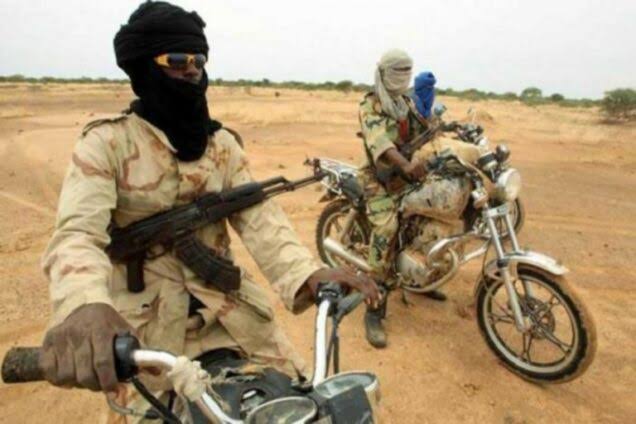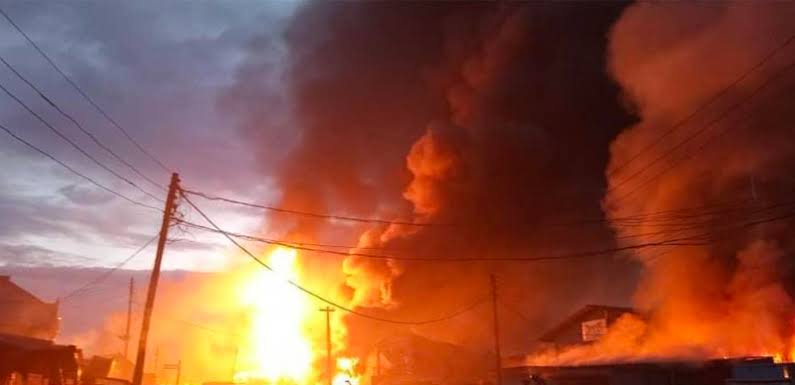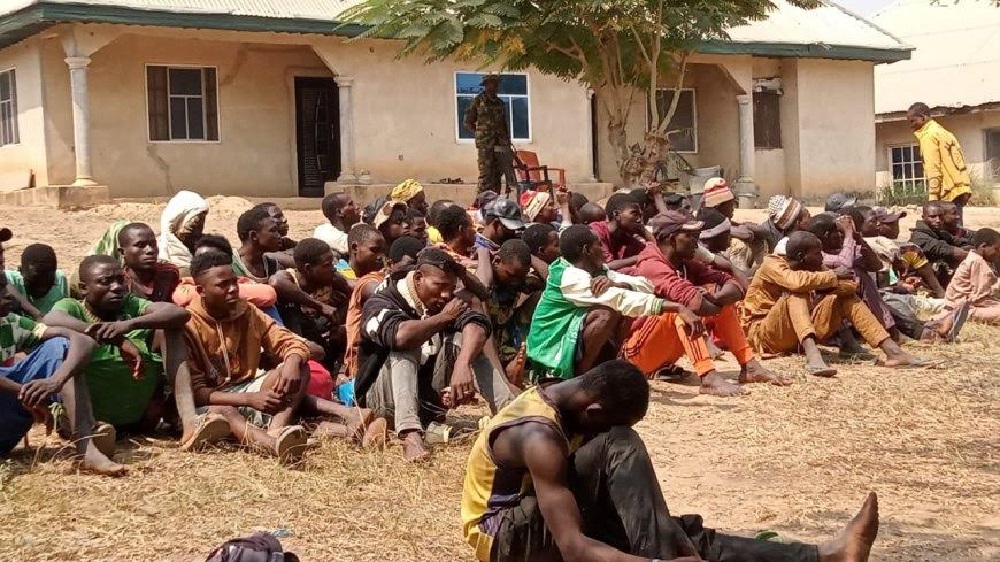
After a relative lull in terror attacks in the country, there was a resurgence this week amid fears that the fresh raids may signal a renewed offensive by terror groups.


Findings by our correspondents showed that no fewer than 77 people were reported killed and 43 kidnapped in different terror attacks on 10 states in the last one week.
It was also discovered that many houses were burnt as more than 1,000 residents were displaced. 
In Katsina State, 30 people were reported killed in Charanci, Safana, Kurfi, and Kaita Local Government Areas of the state between Tuesday and Thursday.
Reports indicate the victims were ambushed by bandits while returning from a condolence visit in Batsari.
Earlier, no fewer than eight soldiers were reported killed when terrorists attacked a military base at Sabon Gari in Dambo LGA of Borno State on Saturday.
On the same day, the spokesperson for the Kebbi Police Command, Nafiu Abubakar, confirmed that two people were killed when suspected Lakurawa bandits attacked Natsini village in Argungu LGA of Kebbi and rustled an unspecified number of cows.
Two people were also killed the same day during a gun battle between gunmen and police operatives in the Umuokanne area of Imo State.
On Sunday, suspected bandits killed the Katsina State Acting Chairman of the Miyetti Allah Cattle Breeders Association of Nigeria, Alhaji Amadu Surajo, and three others at Mai Rana village in Kusada LGA.
Coordinated attacks in Orsu LGA of Imo State claimed 18 lives on Sunday, with communities like Umukabia, Eziawa, Ihitte Nasa, Umuhu, Amaoku, and Amaebe bearing the brunt. Victims sustained deep machete wounds, heightening fear and outrage among locals.
Unknown gunmen were reported to have abducted a senior lecturer in the Department of Philosophy, Prince Abubakar Audu University, Anyigba, Kogi State, Professor John Ebeh on Friday.
On Wednesday, bandits attacked Idu village in Kufana District, Kajuru LGA of Kaduna State, killing two villagers. That same day, two officers were killed in an attack by Boko Haram terrorists at the Nganzai Police Division in Borno State.
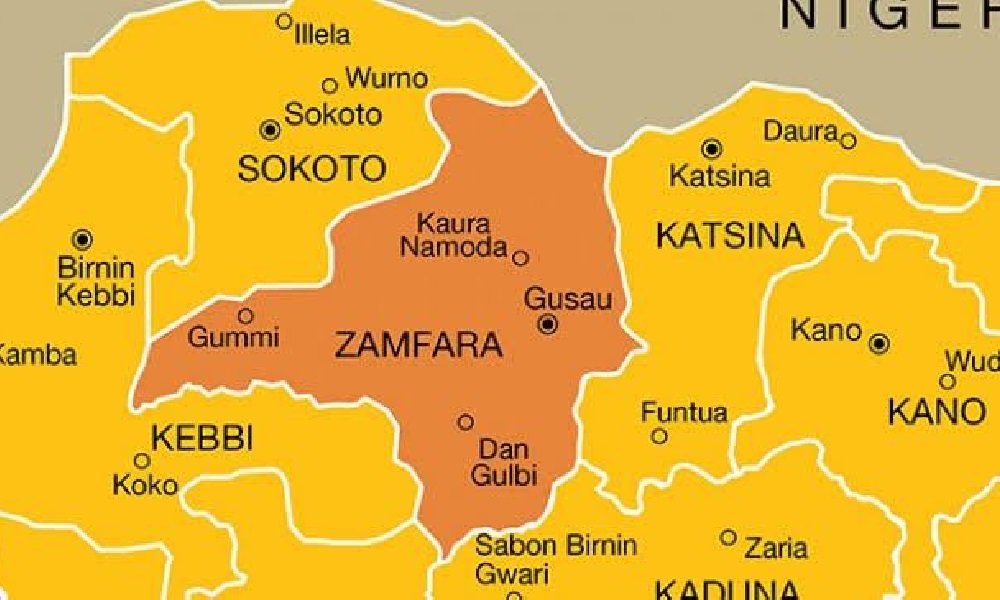
In Zamfara State, over 40 people, mostly women and children were kidnapped on Sunday in Gana village of Shinkafi LGA.
Similarly, gunmen abducted two Catholic reverend sisters on Ufuma Road in Orumba North LGA of Anambra State on Tuesday while they were returning from a vocational association meeting in Ogboji.
In Jigawa State, no fewer than 11 people were also killed, and several houses were razed during an attack by bandits on Gululu village in Jahun and Miga LGAs last Friday, escalating tensions across the state.
The Benue State Governor, Hyacinth Alia, disclosed on Thursday that over 1,000 households were displaced in a series of attacks on communities.
How terrorists killed soldiers – Survivor
A soldier who survived the Borno attack on the military base said the insurgents used drones for surveillance and attack.
In an interview with Saturday PUNCH, the survivor disclosed that the attack reflected meticulous planning and monitoring of their activities at the base.
Our correspondents gathered that the insurgents also set fire to the base and destroyed military vehicles.
The soldier said the attackers used drones to drop bombs on the camp before commencing sporadic shooting.
He said, “They started the attack with a drone. You could tell the attackers already knew our position by surveying with the drone camera. After noticing we were relaxed, they started dropping bombs with the drone.
“They later came en masse and started shooting sporadically while officers tried to seek cover. Eight soldiers were killed in the process, and 10 others sustained serious injuries. The way everything played out, it was a retaliation.”
A member of the Civilian Joint Task Force described the attack as shocking and brutal.
“It was a terrible experience. Thank God there was early reinforcement,” he added.
A resident, who also spoke under condition of anonymity, claimed the insurgents had overpowered the troops before reinforcements arrived.
“The insurgents met the soldiers unprepared. But when the military got reinforcement, the insurgents retreated. As a community, we went there after the situation was calm. At that time, some soldiers were already chasing the attackers into the bush. So, there will be more casualties,” the source said.
Govs respond to attacks
It was gathered that the rise in terror attacks, once concentrated in Northern Nigeria, is now spreading to other regions, including the South-West, prompting state governors to remain on high alert.
The Oyo State Governor, Seyi Makinde, on Monday, warned that bandits fleeing military operations in the North-West were seeking refuge in the states.
Speaking at the 2025 annual inter-faith service for workers held at the Secretariat, Agodi, Ibadan, Makinde assured residents that his administration remained resolute in its efforts to track down and eliminate the criminal elements.
“During a security briefing this morning, I learned that some bad elements from the North-West are relocating here due to military heat in their zones. But we will find and deal with them,” he said.
The Ogun State Government also contacted relevant security agencies, including the military and the police over the reported influx of bandits into South-West states.
The Special Adviser to the Governor on Security, AIG Olusola Subair (retd), disclosed this in an interview on Thursday.
He stated that the Amotekun Corps had been reinforced with more patrol vehicles and additional personnel to counter any security breaches.
“The state government is very much aware of the reported influx of bandits into South-West states. We have our intelligence too, and we’ve activated all necessary measures to ensure synergy among security agencies.
“The military and the police are all aware, and the synergy is already in place. The Amotekun Corps has been strengthened with more patrol vehicles, personnel recruitment, and training. So, we are leaving nothing to chance. The government is on top of the situation, and residents of the state have nothing to worry about,” Subair stated.
The Ekiti State Government also confirmed that it had enhanced its security networks and fortified the Amotekun Corps to mitigate potential security risks.
The state Commissioner for Information, Taiwo Olatunbosun, revealed this in an interview on Thursday, adding that Governor Biodun Oyebanji had provided the necessary logistical support to security agencies to safeguard the state.
He noted that the governor had also established the Agro Rangers to collaborate with the Amotekun Corps and the Peace Corps for more effective coordination in addressing rising security threats.
The Kogi State Governor, Ahmed Ododo, stated that his administration was well-prepared for the challenge.
The governor, speaking through his Special Adviser on Media, Ismail Lash, noted that his administration had been conducting clearance operations across the state, particularly along borders with Kwara, Ekiti, Nasarawa, Benue, Ondo, and other states, including the Federal Capital Territory.
Meanwhile, the Nasarawa State Governor, Abdullahi Sule, emphasised that his administration continued to work closely with security agencies to ensure that the rise in bandit attacks did not spill into his state.
The governor, through his Senior Special Assistant on Public Affairs, Peter Ahemba, stated this in Lafia, the state capital, on Thursday.
He commended security agencies for their cooperation, stating, “Bandits are on the run in Nasarawa State because there is no space for them to occupy. There is no community or local government area under the control of bandits in Nasarawa State.
“We are aware that the issue of insecurity is almost everywhere in the country, but I can assure you that we have never had an instance where bandits have taken over even a community in our dear state,” Governor Hyacinth Alia of Benue State assured during an interview on Thursday.
He expressed confidence that the recent launch of the State Civil Protection Guards, comprising 5,000 personnel, would effectively curb the growing menace of banditry.
Similarly, the Special Adviser on Security Matters to the Sokoto State Governor, Col. Ahmed Usman (retd), confirmed that the state’s Community Guard Corps had been bolstered to work alongside conventional security forces.
“The joint patrol team of the Nigeria Police Force and members of the Sokoto Community Guards recently foiled a banditry attack on a commercial vehicle at Kwanar Mahalba, along the Goronyo-Sabon Birni Road.
“The team rescued seven of the 13 passengers in the vehicle; five ran into the bush, while one was tragically shot dead by the bandits,” he said.
Usman assured the public that the state government would continue to provide necessary support and assistance to the joint patrol teams and other security personnel to eliminate banditry in the state.
Similarly, the Chief Press Secretary to the Kebbi State Governor, Alhaji Ahmed Idris, revealed that the state government had strengthened its call for support from security agents to prevent bandit attacks.
He recalled the swift response to the Lakurawa menace, where the governor contacted the Chief of Defence Staff, General Christopher Musa, who promptly ordered the clearance of the bandits from their hideout.
Saturday PUNCH gathered that the Kano State Police Command had also intensified patrols along border towns as part of efforts to enhance security in the state.
The command’s Public Relations Officer, SP Abdullahi Haruna, confirmed in a telephone interview with Saturday PUNCH that the patrols along border towns were in addition to clearance operations in Falgore and Dansoshiya forests.
“Although Kano is not among the states in the North-West battling banditry and other security challenges, the command is not relenting in its efforts to ensure that Kano remains secure,” he stated.
Haruna explained that the patrols cover border towns along the Kano-Katsina, Kano-Plateau, Kano-Jigawa, and Kano-Kaduna states.
He added that the clearance operations in Falgore and Dansoshiya forests were aimed at curbing criminal activities, particularly cattle rustling and kidnapping.
“The operation is jointly conducted by the police, military, vigilantes, and personnel from other security agencies, with support from the state government,” Haruna added.
ISWAP members in Osun
In a related development, the Department of State Services has arrested 10 suspected members of the Islamic State for West Africa Province, in Ilesa, Osun State.
The suspects are Adamu Abubakar (aka Abu Aisha), Babagana Bashuli, Muhammed Adam, Mustapha Abacha, andKaturu Muhammed, Babakura Abacha, Muhammed Ciroma, Ali Gambo, Muhammed Umoru, and Muhammed Bundi.
According to the DSS, the suspects were arrested in the Ilesa East LGA of the state.
The arrest came to public knowledge when the DSS sought an order of a Federal High Court in Abuja to detain the suspects for 60 days.
Justice Emeka Nwite granted the order on Friday, declaring that there was merit in the ex parte application filed by the DSS counsel, Y.I. Umar, before the court.
He said, “An order is hereby made enabling the State Security Service, the applicant, to detain the respondents for 60 days pending the conclusion of investigation.”
The case was adjourned to March 3 for mention.
It was stated in an affidavit deposed to by a DSS official, Yamuje Benue, that the suspects were arrested on December 16, 2024, on reasonable suspicion of their involvement in terrorism activities.
The secret police alleged that the suspects were arrested while undergoing training on how to manufacture and detonate explosives, disclosing that its preliminary investigation revealed that the respondents were members of the Boko Haram/ISWAP terrorist group.
The secret police further stated that the suspects were followers of the late Abubakar Shekau, who escaped from Sambisa forest to Osun State because of the activities of the Nigerian army.
“Intelligence at the disposal of the applicant revealed that the respondents were planning to launch a Boko Haram /ISWAP cell in Osun State.
“That the respondents were arrested while undergoing training on how to manufacture and detonate improvised explosive devices,” the DSS alleged.
Justice Nwite also granted the request of the DSS to detain Ayomide Akintunde and Nurudeen Adesiyan for 60 days pending the conclusion of the investigation.
The DSS said Akintunde and Adesiyan were arrested following an intelligence report from a foreign intelligence service, linking them with a Moroccan terrorist.
The secret police said the Moroccan terrorist, who is currently in detention in Spain, communicated with the duo through their Nigerian telephone numbers.
The DSS also said the suspects admitted ownership of the telephone numbers, which they had been using for more than 10 months.
Experts weigh in
Reacting to the increasing attacks by terrorists, security experts lamented that the use of sophisticated weapons by the hoodlums had added new dimensions to the threat posed by insurgents.
A security expert and Chief Executive Officer of Beacon Security and Intelligence Limited, Kabir Adamu, noted that the use of unmanned aerial vehicles by terrorists was resurfacing as a dangerous trend.
He explained that the development could indicate either external technical support or the development of local capacity by the groups.
According to Adamu, the increasing sophistication of terrorist attacks—such as the combined use of drones, gun-mounted vehicles, and foot soldiers—presents significant challenges for the Nigerian military.
“The ability of the military to defend a target becomes more difficult with such complex attacks,” he warned.
He called for improved aerial surveillance capabilities and the adoption of modern technologies to detect and neutralise UAVs.
“In modern-day warfare, there is technology to shoot down such unmanned aerial vehicles,” the security expert stated, adding that a robust national policy on UAVs must be implemented.
Adamu also stressed the importance of blocking terrorist funding, stating that financial flows were the “oxygen” that allowed terrorism to thrive.
In his submission, a security consultant and fellow of the Institute of Security, Chigozie Ubani, criticised what he termed a systemic failure in the country’s security apparatus.
“Our security systems and institutions have not lived up to expectations. We are supposed to be ahead of terrorists, but instead, they are ahead of us,” he said.
Ubani lamented the failure of the country’s defence industry to produce technologies suited to local needs.
The security consultant, however, warned the Federal Government against using foreign mercenaries in fighting terrorists, insisting that the reliance on foreign military contractors often served external interests rather than Nigeria’s security goals.
“There is a high level of complicity between security forces and terrorists,” Ubani claimed.
He called for urgent reforms to reposition the military and security agencies as proactive forces rather than reactive entities.
A former Director of the Department of State Services, Mike Ejiofor, described the resurgence of terrorist attacks as a setback to the gains previously made in reducing violence in the northeast.
“Boko Haram has international affiliations, so they are getting sophisticated weapons like drones from them. Nigerian security forces must remain alert,” he said.
Ejiofor acknowledged ongoing efforts to prosecute terrorists and their financiers but urged greater transparency and speed in the processes to disrupt the financial channels sustaining terrorism.
Gistcore