Connect with us

News

NAHCON seeks 2% CBN’s charge removal to reduce hajj fare

Published

on

ADVERTISEMENT
Zoom Ad
ADVERTISEMENT
Zoom Ad

By Kayode Sanni-Arewa

The Chairman of the National Hajj Commission of Nigeria (NAHCON), Prof. Abdullahi Saleh Usman, has urged the Central Bank of Nigeria (CBN) to waive the two per cent charge imposed on pilgrims’ funds to further reduce the hajj fare.

Speaking in Abuja, Saleh said one of his major priorities since assuming office was to reduce the cost of hajj and make it more affordable for Muslims across the country.

“I am confident that lowering hajj fares will bring relief to our pilgrims, leaders, and the entire Muslim Ummah,” he said.

Advertisement

Saleh announced that he had engaged key service providers, including airliners, Masha’ir service providers, accommodation providers, and transportation companies, in collaboration with the Forum of State Pilgrims Welfare Agencies to make hajj operations more convenient.

The NAHCON chairman said the negotiations had yielded significant reductions in service costs.

Commenting on Masha’ir services, he said pilgrims were charged 4,770 Saudi Riyals last year, but following discussions, NAHCON secured a reduction of over 700 Saudi Riyals per pilgrim.

He added: “On accommodation in Madinah, the cost per bed space was 5,000 Riyals last year, but a reduction of 200 Riyals per pilgrim has been achieved. Last year’s transportation cost stood at 1,300 Riyals per pilgrim, but this year, we successfully negotiated a 130 Riyal reduction per pilgrim.

Advertisement

“We have worked on the airfare. Given Nigeria’s geographical diversity, airfare costs vary across regions. However, we have secured a $399 reduction per pilgrim.

These reductions have significantly impacted the overall hajj fare, and we are still expecting further adjustments.”

Stressing that NAHCON was not asking for government’s subsidies, Saleh urged authorities to consider selling dollars to the commission at the official government exchange rate.

The agency chairman noted that the request, if approved, would further lower hajj fares and take a lot of burden off the shoulders of pilgrims.

Advertisement

“We have estimated the dollar exchange rate at N1,550, N1,600, and N1,650. But given the fluctuations, we settled on a moderate rate. If we secure a reduction in forex rates, we will refund any savings to the pilgrims,” he said.

Saleh urged governors to support pilgrims’ boards in their states by providing loans for them to settle payments with NAHCON before the final payment deadline set by Saudi Arabian authority.

The NAHCON chairman explained that the commission has no control over payment deadline but could only appeal to the Saudi Arabia’s Ministry of Hajj for an extension, if necessary. He urged intending pilgrims to complete their payments promptly to avoid any last-minute issues.

Saleh also urged states’ pilgrims’ welfare agencies and other stakeholders to intensify public enlightenment campaigns to ensure that intending pilgrims understand the importance of timely payment and proper preparation to have a successful hajj pilgrimage.

Advertisement

The Nation

News

To be defeated, drug barons must lose their wealth, Marwa declares at Cambridge

Published

on

ADVERTISEMENT
Zoom Ad
ADVERTISEMENT
Zoom Ad

. Tells global audience of experts how NDLEA uses asset recovery strategy in fight against drug trafficking

The Chairman/Chief Executive of the National Drug Law Enforcement Agency (NDLEA), Brig. Gen. Mohamed Buba Marwa (Rtd), has told an international gathering of judges, law enforcement chiefs, financial intelligence experts and academics that the war against drug trafficking cannot be won by arrests alone, but must be matched by an equally aggressive pursuit of the proceeds of crime.
Marwa made this declaration while delivering a presentation titled “Criminal Property and the Criminal Process: How Can We Make It More Effective?” at the ongoing 43rd Cambridge International Symposium on Economic Crime, organised by the Centre for Geopolitics, University of Cambridge, United Kingdom.

According to him, the effectiveness of the criminal process should not be measured only by the number of convictions secured. It should also be measured by whether crime is made unprofitable. A trafficker who loses his liberty but retains his fortune has not truly been defeated. His wealth can finance another operation, support his associates and sustain the criminal enterprise.

“The ultimate objective must therefore be to deny criminals the proceeds of their crime, promptly, and lawfully while preserving the value of the property. Nigeria, through the National Drug Law Enforcement Agency, will continue to strengthen this approach.”

Advertisement

Addressing the session chaired by the Honourable Judge Wendy Tien, the NDLEA boss said arresting a trafficker without dismantling his fortune was like “pruning a weed at the stem while leaving its roots undisturbed,” warning that such wealth simply resurfaces “under a different name, through a different front company, in a different jurisdiction.”
He outlined six practical strategies the NDLEA has deployed to strengthen asset recovery, anchored on the National Drug Law Enforcement Agency Act 2004, the Proceeds of Crime (Recovery and Management) Act 2022, and the Money Laundering (Prevention and Prohibition) Act 2022.

He cited the forfeiture of the Hook Hotel, a property linked to a fugitive drug suspect, which was recovered through non-conviction-based forfeiture and sold for $4.2 million, with proceeds paid into the Federal Government’s forfeited assets account domiciled with the Central Bank of Nigeria; proof, he said, that a fugitive “cannot simply outrun the process and retain the benefit of his crime.”
Marwa also disclosed that NDLEA investigators and prosecutors are now embedded together from the inception of cases, a reform that has shortened the interval between arrest and the securing of restraint orders. He revealed that last month alone, the Agency froze bank accounts worth over $7 million and secured interim forfeiture orders covering multibillion-naira assets, including filling stations, multi-storey buildings and exotic vehicles linked to a fugitive methamphetamine syndicate.

On the landmark case of Nigerian billionaire and suspected drug baron Amadi Simon, arrested in Switzerland through a joint operation involving NDLEA, the U.S. Drug Enforcement Administration (DEA), and authorities in Switzerland, Greece and France, Marwa explained that three hotels linked to the suspect were placed under professional asset managers rather than shut down, to preserve their value as going concerns pending the outcome of trial.

He further highlighted the Agency’s use of provisions on unexplained wealth and living beyond one’s legitimate means as a powerful investigative trigger, and the interlocutory sale of perishable and depreciating assets to protect their value ahead of final judgment.
He noted that these efforts have now been institutionalised within Nigeria’s National Drug Control Master Plan 2026–2030, ensuring that financial disruption of drug cartels remains a sustained national priority rather than a series of isolated cases.
Distilling these experiences into three guiding principles: speed over sequence, preservation of value, and institutionalization, Marwa acknowledged that challenges remain, particularly around delays in mutual legal assistance, limited forensic accounting capacity, and the need to balance the rights of accused persons with the State’s duty to preserve assets pending trial. He called for faster international cooperation mechanisms and stronger cross-border recognition of non-conviction-based forfeiture orders.
He thanked the Centre for Geopolitics, the organisers of the Symposium, and Judge Tien for the platform, and reaffirmed NDLEA’s readiness to deepen partnerships with jurisdictions and institutions committed to dismantling the financial architecture of drug trafficking.

Advertisement
Continue Reading

News

Sad! Catholic Priest Commits Su!cide Over Transfer To Another Parish

Published

on

ADVERTISEMENT
Zoom Ad
ADVERTISEMENT
Zoom Ad

In Italy, a 75-year-old Roman Catholic priest took his own life after it was announced that he will be transferred from the parish where he had served for nearly 25 years.

On August 12, the body of 75-year-old Catholic priest Lino Zatelli was found in the Italian city of Trento.

Shortly before his de@th, he had learned of his transfer from the parish where he had served for nearly 25 years, reports Tribune Chrétienne.

That morning, the priest was supposed to celebrate Mass at the Church of San Carlo Borromeo, but he did not appear for the service. The sacristan then went to his home and discovered his body.

Advertisement

Shortly before the tragedy, Zatelli was informed that, as part of a diocesan reorganization, he was required to leave the parish to which he had devoted nearly a quarter of a century.

The priest was deeply distressed by this decision and openly told his parishioners: “I never asked to leave.”

A campaign was even organized to demand he stay at San Carlo, with a petition gathering several hundred signatures.

This tragedy also raises the question of the loneliness and suffering of elederly priests, in Italy as well as in France.

Advertisement

Catholic authors note that for a clergyman, leaving a parish after decades of service means not merely a change of ministry but a break the community that had actually become his family and primary social circle.

At the same time, the authors of the publication emphasize that it is impossible to definitively establish the transfer as the direct cause of the su!cide.

The tragedy has, however, once again drawn attention to the issues of isolation, emotional exhaustion, and lack of support among Catholic clergy.

Advertisement
Continue Reading

News

Over 10, 200 killed in two years under Tinubu govt — Amnesty International

Published

on

ADVERTISEMENT
Zoom Ad
ADVERTISEMENT
Zoom Ad

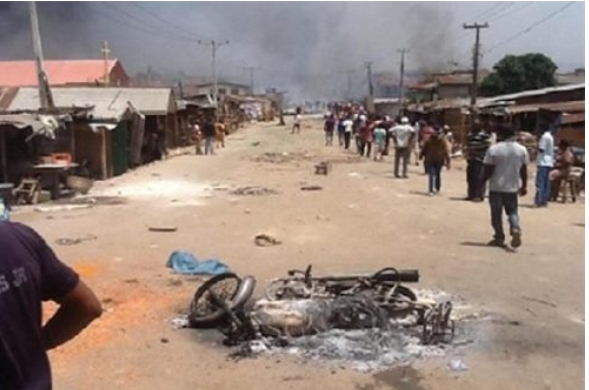
Amnesty International has said that at least 10, 217 people were killed in attacks by gunmen in Benue, Niger, Katsina, Kebbi, Plateau, Sokoto and Zamfara States in the first two years of President Bola Tinubu’s government.

In a Monday statement shared on Facebook, the global rights group said Benue State accounts for the highest death toll, followed by Plateau State, where 2, 630 people were killed.

“It is now over three years since President Bola Tinubu assumed office with a promise to enhance security. Instead, things have only gotten worse, as the authorities continue to fail to protect the rights to life, physical integrity, liberty and the security of tens of thousands of people across the country,” Amnesty said.

The organisation noted that in the first two years of the administration, new armed groups have assumed power.

Advertisement

It identified Lakurawa in Sokoto and Kebbi States, and Mamuda in Kwara State, while adding that hundreds of villages have been sacked by gunmen in Benue, Borno, Katsina, Sokoto, Plateau and Zamfara.

Amnesty warned that escalating attacks are causing a looming humanitarian crisis.

“The majority of those displaced in Plateau and Katsina States told Amnesty International that they had to resort to begging to survive daily life,” the group said.

It cited Dangulbi district in Zamfara State, where “farmers have to watch their harvest of sweet potatoes rot because bandits have prevented them from transporting them to the nearest market.”

Advertisement

The rights group said under international human rights law, the authorities have an obligation to protect lives, ensure those suspected of perpetrating the killings are held to account, and provide victims with access to justice and effective remedies.

“Again and again, the Nigerian authorities are failing to live up to these obligations,” Amnesty stated. (The Sun)

Continue Reading

Trending

Copyright © 2024 Naija Blitz News