News
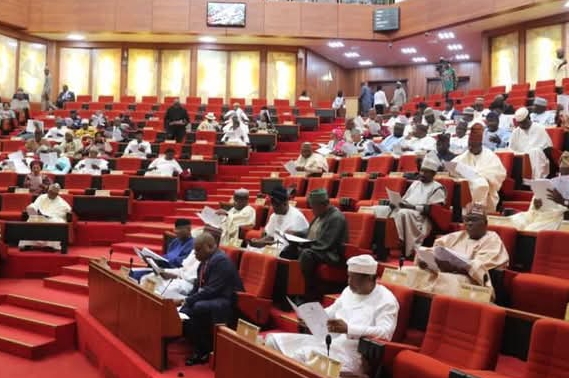
*ANALYSIS OF THE SENATE SEATING CONTROVERSY: A Critical Examination Of Procedural Compliance, Gender Dynamics, And Democratic Principle In The Nigerian Senate*
- /home/naijuinz/public_html/wp-content/plugins/mvp-social-buttons/mvp-social-buttons.php on line 27
https://naijablitznews.com/wp-content/uploads/2025/02/Screenshot_20250221-203711.jpg&description=*ANALYSIS OF THE SENATE SEATING CONTROVERSY: A Critical Examination Of Procedural Compliance, Gender Dynamics, And Democratic Principle In The Nigerian Senate*', 'pinterestShare', 'width=750,height=350'); return false;" title="Pin This Post">
- Share
- Tweet /home/naijuinz/public_html/wp-content/plugins/mvp-social-buttons/mvp-social-buttons.php on line 72
https://naijablitznews.com/wp-content/uploads/2025/02/Screenshot_20250221-203711.jpg&description=*ANALYSIS OF THE SENATE SEATING CONTROVERSY: A Critical Examination Of Procedural Compliance, Gender Dynamics, And Democratic Principle In The Nigerian Senate*', 'pinterestShare', 'width=750,height=350'); return false;" title="Pin This Post">
By Sunny Anderson Osiebe

Below is a critical examination of the situation, considering the Senate President’s actions, Senator Natasha’s rights, and the broader implications for Nigeria’s political image and democratic principles.
*The Senate President’s Alleged Intimidation of Female Senators*
The Senate President’s recent actions towards senator Natasha Akpoti must be scrutinized within the context of his treatment of female senators. And to ascertain if there is a pattern of behavior that has to do with intimidation or marginalization of women in the Senate, because his recent actions raises serious concerns about gender bias and equality in Nigeria’s legislative processes. This is because such behavior undermines the principles of inclusivity and fair representation, which are essential in a democratic society. If female senators are consistently subjected to harsher treatment or exclusion, it reflects poorly on the Senate’s commitment to gender equality and could deter women from participating in future politics and political activities.

*The Manner In Which Senator Natasha Was Asked to Leave the Chamber*
The Senate President’s decision to call the Sergeant-at-Arms to remove Senator Natasha from the chamber must be evaluated for proportionality and respect for due process. While the Senate Standing Orders grant the Senate President authority to enforce rules, the manner in which this authority is exercised matters. If the action was perceived as overly aggressive or dismissive, it could be interpreted as an abuse of power. The use of force or public humiliation to enforce compliance risks undermining the dignity of the Senate and the individuals involved. A more diplomatic approach, such as private discussions or warnings, might have been more appropriate to address the issue without escalating tensions.
*Senator Natasha’s Right To Expression*
Senator Natasha’s right to express herself is a fundamental aspect of democratic governance. While Section 10(2) of the Senate Standing Orders requires senators to sit in their designated seats to be recognized, her refusal to comply could be seen as a form of protest against what she perceived as unfair treatment. If her reassignment was indeed part of a broader pattern of marginalization, her actions might be interpreted as a legitimate stand against systemic bias. However, her defiance of Senate rules also raises questions about the balance between individual expression and collective discipline in a legislative body. While her right to protest is valid, it must be exercised within the framework of the rules governing the Senate.
*International Impact On Nigeria’s Political Image*
The Senate President’s actions have implications beyond Nigeria’s borders. In an era of global scrutiny, incidents like this can damage Nigeria’s reputation as a democratic nation. If the Senate President’s behavior is perceived as authoritarian or discriminatory, it could reinforce negative stereotypes about Nigeria’s political culture. International observers, including foreign governments and human rights organizations, may view such incidents as evidence of systemic gender inequality or a lack of respect for democratic norms. This could affect Nigeria’s standing in international forums and its ability to advocate for democratic values globally.
*The Senate President’s Past Attitude Toward Female Senators*
If the Senate President has a history of contentious interactions with female senators, as could be seen also in his case with Senator Ireti Heebah Kingibe the Senator representing FCT, therefore senator Natasha Akpoti’s incident of February 20th 2025 cannot be viewed in isolation. Because a pattern of behavior targeting women would indicate a deeper issue of gender bias within the Senate leadership. Such behavior not only undermines the credibility of the Senate President but also raises questions about the Senate’s commitment to fostering an inclusive environment. Addressing these concerns would require a thorough review of the Senate’s internal culture and leadership practices.
*Senator Natasha’s Status As An Elected Representative*
As an elected representative, Senator Natasha has a mandate to represent her constituents. Her treatment in the Senate must respect this mandate and the democratic principles that underpin it. If her reassignment and subsequent removal were perceived as unjust or politically motivated, it could be seen as an affront to the voters who elected her. Elected officials must be treated with respect and dignity, regardless of their political affiliations or personal disagreements with leadership. Any action that undermines their ability to fulfill their duties risks eroding public trust in the Senate as an institution.
*Conclusion: Balancing Authority and Fairness*
While the Senate President’s actions were technically within the bounds of the Senate Standing Orders, the broader context raises significant concerns about fairness, gender equality, and democratic principles. The Senate must strike a balance between enforcing rules and respecting the rights and dignity of its members. If the Senate President’s actions are perceived as targeting female senators or stifling dissent, they risk undermining the legitimacy of the Senate as a democratic institution.
To address these issues, the Senate should consider the following steps:
– Conduct an independent review of the Senate President’s conduct, particularly regarding interactions with female senators.
– Establish clear guidelines to ensure that enforcement of rules is proportionate and respectful.
– Promote gender sensitivity training and initiatives to foster a more inclusive environment.
– Encourage open dialogue to address grievances and prevent similar incidents in the future.
Ultimately, the Senate’s credibility depends on its ability to uphold both order and fairness, ensuring that all members, regardless of gender or political affiliation, are treated with respect and dignity.
Sunny Anderson Osiebe
Executive Director
HallowMace Foundation Africa
News
Reps Launch Nationwide Probe into Illegal Mining, Vow Crackdown on Revenue Leakages
By Gloria Ikibah
The House of Representatives has commenced a comprehensive investigation into illegal mineral exploitation across Nigeria, pledging to tackle the activities of criminal networks draining the country’s vast mineral resources.
The move was the resolution at a high-level stakeholders’ workshop on extractive industry governance organised by the House Ad Hoc Committee on Mineral Exploitation, Security and Anti-Money Laundering on Monday in Abuja.
Declaring the workshop open, Speaker of the House of Representatives, Rt. Hon. Tajudeen Abbas, described the committee’s assignment as one of the most significant responsibilities before the National Assembly.
He lamented that for years, illegal operators had continued to exploit Nigeria’s mineral wealth, depriving the country of much-needed revenue and weakening its economic potential.
Abbas explained that the workshop was designed to gather credible information, evidence and practical recommendations from regulators, security agencies and operators within the extractive industry before the House considers further legislative action.
He urged participants to speak openly and contribute meaningful solutions.
According to him, “Nigeria cannot achieve economic diversification, fiscal stability or job creation if the sector that should be a second revenue pillar is bleeding from illegality and opacity.
“This is not an inquisition; it is a partnership. Withhold nothing, speak plainly and proffer solutions. The success of this intervention depends on the quality of information we receive and the sincerity of purpose we all bring to this room”.
Earlier, Chairman of the House Ad Hoc Committee on Mineral Exploitation, Security and Anti-Money Laundering, Rep. Sanni Abdulraheem, said the committee was also examining whether existing laws and regulatory institutions were strong enough to close loopholes that continue to encourage illegal mining.
He explained that the investigation will also trace the financial networks through which proceeds from illegal mining are concealed and laundered, while assessing whether security arrangements around mining communities are adequate.
Abdulraheem identified illegal mining, weak enforcement and money laundering as the major factors responsible for the disconnect.
“Nigeria is blessed. Few nations on earth carry the range and richness of mineral deposits that lie across our states—gold, lithium, tin, coal, tantalite and many more. On paper, these resources should be transforming livelihoods, funding schools and hospitals, and strengthening our national economy. Yet, for too long, a troubling gap has persisted between the wealth in our ground and the prosperity in our communities.
“That gap has a name: illegal mining, weak enforcement, and the laundering of proceeds that should belong to the Nigerian people. It is a gap filled instead by criminal networks, by revenue leakages we can no longer afford to ignore, and by security threats that have, in some of our communities, turned mineral-rich land into contested and dangerous territory”, hesaid.
The lawmaker noted that the committee had already engaged several government agencies and, where necessary, issued summons to compel cooperation.
He emphasised that the exercise was not intended to create confrontation but to ensure transparency and accountability.
“Oversight without candour achieves nothing, and reform without accurate information is guesswork dressed as policy,” he added.
Abdulraheem maintained that addressing illegal mining required collaboration among regulators, security agencies, financial intelligence institutions, state governments, traditional rulers, licensed operators and civil society organisations.
He also commended security agencies, particularly the Nigeria Security and Civil Defence Corps (NSCDC) and the Mining Marshals, for their efforts in protecting the country’s mineral resources.
According to him, “We must understand your capacity gaps honestly, so that we can recommend the support and reform you genuinely need.”
He further noted that illicit mining proceeds often pass through complex financial channels that require coordinated efforts to track and dismantle.
“Illicit proceeds do not vanish—they move through accounts, shell arrangements and cross-border channels that can be traced with the right tools and the right political will. We look to your expertise to help this Committee and the nation close those channels,” he said.
He therefore assured participants that all submissions, data and recommendations received during the workshop would form part of the committee’s final report to the House.
Also speaking at the event, the Nigeria Security and Civil Defence Corps disclosed that its Mining Marshals had arrested more than 671 suspected illegal miners across the country, with 397 already facing prosecution.
Representing the Commandant-General of the NSCDC, Ahmed Audi, the Commander of the Mining Marshals, Attah Onoja, said the Corps had dismantled several illegal mining sites, leading to improved government revenue and renewed investor confidence in the sector.
He, however, identified inadequate logistics, limited manpower, delays in the judicial process and interference from organised criminal syndicates as major obstacles to effective enforcement.
Onoja called for increased funding, improved surveillance technology and the establishment of specialised courts to handle mining-related offences more efficiently.
The workshop attracted regulators, security agencies, industry operators and other stakeholders, who pledged to support efforts aimed at sanitising Nigeria’s mining sector and ensuring that the country’s mineral resources contribute meaningfully to national development.
News
Tinubu Flags Off Tungan Madaki-Zuba Road(Photos)
… Moves to Deepen Integration of Satellite Towns into Abuja Development plan
President Bola Ahmed Tinubu on Monday, advanced his administration’s drive to integrate satellite communities into the Federal Capital Territory’s development framework with the flag-off of the construction of the access road linking Tungan Madaki to the Abuja-Kaduna Expressway through Zuba.

The President, represented by the Speaker of the House of Representatives, Rt. Hon. Tajudeen Abbas, said the project is part of the Renewed Hope Agenda aimed at ensuring that rural and suburban communities benefit from the same level of infrastructure development as residents of the city centre.
According to him, the road project formed a critical component of a broader strategy to connect communities, stimulate economic activities, improve mobility and unlock investment opportunities across the FCT.
“This project is a direct continuation of the road from the Bill Clinton Drive to Tungan Madaki Community Road which we commissioned a few weeks ago as part of the activities marking the third anniversary of the Renewed Hope Administration.
“What began as one road is now growing into a network, and that is how real development takes root,” Tinubu said.
The President noted that residents of Tungan Madaki, Zuba and neighbouring communities, many of whom are farmers, traders and students, have endured years of poor road access that hindered movement, increased transportation costs and limited economic opportunities.

He explained that the new road would provide a direct link to the Abuja-Kaduna Highway, reduce travel time, lower vehicle maintenance costs and facilitate the movement of goods and services.
“This new road will link Tungan Madaki directly to the Abuja-Kaduna Road, cutting travel time, reducing vehicle maintenance costs, and opening a faster route for people and goods.
“It will connect rural productivity to urban opportunity. When farmlands are opened, food becomes cheaper in our markets. When communities are connected, young people have more reason to build enterprises at home,” he stated.
Tinubu further stressed that infrastructure development remains central to his administration’s economic agenda, describing roads as catalysts for prosperity, security and social inclusion.
“Infrastructure is not just concrete and asphalt. It is the bridge between potential and prosperity, and that is the core of the Renewed Hope Agenda,” he added.
The President said the project would also ease traffic pressure on the Abuja city centre, provide alternative routes for commuters and strengthen the economic corridor between the FCT, Kaduna and the wider North-West region.
He noted that improved infrastructure along the axis would encourage investments in housing, healthcare, education and industrial development.
Commending the Minister of the Federal Capital Territory, Nyesom Wike, for the pace of infrastructure delivery in the capital city, Tinubu said the administration was witnessing a renewed emphasis on project completion and measurable results.
“From major highways to community access roads like this one, we are seeing a return to planning, a rejection of abandoned projects, and a focus on results that citizens can feel,” he said.
The President also directed the contractor to ensure timely completion and quality delivery of the project while engaging local labour to create employment opportunities for youths in the area.
Earlier, FCT Minister, Barr. Nyesom Wike, said the road project was in line with Tinubu’s directive that all satellite towns and area councils should be adequately connected to the city centre through modern road infrastructure.
Wike disclosed that the project emerged after the Chairman of Gwagwalada Area Council drew the administration’s attention to the need for a direct link between Zuba and Abuja to reduce travel stress on residents.
“It has been the directive of Mr. President that all communities and all satellite towns must be linked up to the city. What we are doing today is to fulfil that promise that Mr. President made to Nigerians,” Wike said.
He explained that upon completion, residents of Zuba and adjoining communities would enjoy easier access to Abuja and the Nnamdi Azikiwe International Airport without having to travel through Gwagwalada.
The minister described the project as another milestone in the FCT Administration’s efforts to open up rural communities and improve the quality of life of residents.
He expressed optimism that the contractor, China Civil Engineering Construction Corporation, CCECC, would complete the project before the end of the year.
“We are putting pressure on them to ensure that by December, by the grace of God, we will commission this road. For the people of Tungan Madaki and Zuba, this is a Christmas gift,” Wike said.
While delivering a vote of thanks, FCT Minister of State, Dr. Mariya Mahmoud, stated that the construction of the access road from Tungan Madaki to the Abuja–Kaduna Road at Zuba was another bold demonstration of the commitment of President Bola Ahmed Tinubu’s Renewed Hope Agenda and the FCT Administration’s determination to extend infrastructure and economic opportunities to underserved communities.
Mahmoud also said the road would significantly improve connectivity, stimulate commerce, attract investment, and enhance the quality of life of residents across Tungan Madaki, Zuba, and neighbouring communities.
According to the Minister, the project reflects the Federal Capital Territory Administration’s unwavering resolve to ensure that no community is left behind in the ongoing transformation of the nation’s capital.
She expressed profound appreciation to President Bola Ahmed Tinubu, for providing the visionary leadership that has continued to drive unprecedented infrastructure development across the Federal Capital Territory through the Renewed Hope Agenda.
News
Sad: Gunmen k!ll 300-level varsity student, abduct palace secretary, four others in Edo
Unidentified gunmen suspected to be kidnappers have reportedly killed a 300-level student of the Ambrose Alli University, AAU, Ekpoma and abducted five others in Edo State.
The incident happened separately on Friday, July 10, and Sunday, July 12, 2026 in Idoa and Ekpoma communities, respectively.
In the accident that happened on July 12, 2026, a student whose identity is yet to be ascertained was reportedly abducted on the night of the fateful day when the gunmen invaded his residence. A woman was also allegedly abducted by the assailants on the same day.
The killing of the student and the abduction of the woman was disclosed in Esan Political Assembly facebook page.
In the Idoa kidnapping incident, the gunmen abducted the secretary to the palace of the community alongside three children.
It was gathered that the victims were abducted on Friday morning, July 10,2026.
A source who said the secretary is his brother and the children those of his neighbours, added that the abductors have demanded for N30 million ransom.
He said the abductors threatened to kill the victims if the ransom was not paid before the end of July 13.
According to him, my brother was kidnapped on Friday morning at the Idoa community, in Esan west Local Government Area. He is the secretary of the Idoa palace. They are demanding for N30 million.
“He was kidnapped alongside other small children that were with him. His vehicle broke down on his way to the farm and he left it where it broke down.
“The next day, he came back to the place with tools and other things to repair the motor. As he was there to repair the vehicle, gunmen just came out from the bush, rounded them up and took them into the bush.
“They have made contact demanding for N30m ransom and threatened that if we did not bring the money by the end of today, they will kill them.
“The children are those of his neighbours. The children followed him to where he wanted to repair his vehicle just to give him support, and he was to bring them back home after the repair because they live together,” he said.
While appealing to government and security agencies for intervention for the rescue of the victims, he said the incident has been reported to the Police.
At the time of the report the Public Relations Officer of the Edo State Police Command, ASP Eno Ikoedem, was yet to respond to a message sent to her whatsapp.
Recall that a high-ranking chief of the community, identified as Chief Jimah Jacob Ogboi was on February 26, 2026 reportedly killed and his daughters abducted.
The gunmen were alleged to have struck in the night and instantly shot the deceased while they used machetes and other dangerous weapons on his wife.
The gunmen who were four in number, allegedly invaded the deceased house, shot him and went away with his two daughters.
Daily Post
-
News19 hours agoNSITF promises Gambia of technical support, stronger partnership …As study tour ends in Abuja
-
News17 hours ago‘He was our bread winner’: Dad laments 28-Year-Old Lieutenant Killed in Oyo School Rescue Mission
-
News18 hours agoDAY 24 of Projects Commissioning and Flag-Off in the FCT
-
News17 hours agoAfter 56 Days in Captivity, Oriire Parents Scared of Sending Rescued Kids Back to School
-
News18 hours agoOne dies, seven injured as Gombe Assembly Complex under construction collapses
-
News17 hours agoGunmen Kidnap 60-Year-Old Headmaster In Oyo, Demand N30m Ransom
-
News18 hours agoNorwegian Air adorns British Airways logo for 24hrs after losing 2026 World Cup wager
-
News17 hours agoJUST IN: Former Minister Of Science, Nnaji Docked, Denies Certificate Forgery

Warning: Undefined variable $user_ID in /home/naijuinz/public_html/wp-content/themes/zox-news/comments.php on line 49
You must be logged in to post a comment Login