Connect with us

News

We have over N600bn worth of petrol in store ― Dangote

Published

on

ADVERTISEMENT
Zoom Ad
ADVERTISEMENT
Zoom Ad

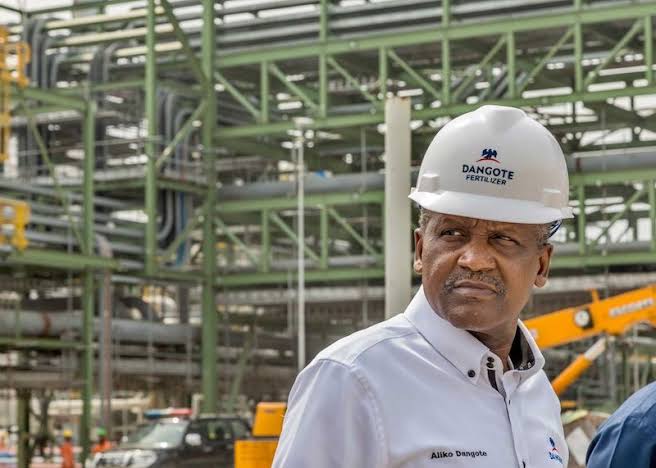
President of Dangote Industries Limited (DIL), Aliko Dangote said his company – the Dangote Petroleum Refinery – has enough Premium Motor Spirit (PMS otherwise known as petrol) in storage to sufficiently meet the local needs of Nigeria.


Speaking at the weekend, Dangote disclosed that the oil refinery has “more than half a billion litres of petroleum and over 600 billion Naira worth of products in its tanks.

Dangote said, “…as we speak right now we have more than half a billion litres. The Refinery is producing enough refined products, like gasoline, diesel, and kerosene, to meet 100 per cent of Nigeria’s requirements.

Speaking after a tour of the Refinery complex by a Zambia Government delegation, led by the country’s Minister of Energy, Mr. Makozo Chikote, Dangote stated that the refinery project, like other projects in the past, is not for Nigeria alone.

Advertisement

“This refinery is not only for Nigeria; it is for Africa. We must sustain the African Continental Free Trade Area (AfCFTA) deal. We are trying to see how we trade with other African countries

The Zambian Minister of Energy said his takeaway from the Dangote Refinery working visit was that the President, Aliko Dangote, is truly focused on the bigger picture for Africa.

Chikote, who led a delegation of energy experts to the Dangote Petroleum Refinery to partner Zambia on energy solutions, expressed satisfaction and readiness to work with the African manufacturing giant.

After a tour of the Dangote complex at the Free Trade Zone, Ibeju Lekki, starting from the Single Point Mooring to the Dangote Jetty, the biggest fertiliser plant in Africa and the 650,000bpd largest single-train refinery in the world, the Minister enthused that the presentation by the Vice President, Oil and Gas of Dangote Industries Limited, Mr. Edwin Devakumar, made their hearts “jump”.

Advertisement

He stated that the presentation speaks to the challenges of his country, Zambia.

The energy minister added, “In Zambia, we created an environment for the private sector to participate in the growth and development of our country. Currently, 100 per cent of our petroleum is done by the private sector.

“We are targeting increased productivity in mining, agriculture, and other sectors. Your presentation is an immediate solution to our energy needs. We are trying to promote competition among our private players

“We are looking at Dangote coming on board, which would lead to efficient, reliable, quality, and competitive products, and we want these done like yesterday.”

Advertisement

“Coming to the Dangote Petroleum Refinery, we have learned so many advantages of bringing many players for competition, which has improved the lives of the citizens.”

According to him, “From what we have seen, we need to promote trade within Africa to promote each other. We need these countries together to make Africa efficient, and a reliable trade hub.

“We have seen here that we can learn from what Dangote has done, and this would lead Africa and Africans to stand on their feet and not depend on overseas support in terms of trade. I believe going forward that people have learned a few lessons. The one lesson I have learned from this visit is that Dangote looks at the bigger picture for Africa.”

Another member of the Zambia delegation, Samuel Maimbo, the Vice President of Budget, Performance Review, and Strategic Planning at the World Bank Group, presently campaigning for the presidency of the African Development Bank (AfDB), explained that there is not enough development aid to develop Africa.

Advertisement

“There is also not enough government funding to develop Africa. The only way we can finance Africa’s growth at a pace and scale that solves our problem is by working through the private sector, which is why we are here today, to learn and to see what an ambitious programme looks like,” he stated.

He added that it is only the private sector that can help develop the continent of Africa.

The Vice President of Dangote Industries Limited, Edwin Devakumar stated that the Refinery produces the best quality products as its core business strategy.

“The project concept was to process the crude from Nigeria and add value. But we also wanted to provide some flexibility to process most of the African crudes and some of the Middle Eastern crudes,” Edwin said.

Advertisement

He said: “In another concept, what we did was maximum value extraction. That is a process where every barrel of crude which goes in, the value addition should be the best.”

According to Edwin, “the Refinery can meet all our requirements. 44 per cent can meet the entire requirements of Nigeria, and 56 per cent of the production would be exported. Every day, we produce lighter products of 104 million litres; 57 million litres of petrol every day; 20 million litres of jet fuel; and 27 million litres of diesel production.

“The local consumption is just around 46 million litres, and the remaining 58 million litres will be exported daily,” he added.

Credit: Vanguard
Advertisement

News

NDLEA starts nationwide training of counselors on standard rehab guidelines(Photos)

Published

on

ADVERTISEMENT
Zoom Ad
ADVERTISEMENT
Zoom Ad

. We’ll continue to entrench best global practices in our drug demand reduction efforts, says Marwa

The National Drug Law Enforcement Agency (NDLEA) has commenced a comprehensive training programme for its counselors nationwide, aimed at standardizing operational protocols and strengthening clinical competencies in line with global best practices for drug demand reduction.

The training, which commenced at the NDLEA Academy, Jos, Plateau State, is being coordinated by the Directorate of Counseling, Treatment and Rehabilitation (DCTR) and brings together over 100 counselors drawn from the Agency’s formations across the country.

The exercise marks the first Agency-driven capacity-building programme of its kind for NDLEA counselors in several years, a development that has been widely commended by participants as a demonstration of the Agency’s renewed commitment to the professional growth of its counseling workforce.

Advertisement

Speaking at the commencement of the phase 1 of the exercise, Chairman/Chief Executive Officer of the Agency, Brig Gen Mohamed Buba Marwa (rtd) who was represented by the Director, Counseling, Treatment and Rehabilitation, ACGN Bashir Ibrahim, said the training is critical to revitalizing staff morale and equipping officers with modern therapeutic tools to tackle the evolving complexities of substance use disorders, describing it as a reaffirmation of the rehabilitation pillar of the Agency’s mandate and a guarantee that clients across NDLEA facilities receive evidence-based, quality interventions.

According to him, “key objectives of the training include harmonizing practice through uniform protocols across all State Command rehabilitation facilities; enhancing clinical proficiency to address emerging psychoactive substances and co-occurring mental health disorders; aligning the Agency’s rehabilitation practices with national and international standards; strengthening ethics, confidentiality and quality assurance; improving data management for evidence-based policymaking; promoting continuous professional development through peer review and clinical supervision; and optimizing rehabilitation outcomes by reducing inconsistencies in service delivery.”

He said the initiative underscores the Agency’s commitment to building a resilient, well-equipped counseling workforce capable of responding effectively to the nation’s drug demand reduction needs, adding that the training is expected to significantly improve the quality of care across NDLEA rehabilitation facilities and reinforce the integrity of Nigeria’s drug treatment and rehabilitation architecture.

Marwa assured that the Agency will continue to invest in the capacity of its personnel as part of its holistic approach to tackling drug supply and demand reduction in the country.

Continue Reading

News

Gov Muftwang saddened over demise of Dotun Oladipo condoles with family says he was an outstanding media practitioner

Published

on

ADVERTISEMENT
Zoom Ad
ADVERTISEMENT
Zoom Ad

The Governor of Plateau State, Caleb Manasseh Mutfwang, has extended his heartfelt condolences to the Oladipo family and the Nigerian media industry following the passing of Dr. Samson Dotun Oladipo, a veteran journalist and distinguished media professional.

In a condolence message, Governor Mutfwang described the late Dr. Oladipo as an ace journalist and a towering figure in the media industry, whose immense contributions to journalism helped shape public discourse, promote democracy and good governance, and project a positive image of Nigeria before the international community.

The Governor commended his decades-long career in journalism, marked by professionalism, intellectual depth, integrity, and an unwavering commitment to ethical journalism.

He noted that Dr. Oladipo’s dedication to mentoring and nurturing younger professionals contributed significantly to building a new generation of journalists equipped with the knowledge, skills, and values required to serve the nation creditably.

Advertisement

Governor Mutfwang recalled with nostalgia his encounter with Dr. Samson Dotun Oladipo during one of the visits of the Nigerian Guild of Editors to Plateau State for its Annual General Meeting, describing the memory as a cherished one, and expressed deep sorrow over his passing.

Governor Mutfwang said the demise of Dr. Oladipo, a newspaper editor and later Publisher of the Eagles Online platform, was not only a monumental loss to his immediate family, the Nigerian Guild of Editors (NGE), the Nigerian Union of Journalists (NUJ), and the journalism profession, but also a profound loss to the entire media community and the nation, considering his remarkable contributions to journalism and national development.

On behalf of his family, the Government and the peace-loving people of Plateau State, Governor Mutfwang conveyed his deepest sympathies to the Oladipo family, the Nigerian Guild of Editors, the Nigerian Union of Journalists, and the entire media community over the painful loss. He prayed that Almighty God would grant the deceased eternal rest and comfort the family, colleagues, and all those mourning his passing.

Advertisement
Continue Reading

News

Discovery: ‘True Tomb’ Of Jesus Christ Found After 2,000 Years Matches Biblical Description Account

Published

on

ADVERTISEMENT
Zoom Ad
ADVERTISEMENT
Zoom Ad

After years of searching, Italian archaeologists have discovered an ancient site that matches a Bible description of the tomb where Jesus Christ was buried.

This was made known by a preliminary study in the Jerusalem archaeological journal Liber Annuus.

“We have found evidence of a funerary landscape,” lead archaeologist Francesca Romana Stasolla, of the “La Sapienza” University of Rome, told the Daily Mail.

The researchers had been excavating Jerusalem’s Church of the Holy Sepulchre, a fourth century Roman Church that was built over a holy site where many Christians believe Christ was crucified, buried and then resurrected.

Advertisement

True tomb? of Jesus Christ found after 2,000 years and it matches the Biblical description
The church of the Holy Sepulchre

As a result, it’s become a mecca for religious pilgrims from across the world, attracting around four million visitors per year.

?True tomb? of Jesus Christ found after 2,000 years and it matches the Biblical description
Pilgrims praying at the Church of the Holy Sepulchre

During the final phases of the excavations in 2025, the team found a peculiar landscape that suggests they might have been onto something.

Advertisement

Underneath the church was an abandoned quarry, cultivated plots of land, rock-cut tombs and an ancient garden.

Coincidentally, the Book of John said: “At the place where Jesus was crucified, there was a garden, and in the garden a new tomb, in which no one had ever been laid.”

While no one had been found in the tomb, the abundance of parallels was compelling.

John 19:20 says that the crucifixion occurred close to Jerusalem, while Hebrews 13:12 claims that it occurred outside the city gate, which was the exact location of the quarry at the time of Christ.

Advertisement

Sections of the quarry measured 20 feet deep and had been filled with dirt, suggesting that it served a pastoral purpose.

The site’s agricultural function was further supported by the discovery of olive trees and grapevines — possibly the same plant referenced in John 19:41 — that date back to the time of Jesus‘ de@th, which is believed to have happened around 33 A.D.

“The gospel mentions a green area between the Calvary and the tomb, and we identified these cultivated fields,” Stasolla told the Times of Israel.

In fact, the graves, which were carved directly into the stone, proved that it was an actual burial ground, and matched descriptions by Matthew, Mark and Luke of Jesus’ grave as having been carved from rock.

Advertisement

The evidence goes beyond parallels to the Bible. One particular chamber had been obstructed by a Roman structure built during Emperor Hadrian’s reign in the second century.

Around 200 years later, builders employed by Constantine’s workers destroyed the Roman structure and dug up the site to reveal the tomb, which they then separated from the other chambers.

While this doesn’t definitely prove that this was Jesus’ burial site, the campaign to preserve it suggested that knowledge of the site had been passed down to early generations of Christian worshippers.

“The real treasure we are revealing is the history of the people who made this site what it is by expressing their faith here,” Stasolla told the Times. “Whether someone believes or not in the historicity of the Holy Sepulchre, the fact that generations of people did is objective. The history of this place is the history of Jerusalem, and at least from a certain moment, it is the history of the worship of Jesus Christ.”

Advertisement
Continue Reading

Trending

Copyright © 2024 Naija Blitz News