…maintain 7.5% VAT, reject reintroduction of inheritance tax
By Gloria Ikibah
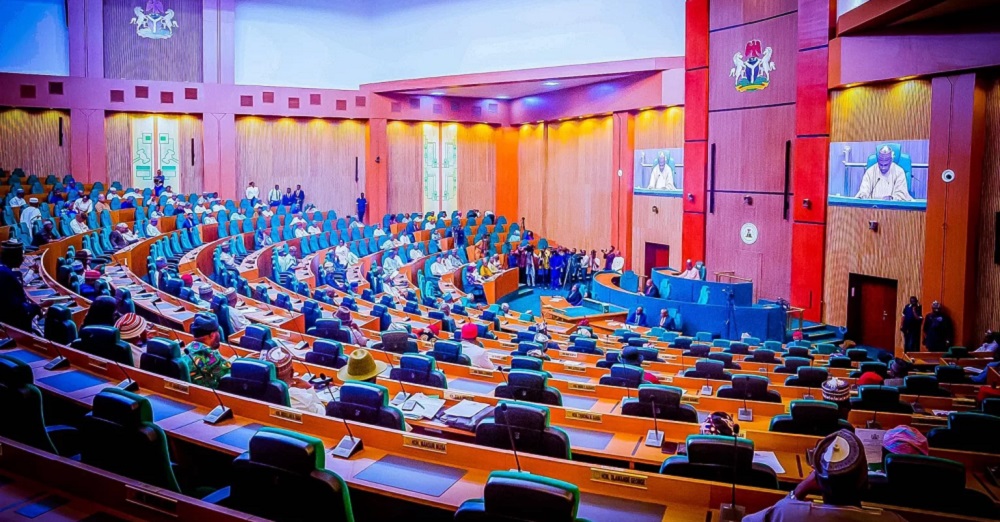
The House of Representatives has considered and adopted the four Tax Reform Bills on Thursday at plenary.
Chairman House Committee on Finance, Rep. James Faleke, presenting the report at the committee of the Whole, said the report was an extensive review of the Bills carried out by the Committee, with careful consideration of public input.
In the Committee of the Whole presided by the Speaker of the House, Tajudeen Abbas, the lawmakers considered the clause by clause of the four bills.
The proposed piece of legislation aimed at overhauling Nigeria’s tax framework includes: the Nigeria Tax Bill, the Nigeria Tax Administration Bill, the Nigeria Revenue Service (Establishment) Bill, and the Joint Revenue Board (Establishment) Bill.
Key adjustments were made to the Nigeria Revenue Service Bill, Joint Revenue Board (Establishment) Bill, and Nigeria Tax Administration Bill.
Nigeria Tax Administration Bill
Faleke sated that under the Nigeria Tax Administration Bill, the committee retained Value Added Tax, VAT, at 7.5% despite initial proposals to increase it gradually to 15% by 2030. The Committee also made changes to income tax provisions for petroleum operations (Section 78), setting the tax rate for petroleum gains at 30% instead of the previously higher rate of 85%.
The House has also rejected the proposed reintroduction of inheritance tax under the guise of taxation of family income.
Provisions related to excise duties were deleted across various bills due to concerns about their economic impact. The Committee also addressed definitions related to small companies, raising the turnover threshold for their classification to ₦100m while maintaining the asset cap at ₦250m.
New penalties were introduced for non-compliance by Virtual Assets Service Providers (VASPs), which include hefty fines and potential suspension of licenses.
While submitting the report, Faleke reaffirmed the importance of the Tax Reform Bills to Nigeria’s economic development, stating that, “These Bills are critical to the implementation of a modern, transparent, and efficient tax system that will foster economic growth and improve revenue collection.
Faleke stated: “There was a call for deletion of the proposed reintroduction of inheritance tax. Under the guise of taxation of family income as this oversteps divine jurisdiction which places inheritance matters within the scope of Sharia and customary laws of the north and south respectively. So in the amendment, the inheritance tax is defined as inheritance before distribution cannot be taxed.
“Before distribution. Reduction of VAT rates to 5% or alternatively maintain the current rate of 7.5%. The committee adopted the 7.5%. Recommendations for the restatement of contributions towards Naceni Nidda and the court to ensure continuous funding from the development level. This of course was retained without sunset clauses.
“Suggestions to name NIPC as the relevant authority in respect of priority sectors and company operating the area. This of course was amended and adopted. Appeal to reinstate the need for a tax accordingly.
He said :”During the retreat held from March 3rd to 9th, 2025, the Committee reviewed submissions made by the public during the hearing. Representatives from key government agencies, including the Nigeria Export Processing Zones Authority (NEPZA), the National Agency for Science and Engineering Infrastructure (NASENI), the National Information Technology Development Agency (NITDA), and the Tertiary Education Trust Fund (TETFund), were also invited to provide further input.
“We carefully examined every submission to ensure the public’s opinions were incorporated into the review process,” the chairman stated, adding that the retreat involved a thorough review of existing laws proposed for repeal or amendment.
“The Committee recommended amendments to various pieces of legislation, including the Companies Income Tax Act (CITA), Value Added Tax Act (VAT), Personal Income Tax Act (PITA), and the Federal Inland Revenue Service (Establishment) Act, among others. The Petroleum Industry Act, Nigeria Export Processing Zones Act, and Oil and Gas Free Trade Zone Act were also amended to reflect the proposed changes.
According to the Committee Chairman, the bill if passed, has repealed all the companies income tax which was enacted in 1979, Value Added Tax 1993, Personal Income Tax 1993, Federal Income Revenue bill 2007, Capital Gains Tax 1967, Stamp Duties Act 1939, Casino Act 1965, Deep Offshore and Inland Basin Act and then of course Industrial Development Income Tax Relief 1971, Petroleum Profit Tax Act 1959 and of course Venture Capital Incentives 1993.
Several practical amendments were introduced in the Nigeria Tax Administration Bill to enhance efficiency. Section 7 extended the timeline for issuing taxpayer identification numbers (Tax IDs) from two working days to five, allowing room for administrative delays. Additionally, a reduction in the timeline for companies ceasing operations to file their income tax returns (Section 11) from six months to three was introduced to prevent revenue loss.
The VAT system was also revised (Section 22) to ensure that taxable supplies are attributed to their place of consumption, irrespective of where returns are filed, addressing concerns of regional imbalances. The Committee introduced a VAT fiscalisation system (Section 23), requiring the development of further regulations to ensure the system’s effectiveness.
Amendments were made to the reporting thresholds for banking transactions (Section 28), raising them from ₦25m to ₦50m for individuals and from ₦100m to ₦250m for corporate entities. Section 60 mandated court orders before the tax authority could seize movable assets, reinforcing the need for judicial oversight.
One of the most notable additions is the mandatory provision of access to electronically stored taxpayer information (Section 61), in light of the increasing shift from manual to electronic storage.
The Committee also amended Section 77, introducing a new formula for distributing VAT revenues to local governments, ensuring that 70% is distributed equally and 30% based on population.
Nigeria Revenue Service Bill
Significant amendments were made to Section 4 of this bill, which defines the functions of the Nigeria Revenue Service (NRS). The Committee limited the NRS’s scope to exclude individual taxpayers in states and the Federal Capital Territory (FCT), shifting their focus to federal-level revenue.
The composition of the governing board was also revised. Section 7 now requires the board to include six executive directors, appointed by the president from each geo-political zone on a rotational basis. Additionally, one representative from each state and the FCT will sit on the board to ensure proper federal character representation.
Section 13 introduced new qualifications for the Secretary to the Board, who must be a lawyer, chartered accountant, or chartered secretary at the level of Assistant Director or higher. Amendments to the funding of the NRS introduced a fixed cost-of-collection rate of 4% of total revenue, minus royalties, to be appropriated by the National Assembly.
Moreover, the NRS’s borrowing powers (Section 28) were tightened, requiring approvals from both the Federal Executive Council and the National Assembly before any loans can be secured.
Joint Revenue Board (Establishment) Bill
The Joint Revenue Board Bill saw adjustments aimed at improving oversight and transparency. Section 25, which previously outlined the qualifications for Tax Appeal Commissioners, removed the requirement for commissioners to have experience managing businesses, which the Committee deemed irrelevant.
The Committee also emphasized the independence of the Tax Ombud’s office in Section 43 by funding it directly through the Consolidated Revenue Fund, eliminating gifts or grants that could introduce biases. Similarly, provisions were made for additional office expenses under Section 44.
The Committee further introduced new regulations to ensure that the Evidence Act is strictly adhered to during tax appeal proceedings. A significant change was the establishment of independent funding for the Tax Appeal Tribunal (TAT), freeing it from dependence on the Federal Inland Revenue Service (FIRS) to avoid conflicts of interest.