


Connect with us

News

Rivers people should thank Tinubu for declaring Emergency Rule -Ex-Rivers HoS

Published

on

ADVERTISEMENT
Zoom Ad
ADVERTISEMENT
Zoom Ad

…says Fubara had outlined destructive plans to unleash terror

… using his brother in Bayelsa to support his acts

..plans to blow up oil pipelines

…how he ordered demolition of Assembly Complex

Advertisement

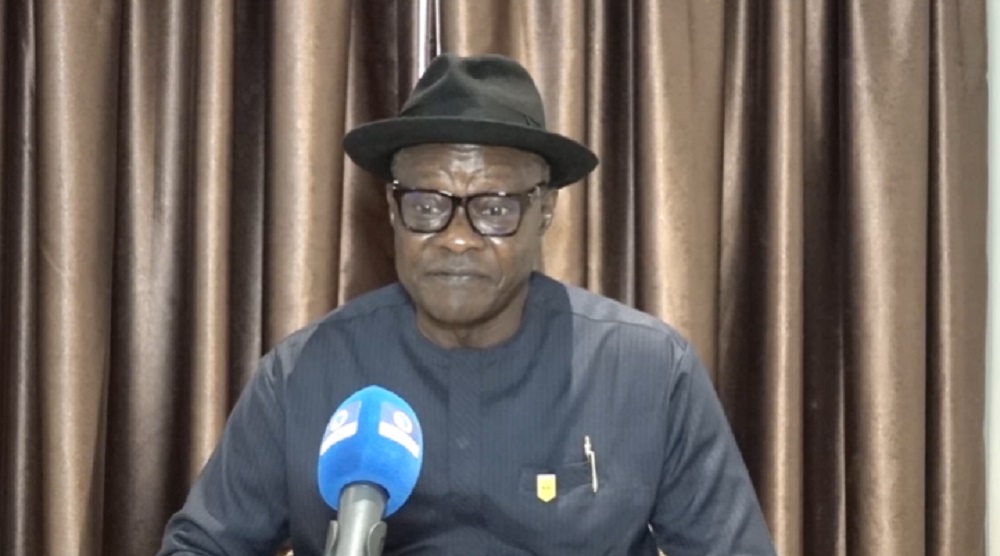
The immediate past Rivers State Head of Service, George Nweke has opened the underbelly of the suspended Rivers Governor Siminalayi Fubara’s highly destructive acts before Emergency Rule was introduced in the State.

Declaring via a viral sighted, Nweke said that Rivers people should thank President Bola Tinubu for his timely declartion Emergency Rule in the State.

“I want to use this medium to thank Mr President for his swift intervention in Rivers State crisis especially on the declaration of a state of emergency that was declared and assented to by our National Assembly.

“You will recall that when the governor was suspended as Head of Service I was the next in command, so I am not speaking as an outsider or as a novice, I am speaking as insider and as someone that has much information.

Advertisement

“If not for the intervention of Mr President, Nigeria would have faced the worst economic sabotage and Rivers State would have been in flames and by extension other neigbouring states of the level of insider destruction that I saw.

“First, it all started with the state house of assembly where the Governor Sim Fubara directed his chief of staff to burn down the assembly in a way to avert his suspected impeachment.
That evening Edison was in Government House with many of his boys including the former chairman of Ibio-Akpo one Mr Chijioke Ewon.

“I was there with them with a bag of money was handed over to Edison for that operation, though I did not actually know what it was meant for or the amount inside.

Read full interview below:

Advertisement

“My dear people of Rivers State, it is with humility and every sense of responsibility and a sense of patriotism that I stand to address you today as your former Head of Service and someone who served from my heart.

“You would recall that I was appointed Head of Service by our suspended Governor Sim Fubara. Let me also use this opportunity to appreciate him for giving me the opportunity to serve as Head of Service.

“With loads of misinformation on print and electronic media, I have chosen to put the record straight. I was not sacked, neither was I pressured to resign, I did so willingly from the depth of my heart.

“However as an insider and a key player in the administration and by my position who worked closely with the suspended governor, it will be unfair for me to keep mute or for me not to address some key factors that has affected or that will affect our state if we continue on this trajectory and I pause to say that good men must talk so that things will be put right.

Advertisement

“I want to use this medium to thank Mr President for his swift intervention in Rivers State crisis especially on the declaration of a state of emergency that was declared and assented to by our National Assembly.

You will recall that when the governor was suspended as Head of Service I was the next in command, so I am not speaking as an outsider or as a novice, I am speaking as insider and as someone that has much information.

If not for the intervention of Mr President, Nigeria would have faced the worst economic sabotage and Rivers State would have been in flames and by extension other neigbouring states of the level of insider destruction that I saw.

First, it all started with the state house of assembly where the Governor Sim Fubara directed his chief of staff to burn down the assembly in a way to avert his suspected impeachment.
That evening Edison was in Government House with many of his boys including the former chairman of Ibio-Akpo one Mr Chijioke Ewon.

Advertisement

“I was there with them with a bag of money was handed over to Edison for that operation, though I did not actually know what it was meant for or the amount inside.

I want to tell Rivers people today, that the house of assembly was complex, …was clear to brought down by a duel of Edison and some of his boys under the instruction of the sitting governor then.
I challenge them to an open confrontation and this will make us to throw more light on this.

A day after that incident, I almost resigned but I was very scared because I know the power of a sitting governor and he knew that I am aware of the whole plan and that I am discomforted with the uncautionable act and deliberate posture of innocence and mire of a sheep.

Another attempt was also made to destroy the residential quarters of the house of assembly members. If not for the press conference that was made there by Rivers youths, Rivers Elders and National Assembly members, that would have been another barbaric demolition in Rivers State.

Advertisement

I came to realise that they actually wanted to demolish that second building because after some weeks, he the governor personally told me and a couple of other that if he knew early he would have gone to pull down their hall before visiting the residential quarters of the assembly and that he didn’t actually know what they had, that they had such a beautiful hall where they are using now for sitting, I was so rudely shocked.

And I asked myself, how could a man that wants to lead his people be destroying his state assets and wasting public funds in a needless ego fight?

Thirdly, I want to advice some key stakeholders who have condemned the state of emergency made by the president and confirmed by the National Assembly to re-track that statement. They are speaking from point of ignorance.
I also understand that they are only seeing the surface. If they had knowledge, they will even be commending Mr President.

If the President did not take proactive steps, no one knows who would have been affected by the sinister plans that were cooking.

Advertisement

While I thank Mr President for the state of emergency that was declared in Rivers State for a period of six months, I will plead with him not to give up on Rivers State affairs because a lot is going on there with Governor Fubara.
One of the factors that got me removed was when Governor Fubara told me that judge to decide who becomes the next president of Nigeria and I asked him how will that work? Is it by votes or by what means? I am still worried.

He clearly told me that he is chief security officer of Rivers State and his brother is in charge of Bayelsa State and all the pipelines are under their care, that at the appropriate time, they will tell the boys what to do and fund was not an issue at all.
That was when he made that statement in his public function that and I quote “I will tell the boys what to do at the appropriate time” deep down in me, I knew that something was up and perhaps the time was near.
He boasted to be the David that will bring down the Goliath of Rivers State. That he has the backing of the crème de la crème in the state, the likes of our former Governor Dr Peter Odili and family, promised to use their contacts in the judiciary including some members of the University Council to break new grounds for him.
The plan was to start from Ijaw speaking areas to destroy oil facilities, to remove attention from the Ijaw and make it have a state wide look. The Ogoni, Oyigbo, Ahoda areas were to be bombed first before the Ijaw zones.
This would have brought down the government of President Tinubu and usher in a new president from the coalition of political parties with a vice president possibly himself as he was boasting.
The media must be captured by paying heavily for airtime and retaining the social media influencers and known social critics in their payroll.
I am not aware of what this revelation means but I am doing this to free my conscience and warn those innocent persons that are used to swell public sentiments, that there is more that meets the eyes in the Rivers matter.
Sometimes I sleep over a the Government House but I started becoming very uncomfortable when Governor Bala Mohammed and some other stakeholders that several nurturer visits to Rivers State.
I recall that one of such visits he told me that he would support Bala Mohammed for President or any other Northerner, that discussion in still ongoing.
Though I am not bothered by who he supports or not, I am more concerned about the quantum of state resources that were being released to these visitors at each of those unwanted visits.
Let me draw the attention of the Nigerian Labour Congress to call the chairman of their Rivers State chapter to order to avoid politicizing Labour.
I am privy to several private meetings between the governor and Labour leaders in the state and largess that accompany each meeting to compromise Labour Union and I pause to ask, why? What is actually the benefits to gain from all these unnecessary destructions.
More worrisome is the several meetings between the governor, his chief of staff and some militant leaders, details of these meetings, I am not privy too since I was not allowed into such meetings. However each meeting ended with huge sums of money in hard currency.
I wish to state categorically that Rivers people and indeed Nigerians are the beneficiaries of the declaration of the state of emergency rule in Rivers state and not Governor Fubara neither it is our former minister Nyesom Wike.
Finally I wish to call Mr President to urge the sole administrator to step up his guards and be very vigilant because I am aware of the sinister arrangement and dastardly plans to continue to harsh their plans if not put in check.
This accounts for the organised media condemnation and seeming public outcry against Mr President and National Assembly. Those who love democracy, those who love Rivers State, those who love development in any ramification and those who love humanity in general will always protect humanity and democracy.
Mr President sir, you have just protected democracy and humanity in Rivers State, you are our hero in Rivers State, thank you sir.
I can now sleep having cleared my conscience.
Long live Federal Republic o f Nigeria!
Long live Rivers State!
THE END

Continue Reading
Advertisement
Click to comment

Warning: Undefined variable $user_ID in /home/naijuinz/public_html/wp-content/themes/zox-news/comments.php on line 49

You must be logged in to post a comment Login

Leave a Reply

News

NDLEA uncovers Saudi Arabia, Europe-bound cocaine in phone chargers, backpack

Published

on

ADVERTISEMENT
Zoom Ad
ADVERTISEMENT
Zoom Ad


…nabs Italy based bizman at Enugu airport excretes 98 wraps of cocaine

… recovers large consignments of illicit drugs in Ondo, Oyo, Edo, Abia, Seme, and Tincan operations

A 30-year-old Italy-based businessman Joseph Cyril has been arrested by operatives of the National Drug Law Enforcement Agency (NDLEA) at the Akanu Ibiam International Airport (AIIA) Enugu for ingesting 98 wraps of cocaine while heading to Italy via Addis Ababa and France.

Advertisement

The suspect who was nabbed at the departure hall of the airport on Sunday 2nd August 2026 during the outward clearance of passengers on Ethiopian Airlines flight ET930, was subsequently placed on excretion observation during which he excreted 98 wraps of cocaine weighing 1.510 kilograms.

‎Investigations revealed that Cyril had arrived Nigeria from Italy on 13th July 2026 and ingested the drug in a hotel in Awka, Anambra State before proceeding to Enugu to board his flight to Europe on Sunday 2nd August. In his statement, he claimed he has been doing business in Italy for years before agreeing to traffic the drug consignment for a fee of 3,500 Euros in order to raise money to relocate to Germany where his family is based.
Attempts by some drug trafficking syndicates to export 1.2 kilograms of cocaine concealed in
25 pieces of phone chargers going to Saudi Arabia were thwarted by NDLEA operatives at a courier firm in Lagos. A similar bid to send 500 grams of the same class A drug hidden in the false bottom of a backpack to Italy was equally aborted in another logistics company by NDLEA officers on Monday 3rd August, while a consignment of 2.3kg Loud, a synthetic strain of cannabis, coming from the United States was intercepted in another shipping company in Lagos on Tuesday 4th August.
Meanwhile, NDLEA officers on patrol along Akure-Ilesha expressway on Tuesday 4th August intercepted a truck heading to the North with 1,633 kilograms of skunk concealed in bags of rice shafts. Two suspects: Buba Jamilu, 40, and Sanusi Ibrahim, 30, transporting the consignment were arrested, while a total of 147kg skunk was recovered from Ita Ogbolu forest during a raid operation on Monday 3rd August.

In Oyo state, operatives acting on credible intelligence on Monday 3rd August raided a drug warehouse in Elebure village, Orire LGA, where they recovered 731.03 kilograms and arrested a suspect, Felicia Thompson, 57, while her partner, Thompson Vincent Nwaka
is at large. In a similar operation in Edo state on Wednesday 5th August, operatives supported by soldiers recovered 65 jumbo bags of skunk weighing 604.5kg at Ewe Luleha in Owan West LGA.

While a drug joint operator, Chibuike Charles, 31, was arrested during a raid at his Samec by powerline base in Osisioma LGA, Abia state where 7kg of skunk was seized on Thursday 6th August, a notorious wanted drug dealer, Adome Claude Sikuru was on Saturday 8th August nabbed at the fibre market drug jungle, Badagry, Lagos, after a three-month manhunt for him. As at the time of his arrest, 88.5kg of skunk was seized from him.

Advertisement

A total of 73 cartons containing 442 packets of cookies and gummies infused with cannabis weighing 309.4kg were discovered during a joint examination of a 40ft container by NDLEA officers, Customs and other security agencies on Tuesday 4th August at the Tincan port complex Lagos. A suspect, Larry Nnaji, has already been arrested in connection with the seizure.

With the same vigour, Commands and formations of the Agency across the country continued their War Against Drug Abuse (WADA) sensitization activities to schools, worship centres, work places and communities among others in the past week. These include: WADA enlightenment lecture to students and staff of Islamic High School, Saki, Oyo state;
Holy Ghost Academy, Nkpor, Anambra; and Madarasatul Hidayatul Aulad Islamiyya, Gaya, Kano; while the Rivers state command of NDLEA paid a WADA advocacy visit to the management of Ignatius Ajuru University of Education, Port Harcourt, Rivers state, among others.

While commending the officers and men of DOGI, AIIA, Ondo, Oyo, Edo, Abia, Seme, and Tincan Commands for the various successful operations, Chairman/Chief Executive Officer of NDLEA, Brig. Gen. Mohamed Buba Marwa (rtd) enjoined them and their colleagues across the country to continue with the ongoing balanced approach to the drug control efforts of the Agency.

Advertisement
Continue Reading

News

The Sundiata Post Model (6): Institutional Success and Its Four Levels

Published

on

ADVERTISEMENT
Zoom Ad
ADVERTISEMENT
Zoom Ad

By Max Amuchie | The Sunday Stew

In the preceding articles, I have argued that the twenty-first-century newsroom must evolve into a knowledge-producing institution; situated that proposition within a broader intellectual tradition; introduced the Dual Engine Architecture through which journalism and knowledge production become mutually reinforcing; and proposed the Realm of the Long Term together with its Seven Pillars as the institutional foundations of enduring organisations.

A natural question now arises.

How should the success of such an institution be measured?

Advertisement

For decades, the commercial media industry understandably prioritised audience size and print circulation. With the rise of digital journalism, these traditional measures were increasingly supplemented—and in many cases displaced—by page views, unique visitors, click-through rates, impressions, engagement metrics and social media reach. These indicators remain valuable because they reveal important aspects of audience behaviour and commercial performance.

Yet they do not tell the whole story.

A media organisation may attract millions of readers while producing little original knowledge. It may dominate online conversations today yet leave no enduring intellectual contribution tomorrow. It may generate impressive revenue while gradually losing public trust. Conversely, an institution may produce ideas that influence scholarship, public policy and professional practice for decades without ever becoming the largest media organisation in its market.

The central proposition of the Sundiata Post Model (SPM) is therefore straightforward: institutions should ultimately be measured not merely by what they produce, but by what they leave behind.

Advertisement

This requires us to rethink what institutional success actually means.


Four Levels of Institutional Success

The SPM proposes that institutional success exists at four progressively deeper levels: Operational Success, Institutional Success, Civilisational Success and Legacy.

Advertisement

These are not competing categories. They are successive stages in the evolution of an enduring institution.


Operational Success

Operational Success concerns an institution’s ability to perform its immediate responsibilities effectively.

Advertisement

For a newsroom, this includes producing accurate journalism, meeting publication deadlines, maintaining editorial standards, growing audiences, generating sustainable revenue and responding effectively to the daily demands of public communication.

These are indispensable functions. Without operational competence, institutions cannot survive.

Yet Operational Success is also the most immediate form of success. It is measured in days, weeks, months and annual performance reports.

It answers a relatively simple question:

Advertisement

Is the institution performing well today?

Many organisations achieve Operational Success.

Far fewer move beyond it.


Advertisement

Institutional Success

Institutional Success represents a deeper level of achievement.

Here, attention shifts from performance to permanence.

The institution is no longer evaluated solely by today’s output but by its ability to preserve its mission while continuously renewing itself. Leadership succession becomes important. Governance becomes important. Institutional memory becomes important. Financial resilience, knowledge stewardship, innovation, public trust and organisational culture become defining concerns.

Advertisement

This is the Realm of the Long Term introduced in the previous article.

The central question is no longer:

How well are we performing?

Instead, it becomes:

Advertisement

Will this institution remain valuable twenty, fifty or one hundred years from now?

Institutions that reach this level become larger than any individual leader.

Their systems become more important than personalities.

Their mission becomes more enduring than their founders.

Advertisement

This transition requires institutionalisation: the process through which an institution converts individual vision, knowledge and leadership into durable systems, structures, practices and values that can survive changes in personnel and leadership.

An institution is not truly enduring if its most important knowledge exists only in the mind of one person, if its critical relationships depend entirely upon one individual, or if its strategic direction disappears when its founder departs.

Institutionalisation is therefore one of the mechanisms through which Institutional Success becomes possible. It transforms personal capacity into institutional capacity and individual achievement into organisational inheritance.

Civilisational Success

Advertisement

The third level extends beyond the institution itself.

Civilisational Success concerns the institution’s contribution to society’s accumulated stock of knowledge.

It occurs when an institution produces ideas, methods, frameworks, archives, research, public debates and intellectual traditions that continue shaping society long after their immediate circumstances have passed.

At this level, the institution no longer influences only its industry.

Advertisement

It contributes to civilisation itself.

Its ideas become reference points.

Its publications become historical records.

Its methodologies become professional standards.

Advertisement

Its research becomes part of society’s collective memory.

The institution’s greatest contribution is therefore not simply the news it reported, but the knowledge it helped humanity preserve.

The SPM is itself grounded in this proposition. As a model for twenty-first-century journalism, it argues that a newsroom organised as a knowledge-producing institution should be capable of generating original intellectual contributions alongside its daily journalism. The development of The Insecurity Triad, the Trinity of Sovereignty Decay (TSD), and the Decoupling Sovereignty Index (DSI) illustrates this possibility. These frameworks did not emerge from a conventional research institute or university department, but from a newsroom deliberately organised to produce knowledge as well as news. They therefore serve as a proof of concept for one of the Model’s central propositions: journalism, when institutionally designed for long-term knowledge creation, can produce intellectual assets whose influence extends beyond the news cycle.

Yet even Civilisational Success leaves one final question unanswered.

Advertisement

What is the highest measure of institutional success?

The SPM proposes a simple answer:


Legacy

Advertisement

Legacy is often misunderstood. It is commonly associated with longevity, reputation or the accomplishments of exceptional individuals. While these may contribute to legacy, they do not define it.

Institutions can exist for centuries without leaving a meaningful imprint on society. Others achieve widespread recognition during their lifetime yet fade quickly from public memory once circumstances change.

Legacy is something deeper.

It measures Generational Influence—the extent to which an institution’s ideas, values, methods and contributions continue shaping future generations.

Advertisement

Time alone does not create legacy.

Survival should not be mistaken for significance.

The true test of an institution is not simply whether it continues to exist, but whether its existence continues to matter.

Institutions achieve legacy when successive generations continue drawing value from what they have created. Their archives remain useful. Their research continues to be consulted. Their journalism retains historical relevance. Their ideas continue shaping public debate. Their methods become part of professional practice.

Advertisement

Legacy therefore transforms institutional success from a temporary achievement into a continuing public resource.

Every enduring institution eventually confronts the same reality.

Its founders leave. Leadership changes.

Generations pass.

Advertisement

If an institution depends entirely upon the vision or personality of a single individual, succession becomes a moment of vulnerability rather than renewal.

The question, therefore, is not simply whether an institution has a great founder or an exceptional leader. It is whether the institution can transform that individual’s vision into a capacity that belongs to the institution itself.

This is the deeper meaning of institutionalisation.


Advertisement

From Personality to Institution

Institutionalisation requires an organisation to deliberately convert individual capacity into institutional capacity.

It begins with the institutionalisation of mission. The institution’s purpose must be sufficiently clear and durable that it belongs to the organisation rather than to the personality of its founder.

It requires systems and processes that allow critical functions to continue regardless of who occupies a particular position. An institution becomes resilient when essential work can be reproduced through established procedures rather than dependent upon individual memory or improvisation.

Advertisement

It requires institutional memory. Decisions, research, methodologies, archives, lessons, relationships and intellectual work must be captured and preserved. What exists only in the mind of one person is not yet fully institutional knowledge.

It requires deliberate leadership succession. The next generation of leaders cannot be an afterthought. Institutions that intend to endure must cultivate successors before succession becomes necessary.

It requires distributed knowledge and authority. Critical knowledge, relationships and decision-making capacity should not become concentrated in a single individual. The institution must develop multiple centres of competence capable of sustaining its mission.

It requires durable governance. Governing structures, accountability mechanisms and institutional principles must be strong enough to protect the mission through changes in leadership and circumstance.

Advertisement

And it requires an institutional culture that reproduces the values of the organisation. The deepest form of institutionalisation occurs when the institution’s values become embedded in the behaviour of successive generations rather than remaining attached to the personality of its founder.

These seven mechanisms—mission, systems, institutional memory, succession, distributed knowledge and authority, governance, and culture—help transform an institution from a personality-driven organisation into a self-renewing institution.

The test of institutionalisation is therefore straightforward:

Can the institution continue to perform, learn, adapt and create value when the person who built it is no longer there?

Advertisement

If the answer is yes, the institution has begun to transcend personality.

The founder’s greatest achievement, therefore, may not be what he or she accomplishes personally, but what the institution becomes capable of accomplishing without them.

The SPM therefore treats stewardship as one of the defining responsibilities of institutional leadership. Leaders are custodians rather than owners. Their responsibility is not merely to achieve success during their own tenure but to strengthen the institution so that it serves generations they will never meet.

This is also where the distinction between journalism and knowledge production becomes most visible.

Advertisement

Daily reporting serves the immediate needs of society.

Knowledge serves both the present and the future.

Investigations become archives.

Research becomes scholarship.

Advertisement

Editorial judgement becomes institutional memory.

Original frameworks become intellectual assets.

Public records become part of society’s historical inheritance.

Every institution should therefore ask itself one final question:

Advertisement

If this institution ceased to exist tomorrow, what knowledge would disappear with it?

The answer reveals the depth of its institutional contribution.

An institution that merely reports events leaves little behind.

An institution that produces enduring knowledge leaves future generations with resources they would otherwise never have possessed.

Advertisement

That is the difference between activity and inheritance.

Between success and significance.

Between performance and legacy.


Advertisement

Beyond Performance

This distinction matters because institutions frequently confuse activity with achievement.

Publishing thousands of stories is activity.

Building a permanent archive of public knowledge is an achievement.

Advertisement

Generating revenue is an activity.

Creating financial systems that preserve editorial independence across generations is an achievement.

Winning today’s audience is an activity.

Earning public trust that survives decades is an achievement.

Advertisement

The SPM therefore argues that enduring institutions should evaluate themselves not merely by annual outputs but by their cumulative contribution to society.

This shifts institutional thinking from production to legacy.


The Highest Measure of Success

Advertisement

The SPM understands institutional success as a continuum rather than a destination.

Operational Success enables performance.

Institutional Success enables endurance.

Civilisational Success enables enduring contributions to society’s accumulated knowledge.

Advertisement

Legacy enables an institution’s ideas, values and contributions to continue shaping future generations.

Every institution must first learn to perform.

Some will also learn to endure.

Fewer will contribute enduring value to civilisation.

Advertisement

Only the rarest institutions ultimately leave a legacy that continues to enrich society long after those who built them have passed.

Institutions are ultimately remembered not for how much they produced, but for what they enabled humanity to remember, understand and build upon. That is why the highest measure of institutional success is Legacy.

Trust is sacred. Stay seasoned.


Advertisement

•Dr Max Nwabueze Amuchie is an African scholar-practitioner and framework builder whose original intellectual work spans insecurity, sovereignty, institutional development, and journalism as knowledge production. His frameworks include The Insecurity Triad, the Trinity of Sovereignty Decay, the Decoupling Sovereignty Index, and the Sundiata Post Model. A member of the League of Nigerian Columnists (LNC), he is the CEO & Theorist-In-Chief of Sundiata Post, Lead Researcher at the Sundiata Post Intelligence Unit (SPIU), and an Expert Member and Peer Reviewer in Behavioural and Social Sciences at ScienceOpen.

Continue Reading

News

16 rescued, several feared trapped as residential building collapses in Kano

Published

on

ADVERTISEMENT
Zoom Ad
ADVERTISEMENT
Zoom Ad


The Kano State Fire Service has saved 16 people after a residential building collapsed in the Dan Dishe area of Kwanar Yashi, Fagge Local Government Area.

Several others are still feared trapped under the rubble, according to reports from the scene.

The incident occurred in the early hours of Saturday when the structure, measuring about 20 by 30 feet, suddenly collapsed.

Advertisement

Spokesperson of the Fire Service, Saminu Abdullahi, confirmed the development in a statement, saying the agency received a distress call at about 4:32 a.m.

“The Kano State Fire Service wishes to inform the general public that at about 4:32 a.m. today, Saturday, 8 August 2026, the Service’s Emergency Response Unit received an emergency call from one of our staff, Aminu Sani Warure, reporting the collapse of a building at Dan Dishe, Kwanar Yashi, Fagge Local Government Area,” Abdullahi said.

“Upon receiving the report, men of the Service from the Headquarters were immediately mobilized to the scene. On arrival, they discovered that a residential building of about 20 by 30 feet had collapsed.”

He said rescue teams pulled 16 people from the debris, including three children who were found unconscious.

Advertisement

The children were identified as Affan Yusuf, five; Hassana Yusuf, seven; and Ummulkursum Yusuf, nine months.

Abdullahi said efforts were ongoing to locate and rescue other victims who may still be trapped.

“The rescue team recovered 16 people from the rubble. Operations are still ongoing as more people are feared trapped,” he added.

The cause of the collapse remains unknown, while investigations have commenced.

Advertisement

“The cause of the incident is yet to be ascertained. An investigation is ongoing,” Abdullahi stated.

He urged residents to take safety precautions, especially during the rainy season.

“The Kano State Fire Service urges members of the public to observe all necessary safety precautions, particularly during the rainy season, to prevent similar incidents,” he said.

The latest incident comes less than a month after a three-storey building under construction collapsed in Nasarawa Local Government Area, killing one person and leaving three others injured.

Advertisement
Continue Reading

Trending

Copyright © 2024 Naija Blitz News