Connect with us

News

Catholic Church gives Anambra APC guber candidate rigid conditions for support

Published

on

ADVERTISEMENT
Zoom Ad
ADVERTISEMENT
Zoom Ad

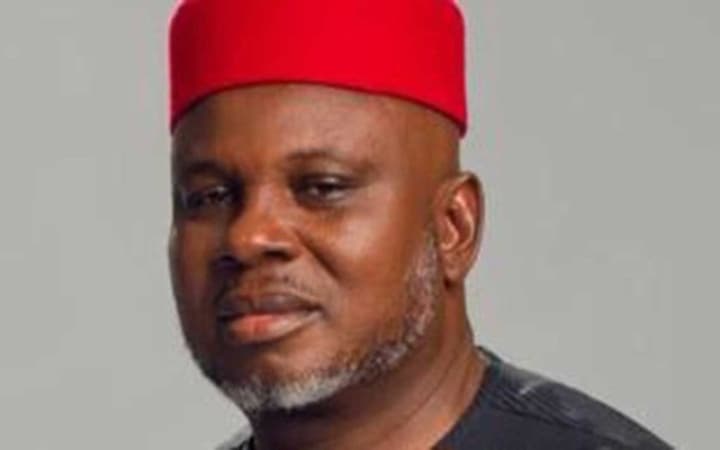
Barely 10 days after he emerged as the All Progressives Congress (APC) gubernatorial standard bearer for the November 8 gubernatorial poll in Anambra State, Prince Nicholas Chukwujekwu Ukachukwu has been given rigid conditions to receive the support of the Catholic Church in the state.


Sources told The Guardian that the basic conditions set before the APC governorship candidate include the selection of a deputy from the Catholic fold, and also that 60 per cent of his cabinet must be Catholics.

This is just as the APC governorship hopeful has been inundated by lobbyists for the position of running mate, even as he engaged with concerned APC stakeholders in the state in a bid to find common ground with various women groups agitating for gender parity.

The Guardian learned that the race for Ukachukwu’s running mate had been narrowed down between two former female Senators, Dr. Uche Lilian Ekwunife and Dr. Margery Okadigbo, who hail from the Central and North Senatorial Districts of the state, respectively.

Advertisement

Although both female politicians are Catholics, the factor of zoning is said to be impacting their chances, because while the more politically active Ekwunife hails from the populous Anambra Central District, Mrs. Okadigbo is from Anambra North, which has just served out eight years of governorship through Willie Obiano.

Also, the fact of her maiden community, Igboukwu in Aguata Local Council, and influence as the current Director General of South East Governors’ Forum is ticking in Ekwunife’s favour, as her candidacy is expected to help slice the votes in Old Aguata Union from where the incumbent Governor Chukwuma Soludo hails. (The Guardian)
Continue Reading
Advertisement
Click to comment

Warning: Undefined variable $user_ID in /home/naijuinz/public_html/wp-content/themes/zox-news/comments.php on line 49

You must be logged in to post a comment Login

Leave a Reply

News

Court Halts Trump’s White House Ballroom Project, President Kicks

Published

on

By

ADVERTISEMENT
Zoom Ad
ADVERTISEMENT
Zoom Ad

An appeals court on Friday upheld an order halting work on Donald Trump’s proposed White House ballroom, enraging the US leader and setting up another Supreme Court battle over the limits of presidential authority.

The US Court of Appeals for the DC Circuit, which had allowed construction to continue while it considered the case, agreed with a lower court that such a massive White House overhaul required the explicit consent of Congress.

It stayed its own decision for two weeks to give Trump time to ask the Supreme Court to intervene.

The Republican president lashed out after the 2-1 ruling, calling it “horrendous, politically motivated, and unlawful”.

Advertisement

The two majority judges were appointed by Democratic presidents, while the dissenting judge was nominated by Trump himself.

The President vowed in a lengthy social media post to immediately appeal to the Supreme Court.

“This decision, made after much of the work has been done and paid for, is a National Security Threat at the highest level. It is also a National Disgrace,” Trump said in another post on his Truth Social platform on Friday night.

Trump initially touted the construction of the ballroom as necessary to host galas but has since repeatedly pointed to the concurrent addition of an underground military bunker and other security features.

Advertisement

Under the district judge’s initial order, work was to be allowed to continue only on a limited set of structures, including those that were underground.

“This holding has nothing at all to do with whether the proposed ballroom is desirable or not as a matter of policy. This ruling does not even necessarily mean that the Defendants may not ultimately construct the ballroom,” the majority wrote on Friday.

“What it does mean is that the Defendants may not do so during the district court’s expeditious litigation without securing Congress’s authorisation, as the Constitution and laws require.”

Trump, who has repeatedly complained that the White House lacks sufficient space for grand galas such as state dinners, unilaterally ordered construction of the massive ballroom.

Advertisement

Work on the project began last year with the sudden demolition of the White House’s entire historic East Wing.

Since then, photographs have shown significant work on a basement complex, with some concrete walls rising above ground level.

Trump has insisted that the ballroom will be privately financed, but media reports in June showed that significant taxpayer funds were going towards the project, which could cost as much as $600 million.

While the White House initially cited a $200 million price tag for the project, it quickly doubled the estimate to $400 million.

Advertisement

The ballroom is just one of Trump’s pet projects aimed at leaving his mark on Washington by the time he leaves office in 2029, along with a renovation of the Lincoln Memorial Reflecting Pool and other parks, as well as the construction of a gigantic arch.

Several of the projects have similarly faced legal challenges, but the ballroom project would be the first to reach the Supreme Court.

Continue Reading

News

Nigeria Risks Losing Out On Fresh $1.4bn US Aid Over ‘Christian Persecution’

Published

on

By

ADVERTISEMENT
Zoom Ad
ADVERTISEMENT
Zoom Ad

Nigeria may be excluded from a new $1.4 billion U.S health and humanitarian assistance package announced earlier this week if the Federal Government fails to take measurable actions to address violence against Christians, according to terms contained in a bilateral Memorandum of Understanding signed by both countries.

The MOU, signed on December 20, 2025 between the U.S Department of State and the Nigerian government under the America First Global Health Strategy, AFGHS, commits Washington to nearly $2.1 billion over five years to expand preventative and curative services for HIV, TB, malaria, maternal and child health and polio.

Under the MoU, Nigeria is also expected to increase its domestic health spending by nearly $3 billion during the term, an expenditure that has been described as the largest co-investment under AFGHS.

A significant portion of the U.S funding is earmarked for Nigeria’s 900 faith-based clinics and hospitals, which currently serve more than 30 percent of Nigerians.

Advertisement

However, the deal contains strict conditions. The MOU states that the agreement was “negotiated in connection with reforms the Nigerian government has made to prioritize protecting Christian populations from violence” and includes “significant dedicated funding” for Christian health facilities.

Crucially, it adds: “As with all foreign assistance, the President and Secretary of State retain the right to pause or terminate any programme which do not align with the national interest, and the Trump administration expects Nigeria to continue to make progress ensuring that it combats extremist religious violence against vulnerable Christian populations.”

The conditionality was reinforced by the U.S House of Representatives, which recently voted to tie Nigeria’s aid to verifiable steps on tackling Christian persecution.

The bill passed last month by the House of Rep tasked Abuja with taking concrete actions to ensure the return of internally displaced persons to their ancestral homes and ensuring protection for persecuted Christians in the Middle Belt region among others.

Advertisement

Meanwhile, in the fresh aid approved by Washington under its AFGHS, the U.S set aside $1.4 billion to support integrated health services through faith and community-based hospitals and clinics in more than 20 countries.

Out of it, $850 million will go through a Faith and Community Initiative Award to World Vision and local faith-based implementers to strengthen over 2,500 faith-based hospitals and clinics across 17 countries with more than 30,000 community health workers trained, paid, and equipped.
An additional $570 million will be channelled directly to faith-based and community hospitals through bilateral MOUs with governments, including Nigeria.

In humanitarian assistance, the State Department also announced $538 million for Samaritan’s Purse and a World Vision–Compassion International consortium to reach 7 million people across 16 humanitarian crises. Over $100 million will be made immediately available for disaster response in 23 disaster-prone countries.

The State Department said the combined $1.4 billion health announcement is the largest to faith-based organisations in over 20 years, with at least 80 percent of resources required to go directly to frontline services.

Advertisement

For Nigeria, the MOU specifically emphasised support for Christian faith-based health care providers, which are described in the agreement as “uniquely positioned” to complement public facilities.

With the U.S shifting more resources to faith-based delivery where such providers account for 40 per cent or more of health facilities in many aid-recipient countries, Nigeria’s access to the new funding will depend on how Abuja addresses concerns raised in Washington.

The State Department said partners like Samaritan’s Purse, World Vision and Compassion International were chosen for their record of rapid deployment in conflict zones and disaster areas without bureaucratic delay.

Advertisement
Continue Reading

News

How Lack Of Electricity Is Causing Nigeria’s Population To Double – Fayose

Published

on

By

ADVERTISEMENT
Zoom Ad
ADVERTISEMENT
Zoom Ad

The newly appointed Chairman of the Rural Electrification Agency (REA), Ayo Fayose, has linked Nigeria’s rising population to the country’s persistent electricity challenges.

Fayose made the remarks on Friday, August 7, 2026, while speaking after assuming office as chairman of the agency.

According to him, the lack of reliable electricity has significant effects on the way Nigerians spend their evenings, particularly in communities where power supply remains inadequate.

He argued that when electricity is unavailable and darkness sets in early, many people are forced to remain indoors, resulting in more people going to bed earlier.

Advertisement

Fayose said the situation could indirectly contribute to population growth, as people have fewer opportunities for entertainment, recreation and social activities outside their homes.

He explained that the lack of electricity means that by early evening, many Nigerians are already preparing to stay indoors because there are limited activities they can engage in outside their homes.

“When you don’t address the issue of electricity, by 7 o’clock it gets dark, and people start engaging with their wives, so the population doubles,” Fayose said.

He added that the issue was not simply about providing electricity for household use, but also about creating an environment where people could remain active beyond their homes after sunset.

Advertisement

Fayose said reliable electricity would help encourage nightlife, recreation and other social activities, thereby giving people more options for how to spend their evenings.

“The simple problem is that, because there is no electricity, people go to bed early. Their minds are already prepared for it. If this is the only option available, they simply stay at home,” he said.

The REA chairman further argued that addressing Nigeria’s electricity deficit could transform the daily lives of citizens, particularly in communities that experience prolonged power outages.

“But if we address the electricity problem, there will be nightlife. There will be recreation outside your wife,” he added.

Advertisement

Fayose’s comments come amid ongoing efforts by the Federal Government to expand electricity access across the country through the Rural Electrification Agency and other power-sector initiatives.

The REA is responsible for promoting and coordinating efforts to provide electricity to underserved and unserved communities, particularly in rural areas.

Access to reliable electricity remains a major challenge in many parts of Nigeria, with inadequate generation, transmission constraints, distribution challenges and limited access in rural communities continuing to affect economic and social activities.

Poor electricity supply has also been identified as a major obstacle to businesses, healthcare services, education and other essential activities, particularly in communities that depend heavily on alternative sources of power.

Advertisement

With Fayose now assuming leadership of the REA, attention is expected to focus on how the agency can accelerate the expansion of electricity access to communities that remain outside the national grid or receive inadequate power supply.

His remarks also highlight the broader social implications of Nigeria’s electricity crisis, which extends beyond households and businesses to affect recreation, social interaction and the general quality of life.

The new REA leadership will therefore face the task of helping to expand access to dependable electricity while supporting initiatives aimed at improving economic opportunities and living conditions in underserved communities.

Advertisement
Continue Reading

Trending

Copyright © 2024 Naija Blitz News