


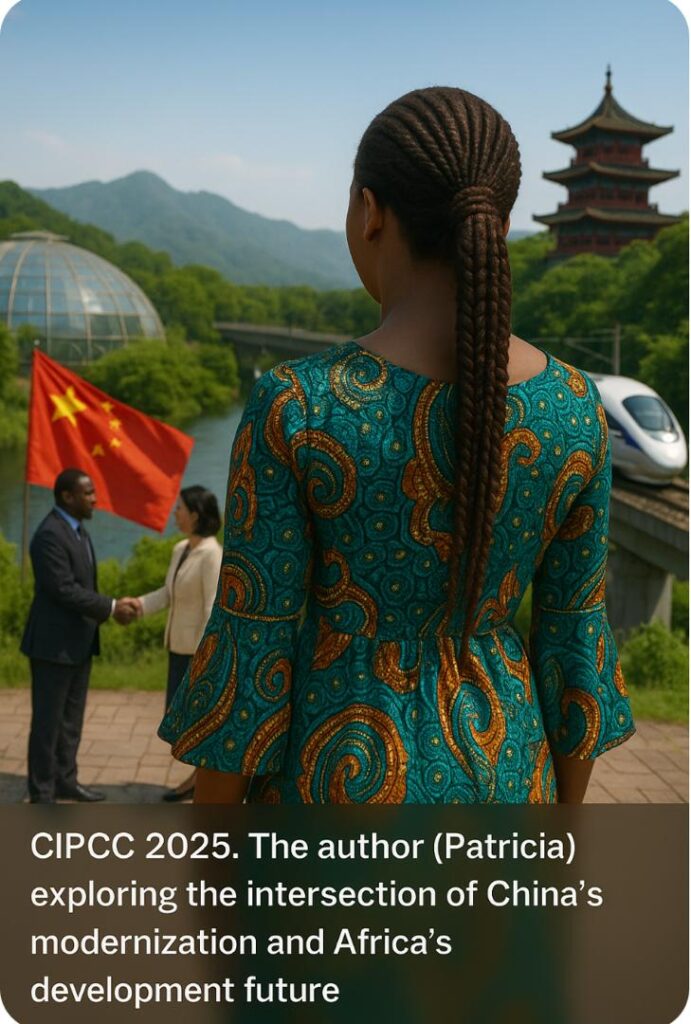
By Patricia Esami – Lubba
From high-speed trains slicing through ancient cities to space stations orbiting Earth, China’s modernization story is one of breathtaking transformation.
As a Nigerian journalist who recently witnessed this progress firsthand, I couldn’t help but ask: what does China’s journey mean for Africa? How can Nigeria and the continent at large engage with a development model that is not only reshaping Asia, but increasingly shaping global dynamics?
Innovation with Inclusion
At the heart of China’s modernization is a commitment to high-quality development. Innovation, green technology, and institutional reforms are driving forces behind its rise. China has made significant investments in research and development, positioning itself as a leader in fields like aerospace and artificial intelligence. But modernization here isn’t just about sleek tech. It’s about people.
In Zhejiang Province, for instance, economic policies have narrowed the urban-rural income gap by 30% in just a decade. This balance between cutting-edge advancement and equitable growth, offers critical insights for African nations striving to uplift broad segments of their populations while pushing for industrialization.
Green Dreams and Shared Goals
China’s approach to ecological harmony stands in stark contrast to older models of industrialization that often ignored environmental costs. The nation’s current plan includes a pledge to cut carbon emissions by 18% and increase clean energy usage to 20% by 2025. This “green shift” is not confined to its borders.
Through initiatives like the Zungeru Hydroelectric Dam in Nigeria and solar power collaborations in countries like Kenya and Ethiopia, Chinese companies are co-investing in Africa’s energy transition. These projects reflect shared sustainability goals, goals that are increasingly urgent as the effects of climate change intensify across the Global South.
Cultural Revival as a Pillar of Progress
Modernization, in China’s view, isn’t merely material but also deeply cultural. During my visit to the Palace Museum and several cultural sites, I observed a determined effort to blend modern advancement with heritage preservation. China is fostering cultural confidence by celebrating its ethnic diversity and integrating traditional arts into its modern narrative.
This commitment to cultural inclusion offers important lessons for Nigeria, Africa’s most populous and diverse country. As Rwanda’s Audace Mudahemuka aptly noted during our exchange in Beijing, China’s concept of “common prosperity”, where no group is left behind resonates strongly with Africa’s quest for equitable development.
A Global Model with Africa at the Table
Perhaps most striking is how China positions Africa in its modernization agenda. Foreign Minister Wang Yi once remarked, “There’s no global modernization without Africa.” That sentiment is more than rhetoric. It is embedded in China’s Belt and Road Initiative (BRI), which has seen Africa emerge as a vital partner in trade, infrastructure, and knowledge exchange.
In 2023 alone, BRI trade with the Global South reached $13.3 trillion, with African countries playing a significant role. Nigeria’s digital economy, Kenya’s Standard Gauge Railway, and Ethiopia’s industrial parks are all part of a broader story, one in which China and Africa are co-authoring a new chapter in global development.
A Shared Future?
China’s modernization is not offered as a rigid template, but as a conversation. It’s a journey anchored in peace, sustainability, and mutual respect. For Africa and Nigeria in particular, it presents an opportunity to reimagine development through a South-South lens, free from the confines of Western paradigms.
As we chart our own modernization path, perhaps the most powerful takeaway from China’s experience is this: when growth is inclusive, culturally rooted, and globally minded, it becomes a bridge not just between economies, but between peoples.
About the Author
Patricia Esami – Lubba aka Duchess is a Nigerian broadcast journalist and international / diplomatic correspondent. In 2025, she was selected as a fellow of the China International Press Communication Center (CIPCC), where she explored the Belt and Road Initiative and its global impacts. She is currently working on a book titled “Bridging Continents: A Journalist’s Journey Through China’s Belt and Road Vision.”
With her years of experience in television reporting, presenting and program production, she brings a unique lens to global affairs, with a special focus on Africa–China cooperation. This is her first published article, transitioning her storytelling from screen to print.