Connect with us

News

Just In: Senate Extends 2024 Budget Implementation to December 31

Published

on

ADVERTISEMENT
Zoom Ad
ADVERTISEMENT
Zoom Ad

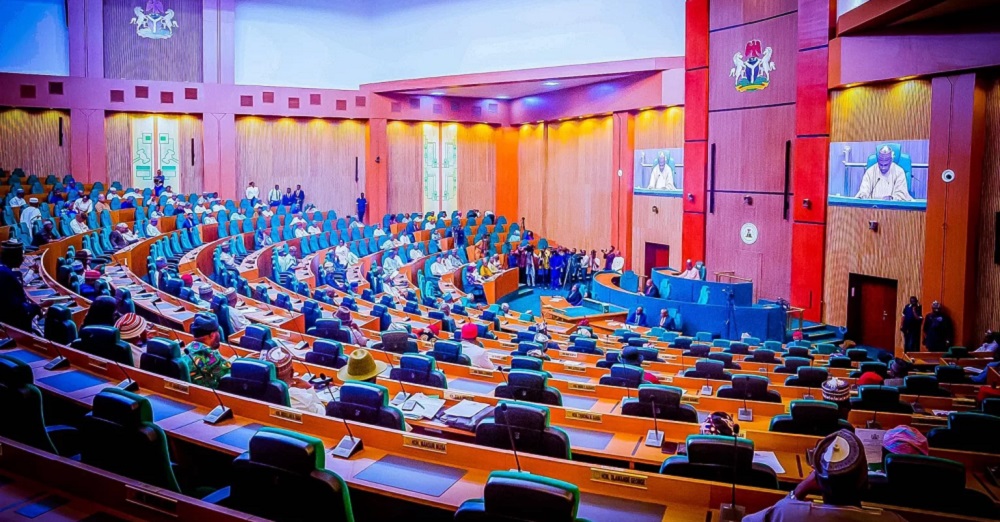
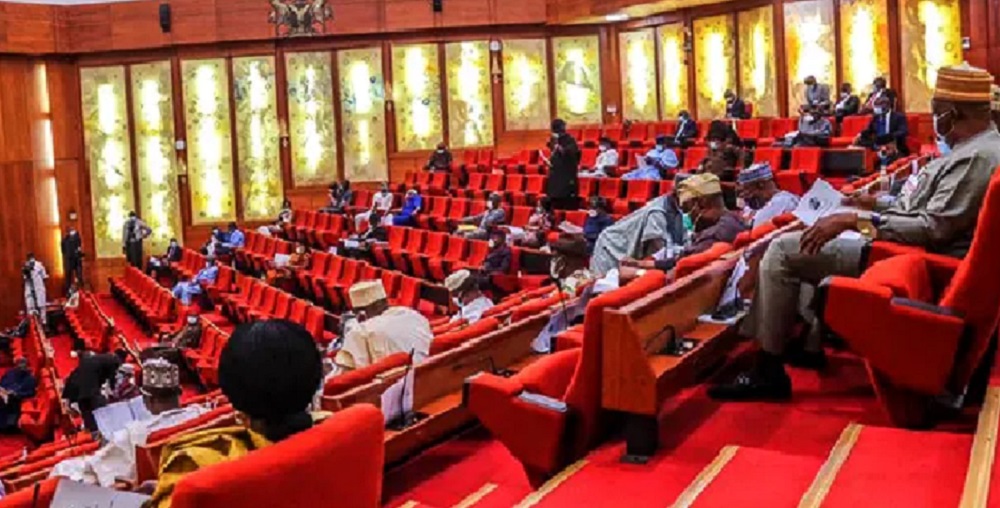
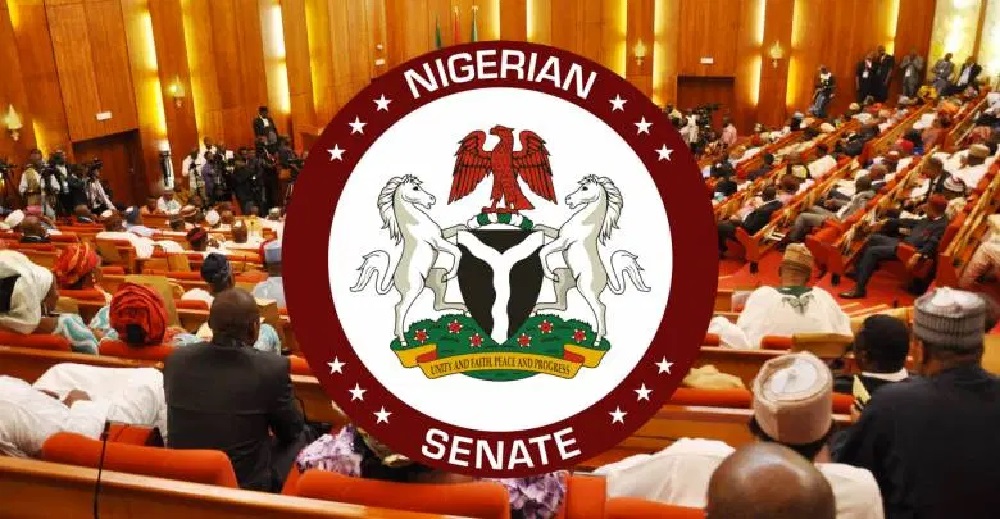
The Senate has for the second time extended the implementation of the capital component of the 2024 budget to December 31, 2025.


The Red Chamber made the resolution during the plenary on Tuesday, following the amendment of the appropriation bill requesting an extension.

The Deputy Senate President, Barau Jibrin, who presided over the plenary, announced the extension of the appropriation bill following its first, second and third reading expeditious passage.

The appropriation bill was considered at the Senate Committee on Supply.

Advertisement

Chairman of the Senate Committee on Appropriation, Olamilekan Adeola, led the debate during the plenary.

Adeola, the senator representing Ogun West Senatorial District, explained that the extension was required to allow the federal government to complete ongoing projects captured in the budgets.

He also claimed that the Nigerian government does not have enough resources to capture the expenditures proposed in the budget.

The appropriations committee chairman, therefore, urged his colleagues to support the extension of the 2024 budget in order to avoid abandoned projects of the federal government in different parts of the country.

Advertisement

The capital component of the 2024 budget was initially moved from December 31, 2024 to June 30, 2025, following a request by President Bola Tinubu.

The President’s justification at the time was to enable the executive arm to complete ongoing capital projects and optimise budgetary allocations. That extension was granted after extensive debate and consideration by both chambers of the National Assembly.

However, as the 30 June 2025 deadline approached, it became evident that several critical projects funded under the 2024 budget had not been completed, prompting the fresh extension.

With the new deadline of 31 December 2025, Nigeria is now operating two budgets within a single fiscal year: the 2024 budget, which is still being implemented and the 2025 budget, which has already passed and is currently in force.

Advertisement

As of the time it was extended in 2024, some critics argued that the extensions reflect weak execution capacity within government Ministries, Departments, and Agencies, while supporters of the move believed it ensures value for money and completion of critical infrastructure projects that otherwise would have been abandoned.
Continue Reading
Advertisement
Click to comment

Warning: Undefined variable $user_ID in /home/naijuinz/public_html/wp-content/themes/zox-news/comments.php on line 49

You must be logged in to post a comment Login

Leave a Reply

News

OpenAI restricts limited release of new model to US only

Published

on

By

ADVERTISEMENT
Zoom Ad
ADVERTISEMENT
Zoom Ad

OpenAI on Friday launched a US-only preview of its latest powerful AI model series to a limited group of partners at the request of the US government, the company said.

The release comes two weeks after the White House took Silicon Valley by surprise by ordering OpenAI’s rival Anthropic to ban all foreign nationals from accessing its Fable 5 and Mythos 5 models, citing national security concerns.

Anthropic swiftly shut down all access to those models, saying it could not reliably comply with the restriction on foreign nationals.

The latest models from leading AI companies, such as Anthropic’s Mythos series and now OpenAI’s GPT-5.6, have drawn major concerns over their reportedly unprecedented ability to identify software vulnerabilities — weaknesses in code that hackers can exploit.

Advertisement

Under pressure over the novelty of their capabilities, Trump earlier this month signed an executive order setting up a voluntary federal review of national security risks in advanced AI models before their release.

The White House has communicated little about how it will enforce its executive order — in which companies are understood to be participating voluntarily — and what models would fall under its review rules.

The intervention was striking for a White House that has otherwise pushed to loosen AI oversight — even moving to block states from writing their own rules.

The strong action against Anthropic has drawn accusations of government overreach, and OpenAI said it was uncomfortable with the process it was required to follow for its new models.

Advertisement

OpenAI said it briefed the US government on its new models’ capabilities ahead of the launch and, at the government’s request, is beginning with a limited preview for a select group of trusted partners whose identities have been shared with authorities.

The partners are US-based, but OpenAI said overseas employees at those companies or entities would also have access to the new models.

“We don’t believe this kind of government access process should become the long-term default,” OpenAI said in a blog post.

“It keeps the best tools from users, developers, enterprises, cyber defenders, and global partners who need them. We are taking this short-term step because we believe it is the strongest path to broader availability in the coming weeks.”

Advertisement

When Anthropic was initially targeted, some believed the safety-focused company was being unfairly singled out by the Trump administration for political reasons.

In an earlier clash with the White House, Anthropic angered Trump’s team by refusing to allow its technology to be used for mass surveillance and autonomous weapons, leading the Pentagon to cancel its contracts with the company.

That feud is now being litigated in two separate lawsuits.

– Three new models –

Advertisement

OpenAI’s GPT-5.6 series comprises three new models: Sol, the company’s new flagship; Terra, a mid-range model for everyday work; and Luna, a fast, low-cost option.

Once broadly available, Terra would be priced at half the cost of its predecessor GPT-5.5, the company said, as it seeks to lock in customers amid fierce competition from Anthropic and Google.

Both OpenAI and Anthropic have filed confidential IPO documents with US regulators and are targeting public listings at valuations approaching $1 trillion, raising the commercial stakes of the AI arms race between them.

AFP

Advertisement
Continue Reading

News

Edo CJ constitutes special court to try cultists, kidnappers

Published

on

By

ADVERTISEMENT
Zoom Ad
ADVERTISEMENT
Zoom Ad

The Chief Judge of Edo State, Justice Daniel Okungbowa, has set up a special court to try cases relating to cultism and kidnapping in the State.

This was disclosed in a statement by the Chief Registrar of the State High Court, B.O Osawaru, dated June 25, 2026, and titled: ‘Establishment and Composition of a Special Criminal Court for Edo State sitting in Benin City.’

According to Osawaru, the establishment of the Special Court, which is to be known as “Special Criminal Court 1”, would take effect from Wednesday, July 1, 2026.

Osawaru, who noted that the court will be sitting in Benin City, the state capital, said it was “pursuant to the request by His Excellency, the Governor of Edo State, Senator Monday Okpebholo, for the constitution of a Special Court for offences relating to cultism and kidnapping, an additional court to be known as “Special Criminal Court 1” is hereby established with effect from Wednesday, the 1st day of July, 2026, for offences relating to cultism and kidnapping and such other matters as may be assigned to the court by the Honourable Chief Judge of Edo State.”

Advertisement

Recall that Governor Monday Okpebholo had on June 18, 2026, during the parade of arrested suspected kidnappers and others for various criminal activities by the Commissioner of Police, Edo State Command, Monday Agbonika, threatened to set up a special court to try cases relating to cultism and kidnapping.

The Governor, in living up to his threat on June 19, 2026, wrote to the Chief Judge of the state requesting him to set up the special court.

The Governor’s request was contained in a letter dated June 19, 2026 and signed by Umar Musa Ikhilor, the Secretary to the State Government and addressed to the Chief Judge of the state.

The letter with reference number SGA.710/T/40 was also received by the office of the chief judge on the same date, June 19, 2026, at about 3:16pm.

Advertisement

The said letter is titled, ”Request for the constitution of a special court for offences relating to cultism and kidnapping”.

The SSG said the request was necessitated by the governor’s unwavering commitment to tackling and eradicating the menace of cultism and kidnapping in the State, as well as strengthening the administration of criminal justice.

The letter also requested the Chief Judge to nominate three judges or such numbers as he may deem fit, to constitute the Special Court.

Advertisement
Continue Reading

News

Army to recruit 28,000 additional soldiers to combat insecurity

Published

on

By

ADVERTISEMENT
Zoom Ad
ADVERTISEMENT
Zoom Ad

The Nigerian Army has announced plans to recruit and train an additional 28,000 personnel as part of efforts to strengthen ongoing operations against insecurity across the country.

The Chief of Army Staff (COAS), Lt.-Gen. Waidi Shaibu, disclosed this on Friday during a press conference to herald the 2026 Nigerian Army Day Celebration (NADCEL), themed “Protecting the Nation and Serving the People: A Way Forward for the Nigerian Army.”

Represented by the Chief of Policy and Plans (Army), Maj.-Gen. Bamidele Alabi, the COAS said the Army has also established additional brigades and units while reviewing its force structure to address operational gaps and respond to emerging security threats nationwide.

According to Shaibu, the recruitment drive forms part of broader reforms aimed at enhancing the Army’s operational effectiveness.

Advertisement

“The Nigerian Army will recruit and train an additional 28,000 troops to help stem the tide of insecurity across the country. We have also established additional brigades and units and are continuously reviewing our force structure to address observed gaps in deployments and emerging security challenges,” he said.

He added that the Army is strengthening its operational capability through the acquisition of modern combat platforms, force multipliers and strategic partnerships, alongside extensive infrastructure upgrades across formations and units nationwide.
The week-long Nigerian Army Day Celebration will begin on July 1 and culminate in the grand finale on July 6, 2026.

Highlighting activities lined up for the celebration, Shaibu said there would be Jumat prayers and interdenominational church services across Army formations, public speaking engagements in secondary schools nationwide, the NADCEL Lecture, the Chief of Army Staff Literary Competition Award Ceremony, a media interaction with senior journalists and the Nigerian Army Officers’ Wives Association (NAOWA) Charity Outreach Programme in Port Harcourt.

He further disclosed that the grand finale would feature the African Land Forces Forum (AFRILAFF) 2026, organised by Great Minds Event Limited, a Dubai-based event management company.

Advertisement

The forum, themed “Securing Africa: Advanced Defence, United Efforts,” will bring together Chiefs of Army and other military leaders from across Africa to discuss regional security challenges and defence cooperation.

According to the COAS, the event will also feature an international defence exhibition where manufacturers and vendors will showcase modern military equipment, technology and combat support systems for potential acquisition by African armed forces.

Shaibu noted that the Nigerian Army Day Celebration was first observed on July 6, 1978, to commemorate the outbreak of the Nigerian Civil War on July 6, 1967.
He described the annual celebration as a reminder of the cost of national disunity and the enduring importance of peace, reconciliation and national cohesion.

The Army chief also recalled that the Nigerian Army traces its origins to 1863 when Lieutenant John Glover of the Royal Navy established a small force of 18 indigenous soldiers known as the “Glover Hausas.”

Advertisement

He said the force later evolved into the West African Frontier Force in 1890 before becoming the Nigerian Regiment, the Queen’s Own Nigerian Regiment and subsequently the Nigerian Military Force.

Following Nigeria’s independence in 1960, it became the Royal Nigerian Army and officially assumed its current name, the Nigerian Army, after the country attained republican status in 1963.

Continue Reading

Trending

Copyright © 2024 Naija Blitz News