

Connect with us

News

Speaker Abbas Calls for African Parliamentary Forum To Be Management of Natural Resources

Published

on

ADVERTISEMENT
Zoom Ad
ADVERTISEMENT
Zoom Ad

By Gloria Ikibah

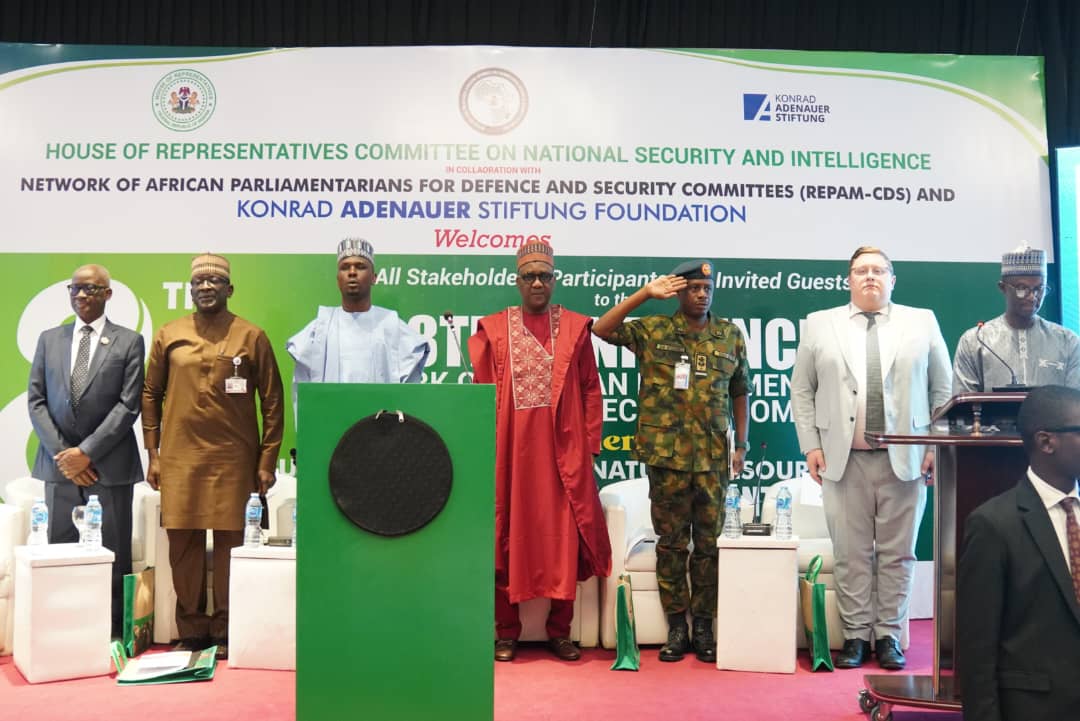
Speaker of the House of Representatives, Rep. Abbas Tajudeen has recommended a special African parliamentary forum to ensure natural resources are harnessed responsibly to serve and empower the Africa people.

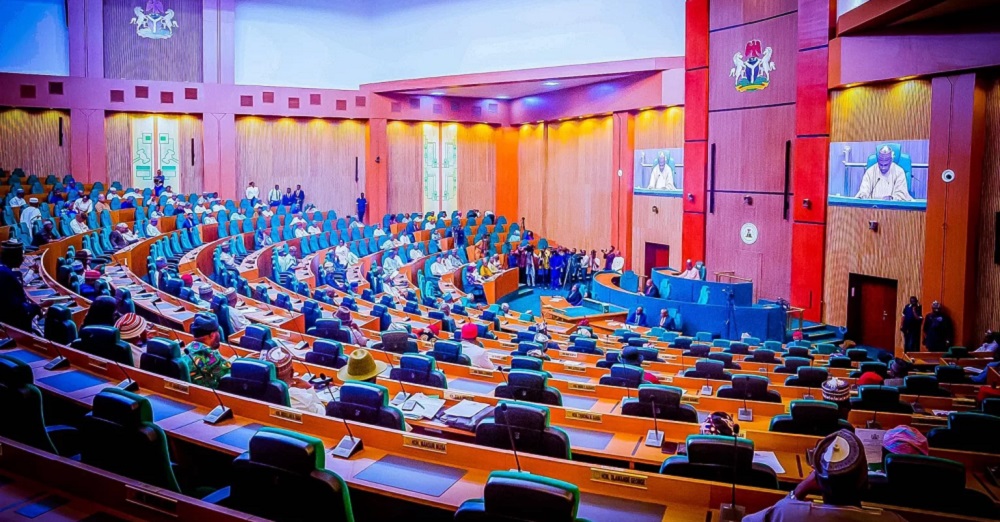
Tajudeen made the recommendation on Wednesday at the opening of the 8th Conference of Network of African Parliamentarians for Defence and Security Committees (REPAM-CDS) in Abuja, with the theme: “Security Governace of Natural Resources in Africa: Parliamentarians Confronted with New International Security Dynamics.”

According to Speaker Abbas, the parliamentary special forum will monitor regions with resource conflicts, collaborate with regional legislative bodies to collect data, recommend safeguards, and support community-led developmentinitiatives.

Advertisement

He emphasised that the struggle for peace is also a struggle for responsible stewardship of Africa’s natural endowments.

Abbas further noted that illicit mining, opaque oil contracts and unregulated timber corridors generate revenue streams that arm insurgents, corrupt institutions and deny communities the dividends of growth.

“Where resource governance is weak, violence takes root; where it is transparent and accountable, prosperity and stability follow. Nigeria’s recent reforms illustrate the point.

“I recommend that our parliaments form a special forum to monitor regions with resource conflicts.

Advertisement

“Let us unite with unwavering resolve to strengthen our committees and harness our natural resources responsibly, ensuring they serve and empower our people,” he sasaid.

Abbas therefore called for a continent-wide agreement on digital sovereignty, to help countries protect their cyberspace and financial systems without infringing on civil rights.

He noted that Africans are watching their parliamentarians and wanted them to turn debates into real action, to match words with results, and to protect democracy, dignity, and our shared heritage.

The Speaker restated that the National Assembly is commited to support by sharing expertise, creating centres for legislative drafting, strengthening intelligence cooperation, and supporting a free press that promotes accountability.

Advertisement

In his remarks, the Chairman, House Committee on National Security and Intelligence, Rep. Ahmed Satomi said parliamentarians play crucial roles in ensuring effective oversight, transparency, and accountability in the management of natural resources and security forces.

Satomi said lawmakers should ensure sustainable and credible governance processes for natural resources born out of the specific circumstances taking place on the local stage and broader agenda for governance across the globe.

“We must work together to develop durable and people-centred security solutions, aligning constitutional provisions with evolving threats and realities on the ground.

“I am delighted that the fundamental objectives of our Network have strongly and strategically positioned us to undertake these responsibilities.

Advertisement

“Let us therefore, work together to address these pressing security challenges and ensure that our natural resources contribute to the prosperity and stability of our great continent,” he said.

The Deputy Speaker of The Gambian Parliament, Hon. Seedy Njie said security concerns every stakeholders, and members of parliament wants the citizens of Africa to live in peace and harmony.

He tasked security chiefs across the continent on protection of territorial integrity and sovereignty of African nations.

“I urged all service chiefs in Nigeria and beyond to work tirelessly to ensure that our people live in peace and harmony.

Advertisement

“The issue of fear, terrorism, bandits and arm rubbery is becoming common in the sub Saharan Africa and we need to do whatever it takes us to take our responsibility seriously and defend our territorial integrity and sovereignty of our nations,” he said.

He further assured that parliamentarians are willing to work with the Federal Government in the advancement of the social-economic wellbeing of Africa.

Also speaking, the National Security Adviser (NSA), Mallam Nuhu Ribadu said the competition for resources has led to conflicts between communities, herders, and farmers, exacerbating existing tensions in several countries.

Represented by the Director Defence Affairs, Maj.-Gen. Peter Malla (rtd), he l said the effects of  mismanagement of natural resources has led to economic instability, corruption, and poverty.

Advertisement

According to him, the extraction of natural resources has also posed security threats, including terrorism, banditry, and kidnapping.

“We must come together to address the challenges we face, we need a comprehensive approach that includes.

“We need to share intelligence and coordinate efforts to prevent and counter security threats related to natural resources extraction.

“We need to secure our borders to prevent the smuggling of goods and the movement of terrorists and bandits.
Advertisement
“We need to leverage technology to detect and neutralize threats before they materialise and engage with local communities to raise awareness and prevent radicalization that fuels terrorism,” he said.
Continue Reading
Advertisement
Click to comment

Warning: Undefined variable $user_ID in /home/naijuinz/public_html/wp-content/themes/zox-news/comments.php on line 49

You must be logged in to post a comment Login

Leave a Reply

News

National tv signal fails in Niger after heavy gunfire

Published

on

ADVERTISEMENT
Zoom Ad
ADVERTISEMENT
Zoom Ad

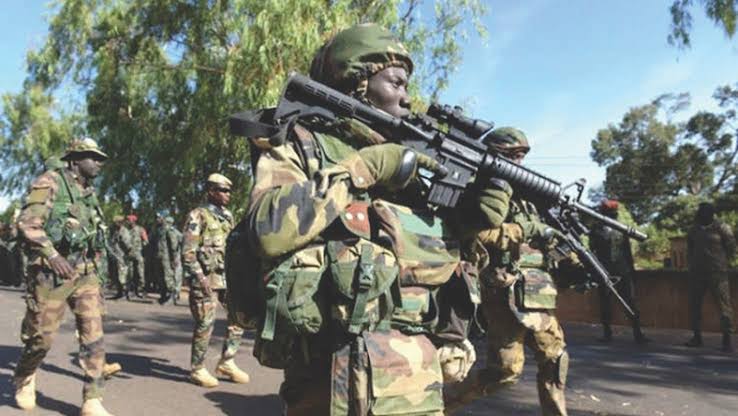
Niger’s national television was off air on Saturday after a night of heavy gunfire in parts of the capital, including around a military base near the city’s airport which has been attacked twice this year by jihadists.

Niger has been ruled for three years by a military junta that has struggled to contain jihadist violence, which has blighted the West African country for around a decade.

The origins of Saturday’s shooting were not immediately clear but the military said: “In light of current events, let us remain calm and avoid sharing unverified information.

“Our defence and security forces have been mobilised for the defence of the homeland,” it wrote on its official social media pages.

Advertisement

One local resident told AFP that there was “heavy gunfire and explosions” at Base 101 in Niamey, a report confirmed by several other witnesses.

At 9:00 am (0800 GMT), a black screen had replaced Tele Sahel’s programming both via satellite and online. Soldiers blocked access to the presidential palace and national television, residents added.

The first shots were heard at about 1:00 am local time (0000 GMT) and continued until daybreak, according to a video published by a local journalist filming the area around the airport.

Another local resident said he heard “bursts of gunfire” at about 7:00 am local time.

Advertisement

“I went to get credit for my phone. I saw a military vehicle heading towards the base that had to turn back,” he added.

“The weapons we’re hearing are not the kind that terrorists on motorbikes can carry. The fighting has been non-stop since last night.”

Another resident in the west of Niamey said he heard sporadic small arms fire at about 5:00 am.

Several social media posts also reported shooting and explosions in the city, particularly in the administrative area where the presidential palace and national television station are located.

Advertisement

Videos online showed armoured vehicles deployed to reinforce the neighbourhood near the airport.

– Rival jihadist groups –
Niamey airport has been targeted twice this year by jihadists, first by the Islamic State in the Sahel (EIS) in January, then in late June by their rivals the Group for the Support of Islam and Muslims (JNIM), the Sahel branch of Al-Qaeda.

The jihadist groups not only target civilians and the military but are also struggling for dominance over each other in the Sahel, and especially in Niger.

Advertisement
Continue Reading

News

Obasanjo jokes at Olota’s 60th birthday, says I’ll attend your 70th, may miss 80th

Published

on

ADVERTISEMENT
Zoom Ad
ADVERTISEMENT
Zoom Ad

Ex-President Olusegun Obasanjo brought humour to the 60th birthday celebration of the Olota of Ota, Oba Professor Abdulkabir Obalanlege, as he jokingly promised to attend the monarch’s 70th birthday while asking to be excused from the 80th.

Obasanjo, who is 89, made the remark while speaking in Yoruba at the anniversary celebration held in honour of the traditional ruler.

The former president recalled calling Obalanlege earlier in the morning to pray for him before turning his attention to the monarch’s future milestone birthdays.

“Kabiyesi, I called you this morning and prayed for you,” Obasanjo said.

Advertisement

He then calculated his own age in relation to the monarch’s next major birthday celebrations, telling the gathering that he would be 99 when Obalanlege clocks 70 in 10 years.

“I’m here celebrating your 60th birthday. I’ll join you for your 70th birthday in 10 years,” he said.

However, Obasanjo joked that attending the monarch’s 80th birthday celebration 20 years from now might be beyond his reach.

“But for your 80th birthday, which is 20 years from now, ẹ yonda mi (you’ll excuse me); you’ll celebrate that one the way it pleases you,” he added.

Advertisement

The comment drew laughter from dignitaries, traditional rulers and other guests who gathered to celebrate the Olota’s diamond jubilee.

The celebration also featured a notable display of Yoruba cultural respect when Fuji musician, King Wasiu Ayinde, popularly known as K1 De Ultimate, prostrated fully before Obasanjo after coming on stage.

The gesture further added to the cultural significance of the event held to mark Oba Obalanlege’s 60th birthday.

Advertisement
Continue Reading

News

SAD! Former Supreme Court Judge, Kalgo is dead

Published

on

ADVERTISEMENT
Zoom Ad
ADVERTISEMENT
Zoom Ad


The judiciary has been thrown into mourning following the death of Hon. Justice Umaru Atu Kalgo, JSC (Rtd.), CON, a former Justice of the Supreme Court of Nigeria and distinguished jurist whose judicial career spanned several decades.

Justice Kalgo reportedly died at about 3:00 a.m. on Tuesday after a prolonged illness.

A resident of Kalgo community, who requested anonymity, said the retired Supreme Court Justice was buried at about 2:30 p.m. in Sokoto in accordance with Islamic rites.

Advertisement

His death marks the end of a distinguished legal career spanning nearly five decades, during which he contributed to legal practice, judicial service, law reform and the development of Nigerian jurisprudence.

Born on May 12, 1937, in Kalgo, present-day Kebbi State, then part of the old North-Western State, Justice Kalgo began his education at Elementary School, Kalgo. He later attended Middle School Sokoto, Middle School Birnin-Kebbi and Government College, Zaria, between 1953 and 1958.

He subsequently pursued legal studies at the Institute of Administration, Ahmadu Bello University, Zaria; the Council of Legal Education, London; the College of Law, Holborn, London; and the Nigerian Law School, Lagos. He was called to the Nigerian Bar in 1965.

Justice Kalgo began his public service career as an Administrative Officer in Northern Nigeria before moving into legal practice in government service. Between 1965 and 1972, he served as State Counsel and later rose to become Deputy Solicitor-General of the North-Western State.

Advertisement

His judicial career began in 1974 when he was appointed a Judge of the High Court of Kano and North-Western State. He subsequently served on the Sokoto State High Court Bench.

On January 1, 1981, Justice Kalgo was elevated to the position of Chief Judge of Sokoto State, a position he held until 1988.

In February 1988, he was appointed a Justice of the Court of Appeal, where he continued to contribute to the development of Nigeria’s appellate jurisprudence.

A decade later, on November 25, 1998, Justice Kalgo reached the pinnacle of his judicial career when he was elevated to the Supreme Court of Nigeria.

Advertisement

He served on the apex court until his statutory retirement at the age of 70 in May 2007.

During his years on the Court of Appeal and Supreme Court benches, Justice Kalgo delivered and participated in numerous judgments covering constitutional, civil and criminal law. His contributions formed part of the body of judicial precedents that continue to influence Nigerian jurisprudence.

Beyond the courtroom, the late jurist played significant roles in national law reform and constitutional development. He served on the Constitution Review Committee between 1987 and 1988, participated in the Constituent Assembly between 1988 and 1989, and was a member of the Law Revision Committee for the Laws of the Federation in 1990.

His public service therefore extended beyond adjudication to the broader development of Nigeria’s constitutional and legal framework.

Advertisement

Justice Kalgo was also recognised for his contributions to national service and was conferred with the national honour of Commander of the Order of the Niger, CON.

His passing brings to a close the life and career of a jurist whose professional journey took him from public administration and government legal service through the High Court and Court of Appeal to Nigeria’s highest court, leaving behind a significant legacy in the country’s legal and judicial history.

Continue Reading

Trending

Copyright © 2024 Naija Blitz News