News
Tinubu Hosts Ibori, Other Members Of 1999 Class Of Governors In Aso Villa
- /home/naijuinz/public_html/wp-content/plugins/mvp-social-buttons/mvp-social-buttons.php on line 27
https://naijablitznews.com/wp-content/uploads/2025/07/rege-1000x571.jpg&description=Tinubu Hosts Ibori, Other Members Of 1999 Class Of Governors In Aso Villa', 'pinterestShare', 'width=750,height=350'); return false;" title="Pin This Post">
- Share
- Tweet /home/naijuinz/public_html/wp-content/plugins/mvp-social-buttons/mvp-social-buttons.php on line 72
https://naijablitznews.com/wp-content/uploads/2025/07/rege-1000x571.jpg&description=Tinubu Hosts Ibori, Other Members Of 1999 Class Of Governors In Aso Villa', 'pinterestShare', 'width=750,height=350'); return false;" title="Pin This Post">
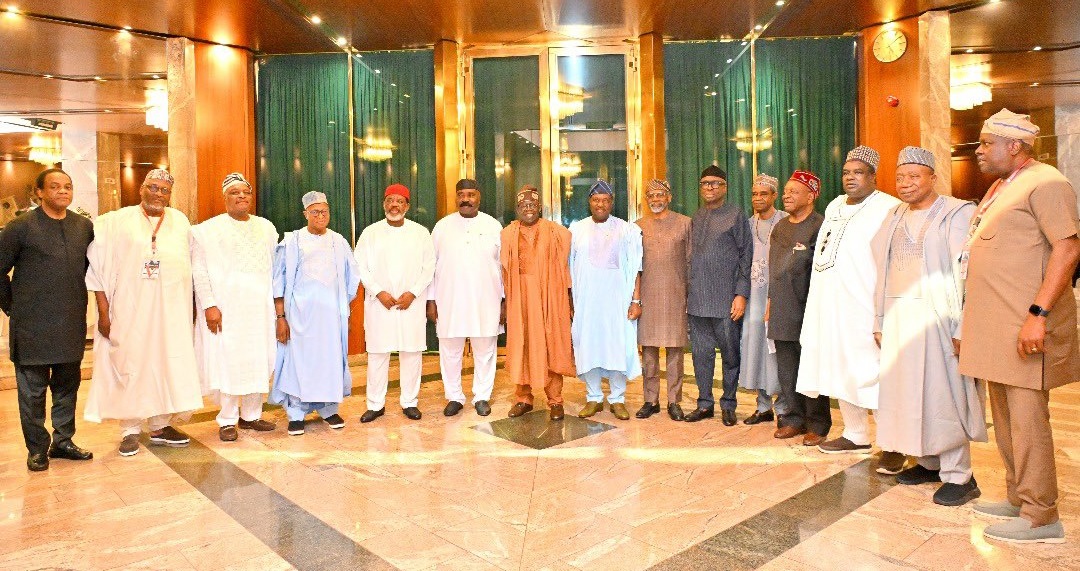
President Bola Tinubu, on Friday, hosted members of the Class of 1999 Governors at the Presidential Villa, Abuja, as former state executives who served at the dawn of Nigeria’s Fourth Republic reunited to engage in what sources described as a closed-door reflection on governance, national unity, and Nigeria’s democratic journey.

The delegation was led by the former Governor of Edo State, Chief Lucky Igbinedion, and included prominent figures such as Chief James Ibori (Delta), Jolly Nyame (Taraba), Adamu Mu’azu (Bauchi), Joshua Dariye (Plateau), Boni Haruna (Adamawa), Donald Duke (Cross River), Adeniyi Adebayo (Ekiti), Sam Egwu (Ebonyi), and Dr. Peter Odili (Rivers), among others.
Although the meeting was held behind closed doors, sources at the Villa revealed that it provided a moment of political camaraderie and reflection, 25 years after their collective emergence as pioneer governors in Nigeria’s Fourth Republic.

President Tinubu himself was part of the same class, having been elected Governor of Lagos State in 1999 under the platform of the Alliance for Democracy (AD). He is now the first among them to ascend to the nation’s highest office.
The visit, according to those familiar with the discussions, was not only a show of solidarity with President Tinubu but also an opportunity to discuss how the collective experience and institutional memory of the Class of ’99 can be harnessed to support national development.
“This visit is symbolic. It shows that leadership transcends time and political affiliations. They are here not just to reconnect but to offer counsel to one of their own who now bears the burden of national leadership,” one source said.
The Class of ’99 is widely considered to have played a foundational role in Nigeria’s return to democratic rule following years of military dictatorship.
The governors, elected under various political platforms, served between 1999 and 2007—a politically formative era that laid the groundwork for democratic institutions and state-level governance.
Since leaving office, many of the former governors have remained active in national politics, with some serving as ministers, party leaders, and lawmakers.
Their reunion at the Villa underscores a rekindling of ties built over decades of shared governance experience.
Insiders suggest that the delegation used the meeting to pledge their support for President Tinubu’s administration and to assure him of their readiness to contribute ideas, offer advice, and rally political support for initiatives aimed at strengthening national unity and sustaining democratic progress.
“We have a stake in the stability and success of this country,” another former governor reportedly said.
“President Tinubu is one of us, and we are committed to standing by him as he leads Nigeria through this crucial phase.”
As the political class and the public continue to debate the best ways to consolidate democracy, Friday’s meeting was a reminder of the relevance of institutional memory, the importance of peer collaboration in leadership, and the enduring bonds forged in times of transition.

News
Kogi varsity expels two students over gay practice, rusticates four for fighting
The Management of Confluence University of Science and Technology, Osara, has expelled two students for alleged involvement in gay practice and rusticated four others for one academic session over a campus fight.
According to a statement issued on Friday by the university’s Information and Protocol Unit, the sanctions were ratified during the 31st Regular Meeting of the University Senate following recommendations from the Students’ Disciplinary Committee.
The statement read, “The Management of Confluence University of Science and Technology (CUSTECH), Osara, has approved the expulsion of two students for involvement in gay practice and the rustication of four others for one academic session over acts of fighting on campus.”
The affected students were notified in letters signed by the Deputy Registrar, Academics, Eli Gbadafu, copies of which were made available to the Information, Public Relations and Protocol Unit of the university.
The statement further read, “The institution stated that the disciplinary actions were taken in accordance with the provisions of the Students’ Handbook, Second Edition, as amended in 2025.”
Onumoko Hamza of the Biology Education department and Abdulazeez Eneji of the Mining Engineering department were expelled over gay practice.
Four other students were rusticated for one academic session over fighting. They are Favor Akowe of the Microbiology department, Simbiat Babamuharuna of the Biology department, Zainab Omayoza of the Biochemistry department, and Sukura Bukola, also of the Biochemistry department.
The statement read, “The University Management reiterated its commitment to maintaining discipline, order and a conducive environment for teaching and learning.”
It added, “Management warned that it would not hesitate to take decisive disciplinary action against any student found guilty of violating the rules and regulations of the University.”
The statement read further, “Students are therefore advised to familiarise themselves with the provisions of the Students’ Handbook and conduct themselves in accordance with the established rules and regulations of the University.”
News
CAN faults FRSC amendment bill, seeks Tinubu’s intervention
The Christian Association of Nigeria (CAN) in the South-West region has appealed to President Bola Ahmed Tinubu to withhold assent to the proposed Federal Road Safety Corps (FRSC) Act (Amendment) Bill, 2026.
The Senate had passed an amendment to the FRSC Act, proposing tougher penalties for a range of traffic offences as part of efforts to improve road safety and strengthen compliance with traffic regulations.
One of the major provisions of the amendment bill introduces a N100,000 fine for motorists who fail to obey traffic lights, road signs, road markings, or other traffic control devices.
In a statement signed by its Chairman, Bishop Dr. Barnabas Tunde Akinsanya, CAN said it supports the Federal government’s efforts to improve road safety and reduce accidents.
It explained that it is concerned about the provisions prescribing sanctions for preaching in commercial buses and prohibiting hawking in such vehicles.
The association further argued that the measures could also infringe on the constitutional rights to freedom of thought, conscience, religion and expression.
According to the association, although the government has a responsibility to protect lives and ensure public safety, it must also uphold the fundamental rights guaranteed under the Constitution.
“We therefore respectfully appeal to the President of the Federal Republic of Nigeria to withhold assent to the Bill in its present form and encourage further consultation with relevant stakeholders, including religious bodies, civil society organisations, legal experts, transport unions, and road safety professionals.
“Such dialogue will help produce legislation that effectively promotes road safety while preserving the constitutional rights and dignity of every Nigerian,” the statement said.
The association also warned that an outright ban on hawking in commercial buses could worsen the economic hardship facing many Nigerians who rely on informal trading for their daily livelihood.
Rather than introducing measures that could further reduce people’s means of survival, CAN urged the government to focus on creating employment opportunities, reducing poverty, improving public transportation, strengthening security and enhancing citizens’ welfare.
The Christian body appealed to President Tinubu to decline assent to the bill in its current form and instead facilitate broader consultations involving religious organisations, civil society groups, legal experts, transport unions and road safety professionals.
It maintained that such engagement would help produce legislation that enhances road safety without undermining the constitutional rights and dignity of Nigerians.
CAN stressed that Nigeria needs laws that promote national unity, safeguard lives without unnecessarily restricting fundamental freedoms, and strengthen public confidence in democratic governance.
The association, however, reaffirmed its commitment to constructive engagement with government to advance justice, peace, constitutional democracy and national development.
News
Court Of Appeal Upholds Refusal To Restrain NCC, Dismisses COSON’s Appeal
The Court of Appeal, Lagos Judicial Division, has dismissed an interlocutory appeal filed by the Copyright Society of Nigeria Ltd/Gte (COSON) against the Nigerian Copyright Commission (NCC), affirming an earlier decision of the Federal High Court refusing to grant an injunction restraining the Commission.
In a unanimous judgment delivered on July 9, 2026, the appellate court also awarded ₦200,000 in costs against COSON.
According to a statement on Saturday, the three-member panel, led by Justice Polycarp Terna Kwahar, with Justice Folasade Ayodeji Ojo and Justice Muslim Sule Hassan concurring, held that there was no existing operating approval that could be preserved through an interlocutory injunction.
The appeal stemmed from COSON’s substantive suit challenging aspects of the Copyright (Collective Management Organisations) Regulations, 2007.
Pending the determination of the case, COSON had sought an interlocutory injunction restraining the NCC from revoking its operating approval or interfering with its management, finances, bank accounts, audits and royalty collection activities.
However, the Federal High Court, in a ruling delivered on December 1, 2021, declined the application, holding that an interlocutory injunction cannot be granted to restrain an action that had already been completed.
The court noted that COSON’s operating approval had been suspended by the NCC in April 2018 and subsequently expired in May 2019, before the substantive suit and the application for injunction were filed.
In affirming the lower court’s decision, the Court of Appeal ruled that the legal status existing before the commencement of the suit was that COSON’s operating approval had already become inoperative.
Justice Kwahar, in the lead judgment, stated: “Both the Appellant and the Respondent have demonstrated vide their affidavit evidence that the Appellant’s operation had prior to the commencement of the suit become inoperative by virtue of the suspension of the Appellant’s licence and expiration by effluxion of time. That is the status quo ante bellum before the commencement of the suit at the lower Court.”
The appellate court emphasized that the purpose of an interlocutory injunction is to preserve the status quo pending the determination of a substantive case, not to reverse actions that had already taken effect before litigation commenced.
It therefore held that granting the relief sought by COSON would have altered, rather than preserved, the existing legal position, and consequently dismissed the appeal for lacking merit.
Reacting to the judgment, the Nigerian Copyright Commission described the ruling as a reaffirmation of its position that there was no subsisting operating approval for the court to preserve through an injunction.
The Commission further reiterated that COSON is currently not approved to operate as a Collective Management Organisation (CMO) in Nigeria.
The judgment is regarded as a significant legal victory for the NCC, reinforcing the Commission’s regulatory authority over collective management organisations and clarifying the legal limits of interlocutory injunctions in disputes involving expired or suspended regulatory approvals.
-
News14 hours ago‘One of my outstanding ministers’ – Tinubu hails Umahi at 63
-
News14 hours agoObi is a man of integrity, nobody should doubt his one term promise- Kwankwaso
-
News23 hours agoTax reform: FG inaugurates inter-ministerial C’ttee to develop 2026 VAT modification order
-
Entertainment4 hours agoNigeria’s Education Threshold Should Be Beyond Akara & Kuli Kuli – Seyi Awolowo
-
News4 hours agoGumi Questions Why No One Has Visited Boko Haram, Bandits to Negotiate Peace
-
News20 hours agoAfter Taking Cocktail Of Drugs young Saudi Arabia prince found dead in London hotel
-
Metro4 hours agoPolice Return Stolen Toyota Highlander to Owner 5 Years After Theft
-
Foreign3 hours agoIranian Commander Issues “One-for-One” Threat to US Over Citizen Deaths

Warning: Undefined variable $user_ID in /home/naijuinz/public_html/wp-content/themes/zox-news/comments.php on line 49
You must be logged in to post a comment Login