News
“How I Was Forced to Accept National Theatre Renaming” – Soyinka
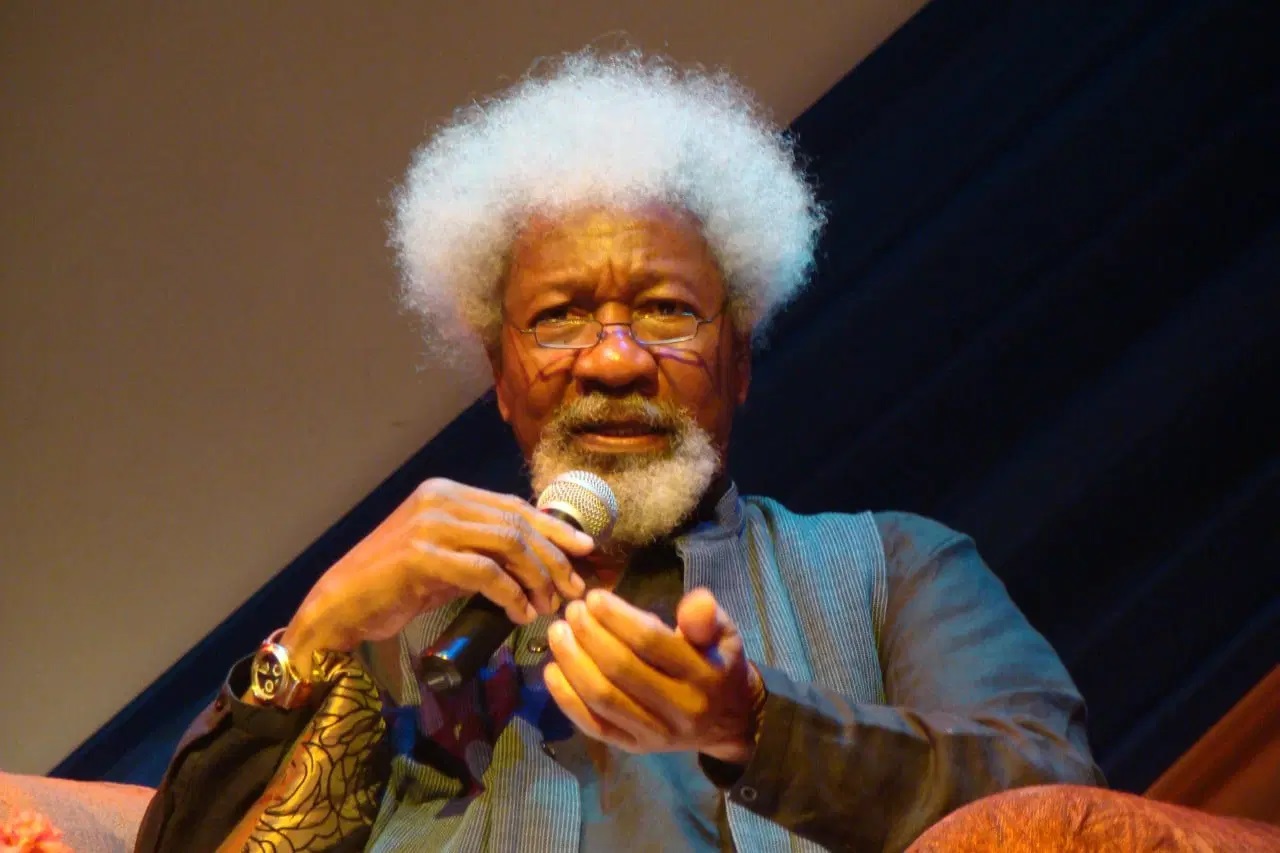
Nobel laureate Prof. Wole Soyinka has explained why he accepted to have the National Theatre in Lagos renamed after him, despite his initial reservations.

Speaking on Tuesday at the reopening of the Wole Soyinka Centre for Culture and Creative Arts (formerly the National Arts Theatre, Iganmu, Lagos), the renowned playwright admitted that he had once considered the historic complex irredeemable and beyond repair.
“I Thought the Building Could Never Be Saved”

Soyinka revealed that before its recent facelift, he never believed the theatre could be restored to global standards.
“I have to stand up in public and watch my name being put up as yet another appropriator. It just didn’t seem very well for me,” he said.
According to him, the ₦68 billion renovation project spearheaded by the Bankers’ Committee proved him wrong and made him “eat his words.”
He recalled how the theatre’s infrastructure had deteriorated so badly that the leaking roofs and exposed electrical wiring once put his actors at risk of electrocution.
Mixed Feelings About the Honour
Soyinka, a vocal critic of successive governments that “appropriate public monuments,” confessed that accepting the renaming was not an easy decision.
He noted that his decision was influenced by several reasons nostalgia, the successful revival of the theatre, and what he described humorously as being “ambushed.”
“Well, I was already ambushed. They shaved my head behind me. I would have raised a squawk. But then I decided, this building belongs to me. It belongs to me,” he remarked with a smile.
The literary icon also recalled the theatre’s early days, noting that when it was first constructed, many nicknamed it “The General’s Hat” because of its unique roof design.
A Landmark Revival for Nigerian Arts
Applauding the transformation, Soyinka expressed hope that with the upgraded facilities, Nigerians would no longer need to travel abroad to experience world-class African theatre productions.
He praised the Bankers’ Committee for their vision and execution, stressing that the edifice had now attained international standards.
President Bola Ahmed Tinubu, who was represented at the event, directed the Central Bank of Nigeria (CBN) to establish a National Arts Theatre Endowment Fund to guarantee the continued maintenance of the complex.
Dignitaries in Attendance
The reopening ceremony attracted top dignitaries, including:
Senator Oluremi Tinubu, First Lady of Nigeria
Senate President Godswill Akpabio
CBN Governor Olayemi Cardoso, who coordinated the Bankers’ Committee
Emir of Kano Muhammadu Sanusi II, a former CBN governor
Governor Babajide Sanwo-Olu of Lagos State
Hannatu Musawa, Minister of Arts, Culture and the Creative Economy
Their presence underscored the importance of the National Theatre as a cultural symbol and a renewed hub for Nigeria’s creative industries.
News
Gag order: SERAP, editors sue NBC over threat to sanction broadcasters for expressing opinions
The Socio-Economic Rights and Accountability Project (SERAP) and the Nigerian Guild of Editors (NGE) have filed a lawsuit before the Federal High Court in Lagos against the National Broadcasting Commission (NBC) over the alleged arbitrary, unconstitutional, and unlawful ‘Formal Notice’, which threatens to sanction broadcast stations and presenters for allegedly ‘expressing personal opinions as facts, bullying or intimidating guests, or failing to maintain neutrality.’”
The NBC had recently threatened to sanction broadcast stations and presenters who ‘express personal opinions as facts’ or ‘bully and intimidate guests,’ claiming it had ‘identified a sustained increase in breaches of the 6th Edition of the Nigeria Broadcasting Code across news, current affairs, and political programmes.’
In the suit marked FHC/L/CS/854/2026 and filed last Friday before the court, SERAP and NGE are asking the court “to determine whether the various provisions of the Nigeria Broadcasting Code relied upon by the NBC to threaten broadcasters are inconsistent with the Nigerian Constitution 1999 (as amended) and the country’s international human rights obligations.”
SERAP and NGE are asking the court for “a declaration that the provisions of the 6th Edition of the Broadcasting Code used by the NBC are vague and overly broad and constitute a fundamental breach of freedom of expression and media freedom guaranteed by the Nigerian Constitution and international human rights standards.”
SERAP and NGE are also seeking “an order of interim injunction restraining the NBC, its agents or privies, whether jointly or severally or any other authority from imposing sanctions on broadcast stations and presenters based on the patently unlawful provisions of the 6th Edition of the Broadcasting Code, pending the hearing and determination of the motion on notice filed simultaneously in this suit.”
In the suit, SERAP and NGE are arguing that: “Unless the reliefs sought are granted, the NBC will continue to use the provisions of the 6th Edition of the Broadcasting Code to threaten and sanction broadcast stations and presenters solely for carrying out their constitutional responsibilities and exercising their rights.”
SERAP and NGE are also arguing that, “The Nigerian Constitution and international human rights law protect both the absolute right to hold opinions and the qualified right to express ideas of all kinds. Journalistic opinion is protected expression.”
Human rights lawyer, Mr Femi Falana (SAN) would lead a team of senior lawyers to represent SERAP and NGE in the lawsuit.
The originating summons, motion exparte, motion on notice and affidavit of urgency filed in court, reads in part: “Value judgments are not susceptible of proof and enjoy heightened protection. Journalism necessarily includes analysis and commentary.”
“The right to impart ideas necessarily includes opinions, commentary, and analysis. A blanket prohibition on the expression of ‘personal opinions by anchors and presenters’ amounts to an impermissible restriction to this right.”
“Journalists are entitled to express their opinions as a matter of professional standard, including commentary and analytical expression, which lie at the very core of journalistic practice and democratic discourse.”
“The Nigerian Constitution is the supreme law, and any law that is inconsistent with it is null and void. The Nigeria Broadcasting Code, as subsidiary legislation, cannot override constitutional rights or exceed its enabling Act. Provisions that are vague and overly broad unlawfully restrict freedom of expression and must be struck down.”
“Under Article 27 of the Vienna Convention on the Law of Treaties, a State may not invoke the provisions of its internal law as justification for its failure to perform international treaties, including the human rights treaties to which Nigeria is a state party.”
“The Nigeria Broadcasting Code, as subsidiary legislation, is subject to the Nigerian Constitution and cannot override fundamental rights. Its vague and overly broad provisions grant excessive discretion and undermine freedom of expression. Such impermissible restrictions are unconstitutional and should be struck down.”
“The NBC’s claim of a ‘crisis of anchor and presenter professionalism’ as justification for restrictive measures is legally insufficient and cannot be a permissible ground of derogation from freedom of expression. Any limitation on the rights must be reasonably justifiable in a democratic society.”
“The blanket prohibition imposed by Section 1.10.3 of the Nigeria Broadcasting Code, which prohibits presenters from expressing opinions. This amounts to prior restraint that impermissibly excludes commentary, analysis, and value judgments—the core of journalism and democratic discourse.”
“Section 1.10.3 amounts to a form of prior censorship or restraint. Such a blanket restriction fails the legal tests of legality, necessity and proportionality required in a democratic society.”
“The NBC’s reliance on multiple vague provisions of the Broadcasting Code to classify a wide range of presenter conduct as ‘Class B breaches’ attracting sanctions is contrary to the Nigerian Constitution and international human rights law.”
“Section 39 of the Nigerian Constitution, article 9 of the African Charter on Human and Peoples’ Rights and article 19 of the International Covenant on Civil and Political Rights to which Nigeria is a state party guarantee the right to ‘receive and impart ideas and information without interference.’”
“Under the Nigerian Constitution and international human rights law, restrictions must pursue a legitimate aim and be necessary and proportionate. The NBC’s reliance on an undefined and subjective standard of ‘professionalism’ introduces vagueness and opens the door to arbitrary enforcement.”
“While the prohibition of misuse of broadcast platforms by political actors is a legitimate concern, it does not justify sweeping or repressive regulatory measures that infringe on fundamental human rights.”
“Addressing any alleged misuse must be grounded in lawful, precise, necessary, and proportionate responses that respect freedom of expression and editorial independence.”
“Ahead of the 2027 general elections, the NBC’s Formal Notice undermines Nigerians’ democratic rights to receive diverse information, hear competing political viewpoints, and engage in open debate.”
“Rather than curbing misuse, such measures risk entrenching self-censorship, limiting scrutiny of political actors, and weakening the media’s essential role in ensuring transparent, accountable, and credible elections.”
“While certain aims such as preventing harassment or ensuring fairness in broadcasting may be legitimate, the provisions as invoked by the NBC are vague, overbroad, and susceptible to arbitrary interpretation.”
“The threat of sanctions for broadly defined conduct creates a chilling effect on journalists and broadcasters, thereby undermining constitutional guarantees and international human rights standards.”
“The provisions of the Broadcasting Code are not formulated with sufficient precision to enable individuals regulate their conduct. The imposition of administrative sanctions without adequate procedural safeguards raises fair hearing concerns.”
“The NBC’s enforcement posture transforms regulatory oversight into a regime of indirect censorship. While the regulation of misinformation may constitute a legitimate aim, the prohibition on presenters expressing ‘personal opinion as fact’ is framed in vague and overly broad terms that fail the requirement of legal certainty.”
“The absence of clear definitions distinguishing fact from opinion renders the provision prone to arbitrary application, thereby creating a chilling effect on legitimate journalistic expression and debate.”
“Although the prevention of harassment in broadcasting is a legitimate regulatory objective, the provisions of the NBC’s notice prohibiting ‘bullying or intimidation’ lack clear and objective criteria, and fail the requirement of precision and foreseeability.”
“The undefined scope of ‘bullying’ or ‘intimidation’ risks capturing critical or adversarial questioning, which is an essential feature of investigative journalism and democratic discourse.”
“The notice would also seriously undermine the media’s constitutional role as a public watchdog because any regulation that discourages rigorous questioning undermines this function.”
“The requirement that broadcasters must always provide ‘fair hearing to opposing views, while ostensibly grounded in principles of balance, imposes an impermissible form of compelled speech and editorial control.”
“Apart from explicitly undermining editorial independence, such a requirement also suppresses legitimate expression, and disregards the autonomy of journalists and media houses. The requirement may also unduly burden or distort programming, particularly in formats such as commentary or opinion-based shows.”
“The classification of the alleged conduct as a ‘Class B breach’ attracting sanctions, including fines or suspension, constitutes a disproportionate interference with freedom of expression and raises serious due process and fair hearing concerns.”
“The Nigerian Constitution and international human rights law provide that individuals and entities are entitled to fair hearing before the imposition of penalties. Similarly, sanctions affecting expression must be strictly necessary and proportionate.”
“The imposition of punitive measures based on vague and broadly defined infractions creates a chilling effect on broadcasters, discouraging legitimate journalistic activity and undermining democratic discourse. Such a regime of sanctions also amounts to indirect or prior censorship.”
SERAP and NGE are therefore asking the court for the following reliefs:
1. A DECLARATION that Sections 1.10.3, 3.3.1(b), 3.4.1(b), 5.3.3(b), 3.1.1, 3.11.1(a), 5.4.1(f), 3.11.1(b), and 5.5.1(b) of the 6th Edition of the Nigeria Broadcasting Code, by reason of their vagueness and imprecision, constitute a breach of the rights to freedom of expression and opinion and access to information as guaranteed by the Nigerian Constitution and the country’s international human rights obligations.
2. A DECLARATION that Sections 1.10.3, 3.3.1(b), 3.4.1(b), 5.3.3(b), 3.1.1, 3.11.1(a), 5.4.1(f), 3.11.1(b), and 5.5.1(b) of the 6th Edition of the Nigeria Broadcasting Code are overbroad, vague and fail to provide citizens and broadcasting stations with sufficient notice of what constitutes a breach, and are consequently unlawful, unconstitutional, null and void.
3. AN ORDER of the Court nullifying and setting aside Sections 1.10.3, 3.3.1(b), 3.4.1(b), 5.3.3(b), 3.1.1, 3.11.1(a), 5.4.1(f), 3.11.1(b), and 5.5.1(b) of the 6th Edition of the Nigeria Broadcasting Code for being inconsistent with, and amounting to a fundamental breach of the rights to freedom of expression and opinion, and access to information as guaranteed under the Nigerian Constitution, the African Charter on Human and Peoples’ Rights and the International Covenant on Civil and Political Rights.
4. AN ORDER OF PERPETUAL INJUNCTION restraining the NBC, whether jointly or severally or any other authority, person or group of persons from enforcing, imposing sanctions, or levying fines on broadcast stations and presenters based on the provisions of Sections 1.10.3, 3.3.1(b), 3.4.1(b), 5.3.3(b), 3.1.1, 3.11.1(a), 5.4.1(f), 3.11.1(b), and 5.5.1(b) of the 6th Edition of the Nigeria Broadcasting Code.
No date has been fixed for the hearing of the interim application and the substantive suit.
News
Unity Schools: FGC Enugu emerges champion of old students 2026 national sports festival
The 2026 National Sports Fiesta of the Unity Schools Old Students Association, USOSA, has ended in Enugu, with the Federal Government College, FGC, Enugu emerging champions.
It topped the table with eight gold, three silver and two bronze medals.
FGC Ikot Ekpene Old Students Association finished in second place with seven gold, seven silver, and three bronze medals.
The keenly contested sports fiesta that featured 30 Unity Schools from across the country.
The week-long sports festival, which was held at the Nnamdi Azikiwe Stadium, Enugu, brought together alumni from federal unity colleges nationwide.
Events featured at the fiesta included football, tug of war, march-past, swimming, lawn tennis, table tennis, snooker, ludo, draughts, badminton, volleyball, basketball, golf, among others.
FGC Ikot Ekpene, one of the strong contenders, battled alongside 29 other schools in its bid to retain the trophy but ultimately settled for second place as FGC Enugu dominated the medals table.
Speaking after the tournament, the President-General of USOSA, Michael Magaji, said the fiesta goes beyond competition, describing sports as a vital tool for national unity and development.
“We are fully aware of the power of sports as a unifying force—one that brings people together and fosters prosperity. This event in Enugu provides us with yet another platform to strengthen our bonds, celebrate our diversity, and demonstrate that we are models of responsible citizenship,” he said.
Magaji noted that while the association remains committed to advancing public education, sports serve as an additional platform to deepen relationships and promote nation-building.
“Through this initiative, we aim to build bridges across the country and reinforce relationships that, in many cases, span 30, 40, or even 50 years,” he added.
He emphasised that USOSA’s interventions are voluntary and aimed at giving back to society, particularly the public education system that shaped its members.
According to him, the association is working to restore the high standards once associated with unity schools.
“These were once centres of excellence, and while standards may have declined over time, our goal is to restore and even surpass those standards, one school at a time,” he said.
News
FCT Teachers Suspend Strike After Wike’s N5bn Monthly Welfare Intervention
The State Wing Executive Council (SWEC) of the Nigeria Union of Teachers (NUT) in the Federal Capital Territory (FCT) has suspended its ongoing strike action with immediate effect, directing teachers in public primary and secondary schools to return to classrooms.
The announcement was made on Sunday by SWEC Chairman, Abdullahi Shafa, during a press briefing in Gwagwalada, Abuja.
Shafa explained that the decision followed an emergency meeting convened to review the intervention of the FCT Minister, Nyesom Wike, in the industrial dispute that began on April 20, 2026.
According to him, the council considered the minister’s commitments and resolved to suspend the strike in the interest of students and the education sector.
He disclosed that the FCT administration had approved a combined monthly financial package of ₦5 billion aimed at addressing teachers’ welfare and outstanding entitlements.
“The minister approved the release of ₦2 billion monthly from FCT Internally Generated Revenue, plus ₦3 billion from the 10 per cent IGR accruing to the Area Councils, to implement the 40 per cent peculiar allowance and settle outstanding entitlements of primary school teachers,” Shafa said.
He also noted that issues around career progression were discussed, including promotion delays affecting teachers across the territory.
Shafa said the minister pledged to engage the Chairman of the FCT Civil Service Commission to resolve the matter, including reviewing the 2024 promotion exercise and removing the vacancy requirement for promotions.
Following the agreement, the union directed all primary and secondary school teachers in the FCT to resume duties on Monday, April 27.
“Arising from the stakeholders’ resolution, the council has directed all FCT primary and secondary school teachers to resume duties,” he stated.
The union, however, warned that it would not tolerate any form of victimisation against teachers who participated in the strike, stressing that their welfare remains a priority.
Shafa added that the union would continue to monitor the implementation of the agreements and review its position if the government fails to comply.
The NUT leadership commended teachers for their solidarity during the strike and reaffirmed its commitment to improved welfare and working conditions in the education sector.
The suspension of the strike is expected to restore normal academic activities across public schools in the FCT.
-
News22 hours agoTrump, wife escape as gunman opens fire during dinner with press men
-
News22 hours agoTrump boasts says, shooting won’t stop him from Iran war
-
News22 hours agoAPC to Makinde: “Your ‘operation wetie’ remark at Ibadan opposition summit is reckless and inciting”
-
News13 hours agoNAF airstrikes destroy terrorists camps in North East
-
News16 hours agoSAD! Malian defence minister k!lled in coordinated attacks
-
News3 hours ago“There Is No Repentant Terrorist” — Nnamdi Kanu’s Lawyer Warns FG, Cites Mali’s Security Collapse
-
Opinion21 hours agoTINUBU’S DANGEROUS OVERREACH: A STARK WARNING AGAINST INTIMIDATING THE LEGISLATURE, JUDICIARY, AND THE NIGERIAN PEOPLE
-
News21 hours agoNDLEA intercepts terror drug ‘captagon’ in Kwara as bizman excretes 45 cocaine wraps(Photos)