Economy
After seven days of consistency, Naira falls again
- /home/naijuinz/public_html/wp-content/plugins/mvp-social-buttons/mvp-social-buttons.php on line 27
https://naijablitznews.com/wp-content/uploads/2024/04/Naira.webp&description=After seven days of consistency, Naira falls again', 'pinterestShare', 'width=750,height=350'); return false;" title="Pin This Post">
- Share
- Tweet /home/naijuinz/public_html/wp-content/plugins/mvp-social-buttons/mvp-social-buttons.php on line 72
https://naijablitznews.com/wp-content/uploads/2024/04/Naira.webp&description=After seven days of consistency, Naira falls again', 'pinterestShare', 'width=750,height=350'); return false;" title="Pin This Post">
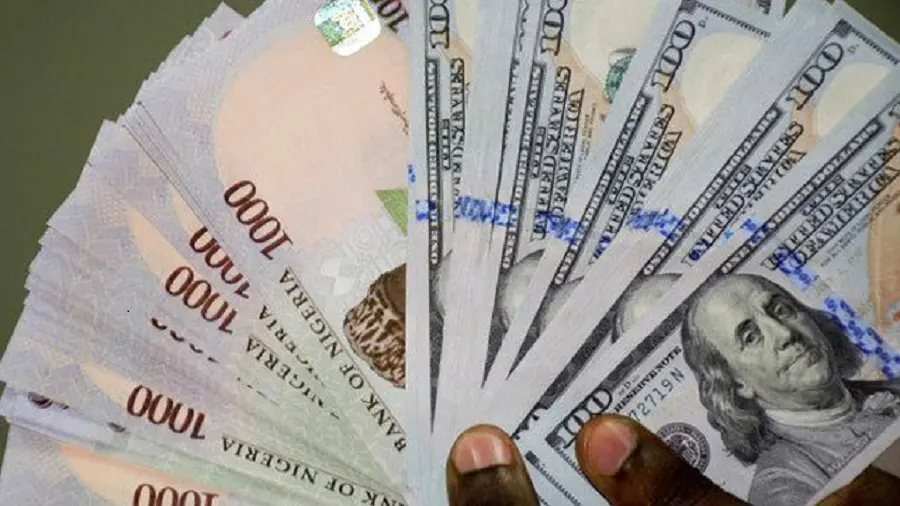
The Naira recorded its first depreciation in more than a week, closing at N1,469/$1 on Friday, October 3, 2025.

This comes after the currency had maintained steady gains, with Thursday’s rate of N1,464.85/$1, which is the currency’s strongest performance so far this year.
Data published on the Central Bank of Nigeria (CBN) website shows that the naira’s latest slip ended a streak of resilience that began after September 23, 2025, when it weakened to N1,493.2/$1, down from N1,491.49/$1 the previous day.

Despite Friday’s slight depreciation, the naira’s overall performance in recent weeks has been relatively positive.
Recall that, on September 30, the currency closed at N1,478/$1, representing a sharp rally from its opening level of N1,527.9/$1 at the start of the month.
During the week, the external reserves rose to $42.4 billion, up from $42.3 billion recorded at the end of September 2025.
According to the CBN data, the reserve has been on an upward swing since the 14th of July 2025.
The closest the external reserve has gotten to the present figure was on September 27, 2019, when it hit $41.992 billion.
Some currency traders attribute the naira’s recent stability to the CBN’s sustained intervention in the foreign exchange market, alongside measures aimed at curbing speculative trading and boosting dollar inflows.
In his 65th Independence Day address, President Bola Tinubu restated his administration’s commitment to sustaining forex reforms. He said, “The Naira has stabilised from the turbulence and volatility witnessed in 2023 and 2024. The gap between the official rate and the unofficial market has reduced substantially, following FX reforms and fresh capital and remittance inflows. The multiple exchange rates, which fostered corruption and arbitrage, are now part of history. Additionally, our currency rate against the dollar is no longer determined by fluctuations in crude oil prices.”
The CBN Governor, Olayemi Cardoso, earlier echoed this commitment.
He highlighted the CBN’s overarching monetary policy objective of taming inflation and driving it down to single digits, a goal.
In December 2024, President Tinubu, during his budget presentation speech, said the 2025 budget was based on the projections that inflation would decline from the current rate of 34.6 per cent to 15 per cent, while the exchange rate would improve from approximately 1,700 naira per US dollar to 1,500 naira.
Several experts expressed doubts about President Tinubu achieving the targets.
In September, CBN reduced the MPR by 50 basis points, lowering it from 27.5 per cent to 27 per cent.
Alongside the MPR cut, the MPC narrowed the asymmetric corridor around the benchmark rate to +250 and -250 basis points, from the previous +500/-100 basis points.
The Committee retained CRR for commercial banks at 45 per cent, while that of merchant banks was set at 16 per cent.
Economy
See Black Market Dollar to Naira exchange rate today 10th September 2026
NOTE: The exchange rate changes hourly. It depends on the volume of dollars available and the Demand. This means…you can buy or sell 1 dollar at a certain rate, and the price can change (high or low) within hours.
The official naira black market exchange rate in Nigeria today, including the Black Market rates, Bureau De Change (BDC), and CBN rates.
The exchange rate fluctuates hourly based on the supply and demand of dollars in the market.
What’s the dollar to naira black market today, 10th September 2026?
The exchange rate for a dollar to naira at Lagos Parallel Market (Black Market) players sell a dollar for ₦1390 and buy at ₦1380 on Thursday, 10th September, 2026, according to sources at Bureau De Change (BDC).
Please note that the Central Bank of Nigeria (CBN) does not recognize the parallel market (black market), as it has directed individuals who want to engage in Forex to approach their respective banks.
Dollar to Naira Black Market Rate Today
Dollar to Naira (USD to NGN) Black Market Exchange Rate Today
Selling Rate ₦1390
Buying Rate ₦1380
Dollar to Naira CBN Rate Today
Dollar to Naira (USD to NGN) CBN Rate Today
Highest Rate ₦1322
Lowest Rate ₦1326.
Economy
See Dollar to Naira exchange rate today, September 9, 2026
The Naira yesterday appreciated to N1,387 per dollar from N1,390 in the parallel market on Monday.
Similarly, the naira appreciated to N1,322.9 per dollar in the Nigerian Foreign Exchange Market, NFEM.
Data from the Central Bank of Nigeria, CBN, showed that the indicative exchange rate for the naira fell to N1,322.9 per dollar from N1,320 per dollar on Monday, indicating N2.9 appreciation for the local currency.
Consequently, the margin between the parallel and official markets narrowed to N64.1 per dollar from N70 per dollar on Monday. The value of interbank turnover in NFEM declined by 48.07 percent to $55.6 million from $107.07 million on Monday.
Economy
CBN tightens watch on banks over terrorism financing
The Central Bank of Nigeria (CBN) has announced that it will be paying closer attention to how banks and other financial institutions in the country are being used, or misused, to move money that could fund terrorism.
In a statement signed by Hakama Sidi-Ali, Acting Director of the apex bank’s Corporate Communications and Investor Relations Department on Tuesday, the CBN said it has made terrorism financing supervision one of its current priorities. According to the statement, this is part of the bank’s “ongoing commitment to protecting the Nigerian financial system from abuse by illicit actors.”
What this means in plain terms is that the CBN will be looking more closely at how banks identify and manage the risk of their platforms being used to fund terrorism, how well they monitor suspicious transactions linked to terrorism financing, how they carry out sanctions ordered against specific individuals or groups, and how promptly they report suspicious activity connected to terrorism financing.
The statement explained that this new push covers four broad areas: how financial institutions manage terrorism financing risk, how they monitor transactions for signs of terrorism financing, how they carry out targeted financial sanctions, and how they report suspicious transactions linked to terrorism.
The apex bank said it will not be sitting back and waiting for problems to surface on their own. Instead, it plans to use a risk-based approach, which means banks and institutions seen as more exposed to this kind of risk will attract closer attention.
This will involve both on-site inspections, where CBN officials visit institutions directly, and off-site checks, where the bank reviews reports and data from a distance.
The goal, the statement said, is to support “effective Anti-Money Laundering, Countering the Financing of Terrorism and Countering Proliferation Financing (AML/CFT/CPF) controls across the financial sector,” referring to the fight against money laundering, terrorism financing, and the financing of weapons proliferation, all of which are governed by existing Nigerian laws and regulations.
The CBN also linked this move to Nigeria’s wider efforts, both at home and internationally, to fight terrorism financing and the financing of weapons proliferation, and to protect the integrity of the country’s financial system.
The apex Bank did not name any specific institution under investigation or give a timeline for these actions, but noted that “further supervisory engagement will be undertaken as appropriate,” suggesting that more steps could follow depending on what its checks turn up.
For the ordinary Nigerian, the announcement signals that the CBN wants banks to be more careful and more accountable in how they track the movement of money through the financial system, particularly where there is any possible link to terrorism or the funding of violent groups.
It is also a reminder that financial institutions operating in Nigeria are expected to follow strict rules designed to keep the banking system safe from being used for illegal purposes.
-
News24 hours agoAlia’s Claim Under Heavy hammer as Photos Show Benue Govt Was Informed Ahead of Obi’s Visit
-
News23 hours agoBREAKING: Heavy shake up in Nigerian Army, top officers affected
-
News19 hours agoAkpabio Petitions DSS Over Viral ‘Anti-North’ Statement, Demands Probe
-
News19 hours agoSad! Kano social media commentator Ibrahim Shagamu killed in his apartment
-
News24 hours agoBenue Govt Challenges Obi To Name Aide Who Led Youths To Block His Convoy
-
Education18 hours agoFinally, FG pays university, polytechnic, lecturers eight months tool allowance
-
Entertainment10 hours agoPopular Nigerian Singer Dies After Illness + Photo
-
News18 hours agoImmigration nabs two with N34m allegedly for kidnap ransom