Connect with us

Foreign

Gaza War Not Over Until Hamas Disarms, Says Netanyahu

Published

on

ADVERTISEMENT
Zoom Ad
ADVERTISEMENT
Zoom Ad

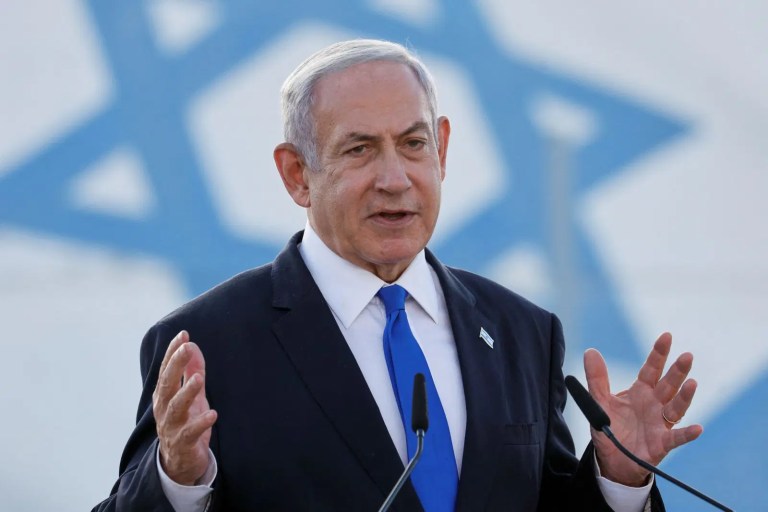
Israeli Prime Minister Benjamin Netanyahu warned on Saturday that the war in Gaza would not be over until Hamas was disarmed and the Palestinian territory demilitarised.


His declaration came as Hamas’s armed wing, the Ezzedine Al-Qassam Brigades, handed over the remains of two further hostages on Saturday night under a US-brokered ceasefire agreement.

The Israeli military said late Saturday that a Red Cross team received the remains of two hostages and the coffins were on their way to its security forces in Gaza.

The issue of the dead hostages still in Gaza has become a sticking point in the implementation of the first phase of the ceasefire. Israel has linked the reopening of the key Rafah crossing to the territory to the recovery of the hostages’ remains.

Advertisement

Netanyahu cautioned that completing the ceasefire’s second phase was essential to ending the war.

He said late Saturday that “Phase B also involves the disarming of Hamas and the demilitarisation of the Gaza Strip.

“When that is successfully completed — hopefully in an easy way, but if not, in a hard way — then the war will end,” he added in an appearance on right-wing Israeli Channel 14.

Hamas has so far resisted the idea and since the pause in fighting has moved to reassert its control over the Gaza Strip.

Advertisement

Rafah crossing closed

Under the ceasefire deal brokered by US President Donald Trump, Hamas has so far released all 20 living hostages, along with the remains of nine Israelis and one Nepalese.

The most recent handover was on Friday night — the body was identified by Israel as Eliyahu Margalit, who died aged 75 in Hamas’s October 7, 2023 attack.

In exchange, Israel has released nearly 2,000 Palestinian prisoners and 135 other bodies of Palestinians since the truce came into effect on October 10.

Advertisement

Hamas has said it needs time and technical assistance to recover the remaining bodies, which it says are buried under Gaza’s rubble.

The two bodies to be returned on Saturday “were recovered earlier today”, the al-Qassam Brigades said on Telegram.

Netanyahu on Saturday hinted that the reopening of the vital Rafah crossing to Egypt could depend on Hamas returning all the bodies of hostages still in Gaza.

The Palestinian mission in Cairo announced that the crossing could open as early as Monday, though only for Gazans living in Egypt who wished to return to the territory.

Advertisement

Shortly after, however, Netanyahu’s office said he had “directed that the Rafah crossing remain closed until further notice”.

“Its reopening will be considered based on how Hamas fulfils its part in returning the hostages and the bodies of the deceased, and in implementing the agreed-upon framework,” it said, referring to the week-old ceasefire deal.

Hamas warned late Saturday that the closure of the Rafah crossing would cause “significant delays in the retrieval and transfer of remains”.

Digging latrines

Advertisement

Further delays to the reopening could also complicate the task facing Tom Fletcher, the UN head of humanitarian relief, who was in northern Gaza on Saturday.

“I drove through here seven to eight months ago when most of these buildings were still standing and, to see the devastation — this is a vast part of the city, just a wasteland — and it’s absolutely devastating to see,” he told AFP.

Fletcher said the task ahead for the UN and aid agencies was a “massive, massive job”.

He said he had met residents returning to destroyed homes who were trying to dig latrines in the ruins.

Advertisement

“They’re telling me most of all they want dignity,” he said.

“We have a massive 60-day plan now to surge in food, get a million meals out there a day, start to rebuild the health sector, bring in tents for the winter, get hundreds of thousands of kids back into school.”

While the Rafah crossing has yet to reopen just over a week since the brokering of the truce, hundreds of trucks are rolling in each day via Israeli checkpoints and aid is being distributed.

‘What did they do wrong?

Advertisement

Some violence has persisted despite the ceasefire.

Gaza’s civil defence agency, which operates under Hamas authority, said on Saturday that it had recovered the bodies of nine Palestinians — two men, three women and four children — from the Shaaban family after Israeli troops fired two tank shells at a bus.

Two more victims were blown apart in the blast and their remains have yet to be recovered, it said.

At Gaza City’s Al-Ahli Hospital, the victims were laid out in white shrouds as their relatives mourned.

Advertisement

“My daughter, her children and her husband; my son, his children and his wife were killed. What did they do wrong?” demanded grandmother Umm Mohammed Shaaban.

The military said it had fired on a vehicle that approached the so-called “yellow line”, to which its forces withdrew under the terms of the ceasefire, and gave no estimate of casualties.

“The troops fired warning shots toward the suspicious vehicle, but the vehicle continued to approach the troops in a way that caused an imminent threat to them,” the military said.

“The troops opened fire to remove the threat, in accordance with the agreement.”
Advertisement
Continue Reading
Advertisement

Foreign

Death Toll From Venezuela Quakes Jumps To 188, Over 1,500 Injured

Published

on

By

ADVERTISEMENT
Zoom Ad
ADVERTISEMENT
Zoom Ad

The death toll from Venezuela’s devastating earthquakes has risen to at least 188, with 971 people injured, National Assembly chief Jorge Rodriguez, said on Thursday.

Interim president Delcy Rodriguez had earlier said that round 30 aftershocks have been recorded following the two strongest quakes on Wednesday.

Authorities initially reported 32 dead and more than 700 injured.

The earthquakes of magnitude 7.2 and 7.5 struck the same area of Venezuela on Wednesday, according to the United States Geological Survey (USGS), causing buildings in the capital to crumble and forcing the closure of the country’s main airport.

Advertisement

US President Donald Trump said late Wednesday that “the two major earthquakes that just hit the great people of Venezuela are both massive in scale and have left a devastating number of deaths.”

“The U.S.A. stands ready, willing, and able to help! I have instructed all agencies of our government to get ready to move quickly,” the American president wrote on his Truth Social platform.

An AFP journalist saw a 22-story building completely destroyed in the capital’s Altamira neighborhood, where people cried out relatives’ names as volunteers climbed over the rubble.

“We need flashlights,” one of them said.

Advertisement

The first quake, with an epicenter 21 kilometers (13 miles) west of the coastal town of Moron, occurred at 2204 GMT, USGS said. Within a minute, a 7.5-magnitude quake struck about 45 kilometers away.

“This earthquake was the second event in a doublet. This magnitude 7.5 mainshock was preceded by 39 seconds by a 7.2 foreshock,” USGS said.

Continue Reading

Foreign

US Targets Alleged ISIS Funding Network, Names Nigerian

Published

on

By

ADVERTISEMENT
Zoom Ad
ADVERTISEMENT
Zoom Ad

The United States government has identified a Nigerian national among several individuals and organisations accused of facilitating financial operations for the Islamic State of Iraq and Syria (ISIS), as part of a broader crackdown on the group’s global funding network.

In a statement issued by the U.S. Department of State, officials said the action targeted three individuals and six entities operating across Europe, the Middle East, and West Africa, who are allegedly involved in moving funds used to support ISIS activities.

According to the department, the measures are aimed at disrupting the terrorist group’s ability to finance attacks and sustain its international operations.

“Under the leadership of President Trump, the United States is dismantling ISIS’s ability to finance terrorism around the world. We are cutting off the financial lifelines from around the world that enable ISIS to fund attacks, support its regional affiliates, and threaten civilians, including religious minorities,” spokesperson Thomas Pigott said.

Advertisement

The statement noted that the network spans France, Syria, Türkiye, and Nigeria, and is believed to have facilitated the cross-border movement of funds linked to the extremist group.

Officials alleged that the designated individuals include a France-based facilitator connected to explosives-related information shared with ISIS supporters, a Syria-based operator who reportedly used cryptocurrency to transfer funds internationally, and a Nigeria-based facilitator whose money exchange businesses were allegedly used as channels for ISIS financing.

The U.S. government said the designations are part of ongoing efforts to dismantle financial pipelines supporting terrorist organisations and to restrict their global operations.

Advertisement
Continue Reading

Foreign

Seven PMs In 10 Years: Britain’s Decade Of ‘Change’

Published

on

By

ADVERTISEMENT
Zoom Ad
ADVERTISEMENT
Zoom Ad

Britain will have its seventh prime minister in 10 years after Labour leader Keir Starmer was ousted on Monday by his own party.

The party’s self-inflicted wound was a trend set by the Conservatives when they were in office.

Starmer announced his resignation on Monday following months of nose-diving poll ratings and manoeuvring by his own MPs.


Advertisement
Britain’s Prime Minister Keir Starmer makes a statement on his future outside 10 Downing Street on the morning of June 22, 2026, in London. Photo by HENRY NICHOLLS / AFP

Veteran Labour politician Andy Burnham has confirmed he will seek to replace him.

The main opposition Tories went through five prime ministers between 2016 and July 2024 when Starmer swept to power in a landslide general election victory.

The rapid turnover at the top prompted Starmer — before he became prime minister — to call for an end to the “chaos” of chopping and changing leaders.

After less than two years, Starmer has now met a similar fate himself.

Here’s what happened to his predecessors:

Advertisement

David Cameron (May 2010 to July 2016)

David Cameron, Libya, UK
Former UK Prime Minister, David Cameron

Britain’s decision to leave the European Union ended Cameron’s second term as prime minister.

After the country voted to leave in a June 2016 referendum, Cameron, who had campaigned to remain in the bloc, resigned.

Theresa May (July 2016 to July 2019)

Britain’s Prime Minister Theresa May announces her resignation outside 10 Downing street in central London on May 24, 2019. Beleaguered British Prime Minister Theresa May announced on Friday that she will resign on June 7, 2019 following a Conservative Party mutiny over her remaining in power.
Tolga AKMEN / AFP

May took over amid the fallout from the Brexit referendum after a long tenure in the notoriously difficult post of interior minister.

She called a snap election the following year to strengthen her hand in Brexit negotiations, but the move backfired when her party emerged as the biggest in parliament but without a majority.

Advertisement

Unable to get her Brexit deal through parliament, the Conservatives suffered a drubbing in European Parliament elections in May 2019, leading to her resignation.


Boris Johnson (July 2019 to September 2022)

A video grab from footage broadcast by the UK Covid-19 Inquiry shows Britain’s former Prime Minister Boris Johnson speaking at the UK Covid-19 Inquiry, in west London, on December 6, 2023 to give evidence. (Photo by UK Covid-19 Inquiry / AFP)

Johnson, a maverick politician famed for making a career out of breaking the rules, had to navigate the coronavirus pandemic and Britain’s departure from the European Union.

He led the Conservatives to victory in the December 2019 snap general election.

Advertisement

But weakened by scandals, he was eventually forced to step down following a cascade of resignations by ministers and aides.

Liz Truss (September 2022 to October 2022)

Britain’s Prime Minister Liz Truss delivers a speech outside of 10 Downing Street in central London on October 20, 2022 to announce her resignation. (Photo by Daniel LEAL / AFP)

Truss was prime minister for just 49 days, the shortest on record, before being ousted over her disastrous tax-cutting mini-budget.

Her economic agenda spooked the markets and took the UK to the brink of financial meltdown, losing her the support of her own party.

Rishi Sunak (October 2022 to July 2024)

Advertisement
Britain’s outgoing Prime Minister and leader of the Conservative party, Risihi Sunak, delivers a statement after his general election defeat, outside 10 Downing Street in London on July 5, 2024, a day after Britain held a general election. (Photo by HENRY NICHOLLS / AFP)

Sunak was at the helm for 20 months before losing the 2024 general election to Starmer, bringing to an end 14 years of Conservative rule.

He brought some stability following the Truss debacle but failed to stop bitter Tory infighting.

The privately wealthy former financier ultimately failed to connect with regular voters struggling with a cost-of-living crisis.

AFP


Advertisement

Continue Reading

Trending

Copyright © 2024 Naija Blitz News