
News
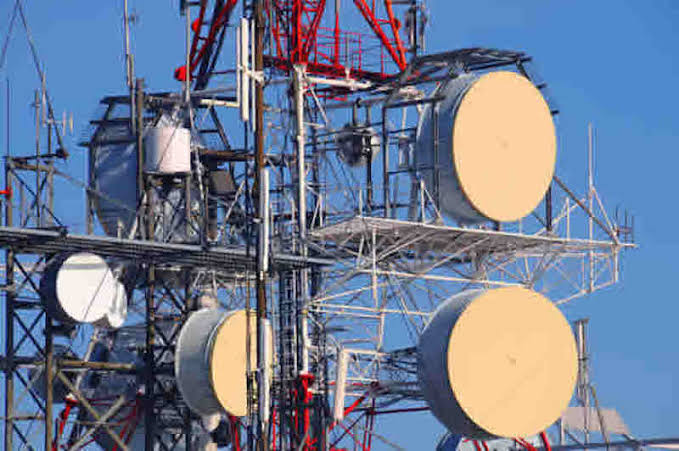
Call Masking resurfaces again in telecom networks

- /home/naijuinz/public_html/wp-content/plugins/mvp-social-buttons/mvp-social-buttons.php on line 27
https://naijablitznews.com/wp-content/uploads/2024/08/images-2024-08-07T082122.677.jpeg&description=Call Masking resurfaces again in telecom networks', 'pinterestShare', 'width=750,height=350'); return false;" title="Pin This Post">
- Share
- Tweet /home/naijuinz/public_html/wp-content/plugins/mvp-social-buttons/mvp-social-buttons.php on line 72
https://naijablitznews.com/wp-content/uploads/2024/08/images-2024-08-07T082122.677.jpeg&description=Call Masking resurfaces again in telecom networks', 'pinterestShare', 'width=750,height=350'); return false;" title="Pin This Post">


By Sonny Aragba-Akpore
It is unusual to receive supposedly foreign calls only for the caller identification to show a local number. Strangely, many people take this for granted especially if eventually the caller is able to identify him or herself on the other side. Talks go on as if nothing has happened. Really? The caller on the other side may be or may not be aware that his or her number didn’t show on this side of the communications link. What has happened is “Call Masking “. It is dangerous to the receiving end and very big economic loss to local network operators.
It is calling dumping that is a potential national security risk as threats and intimidation take place and detrimental to the receiving end and society. And no traces of the caller as the number does not show actual caller who may well pass as a ghost. Call masking is the act of concealing or disguising the origin of an international call and presenting it as a local call. The International Telecommunication Union (ITU)addresses call masking primarily through recommendations that combat fraudulent practices like spoofing and refiling, which manipulate Caller Line Identification (CLI). Although ITU does not ban all forms of call masking, its guidelines aim to ensure the delivery of true call origin information, combat revenue fraud, and protect users from illegal activity. These include evading international call rates where one of the most significant problems identified by the ITU is the masking of international calls to make them appear as less-expensive local calls. This call refiling or masking helps operators and fraudsters bypass international termination rates, causing massive revenue losses for legitimate network operators.
Call masking is executed through a deployment of a technology called SIM boxes, which are devices containing multiple SIM cards deployed to terminate international calls as local ones. The practice bypasses the higher international termination rates, allowing illegal operators to profit from the difference between local and international call costs.
Call masking in Nigeria and indeed anywhere in the globe is the illegal practice of disguising incoming international calls as local calls to exploit the rate difference between international and local call charges, leading to significant revenue loss for telecom operators and potential security risks. The Nigerian Communications Commission (NCC) put measures in the past to combat this through technical solutions, public awareness campaigns, and stricter enforcement, which led to arrests and a decline in the practice until recently when the practice resurfaced.
On Wednesday, December 8,2021 the Federal Executive Council (FEC) at its weekly meeting approved N1.8 billion to combat the menace of call masking in the country.“The first memo that was approved by the Federal Executive Council was for the deployment of regulatory systems in the telecommunications industry, to be implemented by the Nigerian Communications Commission (NCC),” then Communications and Digital Economy Minister,Isa Pantami announced.He said then that money will be deployed for regulatory systems that will have two components to help tackle insecurity in the country and bolster revenue generation by the government.
The minister said the systems were expected to fight criminal activities perpetrated through SIM box traffic and call masking traffic. But it is however not clear how much success was recorded because as we write now, the scourge has resurfaced in delicate dimensions. And despite spirited efforts to combat this, the problem has resurfaced through Subscriber Identification Module (SIM) box activities in general.
SIM boxing is a fraud allegedly committed via the use of a SIM box, by diverting international calls to a cellular device through the internet. The device, routes the connections back into the network as local calls, using hundreds of low-cost or even unpaid and unregistered SIM cards, which are often obtained with forged identities. “The scammers thus benefit by exploiting the difference between local and international charges by paying just local rates or none at all to network operators after billing international rates from the source. The caller pays the high call rates, but the local telecom operator does not collect these, leading to revenue losses to the Mobile Network Operators (MNOS) and the government” an industry player said. With sustained losses by industry players put at nearly $3billion so far, call masking didn’t come open until about eight years ago when operators lamented losing about 2.5 million minutes per day to the activities of the alleged fraudsters.
Although the NCC put in remedial measures to check the menace, the scammers appear to be ahead of the regulator. But an insider said “the commission is aware of the prevalence of the criminal activities and was deploying more technical solutions to tackle the situation “.
“SIM registration across networks has been tightened to reduce the availability of SIM cards for SIM boxing as well as address the security issues around the availability of pre-registered SIMs.”
Arrests made in the past revealed that the alleged perpetrators of SIM boxing had multiple SIM cards registered with fictitious names and used to divert international calls.
Call masking, also known as number masking, is a technique used in telecommunications to conceal the real phone number of one or both parties in a call, typically by substituting it with a temporary or proxy number. While it is commonly used to protect user privacy in ride-hailing apps, customer service platforms, or delivery services, it is viewed as calls with sinister intentions. It leads to call quality degradation because extra layers of routing or anonymization may affect latency or audio quality. “Proxy numbers can introduce complications in call routing, especially if there’s network congestion or number recycling” a telecom engineer admits.
Repeated misuse by bad actors erodes trust in legitimate services using call masking for privacy.
There is also a false sense of security as users might believe their data is secure, but masking does not guarantee end-to-end encryption or data protection.
In many regions of the world including Nigeria, masking without user consent or proper authorization are clear violations of telecom laws. There are sanctions in various degrees.
In this regard, organizations may face heavy fines or license revocations if call masking is used inappropriately or without safeguards. Such safeguards include but not limited to verified and regulated masking solutions and implementation of strong logging and monitoring systems.
Operators are admonished to educate users about masked calls and potential fraud.
Cooperating with telecom regulators and law enforcement, when necessary, could be one of the safeguards. But regulators are sometimes incapacitated especially when real numbers are hidden, making it impossible to hold the caller accountable for malicious, threatening, or abusive behaviour.
And because the caller has no identity, law enforcement is restricted as regulatory agencies may face difficulties in tracing criminal activities in that regard.Essentially such attackers use masked or spoofed numbers to impersonate trusted entities including banks, government organizations and even businesses to carry out attacks by tricking receivers into sharing sensitive information in what is commonly referred to as social engineering attacks. Fraudsters often use call masking to execute voice phishing (vishing) schemes without being traced. The ITU recommendations to combat the broader problem of Caller ID spoofing to prevent the scourge where callers deliberately falsify their numbers are in place.
The recommendations include ITU-T E.157 which provided guidance on the delivery and format of the calling party’s number across international borders.
And to ensure origin identification, resolutions from the World Telecommunication Standardization Assembly (WTSA) encourage the delivery of international Caller Line Identification (CLI) and Origin Identification (OI) information to the destination network. The goal is to provide receiving parties and their operators with information to identify the true origin of a communication.

Nigeria’s First Lady, Oluremi Tinubu, has given reasons why she does not beg for support, stressing that she only works with what God provides while encouraging young Nigerians to embrace contentment, hard work and patience.
She made the remarks on Friday at the State House in Abuja while receiving the leadership of the All Progressives Congress (APC) National Youth Wing. During the meeting, she presented brand-new buses to the youth leaders to support their activities ahead of the 2027 general elections.
She explained that the vehicles were donated by individuals who support her initiatives and decided to hand them over to the APC National Youth Wing to enhance their operations.
The First Lady commended the APC youth leaders for their conduct, noting that they had never approached her office with requests for personal assistance.
She described their attitude as selfless and said she was pleased to support them because the buses would assist them in carrying out their responsibilities.
Mrs Tinubu also advised Nigerian youths against pursuing quick wealth, emphasizing that lasting success is built on diligence, integrity and perseverance rather than shortcuts.
She urged young people to remain disciplined, patient and committed to hard work, noting that laziness does not produce success.
Using the eagle as an example, the First Lady encouraged the youths to develop resilience and determination in the face of challenges.
She urged them to remain focused on their personal goals instead of comparing themselves with others or becoming discouraged by the achievements of their peers.
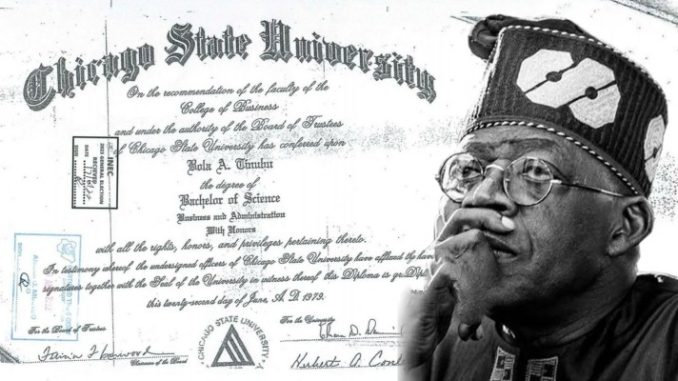
Electoral Commission has begun the public display of the personal particulars and academic credentials of presidential candidates for the 2027 general election.
The exercise, which took off on Saturday, features documents submitted by President Bola Tinubu of the All Progressives Congress and running mate, Vice President Kashim Shettima.
Copies of Tinubu’s Form EC9 sighted showed his Bachelor of Science degree in Business Administration from Chicago State University, United States, which his transcript indicated was awarded “with honours” on June 22, 1979.
The form also carried his National Youth Service Corps discharge documents, which showed he served in Oyo State from December 1982 and was demobilised in November 1983.
His work history, as listed in the form, showed three employers: Mobil Nigeria Limited, where he worked from 1983 to 1992 and left on account of “advancement”; the Lagos State Government, where he served from 1999 to 2007 until the “legal end of tenure”; and the Federal Government of Nigeria, where he has worked from 2023 till date.
The years listed against his primary and secondary school attendance in the same form were entered as “0000,” with only his university qualification, a B.Sc obtained in 1979, indicated.
The President’s personal information section listed his date of birth as March 29, 1952, and his age as 74.
It also listed his birthplace as Lagos, his residential address as No. 4, Queen’s Drive, Ikoyi, and his occupation as “politician.”
For Shettima, the displayed documents traced his education from primary school.
His Certificate of Primary Education, issued by the Ministry of Education, North-Eastern State, showed he attended Lamisula I Primary School between 1972 and 1978, finishing second out of 22 pupils in his final year, with English, History and Religious Knowledge listed as his strongest subjects.
His West African Examinations Council result, obtained at Government Secondary School, Potiskum, in June 1983, showed six credits and passes, including a distinction in Religious Knowledge and Economics.
He proceeded to the University of Maiduguri, where records showed he bagged a Second Class Upper Division degree in Agriculture in August 1989, before earning a Master of Science in Agricultural Economics from the University of Ibadan.
His NYSC discharge certificate indicated he served from October 1989 to October 1990.
The display, contained in Form EC9, is a statutory requirement under Section 29(3) of the Electoral Act, 2026, which mandates INEC to publish candidates’ particulars within 21 days of receipt.
In a statement, the commission explained Form EC9 contains the credentials, personal particulars and affidavits submitted by candidates.
“Form EC9 contains the credentials, personal particulars and affidavits submitted by candidates sponsored by political parties,” INEC stated.
The documents were displayed at INEC offices nationwide, including its Lagos State office in Sabo-Yaba and Local Government Area offices within affected constituencies.
The Electoral Act empowers members of the public to apply to INEC for certified true copies of nomination forms and other documents submitted by candidates, and to seek legal redress over allegations of false declaration or forgery.
Campaigns for the presidential and National Assembly elections are scheduled to begin on August 19, while those for governorship and state assembly elections will follow later, in line with the commission’s revised timetable.

Richest man globally, Elon Musk has said Nigeria alone had four million more births than the entire European Union.
Musk made the claim on his X account on Saturday, citing his artificial intelligence chatbot, Grok, as the source of the information.
“Nigeria alone had 4 million more births than the entire EU last year,” he wrote on X.
Musk’s remarks highlight Nigeria’s high birth rate compared with the European Union.
Available data from Musk’s Grok showed that Nigeria recorded an estimated 7.8 million births in 2025, while the European Union had 3.5 million births.
This means Nigeria recorded approximately four million more births than the EU.
Recall that in February 2026, the United Nations Children’s Fund, UNICEF, said 14 million Nigerian children had their births officially registered over the previous two years, marking significant progress in legal identity coverage.
Africa’s most populous country continues to record a high birth rate, placing further strain on its already fragile economy.
World Bank data showed that Nigeria’s poverty rate stood at 63 percent in 2025 amid rising economic hardship fueled by the skyrocketing cost of living.
Meanwhile, the Emir of Kano, Muhammadu Sanusi II, said at the 31st Nigerian Economic Summit that, for the first time, the country’s economy was growing faster than its population, which is estimated at 250 million.
Daily Post

Why I Don’t Beg for Support – Remi Tinubu

INEC showcases Tinubu, Shettima’s personal details ahead of 2027 elections

Elon Musk reveals Nigeria had four million more births than EU




-

 News7 hours ago
Just in: After Hugh Backlash, FIFA finally Scrap Infantino’s £15B World Cup Private Investment Proposal
-

 News7 hours ago
‘Stop complaining about Buhari, others for your failures,’ Atiku slams Tinubu
-

 News6 hours ago
Colonel Behind Alleged Tinubu Coup Plot Admits Failed Promotion Pushed Him, Reveals How He Was Lured By Army Chiefs
-

 News6 hours ago
How Prison Inmate on D*ath Row Livestreamed On TikTok, Earned Money From Ogun Prison
-

 News6 hours ago
INEC Rejects PDP’s Submission Of Jonathan As 2027 Presidential Candidate
-
 News6 hours ago
SAD: FRSC Enugu Sector Commander Is Dead
-

 News5 hours ago
UK PM Burnham slams Infantino, says he’s the ‘wrong man’ to lead FIFA
-

 News24 hours ago
CSOs, Youth Groups Push for Inclusive NYSC Reform, Convene National Dialogue