News
FG set to cut Cargo clearance time to 7 Days
- /home/naijuinz/public_html/wp-content/plugins/mvp-social-buttons/mvp-social-buttons.php on line 27
https://naijablitznews.com/wp-content/uploads/2025/10/fcjj-1000x509.jpg&description=FG set to cut Cargo clearance time to 7 Days', 'pinterestShare', 'width=750,height=350'); return false;" title="Pin This Post">
- Share
- Tweet /home/naijuinz/public_html/wp-content/plugins/mvp-social-buttons/mvp-social-buttons.php on line 72
https://naijablitznews.com/wp-content/uploads/2025/10/fcjj-1000x509.jpg&description=FG set to cut Cargo clearance time to 7 Days', 'pinterestShare', 'width=750,height=350'); return false;" title="Pin This Post">
The Federal Government has intensified efforts to actualize the implementation of the National Single Window at the nation’s ports by 2026.

The Vice President, Senator Kashim Shettima, said the policy aimed at creating a single platform to harmonise documentation, minimise human contact, and bring full transparency to the cargo clearance process would be a game changer at the ports
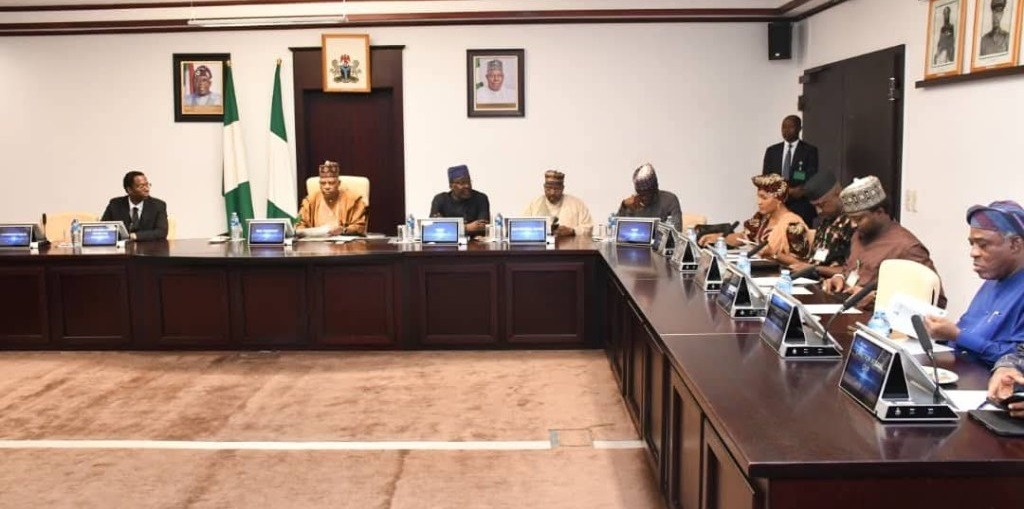
Senator Shettima, who stated this on Thursday during the second meeting of the Ports and Customs Efficiency Committee at the Presidential Villa, noted that the target is to reduce average cargo clearance time from 21 days to less than seven days by the end of 2026, and to position Nigerian ports among the top three most potent trade corridors in Africa.

He stated: “By the end of 2026, we aim to reduce average cargo clearance time in Nigeria to under seven days and to position our ports among the top three most efficient trade gateways on the continent.
“The forthcoming implementation of the National Single Window in the first quarter of next year will be a game changer, a single platform that harmonises documentation, minimises human contact, and brings full transparency to the cargo clearance process.”
VP Shettima also directed the Nigerian Ports Authority (NPA), Nigerian Customs Service (NCS), National Agency for Food and Drug Administration and Control (NAFDAC), Standards Organisation of Nigeria (SON), and other relevant agencies to come up with a roadmap on how to make Nigeria’s weights and measures framework effective.
The weights and measures framework conducts regular surveillance and inspections across Nigeria to ensure that weighing and measuring equipment used in trade is accurate and that consumers receive the correct value for their money in line with standard global practice.
The main objective is to ensure consumer protection, which is achieved by preventing fraud and misrepresentation in commercial transactions involving weights and measures.
Demanding a roadmap for an effective weights and measures framework, the Vice President said the target is to improve port operations, make cargo clearance faster and more efficient by reducing average cargo clearance time from 21 days to less than seven days by the end of 2026, as well as position Nigerian ports among the top three most potent trade corridors in Africa.
Senator Shettima expressed dismay over cargo dwell time at Nigeria’s major ports, which he said “currently averages between 18 to 21 days,” compared to Ghana and Cotonou, Benin Republic, where it takes five to seven days and just four days respectively.
“The cost of clearing goods in Nigeria is estimated to be 30 percent higher than in many of our regional peers. Our ports record cargo dwell times 475 percent above the global average benchmark.
“These inefficiencies are not just statistics; they are symptoms of an economic ailment that costs us investments, drives up consumer prices, and weakens our export competitiveness. We simply cannot afford to continue down this path,” he noted.
The VP however expressed optimism that the Executive Order on Joint Physical Inspection, which is currently before President Bola Ahmed Tinubu, “stands as one of the boldest and most decisive steps toward reversing these trends.
“It marks the dawn of a new era, an era where agencies work together, where systems speak a common language, and where traders and investors can depend on predictability, transparency, and speed,” he added.
The VP demanded synergy among the NPA, Nigerian Customs Service NAFDAC, SON, NIS and other relevant agencies, saying the era of working in silo was over.
His words: But no reform succeeds without ownership. Every agency represented here, the Nigerian Ports Authority, the Customs Service, NAFDAC, NDLEA, Standards Organisation of Nigeria, Immigration, the Quarantine Service, and all our partners, must see ourselves not as isolated operators, but as links in a single, integrated value chain.
“The era of siloed operations must end. Inter-agency rivalry must give way to inter-agency synergy. We are only as efficient as our collaboration allows, and our success will depend not only on what we do individually, but on what we achieve together.”
Earlier, the Director General of PEBEC, Princess Zahrah Audu, drew attention to the impact of inefficient port operations on the Ease of Doing Business in Nigeria, underscoring the imperative for a collective resolve among stakeholders to improve port operations, making cargo clearance faster and more efficient.
She decried the losses incurred as a result of the inefficiency at the nation’s ports while acknowledging the efforts of the Customs and Ports Efficiency Committee, describing the committee as a platform that represents not only interagency collaboration but also a shared commitment to making Nigeria’s ports globally competitive, transparent, and efficient.
For his part, the Managing Director of the Nigeria Ports Authority, Dr Abubakar Dantsoho, emphasized the import of synergy in revamping the nation’s ports, noting that “until there is collaboration and partnership you cannot achieve efficiency at the ports”.
Highlighting steps taken by the ports authority to address bottlenecks faced by importers and exporters at the nation’s ports, the MD said the Customs and Ports Efficiency Committee established by the NPA is recording huge successes through the joint inspection and boarding by relevant agencies operating in the area.
He identified adoption of technology, improvement in infrastructure, human capacity building, and equipment and tools, as areas that can be improved to enhance port efficiency and ensure that Nigeria remains competitive and relevant in the sub-region, continent and beyond.
Stanley Nkwocha
Senior Special Assistant to The President on Media & Communications
(Office of The Vice President)
30th October, 2025
News
“Greatest Threat Is Misinformation, Not Technical Glitch” – INEC Chairman Tasks Media On Osun Poll Coverage
The Chairman of the Independent National Electoral Commission, INEC, Prof. Joash Amupitan, SAN, has described misinformation and disinformation as the greatest threat to the August 15 Osun State Governorship Election, urging the media to prioritize verified and ethical reportage.
He made the call on Saturday in Osogbo during an interactive session with media executives, describing journalists as the “Fourth Estate of the Realm” and critical stakeholders in the democratic process.
“However, your role as the Fourth Estate is critical to the survival of the process. In this final day window, the greatest threat we face is not technical failure, but the pathology of misinformation and disinformation,” the INEC Chairman said.
“Fake news, manufactured election-day panics, and the unauthorized declaration of parallel results are direct assaults on our public peace and democratic stability.”
He said the Commission has accredited field reporters through its dedicated portal “because we want you to see everything,” and in return demanded “a commitment to verified, ethical, and dispassionate reporting.”
“Verify your facts before you broadcast. When a glitch occurs in a single polling unit, do not report it as a systemic failure across the entire state,” Prof. Amupitan charged.
“Use your channels to educate voters: remind them that No PVC means No Voting, and that vote-buying remains a criminal offense that our partners at the EFCC and ICPC have been mandated to curb.”
Giving an update on readiness, the Chairman said the just-concluded mock accreditation proved the resilience of the BVAS.
“The Bimodal Voter Accreditation System (BVAS) demonstrated optimal field resilience. On average, it took between 30 seconds to 2 minutes to successfully verify a voter using either their fingerprints or facial recognition,” he stated.
“As a result, we have increased the total number of BVAS for the election from 4,427 to 5,130 so as to service split polling units in large PUs in Ife East, Irewole, Egbedore, Ede North, Osogbo. In the process, we increased the number of back-ups from 664 to 1,328 for quick intervention in case of any malfunction.”
Prof. Amupitan also addressed insecurity, saying INEC has moved “from reactive monitoring to proactive prevention” through ICCES. He listed hotspot LGAs to include Atakumosa East and West, Boripe, Ede North and South, Ife Central, Ifedayo, Ila, Osogbo, Ifelodun, and Oriade.
On inclusivity, he reaffirmed the Commission’s commitment to vulnerable voters.
“Democracy is incomplete if it excludes vulnerable populations. The Commission has integrated practical assistive devices across polling locations based on our disability mapping in Osun State. We have provisions for braille ballot guides for visually impaired voters; magnifying glasses for voters with albinism and low vision; EC40H poster manifests for hearing-impaired citizens and Priority Voting Queues for Persons with Disabilities (PWDs), pregnant women, nursing mothers, and the elderly,” he said.
The Chairman said 32,000 NYSC members have been engaged as ad-hoc staff via the INECPRES portal and that training for Supervisory Presiding Officers has been concluded.
“We do not care who wins the election; we only care how they win. Our sole job is to ensure that the process is clean, that every valid vote counts, and that the declaration reflects nothing but the true sovereign will of the Osun electorate,” Prof. Amupitan concluded.
The session had in attendance National Commissioners, the Osun REC Barrister Oluwatoyin Babalola, NUJ and BON leadership, Bureau Chiefs, Editors and other senior media executives.
News
Coalition want explanation over alleged BVAS failure in Osun mock accreditation exercise
A group, aegis of Coalition of Concerned Nigeria Citizens (CCNC), has called on the Independent National Electoral Commission (INEC) to immediately explain the alleged widespread failure of the Bimodal Voter Accreditation System (BVAS) during Saturday’s mock accreditation exercise conducted ahead of the August 15 Osun State governorship election.
The group alleged that the mock accreditation, designed to test the commission’s readiness for the election, experienced significant technical challenges after commencing in selected polling units across the state, raising concerns about INEC’s preparedness for the governorship poll.
In a statement signed by its spokesperson, Comrade Raufu Sodiq, popularly known as “Oluomo Success,” the coalition claimed that although the exercise was scheduled to begin at 8:30 a.m., it started behind schedule in some polling units. It further alleged that less than 40 minutes after the exercise commenced, many BVAS machines stopped recognising fingerprints, facial features and Permanent Voter Cards (PVCs), preventing the successful accreditation of voters in the affected locations.
Describing the development as disturbing, the group said a mock accreditation exercise should ordinarily boost public confidence in the electoral process, adding that the reported malfunction of the accreditation devices during the test exercise had instead raised questions about the commission’s level of preparedness.
The coalition argued that accreditation remains the foundation of every credible election because it determines voter eligibility and protects the integrity of the electoral process. According to the group, any failure at that stage could undermine public confidence in the outcome of the election if not urgently addressed.
CCNC also queried why such challenges allegedly occurred despite what it described as years of preparation and substantial public investment in electoral technology. It called on the Osun Resident Electoral Commissioner and the national leadership of INEC to provide a comprehensive explanation on the cause of the reported BVAS malfunction and disclose measures being taken to prevent a recurrence during the August 15 governorship election.
Among its demands, the coalition asked INEC to clarify whether the reported glitches resulted from software, hardware or configuration problems, explain its contingency plans for the 3,763 polling units across Osun State, replace any faulty BVAS machines and consider conducting another mock accreditation exercise before the election to restore public confidence.
“We believe in strong democratic institutions and do not want to see INEC fail. However, public confidence must be built on competence, transparency and accountability. The people of Osun deserve an election where every eligible voter can cast their vote without avoidable technological failures,” the statement read.
The group further urged the Chairman of INEC to personally address Nigerians before the governorship election by explaining the outcome of the mock accreditation exercise, outlining corrective measures and assuring voters that all identified technical challenges would be resolved before Election Day.
INEC had organised the mock accreditation exercise to assess the functionality of the BVAS and other electoral processes ahead of the governorship election scheduled for August 15 across the state’s 3,763 polling units.
News
Why I Don’t Beg for Support – Remi Tinubu
Nigeria’s First Lady, Oluremi Tinubu, has given reasons why she does not beg for support, stressing that she only works with what God provides while encouraging young Nigerians to embrace contentment, hard work and patience.
She made the remarks on Friday at the State House in Abuja while receiving the leadership of the All Progressives Congress (APC) National Youth Wing. During the meeting, she presented brand-new buses to the youth leaders to support their activities ahead of the 2027 general elections.
She explained that the vehicles were donated by individuals who support her initiatives and decided to hand them over to the APC National Youth Wing to enhance their operations.
The First Lady commended the APC youth leaders for their conduct, noting that they had never approached her office with requests for personal assistance.
She described their attitude as selfless and said she was pleased to support them because the buses would assist them in carrying out their responsibilities.
Mrs Tinubu also advised Nigerian youths against pursuing quick wealth, emphasizing that lasting success is built on diligence, integrity and perseverance rather than shortcuts.
She urged young people to remain disciplined, patient and committed to hard work, noting that laziness does not produce success.
Using the eagle as an example, the First Lady encouraged the youths to develop resilience and determination in the face of challenges.
She urged them to remain focused on their personal goals instead of comparing themselves with others or becoming discouraged by the achievements of their peers.
-
News8 hours agoJust in: After Hugh Backlash, FIFA finally Scrap Infantino’s £15B World Cup Private Investment Proposal
-
News7 hours ago‘Stop complaining about Buhari, others for your failures,’ Atiku slams Tinubu
-
News7 hours agoColonel Behind Alleged Tinubu Coup Plot Admits Failed Promotion Pushed Him, Reveals How He Was Lured By Army Chiefs
-
News7 hours agoHow Prison Inmate on D*ath Row Livestreamed On TikTok, Earned Money From Ogun Prison
-
News7 hours agoINEC Rejects PDP’s Submission Of Jonathan As 2027 Presidential Candidate
-
News7 hours agoSAD: FRSC Enugu Sector Commander Is Dead
-
News6 hours agoUK PM Burnham slams Infantino, says he’s the ‘wrong man’ to lead FIFA
-
News23 hours agoINEC set to publish details of 2027 Presidential, National Assembly candidates on August 1