

Opinion
Is It Because It Is Wike?
- Share
- Tweet /home/naijuinz/public_html/wp-content/plugins/mvp-social-buttons/mvp-social-buttons.php on line 72
https://naijablitznews.com/wp-content/uploads/2025/01/Nyesom-Wike-1000x597.jpg&description=Is It Because It Is Wike?', 'pinterestShare', 'width=750,height=350'); return false;" title="Pin This Post">
by Frank Tietie
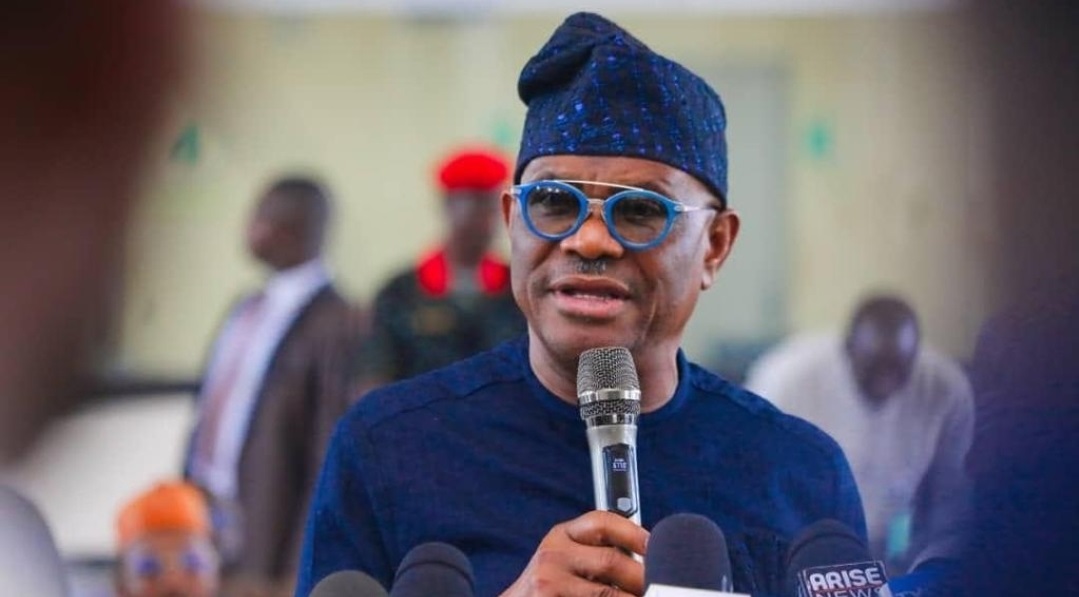
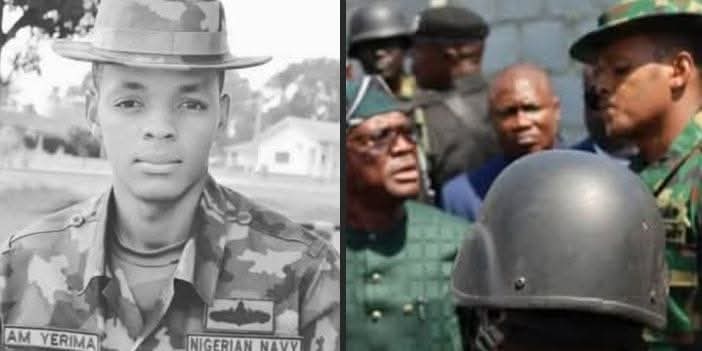
Nyesom Wike, exercising his lawful authority as a Minister of the Federal Government of Nigeria, should have immediately ordered the arrest and detention of the unruly military personnel stationed to obstruct him and officials of the Federal Capital Development Authority (FCDA) from carrying out their legal duties, which included inspecting or enforcing his administrative order regarding any land in the Federal Capital Territory, regardless of whether there were dispute.
Only a deep-seated hatred for Wike (understandably) would explain why many of his detractors would tolerate such impudence by a military officer against him, even in the exercise of his lawful authority as a Minister. It is unacceptable for a young military officer to obstruct the lawful duties of a Minister of the Federal Government of Nigeria.

We have become too used to the abuse and misuse of military power in Nigeria, leading many to accept that it is usual for an officer, who should be on the front line protecting the country’s territorial integrity, to be engaged in a confrontation with a Minister of the Federal Government who is operating in his official capacity.
Sadly, the officer in question is being praised by some Nigerians for his illegal defiance against a Minister appointed by the President to administer the very land over which the officer is defiant, based on some military order.
Many members of the Nigerian military, both in and out of service, seem to believe they are above civil law and view civilians as inferior. This attitude is often tacitly accepted by the public, which tends to tolerate their excesses and human rights violations, especially when they disregard lawful civil authority.
Nigeria’s journey toward democracy has yet to recover from the military hangover, which instilled the belief that force makes right. If military personnel can confront a Minister of the Federal Government in the manner that office treated Wike, what would stop a General Officer Commanding (GOC) from defying the orders of a Vice President or the President himself based on directives from a superior officer? This defiance by this said military officer should be taken seriously, especially considering the statement attributed to the highly respected General Tukur Buratai, former Chief of Army Staff, who warned that the clash between Wike and the military officer poses a threat to national security.
Nigeria is playing with fire if this incident, involving the humiliation of Wike by a military officer, is allowed to go unaddressed, as is often the case in Nigeria’s governance.
Therefore, President Tinubu must invoke his powers under the Tribunals and Inquiries Act to establish a panel of inquiry into the Wike-military incident. This inquiry aims to prevent such occurrences in the future by holding accountable all those found to have violated civil and military law, which could have degenerated to something worse. The significance of this action cannot be overstated for the sake of Nigeria’s democracy.
*Frank Tietie*
Lawyer & Executive Director of Citizens Advocacy for Social and Economic Rights (CASER), writes from Abuja.
Opinion
Gov Mbah’s $30 Billion Bet: Turns Enugu Investors’ Magnet In 3 Years
A Spotlight By Nnolim Nnaji, Member House Of Representatives
As Nigeria marks Democracy Day, Enugu State has quietly emerged as one of Nigeria’s safest and fastest-growing economy under Governor Peter Mbah. Three years in, the administration’s narrative is shifting from laying foundations to scaling transformation, anchored on an audacious goal: a $30 billion economy by 2031.
The numbers back the ambition. Enugu’s 2026 budget stands at ₦1.62 trillion, a 66.5% jump from 2025. What’s striking isn’t just the size, but the structure. 80% of the budget, ₦1.296 trillion, is allocated to capital projects, breaking the recurrent-heavy spending pattern that has trapped most Nigerian states. The shift is powered by a surge in internally generated revenue. IGR contributes 51% of the 2026 budget, roughly ₦825.9 billion, cutting the state’s overdependence on federal allocations and giving Enugu more fiscal autonomy to execute its plans.
Security was the first wall Mbah’s team had to break. By tackling insecurity head-on, Enugu has become one of the safest states in the country, a prerequisite for investment. Phase 2 of the state’s surveillance system, budgeted at ₦11 billion, will deploy CCTV and searchlights at bus stops, junctions, and highways, all linked to a central command center. That sense of security has translated directly into investors confidence. In the last three years, Enugu secured over £500 million in foreign direct investment, with another £2 billion in the pipeline. The pitch to investors is simple: internal rate of return projections of 25-40% making Enugu one of the most competitive emerging-market destinations in Nigeria. The result is visible in the rankings, with the state climbing from 36th to 6th in Nigeria’s ease of doing business index. With the proposed coal power generation plant set to come on stream, more FDI inflows are expected.
Infrastructure has been the most visible proof point. The administration is pushing legacy road projects like the 40km Owo–Ubahu–Amankanu–Neke–Ikem Dual Carriageway, the Abakpa Nike–Ugwogo Nike–Ekwegbe–Opi–Nsukka Road, the Amodu–Akpugo–Akpawfu–Amagunze Road, and upgrades of Enugu–Abakaliki Expressway. The 2026 plan targets 1,200 urban roads and numerous rural roads, ensuring every LGA gets a major project. The goal is to eliminate the rural-urban connectivity gap that has stifled trade and access for decades.
Human capital and basic services are getting the same treatment. The 260 Smart Green Primary Schools and 260 Type-2 Primary Health Centers, one per ward, are nearing completion. Water supply is being revamped through the 9th Mile 24/7 Scheme, Ajali, and Oji River projects. These sit alongside a 10,000-hectare smart city development as a mixed-use commercial and residential hub. If delivered, the schools, health centers, and roads address two of Enugu’s longest-standing pain points: education access and connectivity.
The abandoned International Conference Center and the presidential hotel have been completed to position the state as a hub for regional and national events, tourism, and business summits. At the same time, construction of a state-of-the-art specialist hospital is underway to raise the standard of healthcare delivery and reduce medical tourism out of the state. These projects signal a push to build the kind of infrastructure that attracts investors, skilled professionals, and high-value events.
A less discussed but critical pillar is the revamp of ailing state-owned companies. For years, Enugu’s public enterprises existed mostly on paper, draining resources without delivering value. The Mbah administration is restructuring them for commercial viability and private sector participation, turning dormant assets into revenue-generating ventures, creating jobs, and reducing the burden on the state treasury. This aligns with the broader strategy of mobilizing private capital to complement public spending and accelerate GDP growth from the current ∼$4 billion toward the $30 billion target.
The administration’s boldest signal to the world is Enugu Air. Launched to position Enugu as a regional aviation and logistics hub, the airline plans to grow its fleet to 20 aircraft and expand operations beyond Nigeria by the end of 2026. It already connects the South to the North with daily flights between Enugu and Kano. Enugu is no longer content being a transit point. It has become a destination.
Three years in, the Mbah model is clear: spend on capital, not overhead; secure the state, then market it; and use data-driven incentives like high IRR projections to attract private capital. The risk is execution. Delivering 1,200 roads, functional smart schools, a modern hospital, a completed conference center, revived industries, and a functioning airline in one term is a heavy lift. But if even half of it lands, Enugu will have redefined what subnational governance can achieve in Nigeria.
A Spotlight on Enugu State by Nnolim Nnaji, A member of the House of Representatives
Opinion
ONDO SOUTH SENATE: A NEW CHAPTER BECKONS FOR DR. D.I KEKEMEKE
BY BOLAJI AFOLABI
In the last three to four weeks, the political barometer across the country was charged, as many politicians jostled for various elective positions. Across the major and minor parties, the quest to emerge candidates for states Houses of Assemblies; House of Representatives; Senate; and Governorship brought some frenzy to the political space. As weeks rolled into days, there were clear demarcations and categorization of the aspirants – the serious contenders; the ‘also ran’ group; the ‘coupon’ players; and the outright jokers. Fact is that, each of these were noticeable in all the political parties. From the ruling party, All Progressives Congress, (APC) to the Peoples Democratic Party, (PDP); Social Democratic Party, (SDP); Labour Party, (LP); African Democratic Congress, (ADC); and the newbies Nigerian Democratic Congress, (NDC), politicians of varied persuasion and leanings, with rational and irrational thoughts, as well as sincere and insincere reasons dominated national discussions. All angling for the same thing – candidacies!
At the end of primary elections in virtually all the parties, the dust is clearer, and the cacophony of drama, theatrics has given way to some order in the polity. Away from the buzzing sounds and nuzzling noise, the wheat has been separated from the chaff. To a large extent, there are certainties as to who runs for what in the forthcoming general elections. As expected, the struggle was more fierce in the APC than any other party. Given the peculiarities of our political system, and the mindsets of many politicians, the gravitation towards the APC was readily foretold. With Governors, members of the National Assembly, and some other notable politicians swarming into the ruling party in droves, one cannot expect the contrary during primaries.
Being a beautiful bride, the APC primaries threw up aspirants of varied shapes and sizes. However, at the end of the processes, popular names, not so popular, and fresh faces emerged as the party’s flag bearers for different elective positions in the 2027 polls. From the North to the South, East and West, it was the same. While some outgoing Governors cleared the way for their successors, others emerged as candidates for the Senate – which has become the retirement haven for states chief executives. Also, some preferred choices were railroaded into changing nomenclatures from aspirants to candidates for other elective positions. Though this trend was prevalent in many states, there were few exceptions; where true democratic contests took place.
The APC primaries for Ondo South Senatorial District was one. The list of aspirants who jostled for the ticket included some notable politicians – whose respective resumes are intimidating. Former and present federal legislators, senior party executives, top officials in the state and federal agencies, and some other personalities threw their hats in the ring. For those who understand the place, position, and present status of Ondo South, the number and calibre of aspirants that pushed to be the candidate of the APC was not a misnomer. Variously described as the ‘maritime hub’ and the untapped ‘blue economy wealth’ of the “Sunshine State” the realities of developmental decays and infrastructural deficits that pervade the partly riverine Senatorial District remain painful and pitiable. At the end of the primaries, Dr. I.D Kekemeke emerged the winner with 35, 835 votes – other aspirants including Hon. Akinfolarin Mayowa Samuel, and Hon. Morayo Lebi scored 6,435 and 1,845 respectively.
Considering the tendencies of Nigerian politics, the writer sought for details about the Ondo South Senatorial primaries. The inquisition was driven by one reason. Sometime in October 2025, one was invited to a get-together in honour of Kekemeke by one of his loyal, reliable, and trusted friends; Architect Stephen Adamu, the Principal Partner and Chief Executive of Pine Projects Limited – one of Abuja’s flourishing architectural firms. By the way, the occasion was to celebrate the Ondo-born politician’s academic feat of earning a Doctorate degree in Law. Kekemeke came across as an unusual personality, uncommon politician, who is outrightly frank, disarmingly humble and altruistic in thought and practice. Fortunately, his participation in the primaries provided an opportunity to authenticate or otherwise these attributes from a few of one’s friends and colleagues – though not politicians – but are bonafide indigenes of the District.
Comrade Adebari Ijadola, a civil rights activist described Kekemeke as, “a well grounded politician whose integrity has never been in doubt, a resourceful networker and bridge-builder whose relational capacities will drive good governance and benefit Ondo South.” A paramilitary service officer who pleaded anonymity said, “he is the best person to address unemployment, youth restivness, and infrastructural decay in Ondo South.” He will leverage on his broad experiences in politics and public service for the general well-being and development of our people and district.” Mr. Tubosun Ayodeji, a serial entrepreneur believes that, “without sounding immodest, Kekemeke’s credibility, integrity, accessibility, and acceptance by many people across the State sets him apart from candidates of other parties.” Corroborating, Ms. Morenikeji Ademola, an educationist averred that, “unlike other politicians, he has always used his positions, both past and present to positively touch the lives of people and contributed to the development of the state.”
While R. Buckminster Fuller, a renowned philosopher said, “integrity is the essence of everything successful,” the legendary boxer, Muhammed Ali declared that, “service to others is the rent you pay for your room here on earth,” and an unnamed sociologist concludes that, “the greatest gift of all is the gift of service to humanity.” Indeed, further checks on Duerimini Isaac Kekemeke, widely called “D.I Kekemeke” or “Frank” is an encapsulation of these timeless words. His political career and public service odysseys are framed, driven by service to the people. He does this with unrestrained passion, unequivocal commitment, and unmistakable fervor. Making people the fulcrum of every engagement, he, at different levels and times, has always emerged as the compass for selfless service and purposeful leadership.
As the Minority Leader of the old Ondo State House of Assembly during the aborted Third Republic between 1992 and 1993, Kekemeke, as a young legislator provided the necessary leadership for the opposition caucus through robust advocacy, people-focussed initiatives, and the promotion of welfarist ideals which was the vision of his party. His records of service did not go unnoticed as he was appointed Member, Constitution Drafting Committee of the Peoples Democratic Party, (PDP) in 1998. As the pioneer Board Chairman of the National Examinations Council, (NECO), between 2001 and 2004, he worked assiduously for national and international certifications of the agency’s examinations; standardization, credibility, and integrity of the examinations; established institutional stabilization, financial and administrative procedures, as well as curbing malpractices.
Further, Kekemeke was Attorney General & Commissioner for Justice; Commissioner for Works, Lands, Housing & Transport; as well as the Secretary to the Ondo State Government between 2003 and 2009. He among other things contributed to physical planning, building of housing estates, construction of over 1,000 km of roads, and the delivery of other infrastructures. He established the Office of the Public Defender which provided free legal services to indigent citizens; embarked on comprehensive justice reform and administration; alternative dispute resolution framework. As the “engine room” of the state government, he provided functional and efficient governance through policy ideation, coordination and execution.
Aside from Kekemeke’s legislative and executive experiences, he is proficient in political administration occupying positions that are critical to party development. He was the pioneer Chairman, Ondo State chapter of the APC; National Vice Chairman (South West), APC; re-elected into the same position in 2025. Given the near-total endorsement of his aspiration within and outside the party and across the state, Kekemeke’s chances of being a Senator at the end of the January 23, 2027 general elections look promising. How well he meets the expectations of his constituents thereafter, remains in the belly of time. Like the legendary Jimmy Cliff sang, “Time Will Tell!”
* BOLAJI AFOLABI, a Development Communications specialist was with the Office of Public Affairs, The Presidency, Abuja.
Opinion
Rivers Guber: Rep OK Chinda in the eye of the storm
By Emmanuel Agaji
Since the Rivers gubernatorial primary election was concluded so many things that are indescribable mounted the centre stage with the man Rep Kingsley Chinda in the eye of the storm.
In his usual stoic style of doing things the man Rep Chinda has moved on to issues that will help him galvanize the state into greater heights of excellence if elected governor next year.
Too much talk has never been part of him, the language he understands best even on the floor of the legislature is delivery not over stretched grammar that will not deliver his goal.
This largely contributed to his being voted the most meticulous lawmaker in the National Assembly in two different assemblies.
He delivers his motions and bills with the precision of a marksman targeting a long distance subject.
Rivers state is a microcosm of the entity known as Nigeria parading major ethnic nationalities of the Niger Delta race but at this particular moment what the oil rich state needs is peace and stability not ethnic jingoism.
Going by the feelers from the State, Rep Chinda is largely seen as a good man who anchors everything he does on humanity laced with the glory of God.
He is not truly a quick tempered person as he tries to control this with maturity which made him one of the astute legislators in this clime.
As a legislator he asks diligent questions that will manifest what the legislature is seeking to deliver during its legislative business sessions.
This earned him the accolade of a truth seeker with the sole aim of correcting the wrongs of the past and deliver the goods from the corrections to the doorsteps of Nigerians.
If Rivers people really need a God fearing delivery man, it is OK Chinda who understands the mechanics of Rivers State delivery system as he has been part of the delivery system for more than 25 years.
As Obio/Akpor Federal Constituency Rep, he studied his people and discovered that the approach to use is to teach his people on how to fish rather than doling out bounties that ends at one meal.
He went into the drawing board and created ‘I win u Win’ program for both indigenes and non-indigenes of Obio/Akpor Federal Constituency.
Between 2012 till date OK Chinda embarked on massive training of the residents across all sectors, from health care delivery, maritime, agro allied, IT training, scholarship scheme , purchase of JAMB forms scholarship for outstanding JAMB candidates, sewing, shoe making, empowerment for women, welding and skills acquisition in different trades including massive training of teachers across the constituency in both private and public schools.
In the understanding of this writer, this is corporate governance taken to the hilt as no segment is left out in all the sectors of the economy of the constituency. Here in Nigeria it’s called giving back to society.
The man Chinda is an unusual jinx breaker and a record smasher. As the Chairman of Public Accounts Committee, PAC one of the constitutionally recognized National Assembly committees he smashed all records.
Between 2015 and 2019 Chinda smashed all the records. First chairman to deliver two fully audited reports from 1999 till 2019. First committee chairman to make his committee e-compliant in Nigeria. Go and check the records!
Chinda has given back at the microcosm (Constituency level) at the macrocosm (State level) he would rejig the Rivers delivery system to the benefits of all Rivers people and ensure that peace remains his watchword in the Garden City of Nigeria.
-
Metro11 hours agoPolice Arrest Mother, Daughter Over Alleged ₦18m Romance Scam Targeting Malta-Based Victim
-
News10 hours agoThe Politics Of Maturity: Why Rivers May Need Healing More Than Victory
-
News11 hours agoAkpabio Hails Tinubu’s Reforms, Endorses Re-Election as President Marks Three Years in Office
-
Politics10 hours agoNollywood Actress Gets 2027 Presidential Ticket
-
News11 hours agoSouth African Lawmaker, MK Party Chief Whip Arrested Over Alleged R233,000 Salary Fraud
-
News11 hours agoLawyer Petitions NBC, Seeks Suspension of BBNaija Over Alleged Indecent Content
-
News10 hours agoNigerian Governors Propose ₦100,000 New Minimum Wage
-
Sports10 hours agoBrazilian Teenager Fonseca Knocks Djokovic Out Of French Open