News
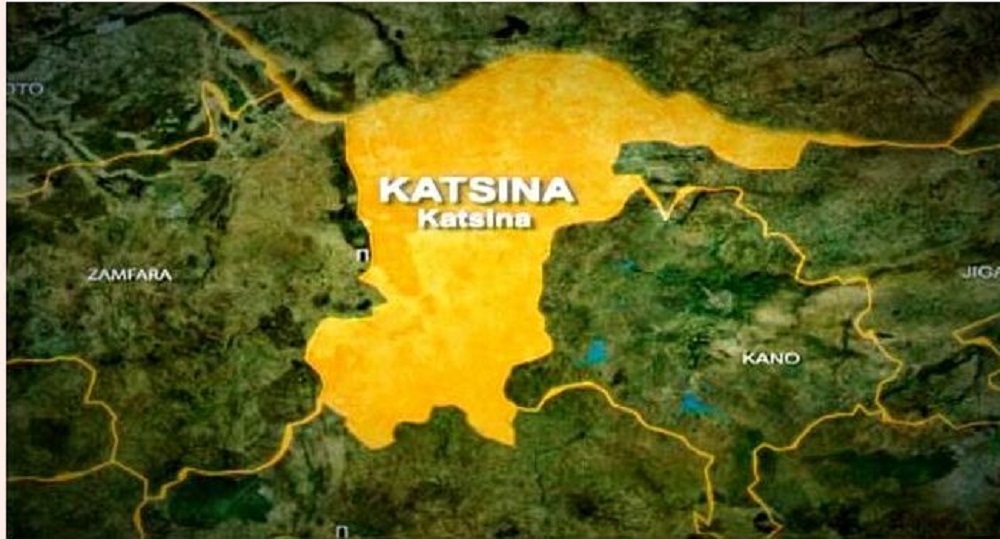
Katsina: Police launch probe as four die in Ramadan alms stampede
- /home/naijuinz/public_html/wp-content/plugins/mvp-social-buttons/mvp-social-buttons.php on line 27
https://naijablitznews.com/wp-content/uploads/2024/10/Katsina-State.jpg&description=Katsina: Police launch probe as four die in Ramadan alms stampede', 'pinterestShare', 'width=750,height=350'); return false;" title="Pin This Post">
- Share
- Tweet /home/naijuinz/public_html/wp-content/plugins/mvp-social-buttons/mvp-social-buttons.php on line 72
https://naijablitznews.com/wp-content/uploads/2024/10/Katsina-State.jpg&description=Katsina: Police launch probe as four die in Ramadan alms stampede', 'pinterestShare', 'width=750,height=350'); return false;" title="Pin This Post">
The Katsina State Police Command has announced the launch of an investigation to determine the circumstances surrounding the deaths of four people at an alms distribution point in Katsina metropolis.

The Command said it regrets to report a stampede that occurred during the distribution of annual Ramadan alms at Kofar Guga Quarters, which left several people injured.
In a statement signed and issued to newsmen today by the State Police Command Public Relations Officer, DSP Abubakar Sadiq Aliyu, it was stated:

“On the 26th February, 2026, at about 9pm, a distress call was received at the Central Police Station in Katsina about a large crowd gathered at the residence of one Alh Dahiru Usman Sarki, a philanthropist, situated at Kofar Guga Quarters, Katsina, resulting in a stampede incident.
Upon receiving the report, a team of policemen promptly responded to the scene where the stampede occurred. The victims were rushed to the nearest hospital for medical attention. Unfortunately, four of the injured later succumbed to their injuries.
The Commissioner of Police, Katsina State Command, CP Bello Shehu, extended his condolences to the families of the deceased and wished those injured a speedy recovery. He also directed that a full investigation be carried out and necessary measures taken to prevent a recurrence.
The Command called on individuals who plan to distribute alms to notify the police for adequate security coverage to ensure the safety of lives and property, as well as orderliness during such events.
The Police assured the public that further developments would be communicated as the investigation progresses.
Tribune Online correspondent in Katsina said that due to poverty, many people now rely on alms distributed by philanthropists for their survival.

News
Speaker Abbas Pledges Sweeping Business Law Reforms, Vows to Scrap Obsolete Legislation Hindering Investment
…promise regulatory certainty, lower cost of doing business, stronger support for enterprises
By Gloria Ikibah
Speaker of the House of Representatives, Rt. Hon. Abbas Tajudeen, has pledged that the National Assembly will repeal outdated laws that impede enterprise, while pursuing far-reaching legislative reforms aimed at improving Nigeria’s competitiveness, attracting investment and accelerating economic growth.
He also promised greater regulatory certainty, reduced cost of doing business, expanded access to finance for businesses and stronger legislative oversight to ensure government agencies faithfully implement economic reforms.
Speaker Abbas made the commitments on Thursday at the Legislative Business Breakfast Meeting held at the National Assembly as part of activities marking the 2026 National Assembly Open Week. The meeting was themed: “The Business of Growth: Legislative Priorities for Investment, Competitiveness and Economic Transformation.”
Setting out what he described as the House legislative priorities for the private sector, the Speaker unveiled five major commitments.
He said: “First, on regulatory clarity and legislative predictability, we commit that laws affecting business will be stable, transparent, and made with your input, so that no investor is ever ambushed by a rule they could not foresee.
“Second, on the cost of doing business, we will build on the tax reforms to harmonise levies across all tiers of government, so that one enterprise is not taxed to exhaustion by federal, state and local authorities at the same time.
“Third, on access to finance, we will strengthen, through law and through oversight, the institutions that lend to the real economy, and press for financing that actually reaches the small and medium enterprises that employ most of our people.
“Fourth, on competitiveness, we will repeal the obsolete laws that frustrate enterprise, and legislate to support local manufacturing, agriculture, and our readiness for the continental market.
“And fifth, on delivery, we will use our oversight not to harass the private sector, but to hold public agencies to account for implementing these reforms faithfully and courteously.”
Abbas said the commitments were informed by extensive consultations with business leaders and reflected the House’s determination to respond to the concerns of the organised private sector.
Explaining why he chose to speak after other participants, the Speaker said Parliament must first listen before legislating.
“I thank you for the candour of this morning’s conversation. I chose to speak last, and deliberately so, because a legislature that wishes to serve the economy must first learn to listen to it. I have heard your presentations and followed the agenda set for us by the Nigerian Economic Summit Group. I speak to you not with the usual assurances but with a considered response and firm commitments”, he said.
He argued that President Bola Ahmed Tinubu’s economic reforms were fundamentally designed to unlock private sector growth rather than expand government.
“Let me begin with a truth that must anchor everything else I say this morning. The reforms of President Bola Ahmed Tinubu, GCFR, were not undertaken for the benefit of government. They were undertaken for you. Governments do not create wealth. They create the conditions in which wealth can be created, and it is you, the entrepreneurs, the manufacturers, the farmers, the traders and the investors of Nigeria, who turn those conditions into factories, into harvests, into exports and into jobs.
“The President has made it plain that his agenda is private-sector-led. That places you not at the margins of the Renewed Hope Agenda, but at its very centre. And a Parliament that understands this will measure its own success by one test above all, whether the laws it makes help you to invest, to grow and to employ”, Abbas added.
The Speaker acknowledged the mounting pressures confronting businesses, saying manufacturers and investors had consistently raised concerns over high borrowing costs, shrinking access to credit, foreign exchange volatility, multiple taxation, poor electricity supply, insecurity, policy uncertainty and port inefficiencies.
“Let me first prove to you that we heard you clearly. You told us, as the Manufacturers Association of Nigeria has told the whole nation, that borrowing has become prohibitively expensive, and that credit to the manufacturing sector actually shrank by close to two trillion Naira last year, starving industry of the money it needs to grow.
“You told us that the liberalisation of the exchange rate, though necessary, has raised the cost of the machinery and raw materials you must import. You spoke of power that remains unstable despite higher tariffs, forcing factory after factory to run on costly diesel. You spoke of multiple taxation, of too many agencies collecting too many levies at the same gate despite the recently passed tax laws. And you spoke of the difficulty of clearing goods through our ports, the drag of insecurity on farms and supply lines, and the uncertainty that comes when policy shifts without warning.
“These are not idle complaints. They are the honest testimony of the men and women who create our jobs, and this House has heard them”, he noted.
Although he admitted that recent reforms had imposed hardship on Nigerians, Abbas maintained they were unavoidable.
He insisted that Parliament had not merely supported the administration’s reforms but had actively driven them through legislation.
“Permit me to place these concerns within the larger picture. The decisions this country took, to remove the costly fuel subsidy, to stop the reckless printing of money to cover deficits, and to unify our fractured exchange rates, were long avoided but could no longer be postponed. They have been hard, and I will not pretend otherwise.
“But the world’s most sober observers now tell us the direction is right. The International Monetary Fund, in its most recent assessment, has commended these reforms for rebuilding confidence and reducing our vulnerabilities, and projects that our economy will grow by more than four per cent this year.
“Yet that same assessment carries a warning we dare not ignore, that poverty and food insecurity in our country remain painfully high. This is precisely the point the Nigerian Economic Summit Group has pressed upon us all: that we must stay the course on reform, but we must now turn these economic gains into visible social progress. Stability at the top means little until it is felt on the factory floor, in the market, and on the family table.
“And let me be clear that this Parliament has not been a bystander to reform. We have been its legislative engine, and our record is one of concrete action”, he stated.
Abbas highlighted key legislative milestones, including the new tax reform laws, the Electricity Act, the Investments and Securities Act, the establishment of six regional development commissions, the recovery of over N60 billion through legislative oversight, the approval of a new national minimum wage, and expanded access to student loans and consumer credit.
“This is what our Legislative Agenda promised, an economy placed at the very centre of our work”, he said.
Looking beyond Nigeria’s immediate economic challenges, Abbas said the country must position itself to benefit fully from the African Continental Free Trade Area (AfCFTA).
“We also see the opportunities that lie just beyond our present difficulties. The African Continental Free Trade Area has opened a single market of more than a billion people, and Nigeria, as the largest economy on the continent, must be equipped to sell into it and not merely to buy from it.
“Our young people are building a digital and creative economy that already earns this nation global respect, our farmland can feed the region if we add value at home, and our abundant gas can power a fresh wave of industry. The Nigerian Economic Summit Group speaks of a trillion-dollar economy within our reach, and this House intends to legislate deliberately for that ambition”, Abbas said.
The Speaker challenged business leaders to move beyond annual engagements by maintaining continuous dialogue with Parliament.
“Yet the law can do only so much from a distance. If we are to get this right, we need you as partners, and not merely as petitioners.
“So I ask four things of you. Do not allow this Communiqué to gather dust. Bring it to our relevant committees, on commerce, on trade and investment, on industry, on finance and on banking, as a living working document.
“Come to our public hearings, and come with data, because sound law is built on evidence and not on anecdote. Tell us honestly when a law we have made is not working as intended, so that we can move quickly to amend it.
“And let us, from today, institutionalise this engagement, so that the conversation between Nigerian business and its Parliament no longer waits for an annual breakfast, but becomes a permanent and structured partnership”, he asserted.
Drawing lessons from South Africa, Kenya, the United Kingdom and India, Abbas argued that sustained dialogue between lawmakers and investors was a hallmark of successful economies.
To entrench that relationship, he proposed the establishment of a standing National Assembly and Business Executive Roundtable (NABER), to meet twice annually.
“So let me move us from lesson to action. I propose, here and now, that we institutionalise this gathering. Let us establish a standing National Assembly and Business Executive Roundtable (NABER), convened twice every year, that brings the leadership of both chambers and our economic committees together with the organised private sector, the Nigerian Economic Summit Group, organised labour and our development partners.
“Its mission would be simple and serious, to keep the conversation between Parliament and the productive economy continuous, structured and grounded in evidence, rather than occasional and reactive. Its purpose would be fourfold: to review, each half-year, the true state of our business environment; to track the implementation of our reforms and the fate of the commitments we make to one another; to shape a shared, pro-growth legislative calendar for the year ahead; and to surface the obstacles to investment early enough for us to remove them by law.
“The Roundtable should have a permanent home here at the National Assembly Library, so that it endures as an institution and does not depend on the goodwill of any single session”, he said.
Abbas reaffirmed the commitment of the House to supporting enterprise.
“Let me close with a commitment. The commitment is that this House, in step with the Renewed Hope Agenda of Mr President, will remain pro-growth and pro-business, because every job you create is a family lifted, and every investment you make is a vote of confidence in Nigeria”, he noted.
House Leader Rep. Julius Ihonvbere also advocated more frequent engagement between Parliament and the organised private sector, arguing that stronger collaboration was essential to promoting economic growth, strengthening democratic institutions and creating a more favourable business climate.
Chairman House Committee on Commerce, Rep. Ahmed Munir, said the legislature was aligning its agenda with the needs of businesses by pursuing reforms to improve regulatory certainty, reduce bureaucratic bottlenecks and modernise Nigeria’s commercial laws.
He disclosed that several key bills, including the African Continental Free Trade Area (AfCFTA) Bill, the Climate Resilience Commerce Bill, the Sale of Goods Act Amendment Bill, the Digital Economy Mainstreaming Bill, the Sustainable Finance Bill, amendments to the Bankruptcy Act and reforms to the Nigerian Export Promotion Council Act, were designed to strengthen investment, boost innovation and improve Nigeria’s competitiveness.
Minister of Industry, Trade and Investment, Dr Jumoke Oduwole, stressed that legislative backing remained critical to sustaining Nigeria’s economic reforms.
I
She said the drive of the Federal Government to promote industrialisation, expand exports and build a $1 trillion economy by 2030 is dependent on strong collaboration between the executive and the legislature.
According to the minister, recent data from the Nigerian Economic Summit Group’s Business Confidence Monitor showed that the country’s business environment remained in expansion territory for the sixth consecutive month, reflecting growing investor confidence in ongoing reforms.
Executive Secretary of the Policy and Legal Advocacy Centre (PLAC), Clement Nwankwo, identified insecurity and excessive taxation as two of the greatest obstacles to investment in Nigeria.
He warned that insecurity continued to undermine agriculture and economic activity, while multiple taxes and levies imposed by government agencies discouraged investment despite ongoing tax reforms.
Nwankwo urged the House Committee on Commerce and other relevant committees to intensify oversight of regulatory agencies to ensure businesses were protected from excessive taxation and practices that stifle enterprise, stressing that a more business-friendly environment was essential for sustainable economic growth.
News
2027: Reps Rally Youths to Shape Nigeria’s Democratic Future Through Active Participation
By Gloria Ikibah
The House of Representatives has urged Nigerian youths to take a leading role in shaping the country’s democratic future by participating actively in the 2027 general elections, saying the strength of Nigeria’s democracy will depend largely on the decisions, conduct and civic engagement of young people.
The appeal was made on Thursday during the Youth Town Hall, one of the flagship events of the 2026 National Assembly Open Week at the National Assembly Complex, Abuja.
The gathering brought together lawmakers, senior government officials, development partners, youth leaders, civil society organisations and students to discuss ways of expanding youth participation in governance, strengthening democratic accountability and promoting nation-building.
Speaking on behalf of the Speaker of the House of Representatives, Rt. Hon. Abbas Tajudeen, the House Majority Leader, Rep. Julius Ihonvbere, said the 10th House had deliberately placed youth development, inclusion and leadership at the centre of its legislative agenda.
He noted that the Youth Town Hall had grown beyond a forum for dialogue into a recognised platform through which young Nigerians contribute directly to policymaking and legislative reforms.
According to him, several proposals now being considered as part of the ongoing constitutional amendment process and other national reforms were inspired by recommendations made at previous editions of the Youth Town Hall.
“Many of the ideas now reflected in the ongoing constitutional amendment proposals and other national policies were shaped by contributions made during previous editions of this Town Hall. Your voices have influenced outcomes, and that is precisely why this platform remains relevant,” Ihonvbere stated.
The Majority Leader highlighted a number of youth-focused legislative initiatives undertaken by the House, including the passage of the National Youth Service Corps (NYSC) Reform Bill, the proposed Nigerian Youth Welfare Scheme Fund Bill sponsored by Speaker Abbas, and the constitutional amendment bill seeking to reduce the minimum age for governorship candidates from 35 to 30 years.
He also pointed to reforms in education financing, taxation, electricity, cybersecurity and the digital economy, describing them as strategic interventions aimed at creating more opportunities for innovation, employment and economic empowerment.
With political activities ahead of the 2027 elections already gathering pace, Ihonvbere said young Nigerians, as the country’s largest voting bloc, would play a decisive role in determining the credibility and direction of the nation’s democracy.
“The quality of our elections and the future of our democracy will, to a large extent, be determined by the choices, conduct and active involvement of young Nigerians,” he said.
Minister of Youth Development, Ayodele Olawande, commended the National Assembly for institutionalising the Youth Town Hall, describing it as a landmark initiative that has opened the legislature to meaningful engagement with young people.
He observed that previous administrations had inadvertently created a disconnect between youths and public institutions but said the current administration was deliberately reversing that trend through inclusive governance and sustained dialogue.
“It is very important that young Nigerians are given the space to speak, ask questions, share ideas and take part in decisions that affect their future,” the minister said.
Olawande disclosed that the Ministry of Youth Development had established several platforms to promote direct engagement between government and young citizens while implementing programmes focused on entrepreneurship, digital skills, vocational training and access to affordable finance.
He listed the Nigerian Youth Academy, digital skills initiatives, youth enterprise support programmes and the proposed Youth Green Fund among the interventions designed to prepare young Nigerians for opportunities in the rapidly growing digital and green economies.
Also speaking, the Executive Vice Chairman and Chief Executive Officer of the National Agency for Science and Engineering Infrastructure (NASENI), Khalil Suleiman Halilu, challenged young Nigerians to embrace innovation, technology and artificial intelligence as tools for national development and global competitiveness.
Halilu argued that innovation, rather than natural resource endowment, would determine the future prosperity of nations. He disclosed that NASENI’s Innovate Nigeria programme is offering grants of up to ₦250 million to support innovators, inventors and technology-driven enterprises.
He encouraged young people to continually develop their knowledge and skills while creating practical solutions to Nigeria’s socio-economic challenges.
Yiaga Africa also urged Nigerian youths to move beyond discussions by translating their passion into sustained civic engagement before, during and after the 2027 general elections.
Representing the organisation, a speaker encouraged eligible young Nigerians to register to vote, participate actively in elections, reject misinformation, violence and hate speech, and hold elected officials accountable based on issues, performance and integrity rather than personalities or ethnic considerations.
The organisation, which supports the Youth Town Hall under the European Union Support to Democratic Governance in Nigeria Programme, also praised the National Assembly for promoting transparency, openness and greater citizen participation through the annual National Assembly Open Week.
Ihonvbere reaffirmed the House of Representatives’ commitment to ensuring that young Nigerians become active partners in governance rather than passive beneficiaries of government policies.
He said the House had intentionally pursued legislation aimed at expanding access to quality education, strengthening digital literacy, promoting entrepreneurship, encouraging innovation and modernising institutions capable of creating sustainable employment opportunities for millions of young Nigerians.
The House Leader also challenged youths to play constructive roles in safeguarding Nigeria’s democracy ahead of the 2027 elections.
“Register to vote. Reject violence. Reject vote-buying. Reject misinformation and political cynicism. Base your political choices on evidence and integrity rather than emotion,” he urged.
He stressed that democracy goes beyond voting on election day, noting that genuine democratic governance depends on continuous citizen participation in schools, communities, workplaces, civic organisations and public institutions.
He assured participants that the House of Representatives would continue to strengthen an open, transparent, accountable and inclusive parliament where the ideas, aspirations and voices of young Nigerians help shape national development and deepen democratic governance.
News
BREAKING: Ex-Speaker Gbajabiamila sues PFIPC’s Adeyemi for N15bn over defamation
Chief of Staff, to President Bola TInubu, Femi Gbajabiamila, has instituted a legal action against the purported Director General of the Presidential Foreign Promotion Council, Adeniyi Adeyemi.
Gbajabiamila sued Adeyemi for alleged defamation.
In the suit filed before a Federal Capital Territory, FCT, high court, Gbajabiamila is seeking N10 billion as general damages, N5 billion for aggravated damages, N200 million as the cost of the action, and an order compelling Adeyemi to publish a full retraction and apology in five national newspapers.
More to follow…
-
News18 hours agoXenophobia: FG evacuates 1,490 Nigerians from South Africa
-
Sports23 hours agoJust IN: Argentina Cruise Past England To Set Up 2026 Final World Cup Showdown With Spain
-
Foreign18 hours agoStrikes on Iran to continue until ‘I say it’s enough’ – President Trump declares
-
News18 hours agoFG begins fresh count of Nigeria’s out-of-school children
-
News18 hours agoADC demands probe of physiotherapist’s death, asks Umahi to step aside
-
News18 hours agoThree Parties Miss INEC Deadline For Presidential Candidate Upload
-
News18 hours agoRecruitment of 50,000 Police Constables: PSC releases names of successful applicants
-
News14 hours ago48 Choice Properties Linked To Ex-AGF Malami, Including Rayhaan Varsity Hotels, Forfeited To Nigerian Govt (List)