News
Fuel Price In Nigeria May Soon Increase Amid US War With Iran
- /home/naijuinz/public_html/wp-content/plugins/mvp-social-buttons/mvp-social-buttons.php on line 27
https://naijablitznews.com/wp-content/uploads/2024/03/fuel.jpg&description=Fuel Price In Nigeria May Soon Increase Amid US War With Iran', 'pinterestShare', 'width=750,height=350'); return false;" title="Pin This Post">
- Share
- Tweet /home/naijuinz/public_html/wp-content/plugins/mvp-social-buttons/mvp-social-buttons.php on line 72
https://naijablitznews.com/wp-content/uploads/2024/03/fuel.jpg&description=Fuel Price In Nigeria May Soon Increase Amid US War With Iran', 'pinterestShare', 'width=750,height=350'); return false;" title="Pin This Post">
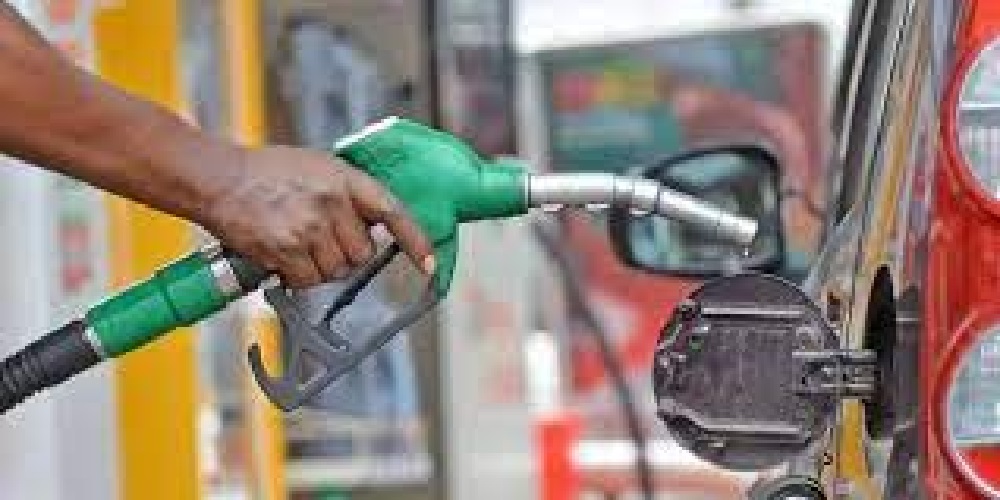
Nigeria could soon face another round of petrol and diesel price increases following renewed conflict between the United States and Iran, which has unsettled the global crude oil market.

Energy analysts say escalating hostilities in the Middle East are already pushing risk premiums into oil prices and could directly affect fuel costs in Nigeria despite recent gains in local refining capacity.
Checks by POLITICS NIGERIA in major cities show petrol selling between N824 and N880 per litre, depending on location and logistics. This comes shortly after the Dangote Petroleum Refinery reduced its ex-depot price of petrol from N799 to N774 per litre in February 2026.

However, experts warn that the relief may be short-lived if crude oil prices approach the $90 per barrel mark due to the conflict.
The tension has disrupted tanker movements around the strategic Strait of Hormuz, a key route for global oil shipments. The corridor handles more than 20 per cent of the world’s oil supply, and any threat to it usually sends prices upward.
Speaking on the implications for Nigeria, Kelvin Emmanuel, Chief Executive Officer of Dairy Hills, said the country remains exposed because the Dangote refinery still relies heavily on imported crude.
He said, “Dangote currently processes an average of 18 million barrels of crude oil monthly. Out of this, about 12 million barrels are imported, while he gets about 5.7 million barrels, which is the equivalent of six cargoes, from the Nigerian National Petroleum Company Limited.”
He added that rising war risk insurance premiums for tankers would further increase landing costs of crude in Nigeria.
According to him, “If crude prices rise above $90 per barrel, the refiner will have to revise the price of PMS and diesel in Nigeria.”
Emmanuel also questioned the transparency of the naira-for-crude deal, stating, “The government claims that it supplies him nearly 190,000 barrels under the naira-based crude swap but is unable to account for the volume of cargoes given under said arrangement, or specify the equivalent petrol and diesel output.”
Olatide Jeremiah, Chief Executive Officer of Petroleumprice.ng, said Nigeria’s dependence on foreign crude makes local fuel prices vulnerable to international shocks.
He explained, “Nigeria is the largest crude oil producer in Africa and at the same time hosts the biggest refinery on the continent and the seventh largest globally. Ideally, a hike in global crude prices should not have a direct impact on local fuel prices.”
But he warned that the situation is different in practice.
He said, “Fuel prices will be at the mercy of oil prices. Petroleum traders in Nigeria have been tracking events between Iran and the US, and a surge in oil prices is expected. For Nigeria, revenue will increase, but Nigerians should brace for higher fuel prices on Monday, no doubt.”
Jeremiah urged the federal government to boost crude production and curb oil theft, describing the crisis as a wake-up call for domestic supply to refineries.
An energy law expert at the University of Lagos, Dayo Ayoade, said Nigeria can no longer shield citizens from global oil price swings following the removal of fuel subsidies.
He noted, “Without subsidies, any crude price increase will directly impact fuel prices at the pump. More revenue may come in, but we must remain cautious.”
Petroleum economist Wumi Iledare cautioned against panic, saying the global oil market is now more diversified than in past crises.
He said, “We must resist the temptation to interpret the US–Iran strike as the beginning of another historic oil shock.”
Meanwhile, the National Publicity Secretary of the Independent Petroleum Marketers Association of Nigeria, Chinedu Ukadike, said marketers were watching developments closely.
He stated, “Anything that affects the international oil market will affect local supply and prices. We are watching the trend and the reactions of the refinery and the government.”
News
WATCH: This is Remodelled Abuja City Gate
Remodelled Abuja City gate will be unveiled today.
#ProjectsFCT2026
#FCT31DaysCommissioning
News
Court orders EFCC to pay N10m fine for defaming ex-Power Minister, Agunloye
A High Court of the Federal Capital Territory (FCT) sitting at Maitama has ordered the Economic and Financial Crimes Commission (EFCC) to pay a fine of N10million for defaming a former Minister of Power, Dr. Olu Agunloye, through a libelous publication on its social media handles.
The court, in a judgment delivered by Justice Peter Kekemeke, found that the anti-graft agency damaged the claimant’s reputation.
Agunloye, in a N10billion defamation claim he filed before the court, insisted that the publication the EFCC carried on its website and X (formerly Twitter) handle, titled: “EFCC arraigns Agunloye over $6billion fraud,” tarnished his image and occasioned reputational damage against him.
In the writ of summons marked FCT/HC/CV/1199/2024, which he filed through his team of lawyers led by Mr. Adeola Adedipe, SAN, he claimed that the agency dented his good name and dragged his integrity into the mud.
He told the court that the commission accused him of being a corrupt and fraudulent individual through the defamatory post it shared on its official website and other allied online platforms.
He prayed the court to declare that the post was false and defamatory.
Besides, he sought an order for EFCC to retract the publication against him and tender an unreserved apology.
He equally sought the award of N1billion to him as general and exemplary damages.
Delivering judgment in the matter on Wednesday, Justice Kekemeke held that the publication the claimant complained about had all the ingredients of defamation.
He held that the publication made by the EFCC was in permanent form with the name of the claimant mentioned.
The court further held that EFCC’s sole witness in the case, an Assistant Commissioner of Police, Umar Hussain Babangida, despite initially denying knowledge of the said publication, later admitted that it was from the defendant’s media department.
According to the judge, the case did not challenge EFCC’s power to investigate economic and financial crimes as claimed by the defendant.
He noted that having gone through the charge in the criminal case against the claimant before the Apo Division of the FCT High Court, there is nowhere in it that alleges fraud, contrary to the EFCC’s publication.
The court added that the issue of fraud is not in any of the exhibits tendered before it in the course of hearing the case, as stated in what it described as a “sensational headline” in the publication.
The judge held that EFCC failed to prove the truth of the said publication.
Stressing that the EFCC is not a news outlet but an investigative agency, Justice Kekemeke held that the commission knew that Agunloye was not involved in a fraud of $6billion.
The court held that the claimant successfully proved that the publication against him was accentuated by malice, and resolved issues one and two in favour of the former minister.
The court declared that the contentious publication on EFCC’s official website and X handle was false and defamatory.
It ordered the commission to retract the publication and offer a public apology to the claimant on its website and in two other national dailies.
The court further issued an order of perpetual injunction restraining EFCC from defaming the former minister.
Meantime, reacting to the judgment on Wednesday, counsel for EFCC, Dr. Wahab Shittu, SAN, said the commission would file an appeal to challenge it.
Shittu, SAN, contended that the case was premature, as the claimant’s criminal charge had yet to be concluded and judgment delivered.
“Though the court has delivered its judgment, we are definitely going to appeal the court’s decision,” he added.
News
Defence minister orders troops to shoot bandits on sight
Christopher Musa, minister of defence, has ordered security personnel deployed to combat banditry and terrorism to take immediate action against armed criminals.
He warned that any operative who fails to engage bandits or terrorists under the guise of awaiting orders would be regarded as an accomplice.
Musa issued the directive on Wednesday in Sokoto during the commissioning of 62 operational vehicles and security equipment valued at N27.127 billion, procured by the Sokoto State government to strengthen security operations across the state.
Addressing troops and other security personnel, the defence minister stressed that operatives already deployed to conflict zones have the authority to confront armed criminals without waiting for further directives.
“Once you are deployed, do not wait for any order from anybody to shoot any bandit or any terrorist.
“Anybody who refuses to shoot or kill any bandit or terrorist in the name of waiting for an order, we will treat you like a bandit,” Musa said.
His remarks come amid renewed efforts by the federal government to intensify military operations against armed bandits and terrorist groups operating across the North-West and other parts of the country.
Musa described the commissioning of the security assets as more than the unveiling of equipment, saying it reflected strategic leadership and a shared commitment to strengthening Nigeria’s security architecture.
“This event is not merely the unveiling of security assets. It is a demonstration of strategic leadership, responsible governance and our collective determination to strengthen the security architecture of Sokoto State and Nigeria as a whole,” he said.
The minister commended Ahmed Aliyu, the governor, for sustaining logistical support to security agencies, describing the governor’s investment in security as a model worthy of emulation.
Identifying himself as “a proud son of Sokoto”, Musa said the state had remained relatively peaceful because of strong collaboration among the government, security agencies and local communities.
He noted that the newly commissioned armoured vehicles and tactical equipment would enhance operational mobility, intelligence gathering and force protection in the ongoing campaign against banditry, terrorism and kidnapping.
The defence minister also urged security agencies to ensure proper maintenance and effective deployment of the newly acquired assets.
“This equipment costs billions of naira. We don’t want to hand them over and then you throw them away or mishandle them. They must serve the purpose for which they were procured,” he said.
While calling for decisive action against criminal groups, Musa reminded security personnel to uphold professionalism and respect the rights of law-abiding citizens.
“You are not to go there and extort or harass the people. You are there to protect them and work with them to eliminate bandits and terrorists operating within your area,” he added.
Earlier, Aliyu said the latest procurement formed part of his administration’s sustained investment in improving security since assuming office.
According to him, the state purchased bulletproof vehicles, Buffalo Armoured Personnel Carriers (APCs), 320 motorcycles, 3,200 security gadgets, 2,000 bulletproof helmets and protective vests, 200 night-vision goggles, thermal devices and other tactical equipment.
“In all, we are distributing 62 vehicles and the security equipment highlighted above. These vehicles and security equipment cost the Sokoto State Government N27.127 billion,” the governor said.
Aliyu disclosed that his administration had already committed more than N36 billion to security interventions, including the construction of military and police barracks, procurement of operational vehicles and motorcycles, establishment of the Sokoto State Community Guard Corps and support for the Nigerian Air Force Base in the state.
The governor also revealed that his administration had transmitted a bill to the Sokoto State House of Assembly seeking tougher penalties for informants who aid bandits and other criminal elements.
“The bill is currently before the State House of Assembly, and once it is passed, we will sign it without any further delay,” he said.
He further announced the approval of a Command and Control Centre aimed at strengthening surveillance, intelligence sharing and coordination of security operations across Sokoto.
Aliyu appealed to residents to continue providing credible intelligence to security agencies, stressing that defeating insecurity requires active collaboration between the government, security forces and the public.
“Security is a collective responsibility, and together we shall overcome every security challenge confronting our state,” he said.
-
Economy18 hours agoCBN Clarifies Status Of ₦100 Notes In Nigeria
-
News13 hours agoVideo: DAY 22 of Projects Commissioning in the FCT
-
News22 hours agoPFIPC: Adeyemi ready to submit documents to security operatives
-
News19 hours agoRowdy Reps Clash Over Bid to Summon Tinubu on Budget Delays
-
News19 hours agoSad: Kola Olawuyi’s widow, Abimbola, is dead
-
News18 hours agoPhotos: Abuja’s Transformation Mirrors Nigeria’s Renewed Hope Agenda, Tinubu
-
News13 hours agoTinubu Sends Two Key Bills to Reps, Rejects Two National Assembly Amendments
-
Sports19 hours agoWorld Cup: We’ve suffered grave injustice, Egypt coach laments after loss to Argentina