Connect with us

News

Nigeria qualify for FIFA U20 Women’s World Cup Poland 2026

Published

on

ADVERTISEMENT
Zoom Ad
ADVERTISEMENT
Zoom Ad

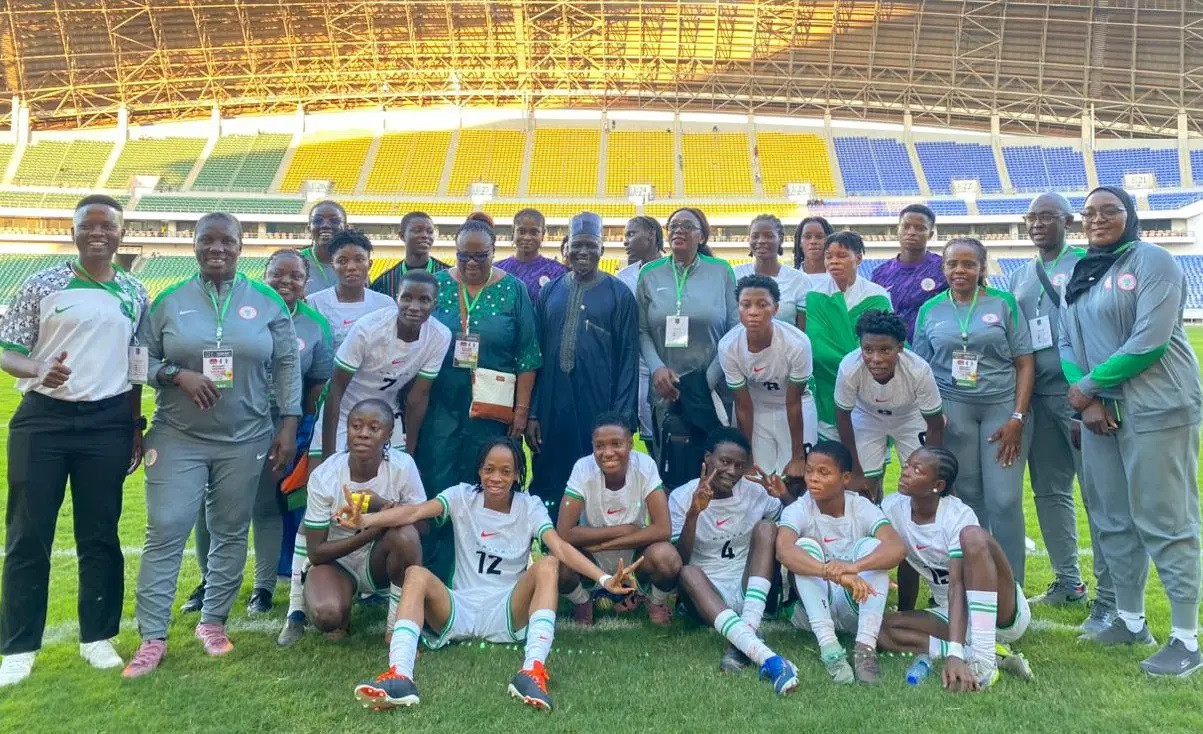
Nigeria’s U20 women’s team, the Falconets, have secured qualification for the 2026 FIFA U20 Women’s World Cup in Poland after edging past Malawi’s Young Scorchers 3-2 on aggregate.


Despite suffering a 1-2 defeat in the second leg in Lilongwe on Saturday, the Falconets advanced thanks to their 2-0 first-leg victory secured in Ikenne the previous week.

The hosts took the lead early in the first half through a header, capitalising on a Nigerian defensive error. The Falconets came close to equalising when Favour Nkwocha’s powerful header struck the woodwork following a dangerous cross from Kindness Ifeanyi. Malawi went into the break leading 1-0 on the day.

The Young Scorchers increased the pressure in the 55th minute, scoring again to level the aggregate score at 2-2 and putting Nigeria’s qualification under serious threat.

Advertisement

However, Coach Moses Aduku’s substitution proved decisive. In the 62nd minute, Precious Oscar, who came off the bench, pressed aggressively, dispossessed a Malawian defender, and calmly slotted home the equaliser on the day, restoring Nigeria’s aggregate advantage.

The Falconets then defended resiliently to protect their slim lead and secure qualification, maintaining Nigeria’s proud record of never missing a FIFA U20 Women’s World Cup finals.

The 2026 edition of the tournament will be held in Poland from 5th to 26th September 2026.

The Nigeria team expressed gratitude to Nigeria’s High Commissioner to Malawi, Ambassador Ibrahim Miringa, and his team for their support during the team’s stay in the country.

Advertisement
Continue Reading
Advertisement

News

1999 Constitution lifted from civilian draft, not military — Abdulsalami

Published

on

By

ADVERTISEMENT
Zoom Ad
ADVERTISEMENT
Zoom Ad

Former Head of State, Gen Abdulsalami Abubakar (retd.), has dismissed as false the long-standing claim that Nigeria’s 1999 Constitution was written by the military.

He insisted that close to 95 per cent of the document was lifted from the 1979 Constitution, a text drafted by 49 civilian legal experts with no soldiers involved.

The claim comes as prominent Nigerians demand a new constitution for the country, insisting that the 1999 Constitution was imposed on the country by the military.

However, in Chapter 23 of the 264-page, 27-chapter autobiography, titled ‘Call of Duty,’ Abdulsalami said the decision to adopt the 1979 Constitution, rather than the late Gen Sani Abacha’s unpopular 1995 Draft Constitution, came to him as a welcome relief after a 25-member committee he set up found that Nigerians nationwide, at home and in the diaspora, had overwhelmingly rejected the Abacha-era document.

Advertisement

Abdulsalami revealed that upon taking office in June 1998, he set up a 25-member constitution debate coordinating committee, chaired by Justice Niki Tobi, with Dr Suleiman Kumo as Deputy Chairman, to coordinate a national debate on Abacha’s 1995 Draft Constitution, not to write a fresh one.

He wrote, “At the inauguration of the CDCC on 11 November 1998, I raised several contentious issues in the Draft 1995 Constitution and mandated them to come up with fresh ideas.

“I need to reemphasise here that their job was not to write a new constitution but to coordinate a debate on the draft. I have heard many critics say the Niki Tobi Committee was set up to write a new Constitution. That is absolutely false.”

He disclosed that the committee received a total of 405 memoranda from ethnic, cultural and regional associations, with the Afenifere/NADECO bloc insisting the 1995 draft was an “Abacha Constitution” that should be discarded entirely, while Nigerians in the United States held a separate forum on the document at the Grand Hyatt Hotel in Washington, D.C.

Advertisement

According to Abdulsalami, Justice Tobi’s committee found a national consensus when its findings were submitted.

He quoted Justice Tobi as reporting, “In the light of the memoranda and the oral presentation on the 1995 Draft Constitution, it is clear that Nigerians basically opt for the 1979 Constitution with relevant amendments.

“Putting it in another language, the common denominator in the mouths of Nigerians the world over is the 1979 Constitution with relevant amendments.

“They want it, and they have copiously given their reasons for their choice in the different memoranda and oral presentations.

Advertisement

“So, we have recommended to the Provisional Ruling Council the adoption of the 1979 Constitution with relevant amendments from the Draft 1995 Constitution.”

Abdulsalami admitted that the idea of simply reverting to the 1979 Constitution had not originally occurred to him, but that the recommendation came as a relief because it offered the fastest route out of a looming political crisis.

“I must confess that this was a welcome relief to me. Adopting the Draft Constitution wholesale would definitely be opposed by the Afenifere/NADECO bloc, which never wanted to have anything to do with Abacha.

“There was the real danger that we could go into another phase of crisis over that. For someone who wanted to get the transition programme done with as quickly as possible, I was quite comfortable with the option of adopting the 1979 Constitution.

Advertisement

“In all honesty, the thoughts of the 1979 Constitution did not initially cross my mind at all. After Tobi’s presentation, I found it attractive. That Constitution was a well-debated document,” he wrote.

He noted that many of the same politicians who later campaigned vigorously against the 1999 Constitution had themselves participated in debating the 1979 Constitution and contested elections under it.

“It is ironic that many of those vociferously campaigning against the 1999 Constitution participated in the debate over the 1979 Constitution and even ran for various elections under it.

“They loved the Constitution then but now regard its replica as the worst legal document ever,” Abdulsalami wrote.

Advertisement

Addressing the allegation that the military authored Nigeria’s current constitution, the former Head of State refuted the claim, saying the document owes its lineage to a Constitutional Drafting Committee set up in 1975 under the Gen Murtala Muhammed administration.

“It is false to say the military wrote it. The 1979 Constitution and the Draft 1995 Constitution, both of which the 1999 Constitution borrowed from, were not written by the military, even if they were produced under military rule.

“They were written by some of the best brains the country had to offer. I need to put this on record because there are many Nigerians who are not aware of the history and keep repeating this distortion,” he wrote.

The former head of state disclosed that the CDC had 50 members, chaired by Chief FRA Williams, adding that Chief Obafemi Awolowo was nominated to serve but excused himself, believing it would be morally wrong to draft a constitution while also planning to participate in Second Republic politics, a decision that brought the committee’s membership down to 49.

Advertisement

“The CDC studied different Constitutions across the world and produced the draft that was submitted to the military government in 1976.

“By the way, all constitutions are drafted by a group. There is no constitution in the world where each clause is written by ‘the people’.

“Even if a ‘sovereign national conference’ was to produce the ‘perfect constitution’, it would still be drafted by a small group of people, not 200 million people,” he wrote.

Abdulsalami further disclosed that the CDC’s draft was subsequently scrutinised clause by clause by a 230-member Constituent Assembly headed by Justice Udo Udoma, set up under Gen Olusegun Obasanjo in 1977, of which only 20 members were appointed by the military government, and none of them was a soldier.

Advertisement

“Of the 230 members, only 20 were appointed by the Military Government, and they were neither soldiers nor military officers. Seven members of the CDC were also in the Constituent Assembly.

“The rest were elected based on a representation formula that used population, states and councils as factors,” he wrote.

On the criticism that two military-era decrees were retained in the document, the Land Use Act and the National Youth Service Corps Act, Abdulsalami argued the claim was being used to delegitimise the entire constitution unfairly.

“I would not consider this a disaster that should invalidate the other provisions of the Constitution. People are only trying to force the issue,” he wrote.

Advertisement

He also rejected the argument that the 1999 Constitution lacked legitimacy for never having been put to a referendum, noting that no Nigerian constitution, including the 1979 document many critics now praise, was ever subjected to one.

Abdulsalami wrote, “This argument is only applied to discredit the 1999 Constitution.

“It is all the more obvious when some of the people who participated in producing the 1979 Constitution join the chorus of those attacking the 1999 Constitution.”

The former Head of State confirmed he signed Decree No. 24 of 1999 on May 5, 1999, to promulgate the 1999 Constitution, which took effect on May 29, 1999.

Advertisement

It retained the presidential system and federal structure of the Second Republic while introducing the 13 per cent derivation formula for mineral-producing states, a provision Abdulsalami said was designed to address “the neglect of the Niger Delta.”

He wrote, “A Constitution is a living document. It is subject to amendments, alterations and updates.

“The U.S. Constitution has been amended 17 times in 200 years. Even the much-criticised 1999 Constitution has been amended five times. There is no perfect Constitution in the world.”

Advertisement
Continue Reading

News

Oshiomhole makes a U-turn over Natasha suspension forgery claim

Published

on

By

ADVERTISEMENT
Zoom Ad
ADVERTISEMENT
Zoom Ad

Senator Adams Oshiomhole has clarified his earlier comments on the controversy surrounding the suspension of Senator Natasha Akpoti-Uduaghan, denying that he alleged that signatures of lawmakers were forged in the report that recommended the Kogi Central senator’s suspension.

Oshiomhole, in a statement issued on Tuesday, said his comments during an interview on AIT’s Politics Today programme on Monday were misrepresented, insisting that he never claimed any senator’s signature was forged.

The former Edo State governor said his position was consistent with that of the Senate spokesman, Senator Yemi Adaramodu, that no senator’s signature was forged because no lawmaker had complained to him about such.

He, however, explained that the only issue he raised was that a senator who served on the committee had claimed that attendance signatures of some lawmakers were attached to the final report.

Advertisement

Oshiomhole said, “The insinuation that I said signatures of Senators were forged is a complete misrepresentation of what I actually said

“I agree absolutely with the spokesperson of the Senate, Distinguished Senator Yemi Adaramodu, that no signature of Senators was forged in Natasha Akpoti’s suspension. This is because no Senator complained to me that his or her signature was forged.

“The only comment I made is that one Senator, who is a member of the Committee, claimed’ that the signatures of attendance of some Senators were attached to the final report.”

The Edo North senator added that any suggestion that he accused anyone of forging signatures was “completely untrue” and should be disregarded.

Advertisement

Oshiomhole said the issue of Akpoti-Uduaghan’s suspension had been concluded, adding that the Senate had moved on.

“Finally, I regret if my comments may have caused embarrassment to any Senator or the 10th Senate as an institution,” he stated.

His clarification came hours after the Senate dismissed claims that the suspension process was manipulated, accusing Oshiomhole of attempting to reopen a settled matter.

The Senate spokesman, Senator Yemi Adaramodu, had earlier said the disciplinary action against Akpoti-Uduaghan followed due process and was handled openly on the floor of the chamber.

Advertisement

Adaramodu said the allegation that lawmakers’ signatures were forged never arose during the proceedings, questioning why the issue was being raised months after the matter had been concluded.

He maintained that the Senate had established that any senator who violates its rules would face appropriate sanctions, insisting that the Akpoti-Uduaghan matter was transparently handled.

Continue Reading

News

Forget evidence, I clearly won 2023 presidential election – Peter Obi

Published

on

By

ADVERTISEMENT
Zoom Ad
ADVERTISEMENT
Zoom Ad

The Nigeria Democratic Congress, NDC, 2027 presidential candidate, Peter Obi, has insisted that he won the 2023 presidential election.

Obi charged Nigerians to forget about the proof because he won but was not declared the winner.

In an interview with Rufai Oseni, the former Anambra State governor stressed that someday the process would recognise his victory.

He said: “Do you know that in the last election I won? Forget about the proof, they didn’t declare me.

Advertisement

“I have contested elections in Nigeria as a presidential candidate and won, leave what’s declared because one day the story will be told.

“For now, I can tell you that I’m offering myself for the general election in Nigeria. One day, the process will recognise it.”

Obi, who contested the 2023 presidential election under the Labour Party, LP, came third behind the Peoples Democratic Party’s Atiku Abubakar and President Bola Tinubu.

Advertisement
Continue Reading

Trending

Copyright © 2024 Naija Blitz News