News
Senate To Begin Deliberations On State Police This Week
- /home/naijuinz/public_html/wp-content/plugins/mvp-social-buttons/mvp-social-buttons.php on line 27
https://naijablitznews.com/wp-content/uploads/2024/11/Senate.jpg&description=Senate To Begin Deliberations On State Police This Week', 'pinterestShare', 'width=750,height=350'); return false;" title="Pin This Post">
- Share
- Tweet /home/naijuinz/public_html/wp-content/plugins/mvp-social-buttons/mvp-social-buttons.php on line 72
https://naijablitznews.com/wp-content/uploads/2024/11/Senate.jpg&description=Senate To Begin Deliberations On State Police This Week', 'pinterestShare', 'width=750,height=350'); return false;" title="Pin This Post">
Senate Leader Opeyemi Bamidele described the current calls for a probe of the military as unpatriotic, arguing that such a move would amount to a misplacement of priorities

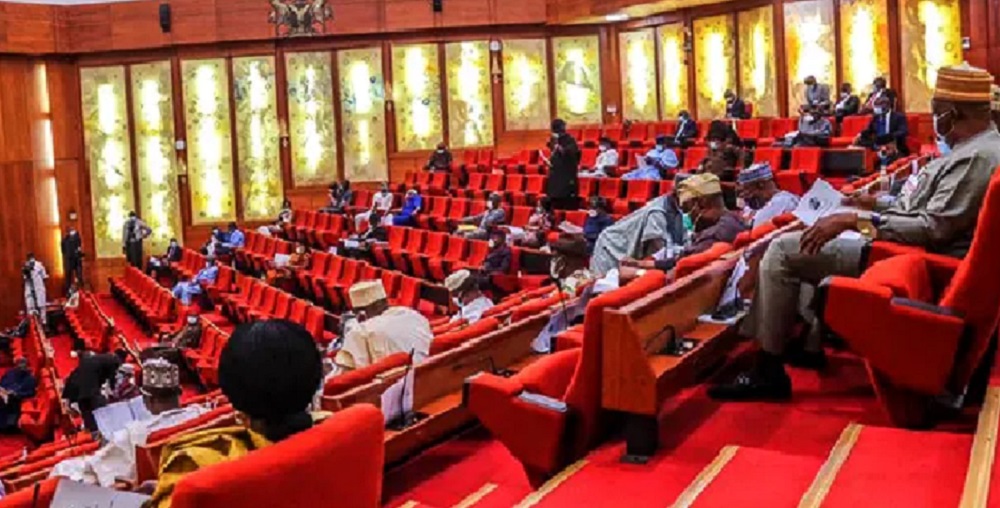
The Senate has pledged to commence urgent deliberations on the establishment of state police this week as part of efforts to address the growing insecurity across the country.
Speaking at a media briefing with Senate correspondents, the Senate Leader, Senator Opeyemi Bamidele, stated that the matter had gained priority among other issues in the ongoing constitutional review process.
According to him, the upper chamber is committed to supporting Nigerians’ demand for state policing and has already held a series of consultations with relevant stakeholders.
READ ALSO: State Police Constitutional Framework Near Completion, Presidency Says
‘We are standing with Nigerians on state police. That will come to fruition this week during plenary.
ADVERTISEMENT
“We have been holding a series of meetings with stakeholders and will fast-track deliberations so that the bill can proceed to the 36 state houses of assembly and eventually receive presidential assent,” he said.
The Senate Leader also described the current calls for a probe of the military as unpatriotic, arguing that such a move would amount to a misplacement of priorities given the country’s current security challenges.

On the controversy surrounding lawmakers’ remuneration, he asserts that the Senate would soon address public concerns by ensuring that details of senators’ salaries and allowances, as well as those of ministers and other public office holders are published.
He made the remarks while responding to recent court pronouncements that reportedly described the purchase of 110 billion SUVs and allowance scheme for lawmakers as illegal.
ADVERTISEMENT
Defending the acquisition, the Senate Leader again maintained that the vehicles were provided to facilitate constituency engagements and other official duties.
“Every vehicle given to us is meant for constituency work and other official assignments. Public office holders are entitled to such provisions. It is neither strange nor peculiar to lawmakers in Nigeria,” the senator said.
He added that the Senate was not surprised by the criticism, noting that the legislature’s oversight responsibilities often attract opposition and hostility.
Channels

News
Major reason why dancing Gov Adeleke won Osun again: The Forces Behind the Governor’s 2026 victory
Dancing Governor Ademola Adeleke’s victory in the 2026 Osun State governorship election was more than a routine incumbency advantage.
It was the product of several political forces coming together at a critical moment: a strong grassroots structure, the visibility of his administration, strategic vote mobilisation and an opposition that failed to convert its numerical strength into a winning coalition.
When the Independent National Electoral Commission (INEC) finally declared the result, Adeleke of the Accord Party had secured 511,067 votes, defeating the All Progressives Congress (APC) candidate, Bola Oyebamiji, who polled 444,815 votes.
The governor won by 66,215 votes and carried 19 of the state’s 30 local government areas.
The figures tell only part of the story. Behind them lies a political campaign that demonstrated the importance of grassroots organisation, personal popularity and the ability to turn incumbency into electoral advantage.
The incumbency advantage
Perhaps the most obvious factor was Adeleke’s position as the sitting governor.
Unlike his principal challenger, Adeleke entered the contest with an established political structure and a record voters could assess. His campaign was therefore not based entirely on promises about what he would do; it could point to projects and programmes undertaken since his assumption of office.
Before the election, his campaign organisation repeatedly highlighted his administration’s achievements and its five-point agenda, while presenting the governor as a leader with a record to defend. That strategy gave his campaign a simple message: voters should compare the administration they had experienced with the alternative being offered.
In an election where more than two million voters were registered, that distinction mattered.
A powerful grassroots machine
Osun politics has always been heavily influenced by grassroots mobilisation, and Adeleke’s political strength has increasingly been built around that reality.
The governor did not rely solely on major rallies in Osogbo or other urban centres. His campaign maintained visibility across local governments and communities, with political structures working to translate his popularity into actual votes.
The final result showed how effective that machinery was.
Adeleke did not simply win narrowly in a handful of constituencies. He accumulated sizeable margins in several areas, producing a statewide advantage that the APC could not overturn. Reports from the collation exercise showed Accord taking important victories in places including Iwo, Ede South and Ife North.
That pattern is significant: in a first-past-the-post election, winning comfortably in multiple local governments can be more decisive than producing isolated landslides.
The Adeleke factor
Another major reason for the victory was the governor’s personal political brand.
Adeleke has developed an unusual connection with sections of the Osun electorate, particularly among younger voters. His dancing, informal public appearances.
News
BREAKING: Adeleke dismantles APC with 511,067 votes
…won 19 LGAs To Defeat Oyebamiji by 66,252 Votes
The Independent National Electoral Commission on Sunday declared Adeleke of the Accord Party winner of the 2026 Osun State governorship election, defeating APC’s Munirudeen Bola Oyebamiji by a margin of 66,252 votes.
The announcement ended days of tension, IReV blackouts, and allegations of foul play.
THE FINAL FIGURES—
After collation across all 30 LGAs, INEC announced:
– Accord Party – Ademola Adeleke: 511,067 votes
– APC – Bola Oyebamiji: 444,815 votes
– ADC – Najeem Salaam: 17,180 votes — distant third
Total valid votes: 985,079
Rejected ballots: 20,721
Total votes cast: 1,005,800
From 2,339,544 registered voters, 1,010,684 were accredited — a turnout of 43.2%.
—LGA BREAKDOWN: ADELEKE DOMINATES—
Adeleke carried 19 of 30 LGAs, including his strongholds of Ede, Osogbo, Ilesa, and Iwo.
Oyebamiji won 11 LGAs, but couldn’t overcome Adeleke’s margins in the populous urban centres.
The 66,252-vote gap is one of the widest in a competitive Osun governorship contest in the last decade.
The result is a massive blow to the APC.
The party had thrown everything at Osun.
National Chairman Nentawe Yilwatda called it a “must-win.”
A 276-member campaign council led by Gov. Hope Uzodimma was deployed. Senate President Godswill Akpabio, Speaker Tajudeen Abbas, Minister Adegboyega Oyetola, and several governors stormed Osogbo for the mega rally.
Despite that, APC leaders were seen leaving the state late Saturday as results tilted heavily against them.
“This was a referendum on performance, not party structure,” a political analyst in Osogbo said. “Osun people voted for continuity.”
—ADELEKE’S VICTORY SPEECH—
While INEC had yet to issue the Certificate of Return at press time, celebrations had already erupted in Ede, Adeleke’s hometown.
Supporters were seen dancing in the streets chanting “Imole ti de.”
Adeleke, who defected from PDP to Accord Party earlier this year, campaigned on consolidating his welfare programmes, infrastructure projects, and grassroots empowerment.
With 95.85% of results uploaded to IReV by 1:33am Sunday and collation now complete, INEC is expected to issue Adeleke his Certificate of Return in the coming days.
For the APC, the loss raises urgent questions ahead of 2027.
If a “must-win” state with full federal backing can be lost by over 66,000 votes, the party’s 2027 playbook may need a rewrite.
News
How to apply: UK opens 2026 Commonwealth Fellowships for Nigerians
The United Kingdom has opened applications for the 2026/27 Commonwealth Fellowship Programme, offering Nigerian professionals and university academics an opportunity to undertake fully funded fellowships in the UK.
Applications for the programme opened on July 28, 2026, and will close at 4:00 p.m. BST on August 25, 2026.
The fellowship is designed for mid-career professionals and university academics from eligible Commonwealth countries, including Nigeria. Successful applicants will spend between six weeks and three months in the UK, depending on the fellowship category.
Announcing the programme on X, the UK in Nigeria urged eligible candidates to submit their applications before the deadline.
“Applications are currently open for the #CommonwealthFellowships 2026/27! Professional Fellowships for mid-career professionals and Academic Fellowships for PhD-holding university staff. Open to candidates from all Commonwealth countries till 25 August 26.”
According to the Commonwealth Scholarship Commission (CSC), the programme has two categories: the Commonwealth Professional Fellowship and the Commonwealth Academic Fellowship.
The Professional Fellowship is aimed at experienced professionals seeking to develop their skills and expertise through placements with UK organisations working in their respective fields.
The Academic Fellowship is designed for university lecturers and researchers who hold a PhD and are employed by a recognised university in an eligible Commonwealth country outside the UK.
Around 40 fellowship places are expected to be available for the 2026/27 cycle, with about 30 allocated to applicants from Commonwealth countries eligible for official development assistance, including Nigeria.
Who can apply?
For the Commonwealth Professional Fellowship, applicants must have at least five years of relevant full-time work experience, or the equivalent in part-time experience, before the fellowship begins.
Applicants for the Commonwealth Academic Fellowship must hold a PhD and be employed by a recognised university in an eligible Commonwealth country outside the UK.
All applicants must also meet several general requirements.
They must:
Be citizens of, or have refugee status in, an eligible Commonwealth country.
Be permanently resident in an eligible Commonwealth country.
Be employed by an organisation they intend to return to after completing the fellowship.
Provide at least two references, including one from their current employer, unless they are self-employed.
Not have received a Commonwealth Fellowship within the previous five years.
How long will the fellowship last?
Professional Fellowships will last between six weeks and three months and are expected to begin between mid-February and mid-March 2027.
Academic Fellowships will run for three months, with programmes scheduled to begin in January or February 2027.
Successful applicants are therefore expected to undertake their fellowships in the UK in early 2027.
How can Nigerians apply?
Interested Nigerian applicants must complete the online application through the Commonwealth Scholarship Commission’s application portal before the August 25 deadline.
Applications close at 4:00 p.m. BST on August 25, 2026.
Applicants will be required to provide information and documents including:
Educational qualifications.
Employment history.
Relevant professional experience.
Publications and awards, where applicable.
Two references.
A personal statement.
A development impact statement.
Leadership and voluntary experience.
A scanned copy of a valid passport or national identity card.
The development impact statement is an important part of the application. Candidates are expected to explain how their proposed fellowship aligns with one of the CSC’s six development themes and how the skills and knowledge gained will contribute to development in their home country after they return.
The six themes are:
Science and technology for development.
Improving health systems and population health.
Innovation and entrepreneurship.
Peace, security and governance.
Crisis response and resilience.
Access, inclusion and opportunity.
What does the Commonwealth Fellowship cover?
The Commonwealth Fellowship is fully funded, meaning successful applicants do not have to cover the main costs associated with undertaking the programme in the UK.
According to the CSC, fellows will receive:
Return airfare between their home country and the UK.
Reimbursement of the standard UK visa application fee.
A monthly stipend of £2,218, or £2,753 for fellows based in the London metropolitan area.
An arrival allowance of up to £1,247.09.
Additional funding for approved conferences, short courses and visits to other UK organisations where necessary.
For Nigerian professionals and academics seeking international exposure and professional development, the fellowship provides an opportunity to gain experience in the UK while receiving financial support for travel and living expenses.
Eligible candidates are encouraged to complete their applications before the August 25, 2026 deadline.
-
News17 hours agoBREAKING: Gov Adeleke in Early Lead, Wins First INEC Announced Results
-
News5 hours agoJonathan, Oborevwori, Diri, Ibori Mourn 104-Year-Old Prince Penawou
-
News22 hours agoOsun Decides: We’re monitoring INEC boss from all sides— Peterside
-
News5 hours agoFerran Torres Joins PSG From Barcelona
-
News5 hours ago“U No Try President Bola Tinubu’ – Davido Accuses Tinubu Of Planning To Withdraw Police, Military From Osun
-
News22 hours agoPolice Bust Human Parts Syndicate in Oyo, Nab 10, Recover Heart, Skull
-
News15 hours agoOsun election: Oyinlola Loses Polling Unit to Accord Party
-
News18 hours agoDavido Alleges He Was Barred From Entering Osun to Cast His Vote