Connect with us

Foreign

US says ships exiting Hormuz, ‘expectation’ of no Iran tolls

Published

on

ADVERTISEMENT
Zoom Ad
ADVERTISEMENT
Zoom Ad

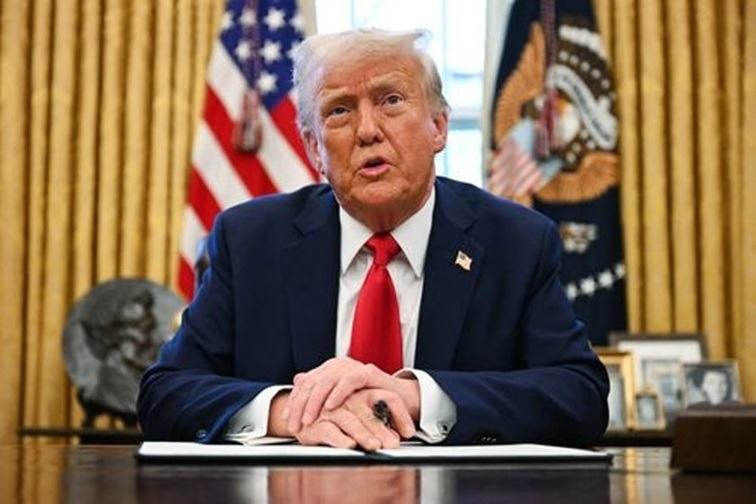
US President Donald Trump said on Monday that oil tankers are again exiting the Strait of Hormuz, following a peace deal, but uncertainty persisted over whether Iran will keep imposing tolls on ships in the vital waterway.


Mediator Pakistan announced on Sunday that the United States and Iran had agreed to an “immediate and permanent termination” of military operations, but the text of their peace deal has yet to be released.

The deal is expected to be signed on Friday in Switzerland and be followed by further “technical” talks on a long-term agreement.

Trump said that with the signing, the Strait of Hormuz — a vital waterway for Gulf energy exports — would be reopened and a US naval blockade of Iran would be lifted.

Advertisement

On Monday, while flying to a G7 summit in France, Trump posted on his Truth Social platform that “ships are starting to move, many loaded up with Oil, out of the Strait of Hormuz.”

“They are going along the Southern ‘Highway,’ which is totally safe, secure, and pristine,” he wrote, apparently referring to a shipping route nearer to Oman in the narrow waterway.

Trump said last week that the US military had secretly helped more than 200 commercial ships carrying over 100 million barrels of oil pass through the Strait of Hormuz since May.

“There are other areas of travel, also!!!” he posted Monday, without further details.

Advertisement

Iran, in response to the US-Israeli strikes that began on February 28, effectively halted traffic through the Strait of Hormuz.

Closure of the strait, which normally carries around a fifth of global oil and gas exports, caused energy prices to spike around the world.

Iran later moved to set up a payment system for transiting ships.

– Toll-free? –

Advertisement

US Vice President JD Vance was asked on CNBC Monday morning if there was an understanding with Iran that the strait would reopen toll-free for just an initial period of 60 days or indefinitely under the deal.

“Our expectation is that the strait is going to be opened in a toll-free way for the long term, and that’s the sort of thing that we’re going to figure out in these technical negotiations,” he said.

Iran’s foreign ministry meanwhile said on Monday that the deal would allow it to charge maritime service fees on ships transiting the Strait of Hormuz, rather than imposing “tolls.”

Uncertainty also surrounds other key aspects of the deal, including Iran’s access to its frozen funds and relief from international and US sanctions.

Advertisement

Vance did not give specifics on the terms of the relief Monday, but emphasized that it would be dependent on a “verification process.”

“We say to the Iranians, you are welcome to have access to an unsanctioned economy, you’re welcome to be reinvited into the world economy, but only if you honor the commitments that you make in this agreement.”

“You don’t have access to the money to rebuild that nuclear program,” Vance said, “but if you’re willing to give up that program long term, if you’re willing to accept the inspections and verification regime that’s necessary to give us the confidence you’re never going to have a nuclear weapon, then we want you to be a prosperous country, and we will reinvite you into the community of nations.”

Asked who would be representing the United States at the signing ceremony, Vance said there will be a “full spectrum of representatives.”
Advertisement
Continue Reading
Advertisement

Foreign

Nigerians react as UK permits foreign workers to change employers

Published

on

ADVERTISEMENT
Zoom Ad
ADVERTISEMENT
Zoom Ad


Nigerians and other foreign workers in the UK have welcomed a new immigration policy allowing recognised victims of modern slavery on Skilled Worker visas to leave exploitative employers and take up new jobs without putting their immigration status at risk.

The UK Home Office announced the change on Thursday, saying workers who have been formally recognised as victims of modern slavery should not be forced to remain with abusive employers because of their immigration status.

“No victim of modern slavery should be trapped with an exploitative employer because of their immigration status,” the Home Office said in a post on its official X account.

Advertisement

It added that recognised victims on Skilled Worker visas would now be able to leave abusive employers and work elsewhere without risking their immigration status.

The development has attracted positive reactions online, particularly from Nigerians who work in or are familiar with the UK’s care and support sector.

An X user, @daddyhope, described the announcement as “good news for care workers”, saying the policy could remove the fear of deportation allegedly used by some exploitative employers to control sponsored workers.

“From today, care workers and other Skilled Worker visa holders who are formally recognised as victims of modern slavery will be allowed to leave abusive employers and work elsewhere without risking their immigration status,” the user wrote.

Advertisement

Another user, @JajaPhD, welcomed the policy but sought clarification on who qualifies as a recognised victim.

“Sounds like progress. What’s a recognised victim though?” the user asked, pointing to concerns among some care and support workers who may feel trapped in exploitative workplaces because they fear losing their sponsorship and livelihoods if they report abuse.

Similarly, @MzHorlabc11 described the development as “a step in the right direction”, while calling for more clarity on how the new arrangement would operate in practice.

Other users expressed stronger support for the move.

Advertisement

@Unfilteredxrp8 described the announcement as “fantastic news”, saying it would provide relief to many skilled workers living in the UK.

@Prestigious_Gt also welcomed the development, suggesting that the change could encourage employers to improve their treatment of sponsored workers.

“Some employers deserve this news. They will be calmer and more respectful moving forward,” the user wrote.

Another X user, @RealMrKay, expressed optimism that the policy would encourage employers to treat sponsored workers more fairly.

Advertisement

The user said they knew people who were unhappy with their sponsors over what they considered unfair treatment compared with workers who did not require sponsorship.

The UK Government’s move provides an important safeguard for people who have been formally recognised as victims of modern slavery and whose immigration status is linked to their employment.

However, reactions online also highlighted the need for greater public understanding of the process through which a worker becomes formally recognised as a victim of modern slavery.

The change is particularly relevant to care workers and other sponsored employees, who have previously faced restrictions linked to their employer-sponsored immigration status when attempting to leave abusive or exploitative workplaces.

Advertisement
Continue Reading

Foreign

Nepal flood: Death toll hits 1,222, 4,875 missing

Published

on

By

ADVERTISEMENT
Zoom Ad
ADVERTISEMENT
Zoom Ad

The death toll from last week’s devastating flash floods in Nepal has risen to 1,222, with 4,875 people still missing as rescuers continue to search through debris and isolated communities a week after the disaster.

According to The Hindu, citing Nepal Police and the National Disaster Risk Reduction and Management Authority, bodies have been recovered across eight districts, with Chitawan recording the highest number at 348, followed by Nawalparasi East with 218 and Nawalparasi West with 208.

Nuwakot has recorded 155 deaths, while 127 bodies have been recovered in Rasuwa, 69 in Gorkha, 60 in Dhading and 38 in Tanahu.

The scale of the disaster has also complicated the search for missing people, 583 of whom are foreigners, while thousands remain unaccounted for in areas where roads, bridges and communication networks were swept away.

Advertisement

The joint security operation involving the Nepal Army and other security agencies has so far rescued 11,993 people by helicopter and land routes. About 21,314 security personnel have been deployed for search and rescue operations.

The humanitarian crisis was underscored on Wednesday in Bidur, where survivors were forced to use a temporary cable crossing over the swollen Trishuli River after floodwaters destroyed roads and bridges.

The Nepal Army installed the roughly 250-metre cable, which residents and soldiers have been using to move people across the river, including those needing medical treatment, medicines, food and other essential supplies.

The disaster has also spread across the Nepal-China border. In Tibet’s Gyirong county, where flooding struck near the Nepal border, 21 people have died, and 541 remain missing, according to Chinese authorities cited by The Hindu.

Advertisement

China reopened the highway leading to the Gyirong border crossing on Wednesday after floodwaters destroyed sections of the route, allowing heavy rescue equipment to reach the disaster zone.

Reuters reported that search teams equipped with life-detection devices and dogs were subsequently deployed.

India has also stepped up its response, with a fifth aircraft arriving in Nepal carrying an 11-member rescue team, specialised equipment and 5.5 tonnes of essential medicines, according to India’s Ministry of External Affairs.

The disaster has meanwhile renewed scrutiny of development and environmental practices in the Himalayan region. Environmentalist Sunita Narain said the scale of the flooding was linked to decades of treating rivers and mountains as though they could be continually re-engineered, particularly through extensive hydropower development.

Advertisement

The continuing recovery operation comes as authorities confront the destruction of transport links and the large number of people still missing, leaving the final human cost of the disaster uncertain.

Continue Reading

Foreign

Popular Champion Golfer, Tiger Woods, Loses Driver’s License Over Reckless Driving

Published

on

By

ADVERTISEMENT
Zoom Ad
ADVERTISEMENT
Zoom Ad

Tiger Woods has been fined and suspended from driving for five years after entering a plea agreement to a reckless driving charge, following March’s rollover car crash in Florida.

The 15-time major champion was arrested in March and spent eight hours in jail before being bailed, after the Land Rover he was driving rolled over in a collision with a pick-up truck towing a trailer.

Woods previously entered a written plea of not guilty via his lawyers to charges of driving under the influence, property damage and a refusal to submit to testing.

The former world No 1 attended a plea conference hearing at Martin County Courthouse in Florida on Wednesday, where he pleaded guilty to a lesser charge of reckless driving and the refusal to submit an unlawful test.

Advertisement

Judge Darren Steele accepted the plea agreement, which amended the original DUI charge and resolved the refusal to submit a test charge, while Woods also entered a plea to a careless driving citation.

On the reckless driving second offence charge, Woods received a $1,000 (£748) fine and a five-year driving suspension.

On the second count, the refusal to submit to a lawful test, he received a $500 (£370) fine.

“There are no exceptions. If you were to drive for any reason at all, you would go ​immediately back to jail,” Steele told the court.

Advertisement

Woods was ordered to pay the minimum fine for the careless driving citation, which also carries a five-year driving ban to run concurrently with the suspension on the reckless driving charge.

The 50-year-old said little during the hearing. He arrived at the courthouse with Vanessa Trump, his girlfriend and President Donald Trump’s former daughter-in-law, who sat behind him during a hearing that lasted under 10 minutes.

He was also fined court costs, according to court documents. A no-contest plea is not an admission of guilt, but means the accused will offer no defense.

The plea is treated as a conviction in the criminal justice system.

Advertisement

The police report from the March 27 crash said deputies found two hydrocone pills – used to treat pain – in his pocket, and he showed signs of impairment.

It described Woods’ movements as slow and lethargic when speaking to deputies at the scene.

The report also said Woods appeared to be sweating, his eyes looked glassy, and his pupils were dilated.

Woods managed to crawl out of his car without any injuries and told a deputy he was looking down at his phone and changing the radio station when he hit the truck.

Advertisement

Woods has not featured in a professional golf event since missing the cut at The Open in July 2024.

He made his first public appearance since returning from treatment in Switzerland on June 23, when he introduced the PGA Tour’s plans to revamp its schedule for 2028.

Woods remained as chairman of the PGA Tour’s Future Competition Committee after his arrest.

Advertisement
Continue Reading

Trending

Copyright © 2024 Naija Blitz News