News
Atiku-Hired U.S. Lobbying Firm Questions Authenticity Of Purported Trump Letter To Tinubu, Demands Original Document
- /home/naijuinz/public_html/wp-content/plugins/mvp-social-buttons/mvp-social-buttons.php on line 27
https://naijablitznews.com/wp-content/uploads/2026/07/dsbc-1.jpg&description=Atiku-Hired U.S. Lobbying Firm Questions Authenticity Of Purported Trump Letter To Tinubu, Demands Original Document', 'pinterestShare', 'width=750,height=350'); return false;" title="Pin This Post">
- Share
- Tweet /home/naijuinz/public_html/wp-content/plugins/mvp-social-buttons/mvp-social-buttons.php on line 72
https://naijablitznews.com/wp-content/uploads/2026/07/dsbc-1.jpg&description=Atiku-Hired U.S. Lobbying Firm Questions Authenticity Of Purported Trump Letter To Tinubu, Demands Original Document', 'pinterestShare', 'width=750,height=350'); return false;" title="Pin This Post">
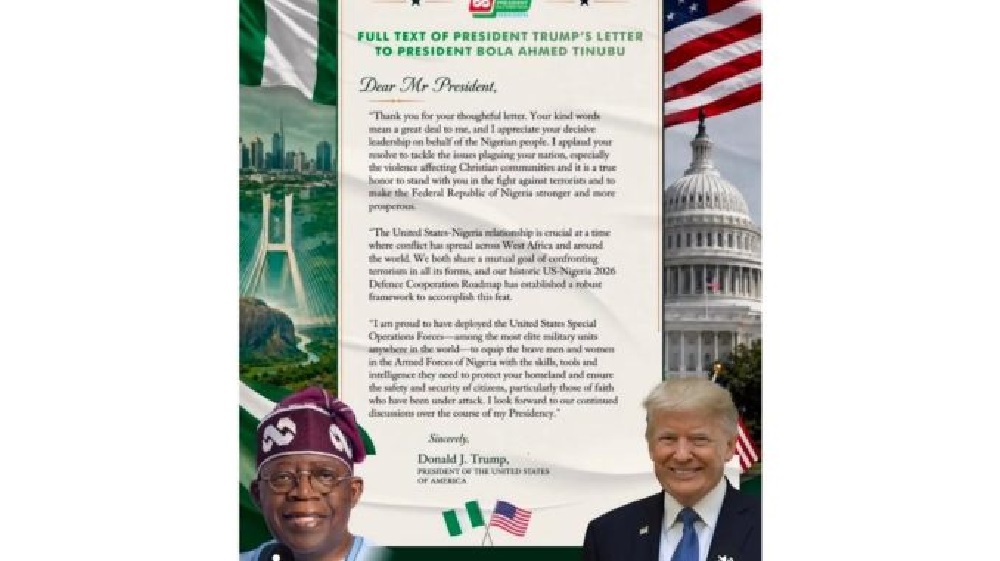
A United States-based policy advisory and lobbying firm retained by former Vice President Atiku Abubakar, Von Batten-Montague-York, has questioned the authenticity of a purported letter said to have been written by U.S. President Donald Trump to Nigerian President Bola Tinubu.

The firm urged the Nigerian presidency to release the original document rather than a typed transcript circulated on social media.
It raised the concerns in a statement posted on its official X account on Wednesday after comparing what it described as an authentic letter sent by Trump to Argentine President Javier Milei with the version published by an account linked to President Tinubu.

According to the firm, the differences between the two documents were significant enough to warrant public scrutiny.
“A Tale of Two Letters: On the left, we have an actual copy of President @realDonaldTrump’s letter to Argentine President @JMilei. On the right, we have what an account linked to President Tinubu, using the Facebook handle @PBATMediaCentre, has posted as President Trump’s letter to President Tinubu. The difference is beyond clear,” the firm stated.
The organisation stressed that it was not categorically alleging that no diplomatic correspondence existed between Trump and Tinubu but questioned why the Nigerian presidency had published only the text of the purported letter instead of an image of the signed original.
“We are not saying that a standard diplomatic response letter was never sent to President Tinubu. Nor are we saying that President Tinubu fabricated the purported letter. After all, Tinubu’s staff could easily create a fake letter tomorrow and post it as a rebuttal,” it said.
“What we are saying is that it is unusual for a letter to be quoted in full, including the date and signature block, rather than simply publishing an image of the actual letter itself. Until the actual letter is released, whether real or fake, Nigerians must understand that Tinubu is trying to fool you.”
The post tagged several international media organisations and institutions, including The Washington Post, CNN Africa, BBC Africa, Reuters, AFP, Foreign Policy, Nigeria’s National Assembly and the Independent National Electoral Commission (INEC).
The controversy centres on a letter attributed to President Trump and widely shared by the Tinubu presidency on Wednesday.

In the purported correspondence, Trump thanked Tinubu for what he described as a “thoughtful letter” and praised the Nigerian leader’s efforts to combat insecurity.
“Thank you for your thoughtful letter. Your kind words mean a great deal to me, and I appreciate your decisive leadership on behalf of the Nigerian people,” the letter reportedly read.
It further stated, “I applaud your resolve to tackle the issues plaguing your nation, especially the violence affecting Christian communities and it is a true honor to stand with you in the fight against terrorists and to make the Federal Republic of Nigeria stronger and more prosperous.”
The purported letter also referred to a “US-Nigeria 2026 Defence Cooperation Roadmap” and claimed that the United States had deployed Special Operations Forces to assist Nigeria’s Armed Forces in combating terrorism.
“I am proud to have deployed the United States Special Operations Forces among the most elite military units anywhere in the world to equip the brave men and women in the Armed Forces of Nigeria with the skills, tools and intelligence they need to protect your homeland,” the document reportedly stated.
However, Von Batten-Montague-York contrasted the publication with what it described as an authentic White House letter sent by Trump to Argentine President Javier Milei.
Unlike the Tinubu correspondence, the Milei letter was released as a scanned image on official White House stationery bearing Trump’s signature.
The January 16, 2026 letter invited Argentina to become a founding member of a proposed international body known as “The Board of Peace,” which Trump described as part of his broader initiative to resolve global conflicts and promote peace in the Middle East.
The lobbying firm argued that the existence of a publicly available signed letter to Milei highlighted what it described as the unusual manner in which the Tinubu correspondence was presented.
News
India Moves to Bridge BRICS Divisions Ahead of Summit
By Gloria Ikibah
India is working to bridge differences among members of the expanded BRICS bloc as negotiations continue on a joint declaration ahead of the group’s leaders’ summit in New Delhi.
Additional Secretary and spokesperson of India’s Ministry of External Affairs, Randhir Jaiswal, disclosed this at a dinner organised for journalists and content creators in New Delhi ahead of the summit.
Jaiswal said India regarded all BRICS members as partners and was committed to bringing them together despite differences within the grouping.
“India is friends with all BRICS member countries. As friends, it is our intention to bring all our partners together,” Jaiswal said.
Asked whether India had initiated any specific measure to narrow the divisions among members, the Indian official pointed to the ongoing negotiations on the summit’s joint declaration.
“You will have to wait for the joint statement.
The joint statement is being negotiated and there you will see how India brings everybody together,” he said.
Jaiswal said negotiations were being conducted collectively with all BRICS members but declined to disclose the countries involved in specific disagreements.
India is scheduled to host the 18th BRICS Leaders’ Summit on September 12 and 13, 2026, as the bloc adjusts to a more complex diplomatic environment following its expansion to 11 members.
Under its 2026 chairmanship, India has focused on resilience, innovation, cooperation and sustainability, while seeking to advance development priorities and strengthen the voice of the Global South.
The country’s economic agenda for the bloc includes the proposed BRICS Economic Partnership 2030, measures to expand trade in services, strengthen resilient supply chains and improve access to financing for small and medium-sized enterprises.
However, the expansion of BRICS has also brought together countries with divergent geopolitical and economic interests, making consensus on politically sensitive matters more difficult.
One of the most visible areas of disagreement has been between Iran and the United Arab Emirates. During the BRICS foreign ministers’ meeting in New Delhi in May, the UAE rejected Iranian allegations and defended its sovereignty and right to protect its national security.
The development highlighted the difficulty of reaching common positions within a grouping whose members have competing regional interests.
Differences also remain between India and China. Although both countries have taken steps to stabilise relations following the 2020 border clashes, they remain strategic rivals, with disagreements over security, technology and market access continuing to affect bilateral cooperation.
Another major area of tension involves Egypt and Ethiopia over the Grand Ethiopian Renaissance Dam and the use of Nile waters.
The dispute received renewed attention following Chinese President Xi Jinping’s state visit to Egypt from September 1 to 2.
In a joint communiqué issued during the visit, China recognised Egypt’s “legitimate right” to protect its water security, food security and development interests.
The two countries also called on Nile Basin states to comply with international law, including obligations relating to the prevention of harm.
Although the communiqué stopped short of explicitly endorsing Egypt’s position against Ethiopia, the reference to Nile-related concerns in a high-level China-Egypt statement adds another layer to the discussions within BRICS, where China, Egypt and Ethiopia are all members.
Economic differences are also expected to feature in discussions on the future direction of the bloc.
Russia and China have supported greater use of national currencies and alternatives to existing international financial arrangements, while other members have different priorities and approaches to economic cooperation.
With the summit bringing together leaders from 11 countries, India faces the challenge of producing a declaration that reflects the interests of members despite their competing geopolitical, security and economic positions.
The ongoing negotiations on the joint statement are therefore expected to provide an important test of India’s ability to build consensus within the enlarged BRICS grouping.
News
INEC uploads NDC’s logo, leadership as party wins in court
Independent National Electoral Commission (INEC) has uploaded the new logo of the Nigeria Democratic Congress (NDC) on its official website.
The commission also updated the party’s leadership, placing Cleopas Moses Zuwoghe as the National Chairman of the NDC, while Ikenna Morgan Enekweizu is listed as National Secretary.
This followed an order of the Federal High Court sitting in Abuja, which ordered the electoral body to recognise and use the NDC’s modified digital “two-finger” logo as its official symbol for elections.
The judgment, delivered by Justice J.O. Abdulmalik, followed a suit filed by the NDC after INEC allegedly removed the party’s modified logo from its system and restored an older association logo.
Advertisement
The NDC said its National Executive Committee approved the modified logo at its March 25, 2026, meeting and subsequently forwarded it to INEC.
According to the party, INEC initially uploaded the new logo but later removed it without providing any valid reason and reinstated the old logo.
The party said it gave the commission enough time to resolve the matter administratively before approaching the court.
In the judgment, the court ordered INEC to “forthwith approve” the NDC’s modified logo, including its symbol and colours, for use by the party “for all purposes as a political party,” including all elections conducted by the commission.
The court also granted a perpetual injunction restraining INEC from stopping or interfering with the NDC’s use of the digitally designed two-finger victory sign.
The NDC described the ruling as a victory for the party and thanked the judiciary for its intervention.
The party has consequently directed all its candidates and members to use only the approved logo on campaign materials, including banners, posters and other publicity materials.
It acknowledged that some members and candidates may have already produced campaign materials bearing the old logo, adding that it regretted any inconvenience caused.
The NDC said it would intensify public sensitisation to ensure that its candidates, members and supporters use the approved logo going forward.
“We assure our supporters and candidates that there is nothing to worry about. We are in this together,” the party said.
The upload at the INEC portal included Mr John Odey as National Treasurer, while Mainasara Abubakar Sani is the National Financial Secretary. Similarly, Reuben Egwuaba is listed as the party’s National Legal Adviser.
News
Why More Sex Lowers Risks of Women Having Breast Cancer – Doctor
A submission by Dr. Abasi suggesting that women who have more sex may have a lower risk of breast cancer has drawn attention, but the claim requires careful interpretation.
Speaking on women’s reproductive health, Dr. Abasi argued that sexual activity, particularly when it results in orgasm, could have beneficial effects on a woman’s health. He linked orgasm to the release of oxytocin and suggested that the hormone could potentially reduce the risk of breast cancer.
He also used the discussion to challenge the tendency of society to blame women for infertility, stressing that infertility can involve both male and female factors.
“It’s unfair that our society blames infertility on women,” he said, maintaining that responsibility for infertility should not automatically be placed on women.
However, the suggestion that more sex directly protects women against breast cancer is not established medical fact. While sexual activity and orgasm cause temporary hormonal and physiological changes, there is no established recommendation from major cancer-health authorities that women should have more sex as a breast-cancer prevention strategy.
Breast-cancer risk is influenced by several factors, including age, family history and inherited genetic mutations, reproductive and hormonal factors, alcohol consumption, body weight and physical activity. Some risk factors cannot be changed, while others can be modified through lifestyle choices.
Dr. Abasi also touched on childbearing and reproductive health, suggesting that women who have never had children may face increased risks of some reproductive cancers.
Medical evidence does show that reproductive history can influence breast-cancer risk, but this should not be interpreted to mean that women must have children—or have sex—to protect themselves from cancer.
For women, established preventive measures include maintaining a healthy weight, engaging in regular physical activity, limiting alcohol consumption, avoiding tobacco, knowing one’s family history and following age- and risk-appropriate breast-cancer screening recommendations.
The discussion therefore highlights an important distinction between a biological hypothesis and proven cancer prevention.
While sex and orgasm may have physical and psychological benefits, there is currently insufficient evidence to tell women that having more sex—or reaching orgasm—is a proven way to prevent breast cancer.
-
News20 hours agoOil Prices Soar Above $100 as Middle East Tensions Raise Fresh Global Supply Fears
-
News20 hours agoArewa Group Rejects Viral ‘Anti-North’ Akpabio Quote, Commends Senate President for Promoting National Unity
-
News19 hours agoNCC Moves to Block Unapproved Phones From Nigerian Networks — What Users Must Know
-
News20 hours ago‘ War Will End Immediately After Election’ — Trump Speaks On Iran Crisis
-
News19 hours agoCourt Grants 67-Year-Old UK-Based Nigerian Woman N150m Bail Over Alleged 13kg Cocaine Shipment
-
Economy19 hours agoSee Black Market Dollar to Naira exchange rate today 10th September 2026
-
Economy3 hours agoCheck Out Full List Of Approved Channels To Buy Dangote Refinery IPO
-
News15 hours ago2023 Poll: “I Knew We Would Lose” — Okowa Reveals What He Told Christian Leaders Before Election