Opinion
Ai beckons to everyone, everywhere
- /home/naijuinz/public_html/wp-content/plugins/mvp-social-buttons/mvp-social-buttons.php on line 27
https://naijablitznews.com/wp-content/uploads/2025/03/images-2025-03-05T131612.808.jpeg&description=Ai beckons to everyone, everywhere', 'pinterestShare', 'width=750,height=350'); return false;" title="Pin This Post">
- Share
- Tweet /home/naijuinz/public_html/wp-content/plugins/mvp-social-buttons/mvp-social-buttons.php on line 72
https://naijablitznews.com/wp-content/uploads/2025/03/images-2025-03-05T131612.808.jpeg&description=Ai beckons to everyone, everywhere', 'pinterestShare', 'width=750,height=350'); return false;" title="Pin This Post">
By Sonny Aragba-Akpore

Rising from its 2026 yearly Global Summit recently, the International Telecommunications Union (ITU) listed prospects of Artificial Intelligence (AI) for everyone everywhere as the fulcrum of the maiden Global Dialogue on AI Governance. This is the first mandated by the United Nations (UN)Member States, where every country had a voice in shaping the future of AI. The two-day event, which formed part of the World Summit for Information Society (WSIS) week, emphasised science-based collaboration as the foundation for addressing challenges such as trust, equity, and accessibility, and is set to reconvene in New York in May 2027.
Back-to-back with the AI Dialogue, the yearly AI for Good Global Summit 2026 showcased the latest breakthroughs in AI innovation, showing how real-world solutions, skills development, and standards work together to translate into AI that works for all. At the heart of the summit was the first meeting of the newly formed AI for Good Global Commission, co-chaired by Rwanda’s President Paul Kagame and Salesforce Chair and CEO Marc Benioff, with ITU Secretary-General Doreen Bogdan-Martin serving as Vice-Chair.
Commissioners called for urgent action on trust, equitable access, and real-world AI solutions, highlighting AI’s unparalleled potential to address global challenges. With the future of AI depending on trust, AI for Good announced a new Focus Group on Agentic AI to develop frameworks for trusted digital identity and to ensure that the behaviour of AI agents remains trustworthy and accountable throughout their lifecycle. ITU’s Goodwill Ambassador for the AI for Good AI Skills Coalition, will.i.am, highlighted the importance of skills and education at Summit events throughout the week, while also participating in the announcement of three new AI Skills Coalition partners during the initiative’s yearly meeting.
The AI for Good Global Summit and World Summit for Information Society (WSIS) Forum 2026 wrapped up a landmark Geneva Digital Week, having brought together over 12,000 participants from 177 countries to drive global efforts towards safe and responsible artificial intelligence (AI). The week celebrated breakthroughs in AI and digital innovation, uniting world leaders, tech pioneers, policymakers, civil society, and youth from around the globe.
Showcasing cutting-edge technology to historic discussions on AI governance, the events underscored a shared vision to ensure “AI and digital technologies benefit all of humanity.” “At Geneva Digital Week, the world came together to shape our shared digital future,” said ITU Secretary-General Doreen Bogdan-Martin. “We demonstrated that AI governance, innovation and digital development are not separate challenges — and that international cooperation remains our most powerful tool to solve them, while ensuring technology benefits all people, everywhere.”
With the domestication of the governing rules for Artificial Intelligence (AI), very soon, it will be available for everyone. On July 9, 2026, the ITU announced a new initiative to develop frameworks for trusted digital identity and to ensure that the behaviour of AI agents remains trustworthy and accountable throughout their lifecycle.
With Commissioners calling for urgent action on trust, equitable access, and real-world AI solutions, highlighting AI’s unparalleled potential to address global challenges, the Summit rose with a unified purpose to push AI to all global communities. The future of AI will depend on trust, as AI for Good announced a new Focus Group on Agentic AI to develop frameworks for trusted digital identities. As AI systems plan and act with growing independence, the ability to establish an agent’s identity and whether its behaviour can be trusted becomes critical.
Increasingly, AI agents need to identify and authenticate one another. Just as importantly, their decisions and actions must remain accountable, controllable and trustworthy. Identity systems establish who is acting, while trustworthiness determines whether that actor is reliable. Together, they provide the foundation for safe interaction between humans and autonomous AI systems. The Focus Group will address the challenges of trust management for people and AI agents, the overall trustworthiness of agentic AI systems, and ways to strengthen confidence in how AI agents behave while retaining authority over their actions.
“AI agents will soon negotiate, transact and make decisions on our behalf,” said Focus Group Co-Chair Debora Comparing. “Before that future becomes reality, we need common international foundations that establish who these agents are, when they can be trusted, and how people will remain in control. That is the challenge this Focus Group has been created to address.” “Agentic AI introduces a new class of digital actors that will increasingly collaborate with people and one another,” said Co-Chair Amir Banifatemi. “Identity tells us who is acting, and trustworthiness tells us how that actor can be expected to behave. Bringing these together creates the common foundation needed for interoperable, accountable, and trusted AI systems at a global scale.”
The group is open to technical experts as well as specialists in policy, law and regulation to develop: common terminology and definitions; reference architectures for identity, trust, agent discovery, and interoperability; trust frameworks and lifecycle (assurance) models; interoperability mechanisms for digital identity and credentials; security criteria and benchmarks for the continuous assessment of AI agents; and, a standardization roadmap to coordinate action across expert communities.
Throughout the week, the WSIS Forum 2026, the UN’s longest-standing platform for advancing digital development, gathered global stakeholders to explore innovative ways technology can power sustainable development. With a renewed mandate through 2035, the Forum featured high-level discussions and grassroots exchanges spanning digital cooperation, capacity building, and refugee connectivity. Participants also celebrated the winners of the WSIS Prizes, which honoured top tech solutions for digital development.
A major milestone was reached as the Partner2Connect (P2C) Digital Coalition exceeded its USD 100 billion target, advancing efforts to connect the 2.2 billion people worldwide still offline. WSIS also hosted the final meeting of the International Advisory Body on Submarine Cable Resilience, during which the body adopted its final report with recommendations to strengthen the resilience of the infrastructure that carries over 99 per cent of global data traffic.
Geneva Digital Week closed having linked policy dialogue, science, technical innovation, and actionable solutions, setting the stage for a future where AI and digital technologies work for everyone, everywhere.

Opinion
Mutfwang’s Apology Was Statesmanship, Not Historical Revisionism
By Ayuba Bitrus
Jonathan Ishaku’s lengthy critique of Governor Caleb Mutfwang’s apology to the Igbo community is intellectually engaging, but it rests on a fundamental misconception: that an apology necessarily amounts to an admission of legal guilt or a repudiation of history. It does not.
The governor’s remarks should instead be understood as a moral and political act of reconciliation, consistent with the responsibilities of a leader seeking to heal old wounds rather than reopen them.
The commentary seeks to justify the absence of an apology after the Civil War by relying heavily on legal arguments surrounding secession and the Federal Government’s constitutional obligation to preserve Nigeria’s territorial integrity. That argument, however, misses the point entirely.
Governor Mutfwang was not speaking as General Yakubu Gowon or on behalf of the Federal Government of 1970. He was speaking as the elected governor of Plateau State in 2026—a leader addressing fellow Nigerians who continue to share the same land and destiny.
Leadership often requires acknowledging historical pain even where there is no personal culpability. Across the world, political leaders have apologised for historical injustices they neither committed nor authorised because reconciliation demands empathy as much as legality. Such gestures do not rewrite history; they help societies move beyond it.
Ironically, the commentary itself recounts the massacres of Igbo civilians following the 1966 coup. It also acknowledges that many innocent people suffered, irrespective of the legal arguments surrounding Biafra’s secession. If innocent civilians experienced unspeakable pain, what is objectionable about expressing regret for that suffering? Compassion should never be mistaken for an admission of criminal liability.
The author further argues that Plateau had already demonstrated friendship through the policies of Governors Joseph Gomwalk and Solomon Lar. That argument actually strengthens Governor Mutfwang’s position. His apology did not erase those noble legacies; it built upon them. Acts of reconciliation are not exhausted by history. Every generation has the opportunity—and sometimes the obligation—to reaffirm bonds of unity in language that resonates with its own time.
The criticism that the governor failed to consult widely before apologising also misunderstands the nature of executive leadership. Governors routinely make statements of sympathy, condolence and reconciliation without first obtaining legislative resolutions. Their moral authority derives from the office they occupy and the people they represent.
More importantly, the suggestion that the apology was politically motivated because someone in the audience promised Igbo votes is speculative. The reaction of one listener cannot determine the intent of the speaker. Statesmanship should be judged by the substance of an act, not by the opportunism of those who respond to it.
Governor Mutfwang demonstrated emotional intelligence by recognising that historical memory survives long after legal disputes have ended. Nigeria’s unity cannot be sustained merely by constitutional arguments or military victories. It also depends on trust, empathy and the willingness of leaders to acknowledge the hurts that still linger in the national consciousness.
History remembers leaders not only for the wars they fought but also for the peace they nurtured. Gowon’s famous declaration of “No Victor, No Vanquished” succeeded because it prioritised healing over vengeance. Governor Mutfwang’s apology belongs to that same tradition.
It neither diminishes Plateau’s proud history nor questions the patriotism of those who fought to keep Nigeria one. Rather, it reminds Nigerians that reconciliation is not a single event completed in 1970 but a continuing national responsibility.
Far from being a red herring, Governor Mutfwang’s apology was an act of courage, humility and inclusive leadership. In choosing empathy over triumphalism, he demonstrated the qualities of a true statesman—one who understands that the strongest societies are built not only on justice, but also on the grace to heal.
*Ayuba Bitrus is Coordinator, Plateau Alliance for Peace and Unity
Opinion
The Sundiata Post Model (4): Realm of the Long Term
By Max Amuchie | The Sunday Stew
This fourth instalment of the Sundiata Post Model asks the inevitable question: What must a knowledge-producing newsroom do to survive, adapt and remain relevant across generations?
That question is the gateway to what we call the Realm of the Long Term.
Every institution eventually enters the Realm of the Long Term. It is the stage at which immediate success gives way to enduring relevance, and where the central question is no longer whether an organisation can perform today, but whether it can continue creating public value across generations. Entering this realm requires more than ambition. It demands governance, institutional memory, financial resilience, leadership succession, continuous learning and an unwavering commitment to trust. This is the realm in which institutions either become enduring or gradually disappear.
The Realm of the Long Term is the point at which management ceases to focus primarily on performance and begins to focus on long-term stewardship. Decisions are evaluated not only by their immediate outcomes but by their contribution to the institution’s capacity to create enduring public value across generations.
Within the Sundiata Post Model the Realm of the Long Term rests on seven interdependent pillars: Financial Sustainability, Human Capital and Leadership, Knowledge Stewardship, Governance, Innovation and Adaptation, Trust and Reputation, and Mission Continuity. Together, these pillars determine whether an institution merely survives the present or continues creating public value across generations.
q
1. Financial Sustainability
Financial Sustainability is the institution’s capacity to generate, diversify, steward and invest financial resources in ways that preserve its independence, strengthen its capabilities and enable it to pursue its mission across generations.
Financial Sustainability is the institution’s capacity to generate diverse, mission-aligned sources of income that preserve its independence while strengthening both its Media Operations Engine and its Knowledge Operations Engine over the long term.
No institution, however compelling its vision or noble its mission, can endure without the economic capacity to sustain its work. Institutions do not survive on ideas alone. They survive because they deliberately create the financial resources that allow those ideas to mature into enduring public value.
Within the Sundiata Post Model, Financial Sustainability is understood differently from its conventional treatment in management literature. It is not simply about generating revenue, balancing budgets or maintaining profitability. Rather, it is the strategic financing of a knowledge-producing institution. Its purpose is to preserve institutional independence while providing the resources required to sustain both the Media Operations Engine and the Knowledge Operations Engine over the long term.
The Media Operations Engine generates value through journalism and public engagement. Its financial ecosystem includes advertising, brand partnerships, digital marketing, content syndication, commercial publishing, multimedia production, conferences, annual lectures, policy dialogues, executive forums and other public-facing institutional activities. These are not merely commercial ventures; they are mission-aligned enterprises that strengthen the institution’s capacity to produce independent journalism.
The Knowledge Operations Engine expands the institution’s financial horizon beyond the traditional economics of media. As the institution generates original knowledge, it creates opportunities for research grants, commissioned studies, partnerships with universities, think tanks and research institutions, collaborative projects with international organisations, consultancy, executive education, policy research, book publishing, biographies, proprietary datasets and the licensing of analytical frameworks, indices and methodologies. Knowledge itself becomes an institutional asset capable of creating both public value and sustainable income.
This represents a fundamental shift in how media organisations think about finance. The Sundiata Post Model recognises that journalism and knowledge production are complementary economic activities. The first generates public attention, civic engagement and commercial opportunities; the second generates intellectual capital, scholarly influence and knowledge-based revenue. Together, they produce a diversified and resilient institutional economy capable of supporting long-term growth without compromising editorial independence or research integrity.
Financial Sustainability therefore extends beyond accounting. It encompasses the institution’s capacity to build strategic partnerships, secure collaborative projects, attract research funding, develop intellectual property and transform original ideas into enduring institutional assets.
In the Realm of the Long Term, Financial Sustainability is ultimately the stewardship of institutional resources in service of institutional purpose. It is the first pillar because every other pillar depends upon it. Without sustainable financing, governance becomes fragile, knowledge production becomes intermittent, innovation slows, leadership development suffers and institutional memory gradually erodes.
2. Human Capital and Leadership
If Financial Sustainability provides the economic foundation of an enduring institution, Human Capital and Leadership provide its human foundation. Buildings, technology, financial resources and even brilliant institutional designs do not create enduring organisations by themselves. Institutions ultimately rise or decline because of the quality of the people who lead them and the culture they cultivate.
Within the Sundiata Post Model, Human Capital extends beyond recruitment. It encompasses the deliberate attraction, development, retention and continuous renewal of talented professionals who possess not only technical competence but also a commitment to the institution’s mission, values and standards. An institution enters the Realm of the Long Term only when it begins to think beyond filling positions to building generations of capable people.
Leadership occupies a special place within this pillar. The true measure of leadership is not merely what is accomplished during a leader’s tenure, but what remains after that tenure has ended. Institutions become enduring when leadership is viewed as stewardship rather than ownership. Every generation of leaders inherits an institution from those who came before and bears the responsibility of strengthening it for those who will come after.
This requires intentional investment in professional development, mentorship, succession planning and organisational culture. Expertise must be cultivated. Institutional values must be transmitted. Leadership pipelines must be continuously renewed. The departure of talented individuals should never threaten the continuity of the institution because knowledge, experience and responsibility lhave been systematically transferred to the next generation.
For a knowledge-producing institution, this responsibility becomes even greater. Journalists must continuously improve their craft. Researchers must deepen their methodological competence. Editors must strengthen both editorial judgment and institutional leadership. The objective is not merely to employ professionals but to cultivate an intellectual community capable of sustaining journalism, research and public service over the long term.
3. Knowledge Stewardship
Knowledge Stewardship is the deliberate creation, preservation, governance and transmission of institutional knowledge so that learning accumulates rather than disappears.
Every institution produces knowledge through its daily operations. Yet much of that knowledge is often lost through staff turnover, poor documentation or organisational neglect. The Sundiata Post Model rejects this waste. It regards datasets, editorial experience, research outputs, methodologies, institutional records and accumulated expertise as strategic assets that must be governed, preserved and continuously enriched. Knowledge stewardship transforms experience into institutional capital.
4. Governance
Governance is the system of structures, principles and accountability through which an institution safeguards its mission, exercises authority responsibly and makes sound strategic decisions.
Strong institutions are not sustained by personalities alone but by systems that outlive individuals. Effective governance establishes clear responsibilities, ethical standards, transparency, accountability and strategic oversight. It protects institutional integrity during periods of growth, crisis and leadership transition. Within the Realm of the Long Term, governance provides stability without preventing innovation.
5. Innovation and Adaptation
Innovation and Adaptation are the institution’s capacity to respond intelligently to changing technological, economic and social environments while remaining faithful to its core mission.
Long-term institutions do not survive by resisting change. They survive by adapting continuously without abandoning the principles that define them. Innovation therefore extends beyond technology. It includes new products, new organisational practices, new revenue models, new research methods and new ways of engaging society. Adaptation ensures relevance; mission provides continuity.
6. Trust and Reputation
Trust and Reputation constitute an institution’s accumulated credibility, earned through consistent competence, integrity and public service over time.
Trust is not created by slogans or marketing campaigns. It is built gradually through countless decisions that demonstrate reliability, fairness and professionalism. Reputation becomes one of an institution’s most valuable strategic assets because it influences public confidence, partnerships, talent recruitment and long-term legitimacy. In the Sundiata Post Model, trust is not simply an ethical aspiration; it is an institutional resource that must be deliberately protected.
7. Mission Continuity
Mission Continuity is the institution’s ability to preserve its fundamental purpose while continually renewing its strategies, structures and methods.
Institutions that endure distinguish between mission and method. Their purpose remains constant even as the means of fulfilling that purpose evolve. Mission continuity prevents organisations from losing their identity in response to short-term pressures while enabling them to adapt confidently to changing circumstances. It provides the enduring direction that unites successive generations of leaders, professionals and stakeholders.
The seven pillars are mutually reinforcing. They are not independent compartments that can be strengthened or weakened in isolation. The erosion of one inevitably affects the others, because institutions endure as integrated systems rather than as collections of separate functions.
Without Financial Sustainability, you cannot recruit and retain the best people (Human Capital and Leadership).
Without capable people, Knowledge Stewardship deteriorates.
Without Knowledge Stewardship, Innovation and Adaptation becomes weak because there is little accumulated knowledge to build upon.
Weak Governance eventually damages Trust and Reputation.
Once trust declines, revenue suffers, weakening Financial Sustainability again.
Eventually, Mission Continuity is threatened.
The Global South
While the region has produced many outstanding newspapers and broadcasters, relatively few have demonstrated the kind of uninterrupted institutional continuity that characterises some of the world’s oldest media organisations. Political instability, economic volatility, succession challenges, fragile governance structures and rapidly changing media economics have made institutional longevity the exception rather than the rule.
The Realm of the Long Term is therefore not merely about preserving an existing institution; it is about addressing one of the enduring structural weaknesses of media development in Africa and much of the Global South. The ambition is to build media organisations that do not merely survive their founders, but continue to generate public value across generations.
However, there are few media institutions that have proved capable of surviving across generations. In Nigeria, the Nigerian Tribune, founded in 1949 by Obafemi Awolowo, has endured for more than seven decades, surviving colonial rule, independence, military governments, democratic transitions and the digital revolution. In South Asia, The Hindu in India, established in 1878, and Dawn in Pakistan, founded in 1941, have likewise sustained their institutional identities through profound political, economic and technological change. In the developed world, organisations such as Reuters (founded in 1851), The Economist (established in 1843), The New York Times (founded in 1851) have demonstrated similar resilience over even longer periods.
The longevity of these institutions suggests that enduring media organisations share certain characteristics. They invest in governance, preserve institutional memory, renew leadership, adapt to technological change, cultivate public trust and develop sustainable business models. Their endurance is rarely accidental; it is the product of deliberate institutional choices sustained over decades.
The Sundiata Post Model seeks to identify, organise and systematise institutional principles that appear repeatedly among such media organisations. In that sense, it is both descriptive and prescriptive. It draws lessons from enduring institutions while proposing a coherent framework for building the knowledge-producing newsroom of the twenty-first century.
Finally, history shows that ideas sometimes outgrow the domains in which they were first conceived. Sun Tzu’s The Art of War was written as a treatise on military strategy, yet its principles have since informed thinking on business, leadership and organisational management. Likewise, while the Sundiata Post Model is proposed as a framework for twenty-first-century journalism, its underlying principles of knowledge production, institutional memory, governance and long-term stewardship may ultimately prove relevant to other knowledge-intensive organisations. Whether that broader applicability emerges is not for me, as its author, to determine, but for others—scholars, intellectuals, media executives, publishers, and management experts—to test, adapt, critique and refine through practice.
Trust is sacred. Stay seasoned
•Dr. Max Amuchie is a Scholar-Journalist, Media CEO, Lead Researcher at the Sundiata Post Intelligence Unit (SPIU), and an Expert Member and Peer Reviewer at ScienceOpen. He is the architect of The Insecurity Triad framework for African security analysis as well as the Trinity of Sovereignty Decay (formerly Trinity of State Decay) theory, and the Decoupling Sovereignty Index (DSI)—original frameworks for understanding, categorising, and measuring conflict, state decay, and sovereignty in the Global South.
X: @MaxAmuchie | Email: [email protected]
Opinion
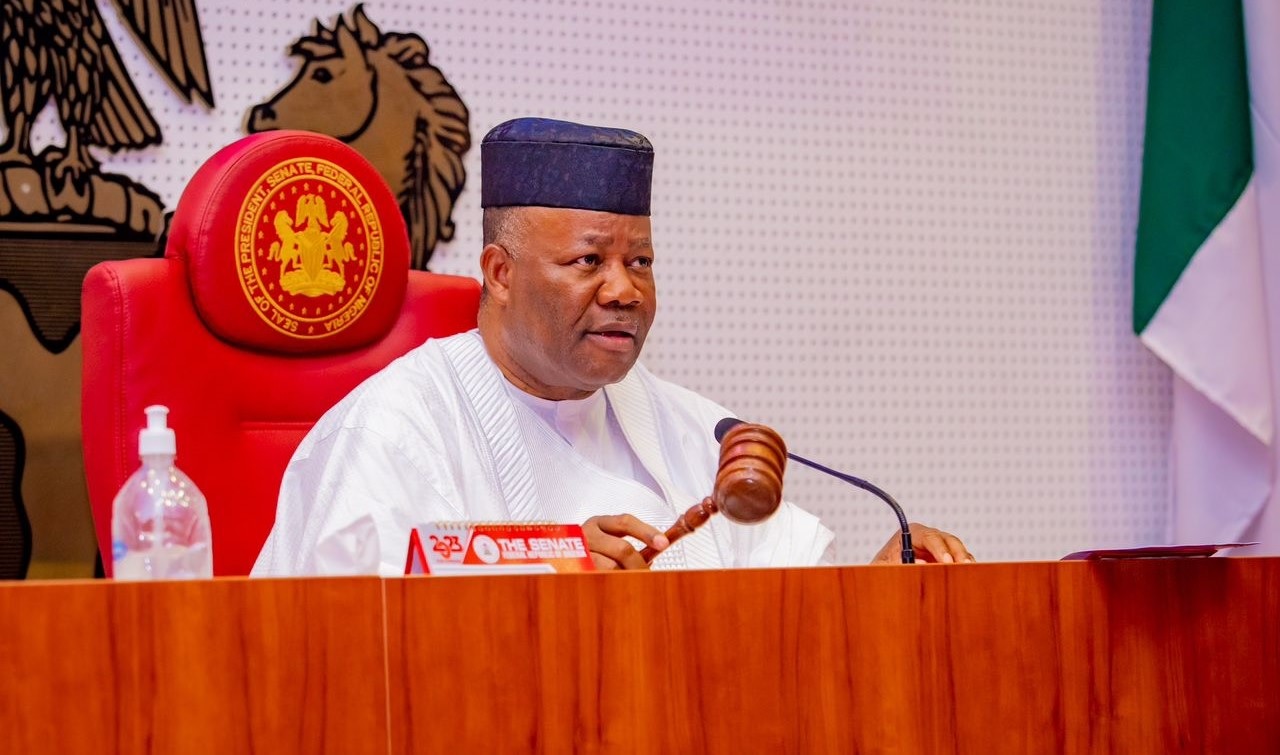
NATIONAL ASSEMBLY OPEN WEEK: AKPABIO’S PUSH FOR A MORE OPEN PARLIAMENT
By Malachy Ukpong
The inauguration of the 2026 National Assembly Open Week by the President of the Senate, Senator Godswill Obot Akpabio, has generated widespread discussion among political stakeholders, governance experts, civil society organisations, members of the diplomatic community, students and ordinary Nigerians.
The initiative has been described by supporters as one of the 10th National Assembly’s most significant efforts to strengthen the relationship between Parliament and the Nigerian people by promoting transparency, public participation and legislative accountability.Across many established democracies, parliamentary open days or open weeks serve as platforms for citizens to better understand how the legislature functions.
Such initiatives allow the public to interact directly with lawmakers, observe parliamentary processes, participate in policy discussions and appreciate the constitutional responsibilities of the legislative arm of government. The National Assembly Open Week seeks to domesticate this democratic culture by opening the doors of Nigeria’s Parliament to wider public engagement.For many Nigerians, the National Assembly has often appeared distant from the people it represents, with legislative activities largely viewed through media reports and political debates.
The Open Week initiative therefore attempts to reduce this perceived distance by creating opportunities for citizens to engage lawmakers directly, ask questions about legislative priorities, understand the processes behind lawmaking and appreciate the oversight and representation functions assigned to the legislature under the Constitution.The programme also reflects an effort by the leadership of the 10th National Assembly to strengthen institutional transparency.
During the Open Week, committees, principal officers and lawmakers showcase legislative activities, explain bills under consideration, provide updates on constituency initiatives and discuss ongoing constitutional and policy reforms.
Such engagements offer citizens the opportunity to better understand how legislation is developed, how oversight responsibilities are carried out and how public resources appropriated by the National Assembly are intended to support national development.Supporters of the initiative argue that transparency is an essential ingredient of democratic governance. When citizens have greater access to information about parliamentary proceedings and decision-making processes, they are better positioned to hold elected representatives accountable.
Public engagement also enables lawmakers to receive direct feedback from the people whose interests they represent, thereby improving the quality of legislation and strengthening public confidence in democratic institutions.Another major objective of the National Assembly Open Week is to promote inclusive governance.
Throughout the programme, stakeholders from different sectors—including traditional rulers, civil society organisations, professional associations, women’s groups, youth organisations, labour unions, faith-based organisations, persons with disabilities, students, development partners and the media—are encouraged to participate in discussions on issues affecting national development.The emphasis on inclusion reflects the position consistently expressed by Senate President Akpabio that democratic governance should accommodate diverse perspectives and ensure that every segment of society has an opportunity to contribute to national policymaking.
According to him, Parliament is not designed to isolate itself from the people but to provide a constitutional platform where differing opinions can be debated, competing interests reconciled and national consensus built.
The Open Week also provides an opportunity to discuss ongoing constitutional amendment proposals before the National Assembly. Among the issues attracting significant public interest are electoral reforms, judicial reforms, local government administration, fiscal federalism, devolution of powers, the proposal for the establishment of state police and measures aimed at improving the participation of women and persons with disabilities in governance. Public conversations during the Open Week allow stakeholders to present memoranda, share expert opinions and contribute ideas that may assist lawmakers during legislative deliberations.One proposal that has received considerable attention is the Special Seats Bill, which seeks to create additional legislative seats reserved for women in the National Assembly and State Houses of Assembly as a temporary affirmative action measure.
Advocates argue that the proposal could help address the persistent underrepresentation of women in elective offices and strengthen gender inclusion in Nigeria’s democratic process.
Discussions during the Open Week provide another avenue for citizens and advocacy groups to express support, raise concerns or make recommendations regarding such constitutional proposals.
The initiative equally strengthens collaboration between Parliament and other arms of government without diminishing the constitutional principle of separation of powers. By creating opportunities for dialogue among legislators, government institutions, development partners and members of the public, the Open Week encourages broader consultation before major legislative decisions are taken. Such engagement has the potential to improve policy implementation by ensuring that laws are informed by practical realities and stakeholder input.Beyond policy discussions, the National Assembly Open Week serves an important civic education function. Many young Nigerians have limited understanding of how bills become law, the oversight responsibilities of legislative committees or the representative duties of elected lawmakers.
Through guided tours, interactive sessions, exhibitions and public lectures, participants gain firsthand knowledge of parliamentary procedures and democratic governance, helping to build a more informed and politically engaged citizenry.At the inauguration of the 2026 National Assembly Open Week, Senate President Godswill Akpabio emphasised the importance of listening to citizens as a foundation for effective governance. He stated: “A Parliament that listens becomes wiser. A democracy that listens becomes stronger.”
The remark underscores the broader objective of the initiative—to promote dialogue, encourage citizen participation and strengthen democratic accountability.Ultimately, the success of the National Assembly Open Week will be measured not merely by attendance or public interest during the event, but by its long-term impact on legislative openness, public trust and citizen participation in governance. If sustained and continuously improved, the initiative could contribute significantly to making Nigeria’s Parliament more transparent, more accessible and more responsive to the aspirations of the people it serves.The National Assembly Open Week therefore represents an important opportunity to deepen democratic engagement by fostering dialogue between elected representatives and citizens. Whether viewed as a transparency initiative, a civic education programme or a platform for inclusive governance, its enduring value will depend on the extent to which it strengthens public confidence in the legislative institution and encourages meaningful participation in Nigeria’s democratic process.
-
News18 hours agoJust in: Dangote gives ₦18.7 trn of his ₦56.2trn wealth to help the needy
-
Metro9 hours agoNavy Arrests Vessel With 650 Metric Tonnes Of Stolen Crude
-
Metro9 hours agoGunmen Kill Serving Army Colonel In Abuja, Injure Wife, Two Others
-
Politics9 hours agoOsun 2026: Accord Is Like Keke Napep Facing Trailer – APC Mocks Adeleke
-
News19 hours agoPanic over mass arrest of Onitsha market leaders as Intersociety raises alarm, petitions IGP
-
News23 hours agoAfter 12years abandonment: Tinubu begins work on Nnamdi Azikiwe road linking GEJ road in FCT(Video)
-
Sports9 hours agoSuper Falcons Receive Rewards For Historic WAFCON 2024 Triumph
-
Sports9 hours agoWAFCON 2026: NSC Announces $5,000-per-goal Incentive For Super Falcons