
News
‘Helicopter Brought Money For Kidnappers’ – Kwara Victims Rejects Govt’s Claim Of No Ransom

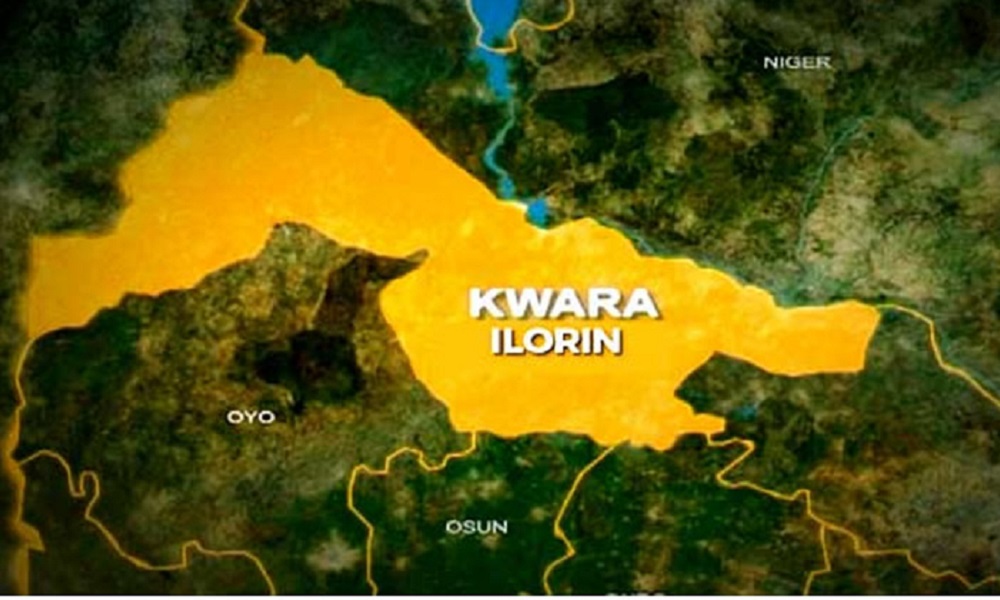


Some women and children abducted from Woro community in Kaiama Local Government Area of Kwara State have reportedly told relatives that money was delivered to their captors by helicopter days before they regained freedom.
According to Sahara Reporters, the account, which has not been independently verified, appears to contradict the Federal Government’s position that the victims were rescued through a coordinated security operation without ransom payment.
A relative who recently visited some of the freed victims said two members of his family were surprised when they heard government officials describe their release as a successful military rescue.
According to him, the victims claimed they witnessed a helicopter arrive at their location in the forest and deliver money to the kidnappers shortly before they were released.
“When they heard that the government was claiming they were rescued and that no money was paid, two of my family members were shocked,” the relative said.
The relative said the abductees were prevented from approaching the money when it was allegedly brought to the kidnappers.
He said, “They said a helicopter came while they were in captivity and money was brought to the kidnappers. They saw it, but they were not allowed to touch the money.
“The kidnappers prevented them from going near it. This was a few days, like four to five days before they were released.”
FG Described Release As Rescue Operation
The allegation comes days after Nigerian security forces announced the release of more than 300 abducted persons in an operation President Bola Tinubu described as the country’s largest single-day hostage rescue.
Among those freed were 163 people abducted from Woro community, alongside 145 other victims, many of whom were said to have been taken from neighbouring Niger State.
During attacks on Woro and Nuku communities in Kaiama LGA, 176 people, mostly women and children, were initially abducted.
Authorities later announced the recovery of 163 of the Woro victims. Survivors reportedly said 13 people died during their nearly six months in captivity.
Accounts from survivors indicated that the abductees endured severe hardship while being held in the forest.
They reportedly suffered from hunger, inadequate medical care and exposure to harsh weather conditions.
Some of the captives were said to have received only one meal daily, while makeshift shelters were later erected to protect them from rainfall.
The victims were reportedly recovered around the Kainji Lake National Park area following an operation involving the military, police and counter-terrorism personnel.
The Presidency described the operation as an intelligence-led success and commended the security agencies involved.
Following their release, the victims were taken for medical assessment before being reunited with their families.
Many were reportedly in poor physical condition after spending several months in captivity.


By Max Amuchie | The Sunday Stew
On 7 June 2026, this column unveiled the Decoupling Sovereignty Index (DSI) as the quantitative extension of the Trinity of Sovereignty Decay (TSD) theory, formerly known as the Trinity of State Decay. It is a measurement instrument designed to track the degree to which a state’s formal authority has separated from its practical, lived reality on the ground. But the index measures a condition with a human face—and that face belongs to a peculiar kind of disappearance: one that does not require a person to die.
A person can remain alive, remain within the borders of a country, retain a name, a nationality and perhaps even a national identity document, and yet become progressively invisible to the institutions that are supposed to make citizenship meaningful.
The person has not left the country. The state has not officially ceased to exist. The constitution may still be in force, parliament—or, in the case of Nigeria, the State Assembly—may still sit, courts may still open their doors, police stations may still bear the name of the state, ministries may still issue statements, and elections may still be conducted. And yet, somewhere within the territory, sovereignty has begun to thin out.
The question is not simply whether a state exists. The deeper question is where, how, and to what degree sovereignty reaches the individual. What happens when the state still claims a person but can no longer reliably see, protect, serve or represent them?
Perhaps the most concise answer is that they begin to become nobody.
Not nobody in the philosophical sense of non-existence. Nobody in the institutional sense.
The DSI Begins With the Zone
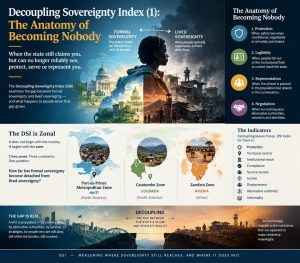
DSI does not begin with the country as its unit of observation. It begins with the zone—the sub-national space in which sovereignty is actually experienced. A country may remain formally sovereign while sovereignty is experienced very differently across its territory. A national government can exercise effective authority in one part and encounter competing authority, weak institutional reach or negotiated compliance in another. The country provides the sovereign frame; the zone provides the analytical field. The question, therefore, is not simply whether the state exists, but where—and for whom—it actually exists.
That distinction is essential. An observation about the Port-au-Prince Metropolitan Zone is not a statement that Haiti as a whole has ceased to function as a sovereign state. An observation about Catatumbo is not a statement about Colombia in its entirety, and an observation about Zamfara is not a description of Nigeria as a whole.
The comparative question is therefore not “Which country has failed?” It is this: what happens to sovereignty inside particular zones when the state’s formal territorial claim becomes detached from its effective institutional reach?
Three Zones, Three Continents
Consider the Port-au-Prince Metropolitan Zone in Haiti, the Catatumbo Zone in Colombia and the Zamfara Zone in Nigeria. They differ in geography, history, political systems and the forms of insecurity they have experienced. They are not three versions of the same crisis. They are three configurations of decoupling.
Port-au-Prince: territorial sovereignty contested. Haiti remains a sovereign state, with international recognition, constitutional institutions and territorial claims. But in parts of the metropolitan area, armed groups have acquired an extraordinary capacity to determine how people move, trade, work and access essential services. When an armed group controls a road, decides who may pass, extracts revenue or determines which population can remain in a neighbourhood, it inserts itself between the state and the citizen.
The resident’s question becomes brutally practical: whose authority determines whether I can move, trade, work or remain here? That is a DSI question. The person’s nationality has not changed, but the lived geography of sovereignty may have.
Catatumbo: sovereignty in competition. In Colombia’s Norte de Santander, the state has not simply disappeared. Armed organisations have competed for territorial and social control alongside formal institutions, in a region shaped by armed conflict, illicit economies and displacement. The escalation of violence in early 2025 produced mass displacement and severe humanitarian consequences.
What matters for DSI is that different forms of authority operate within the same space. The state retains legal sovereignty, an armed organisation may control movement in a locality, an illicit economy may determine livelihoods, and a community may build its own mechanisms of protection. The citizen lives within overlapping systems of authority. This is not the disappearance of sovereignty but the fragmentation of its lived expression.
Zamfara: the negotiated space. In Zamfara, the state remains present: institutions, security agencies and political authority are all formally intact. Yet persistent bandit violence, displacement and attacks on rural communities have created environments in which survival can require strategies beyond ordinary reliance on formal institutions. In some instances, communities have negotiated locally with armed groups.
The DSI question is not whether such negotiations are legitimate or lawful. It is why a community reaches the point of feeling compelled to negotiate its security outside the state’s formal architecture. The community may not have rejected the state. It may simply have found that survival has acquired another institutional address. And once survival acquires another address, sovereignty has begun to move.
These are not a league table of state failure, and DSI is not making one. Nor should every alternative institution be treated as the same phenomenon. A community organisation providing emergency support is not analytically identical to an armed group controlling territory. An informal market is not criminal governance. A negotiated local arrangement is not automatically the displacement of state authority.
The work of DSI is to distinguish these configurations: to determine what has become decoupled, how far the decoupling extends, which institutions have been displaced or bypassed, and what forms of authority have emerged in the space.
The Anatomy of Becoming Nobody
Modern citizenship rests on a quiet assumption: that behind the passport, the identity card, the address, the school record and the court system is an organised authority capable of recognising the individual. The citizen says, in effect, I exist, and the state knows that I exist.
That recognition is more consequential than it appears. To be recognised is to be counted. To be counted is to be legible. To be legible is to be reachable by institutions. And to be reachable is one of the foundations of meaningful sovereignty.
When those connections break, a person may be legally recognised but practically unreachable. A farmer may own land on paper but be unable to cultivate it safely. A victim may report a crime and find that the institution capable of responding has little effective presence. A resident may pay taxes yet rely on private, communal or informal systems for the protection and services that taxation is supposed to support.
The formal relationship remains. The functional relationship weakens. This is sovereignty decoupling.
We tend to look for spectacular signs of state collapse: abandoned buildings, anarchy, the complete disappearance of public authority. But sovereignty can decay without such images. A state can remain visibly present while functionally absent: a police station without effective policing, a court without meaningful access to justice, a school without dependable education, a citizenship document without the protection it is supposed to signify. A government can remain present as an institution while becoming absent as an experience.
Three Disappearances
Protection. The sovereign promise begins with something fundamental: the individual should not have to negotiate their physical existence alone. When that promise becomes unreliable, people search for substitutes: family, community, traditional authorities, political patrons, private security, armed groups, money, migration, silence. The more they depend on these, the less exclusive the state’s protective function becomes. When protection becomes conditional, negotiated or privately purchased, sovereignty has begun to decouple from everyday life.
Legibility. A person can be physically present but administratively absent, with limited access to identification, formal employment, financial systems, education, healthcare or justice. Formal institutions find them hard to reach, and they find the state harder still. That produces a dangerous asymmetry: the state continues to claim sovereignty over the person, while the person experiences little practical access to the institutions through which that sovereignty is supposed to operate. Sovereignty can be claimed from above while being experienced as absence from below.
Representation. An individual may be present, legally recognised and even periodically counted, yet remain politically peripheral. They may vote but have little influence over decisions affecting their immediate security. Policies are made for them and statistics are collected about them, but their institutional voice is weak. They are present in the population and absent in the conversation.
When the Citizen Becomes a Negotiator
At some point, the individual stops assuming that institutions will simply work. Protection, movement, access, justice and economic opportunity must all be negotiated, and sometimes even identity and allegiance. The citizen no longer relates to sovereignty through a stable institutional relationship. The citizen navigates sovereignty as an environment.
People rarely accept institutional invisibility passively. They build networks, find patrons, create informal markets, establish community security, develop alternative ways of settling disputes, migrate, conceal and learn which authority matters in which circumstance. Society does not become empty. It becomes layered.
The person who can no longer rely on one institutional identity begins to acquire several. The citizen becomes a negotiator, the resident an intermediary, the victim a survivor, the worker an informal entrepreneur, the community its own security system. The individual learns to wear different identities because sovereignty itself has become fragmented.
The Sovereignty Gap
Imagine two maps. The first shows the formal territory of a state. The second shows where its institutions can actually perform their functions reliably. The two should overlap. Where they do not, a gap emerges, and the gap is not empty. It may be occupied by community authority, informal economies, political patronage, criminal governance, armed actors, private enterprise or simply the individual’s own survival strategies.
The point is not that every alternative institution is illegitimate or destructive. It is that the growth of alternative systems can reveal where formal sovereignty is no longer performing its functions exclusively or effectively. That is why DSI is not another measure of state failure. It asks a different question: what happens when sovereignty remains formally intact while becoming functionally distributed, displaced or detached?
So the conventional question, “Does the state control the territory?”, gives way to more granular ones. Does the state protect the people who live there? Can they reliably reach its institutions? Can those institutions enforce their decisions? Does institutional presence correspond to institutional function?
Sovereignty is not experienced uniformly across space. It can be strong in a city and weak in a rural community, strong by day and weak after dark, strong in law and weak in practice. That is why the unit of analysis cannot always be the state as a whole, and why the zone is often more revealing.
A decoupled zone is therefore not a territory where government has vanished. It is a space where the relationship between formal and lived sovereignty has weakened enough that alternative forms of authority, protection, compliance or survival begin to fill the gap.
Making Decoupling Visible
The language of sovereignty is often too broad, and the language of state failure too blunt. A country can be described as sovereign while millions of people experience radically different degrees of protection, institutional access and political recognition. DSI begins from the proposition that this variation should be made visible.
If decoupling is real, it should leave observable traces in protection, territorial control, institutional reach, compliance, service access, justice, displacement, alternative authority and informality. The challenge is to determine which signals matter, how they interact and how they should be measured. That is where DSI moves from philosophy into methodology.
It is not another number produced because numbers look scientific. It is a disciplined way of asking a difficult question: how far has formal sovereignty become detached from lived sovereignty? And if that detachment can be observed, compared and measured, perhaps we can identify its stages before the language of collapse becomes necessary.
The Question DSI Leaves Us With
The state may say: you belong to us. The individual may answer: but do I still belong to the protection, institutions and authority that make that belonging meaningful?
Between those two statements lies the territory of decoupled sovereignty. And somewhere inside it is the person who remains legally visible but becomes institutionally invisible. Still a citizen. Still alive. Still within the borders. Still counted. But increasingly forced to survive outside the dependable reach of the institutions that are supposed to define and protect citizenship.
That is what I mean by becoming nobody. It is not disappearance from society.
It is disappearance from the effective field of sovereignty.
The DSI begins there. Not with the collapse of the state.
But with the moment when the map of formal sovereignty and the map of lived sovereignty begin to drift apart.
And perhaps the first task of measuring sovereignty is therefore not to ask whether a state exists.
It is to ask:
Where does it still reach?
Where does it no longer reach?
Who lives in the distance between the two?
And, most importantly:
What happens to them there?
××××××
A Note on the Sign-off
Some phrases become associated with an institution. Others become part of a writer’s voice. And sometimes, as the work evolves, the language evolves with it.
For me, two expressions have accompanied The Sunday Stew in its earlier seasons: “Trust is sacred” and “Stay seasoned.”
Both have served their purpose.
“Trust is sacred” remains particularly important because it is the official motto of Sundiata Post. As the institution has grown, its place has become clearer. It belongs to Sundiata Post—not simply as a sign-off, but as a statement of institutional identity.
“Stay seasoned,” meanwhile, became part of the personal voice of The Sunday Stew. It carried the flavour of the column and its invitation to readers to remain thoughtful, discerning and engaged.
But The Sunday Stew has been changing too.
So this is simply a moment to allow the language of The Sunday Stew to catch up with the journey of the work.
“Stay seasoned” is now retired.
And “Trust is sacred” returns fully to its institutional home at the Sundiata Post.
In their place, the column will now close with:
From the desk to the world.
It feels right because every article in The Sunday Stew begins at a desk.
That is where the real journey begins.
The new sign-off is therefore less a departure from what came before than an acknowledgment of where the work is going.
The work continues.
From the desk to the world
•Dr. Max Nwabueze Amuchie is a Scholar-Journalist and Media CEO, and Lead Researcher at the Sundiata Post Intelligence Unit, Abuja. An Expert Member and Peer Reviewer at ScienceOpen, he is a member of the League of Nigerian Columnists.
X @MaxAmuchie
Email: [email protected]

The National Chairman of the All Progressives Congress (APC), Nentawe Yilwatda, says more than 10 million vulnerable Nigerians who benefited from the N75,000 conditional cash transfer programme do not have access to mobile phones or social media.
Yilwatda disclosed this on Saturday while speaking with journalists after a three-day retreat of the APC National Executive Council in Maiduguri, Borno State.
The beneficiaries, whom he described as poor and vulnerable Nigerians, were largely unable to participate in public discussions about government policies because they lacked access to phones, television and social media.
“We have given 75,000 naira to over 10 million Nigerians across the country using the conditional cash transfer under the Ministry of Humanitarian Affairs and Poverty Reduction.
“Mind you, these people who are poor and vulnerable don’t have telephones to make calls; they are not on social media. They don’t have a television. They cannot come and challenge and discuss as we are doing here, but they are out there,” he said.
Yilwatda also criticised former Vice President and African Democratic Congress presidential candidate, Atiku Abubakar, over his position on the fuel subsidy.
“We are constructing roads and paying people that are working on the road site, and construction is going across the country,” he said.
“Over 30 states could not pay salaries and pensions. After we removed subsidies, all states can pay salaries and pensions, and no state is left behind.
“Today, if you return it, you are saying states shouldn’t pay salaries again. And what suffering are you bringing to Nigeria?”
The APC chairman also argued that a return to fuel subsidy would affect the government’s student loan scheme and other projects.
“The projects we’re doing across the country, like the coastal road and gas project to the north, which have passed Abuja, which are aimed at easing the suffering of Nigerians, will be suspended,” he said.
Yilwatda further accused Atiku of seeking to reverse the gains of the Tinubu administration in pursuit of the presidency, saying the APC and Nigerians would not accept such a move.
The APC chairman said the NEC retreat also reviewed the party’s activities at the national, state, local government, ward and polling-unit levels.
According to him, the party concluded that it remained strong and prepared for the 2027 general elections.
He said the NEC passed a vote of confidence in President Bola Tinubu, Vice President Kashim Shettima and other APC candidates who emerged from the party’s primaries for the 2027 elections.

Ivie Atuwatse III, wife of Ogiame Atuwatse III, the Olu of Warri, has opened up on the joys and challenges of being married to the traditional ruler, saying she takes pride in seeing people celebrate his achievements.
Ivie spoke in a recent interview with BBC News Pidgin, where she discussed life as the wife of the monarch and the demands that come with his position.
She said one of the things she enjoys most about the marriage is watching people appreciate her husband’s personality and achievements.
“The thing wey I like about being married to His Majesty is that, all the fame or the popularity wey him get, na say I get to see the world celebrate his genius, his swag also, cos me too I dey celebrate am,” she said.
“And when the world dey celebrate am, e dey ginger me more. I dey extremely proud of am as a human being, and to see that they also appreciate am dey give me much joy.”
However, Ivie admitted that the Olu’s responsibilities can sometimes make it difficult for her to have enough time with him.
“But on the other side, dem say food wey dey sweet sometimes flies dey like to chop from am,” she said.
“Sometimes e dey busy and it can be hard to want to share my husband with all the many different duties that he has, and so that can be equally difficult.”
She said they were learning to adjust to the demands of his position.
“And so, we are learning to navigate it because sometimes I just want him to myself,” she added.
The interviewer also asked whether she would accept another wife if the Olu changed his position on polygamy, having previously said he was not open to it.
Ivie dismissed the possibility, insisting that she was confident her husband would not change his mind.
“Firstly, His Majesty no go fit change him mind about polygamy. Make we just settle that one for there,” she said.
“Me alone, one me, I be like three women, so I dey alright for am.”

Decoupling Sovereignty Index (1): The Anatomy of Becoming Nobody

We should not relent in building educational root that raised us, for the sake of our kids- IGSOSA President, Adidi (Photos)

10m beneficiaries of cash transfers don’t have phones, not on social media – APC Chairman





-

 News20 hours ago
Tinubu’s tough decisions are already yielding fruits, Yari will deliver on assignment -TSTA
-

 News19 hours ago
EFCC nabs City Boy Movement woman leader
-

 News20 hours ago
PDP group slams Zamfara Governor for attacking Wike, hails FCT Minister’s nationalistic position
-

 Politics20 hours ago
Before dreaming of Aso Villa, APM should first find its feet-Ali Campaign Organization
-

 News19 hours ago
SAD: Pastor Chris Oyakhilome’s mother is dead
-

 News14 hours ago
House of Assembly Candidate, Sanni Urges Unity Among Ekiti ADC Members