There are politicians who campaign for office by promising to repair a leaking roof, and there are those who ask a more fundamental question: What if the problem is the building itself?


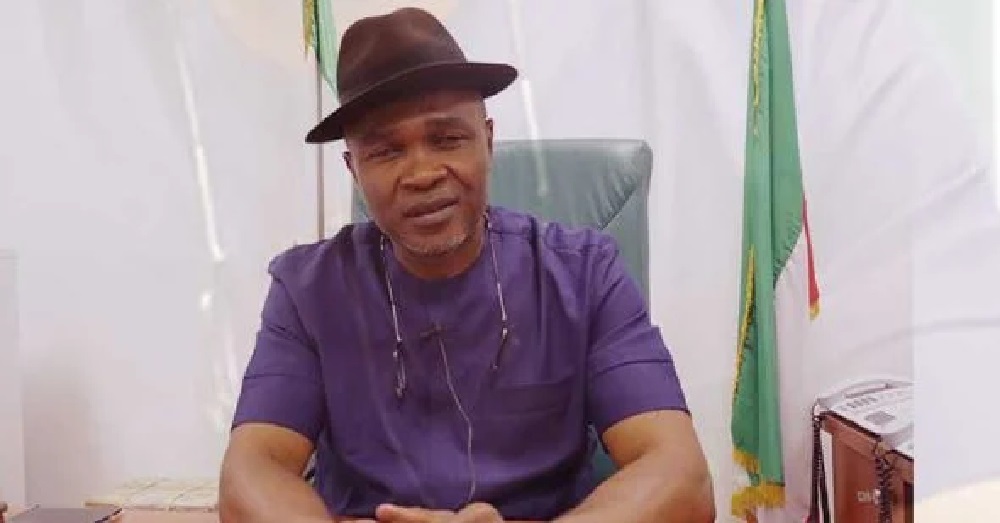
Rep Ogundu Kingsley Chinda appears to belong to the second category.
Long before the 2027 political contest began gathering momentum in Rivers State, Chinda had already ventured into a debate that goes beyond the immediate calculations of elections, political appointments and control of government. 
In 2024, while serving as Minority Leader of the House of Representatives, Chinda joined other lawmakers in sponsoring a constitutional amendment initiative aimed at moving Nigeria from its presidential system towards a parliamentary model of government.
At the time, the proposal attracted scepticism in some quarters. To critics, it appeared to be another ambitious constitutional initiative that could generate passionate speeches in the National Assembly without producing meaningful political change.
But Chinda’s argument was broader than a simple demand to replace the office of president with that of prime minister.
He was questioning the architecture of Nigeria’s democracy itself.
Beyond Changing Governments
Nigeria has operated a presidential system since the return to civilian rule in 1979, except for the periods of military intervention, while the country’s First Republic operated a parliamentary system from independence in 1960 until the military coup of January 1966.
The presidential model was restored under the 1979 Constitution and retained in the 1999 Constitution, which continues to define the framework of the Fourth Republic.
For decades, however, complaints about the cost and efficiency of governance have remained constant.
Successive administrations have merged ministries and agencies, proposed reductions in the size of government, reviewed public-sector structures and introduced various reform committees.
Yet many of the underlying complaints have persisted.
For Chinda, this represents a deeper problem.
His argument is that Nigeria has repeatedly attempted to repair the symptoms of governmental dysfunction without sufficiently examining the political structure responsible for producing them.
In his description, the country risks becoming trapped in a cycle of “motion without movement”—a system in which debates, committees, resolutions and reforms generate activity without fundamentally changing outcomes.
Learning From the First Republic
Chinda’s advocacy for parliamentary government is not, by his account, based on nostalgia for the First Republic.
Nigeria’s first experiment with parliamentary democracy ultimately collapsed amid intense political disputes, regional rivalries, electoral controversies and institutional tensions before the military takeover of January 1966.
The lessons from that period therefore remain central to the parliamentary debate.
Chinda has said lawmakers behind the proposed constitutional change deliberately examined the experience of the First Republic, including the reasons for its collapse.
He also recalled an engagement in Kano with Alhaji Dantata, whom he described as the only surviving member of the First Republic, as part of efforts to understand the strengths and weaknesses of the system from someone who experienced it directly.
Among the issues identified were inadequate understanding of parliamentary practice, ethnic and religious divisions, political self-interest, abuse of power and institutional conflicts.
The historical irony is difficult to miss.
Nigeria may have changed constitutions, political parties and political leaders repeatedly since independence, but many of the underlying challenges identified in the First Republic continue to feature in contemporary political discourse.
The personalities have changed.
The institutions have evolved.
But the political tensions have often remained remarkably familiar.
A System Designed for Nigeria?
At the heart of Chinda’s argument is the belief that Nigeria should stop treating foreign political systems as ready-made templates.
The British parliamentary model and the American presidential model emerged from different historical, social and institutional circumstances.
Nigeria, he argues, should therefore develop a system that reflects its own realities.
That position raises one of the most fundamental questions in Nigeria’s constitutional debate: Can a political system imported from another environment deliver the same results when transplanted into a society with a different history, political culture and social structure?
Chinda believes the answer is not necessarily.
Government does not operate in a vacuum. Political institutions function within societies shaped by ethnicity, religion, culture, economic interests, historical experiences and patterns of political behaviour.
Consequently, constitutional provisions that appear neutral on paper can produce different outcomes when applied in different environments.
This becomes particularly important when public officials are granted broad discretionary powers.
In a society where political, ethnic, religious and personal interests can influence public decision-making, discretion may not always be exercised in the same manner as originally envisaged by constitutional designers.
For Chinda, Nigeria therefore cannot continue importing constitutional provisions “hook, line and sinker” and simply expect them to produce foreign outcomes.
The Cost of Governance Question
One of the strongest arguments behind Nigeria’s recurring reform debates has been the cost of running government.
The country maintains a federal structure involving the executive, legislature and judiciary at the federal level, alongside 36 states and the Federal Capital Territory, with local government administration across the federation.
Critics have long argued that the structure is expensive and that substantial public resources are consumed by political administration.
Governments have responded periodically with proposals to reduce the number of ministries, merge agencies, streamline bureaucracy and cut official expenditure.
But Chinda’s argument goes beyond reducing the number of government offices.
His question is whether the political system itself encourages an expensive and highly centralised structure.
Changing ministries or reducing official allowances, in his view, may amount to rearranging furniture while leaving the underlying architecture untouched.
Not Simply Presidential Versus Parliamentary
The parliamentary debate is often reduced to a straightforward question: Should Nigeria have a president or a prime minister?
But the issue is considerably more complicated.
Under a parliamentary system, the executive emerges from the legislature and remains politically accountable to it.
The head of government is generally a prime minister, while the head of state may occupy a separate position depending on the constitutional arrangement.
In Nigeria’s current presidential system, the executive is separately elected, with the president serving as both head of state and head of government.
The two systems therefore create different relationships between the executive and legislature, different mechanisms of accountability and different incentives for political parties and lawmakers.
Chinda’s proposal is particularly significant because he has advocated a homegrown parliamentary model, rather than simply restoring the First Republic’s structure wholesale.
He has also argued for a gradual approach, beginning at the grassroots and expanding upwards to the national level.
That gradualism could prove crucial.
A change in constitutional structure alone cannot guarantee better governance. A parliamentary system can fail where institutions are weak, political parties lack internal democracy and political actors prioritise personal interests over public institutions.
The same is true of a presidential system.
The central issue, therefore, may not be the name of the system but whether the institutions within it are strong enough to enforce accountability.
From Constitutional Advocate to Governorship Candidate
Chinda’s political argument takes on a new dimension as he moves deeper into the contest for political power in Rivers State ahead of the 2027 governorship election.
That transition will inevitably test the practical implications of his philosophy.
As a legislator, it is possible to argue for structural reform from the floor of the National Assembly. As a governorship candidate, however, the questions become much more immediate.
How would the system improve education?
What would it mean for healthcare?
How would it affect employment and investment?
Could it improve security?
Would it reduce the cost of administration?
And, most importantly, would ordinary citizens feel the difference?
These are the questions that constitutional theory eventually has to answer.
Chinda’s advocacy does not automatically establish that a parliamentary system would solve Nigeria’s problems. Nor does his legislative experience guarantee that such a system would succeed.
But it does distinguish him from politicians whose political programmes begin and end with the pursuit of office.
His intervention invites voters to consider not only who should govern, but how Nigeria should be governed.
The Bigger Gamble
Nigeria’s political history is filled with constitutional experiments.
The country moved from the parliamentary system of the First Republic to military rule, then to a presidential arrangement under the Second Republic, another period of military government and eventually the Fourth Republic’s current presidential system.
Each transition was accompanied by expectations that a new political structure would help resolve old problems.
Yet no constitution can, by itself, eliminate political selfishness, ethnic suspicion, institutional weakness or corruption.
That is perhaps the greatest challenge facing Chinda’s proposal.
If Nigeria changes its political system without changing the political culture operating inside it, the country could simply reproduce old problems under a new constitutional arrangement.
That is why the parliamentary debate should not be treated merely as a contest between presidential and parliamentary loyalists.
It should be a national conversation about representation, accountability, political parties.